
Most independent service businesses in the U.S. are losing local search visibility to competitors who simply publish more relevant, location-specific content. It’s not always about having a bigger budget or a fancier website. Strong content marketing for SEO results can level the playing field by signaling to Google exactly who you serve, where you operate, and why you’re the most trustworthy option. This guide walks you through every stage, from understanding what Google actually rewards to building a repeatable content system that drives real local visibility.
Table of Contents
- Understand what drives local SEO success
- Prepare your content marketing toolkit
- Create and optimize your local content
- Keep content fresh and measure your impact
- Why most local content fails—and how to rise above
- Ready to boost your local visibility?
- Frequently asked questions
Key Takeaways
| Point | Details |
|---|---|
| Expertise matters | Content demonstrating your real-world experience and trust quickly stands out in local search results. |
| Refresh quarterly | Review and update local content at least every three months to maintain search visibility. |
| Leverage both AI and humans | AI tools help with content generation, but human insights make your expertise shine. |
| Measure what works | Track local rankings and engagement to refine and amplify your strongest content. |
Understand what drives local SEO success
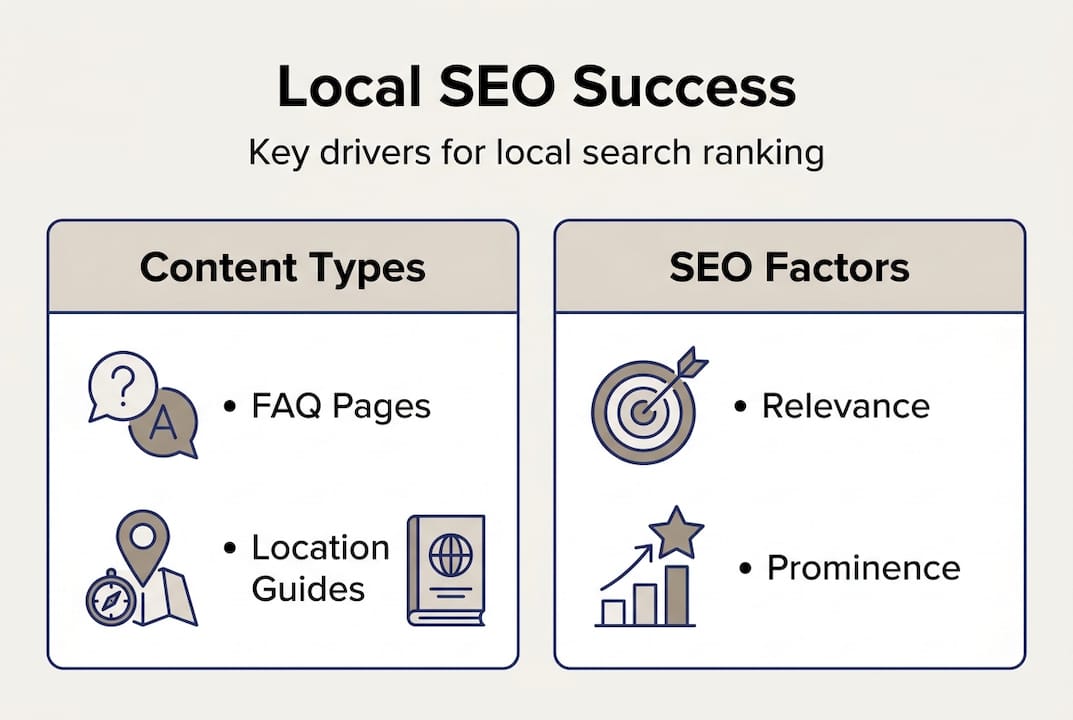
Now that we’ve set the stage, let’s look at what actually determines your local search positioning. Google uses three core factors to rank local businesses: relevance, distance, and prominence. Relevance means how well your business matches what someone searched for. Distance is how close you are to the searcher. Prominence reflects how well-known and trusted your business is online, which is where content marketing does its heaviest lifting.
Beyond these three factors, Google increasingly evaluates content through the lens of E-E-A-T, which stands for Experience, Expertise, Authoritativeness, and Trustworthiness. This framework rewards businesses that demonstrate real-world knowledge, not just keyword stuffing. A plumber who writes detailed posts about local water quality issues, for example, signals genuine expertise in a way that a generic “plumbing tips” article never could.
Here’s a quick look at how key local SEO factors connect to your content strategy:
| Ranking factor | How content helps |
|---|---|
| Relevance | Location-specific pages and service descriptions |
| Prominence | Reviews, backlinks, and authoritative blog posts |
| E-E-A-T | Expert-written FAQs, case studies, and testimonials |
| Search intent | Content that answers real local questions |
Strong local content also improves your visibility in AI-powered search tools. To stay competitive, optimize for GEO with FAQ pages, schema markup, and conversational queries, and update content quarterly to keep pace with algorithm shifts.
Pro Tip: Adding a dedicated FAQ page to your website is one of the fastest ways to capture conversational search queries and improve your chances of appearing in AI-generated answers.
Prepare your content marketing toolkit
Understanding what matters most, you’re ready to assemble your toolkit for effective content marketing. The right mix of content types and tools makes execution far less overwhelming.
Start with these core content types that consistently drive local SEO results:
- FAQ pages: Answer the questions your customers actually ask
- Service pages: One page per service, optimized for your city or region
- Local guides: Neighborhood tips, area resources, or community spotlights
- Testimonials and case studies: Real customer outcomes build trust fast
When it comes to actually creating content, many business owners wonder whether AI writing tools are worth using. The honest answer is: yes, with conditions. AI tools help generate location-specific content while maintaining brand voice, but human oversight ensures E-E-A-T. Think of AI as a first-draft assistant, not a replacement for your expertise.
| Tool type | Best use | Limitation |
|---|---|---|
| AI writing tools | Drafting outlines and first drafts | Lacks local nuance and real expertise |
| Human editing | Adding authentic voice and local detail | Takes more time |
| Keyword tools | Finding local search terms | Requires interpretation |
Here’s a simple three-step setup to get started:
- Claim and optimize your Google Business Profile with accurate categories, services, and photos
- Identify 10 to 15 local topics your customers regularly ask about or search for
- Build a content calendar that schedules one new piece per week or bi-weekly
For more top local SEO tips on structuring your approach, check out our guide on writing engaging content that ranks and converts.
Pro Tip: Set a quarterly calendar reminder to review and refresh your highest-traffic pages. Even small updates, like adding a new FAQ or updating a service description, signal freshness to search engines.
Create and optimize your local content
Toolkit in hand, here’s exactly how to put content marketing strategies into action for local SEO impact. Follow this workflow to produce content that satisfies both your audience and search engines.
- Research local keywords and questions. Use tools like Google’s autocomplete and “People Also Ask” to find what your community is actually searching for. Focus on phrases that include your city, neighborhood, or service area.
- Draft content emphasizing your unique services and location. Generic content blends in. Specific content stands out. Mention local landmarks, reference community events, and describe problems specific to your area.
- Apply schema markup for local SEO. Schema is structured data code that helps Google understand your content. Use LocalBusiness schema on your homepage and service pages.
- Add FAQs to every service page. This directly supports GEO optimization with conversational queries and improves your chances in AI-driven search results.
- Optimize images with geo-data. Add descriptive file names and alt text that include your location and service type.
Beyond the page itself, don’t overlook these off-page signals:
- Actively request customer reviews on Google after every job
- Pursue local backlinks from community organizations, local press, and industry directories
- Pitch your expertise to local news outlets or neighborhood blogs for press mentions
Real expertise always outperforms generic AI content. When you write from actual experience serving your local community, both readers and search engines notice the difference.
Consistency in tone and branding matters too. Every piece of content, from a blog post to a Google Business Profile update, should sound like it came from the same business. This builds authority with content over time and reinforces your positioning as the go-to local expert. And when you’re improving SEO with content, consistency is what separates businesses that plateau from those that keep climbing.

Keep content fresh and measure your impact
Launching great content is just the start. Keeping it effective requires regular attention and measurement.
Search algorithms evolve constantly, and content that ranked well six months ago may underperform today if it hasn’t been updated. Updating content quarterly is one of the most practical habits you can build. It signals to Google that your site is active, relevant, and authoritative.
Here are the key metrics to track as your content strategy matures:
- Local search rankings: Monitor your position for target keywords using a rank-tracking tool
- Google Business Profile insights: Track profile views, direction requests, and call clicks
- Organic website traffic: Watch for month-over-month growth from local search
- Direct inquiries: Count calls, form submissions, and chat messages tied to content-driven visits
- Engagement signals: Time on page and scroll depth indicate whether content is resonating
Pro Tip: Create a simple monthly spreadsheet that logs your top five rankings, GBP call volume, and traffic from organic search. Reviewing it every 30 days helps you spot trends early and adjust before small dips become big problems.
Once you have data, the next move is doubling down on what works. If a specific service page drives most of your calls, expand it with a related FAQ, add a case study, or build a supporting blog post around a related local keyword. Stay informed about SEO algorithm updates so you can adapt quickly, and keep checking the Battle SEO blog for practical updates on what’s shifting in local search.
Why most local content fails—and how to rise above
Here’s what most articles and businesses get wrong about local content marketing, and what you should do instead.
The most common mistake is publishing “me-too” content. These are blog posts that cover the same generic topics every competitor covers, with no local angle, no real stories, and no genuine expertise. Search engines are getting better at detecting this kind of filler, and so are readers. If your content could belong to any business in any city, it’s not helping you rank in yours.
Relying entirely on AI to produce content is the second major pitfall. Human oversight ensures that content reflects real expertise and brand voice, which is exactly what E-E-A-T rewards. AI can speed up production, but it cannot replicate the story of a specific job you completed in your neighborhood, or the nuanced advice you’d give a local customer.
What actually works is specificity. Real-life stories, unique expertise, and genuine community engagement create content that search engines and readers both trust. One bold action you can take right now: write a short blog post spotlighting a specific customer win from your local area. Describe the problem, your solution, and the outcome. That single post does more for your professional content marketing positioning than ten generic how-to articles ever will.
Ready to boost your local visibility?
If you want to skip trial-and-error and accelerate your results, here’s how we can help.
Putting these strategies into practice takes time, consistency, and a clear plan. That’s exactly what Battle SEO is built to deliver. Our local SEO services are designed specifically for independent service businesses that want to dominate their local market without wasting months figuring it out alone.
From optimizing your Google Business Profile to building a content calendar that drives real rankings, we handle the strategy and execution so you can focus on running your business. We also help you improve your GBP engagement to capture more calls and direction requests directly from search. We work with only one business per service category per market, so your spot is exclusive. If you’re ready to become the dominant local authority in your niche, let’s talk.
Frequently asked questions
What types of content work best for local SEO?
FAQ pages, location-specific service pages, customer testimonials, and local guides are the most effective formats for boosting local SEO visibility and capturing conversational search queries.
How often should I update my local content?
Update your core local content at least quarterly to stay aligned with search algorithm changes, reflect new services, and maintain your rankings over time.
Can AI tools write my local content?
AI tools can generate solid first drafts and topic ideas, but human oversight is essential to ensure accuracy, authentic local voice, and the real expertise that builds trust with both readers and search engines.
How do I measure the impact of my local content marketing?
Track local search rankings, Google Business Profile insights, organic website traffic, and direct customer inquiries to get a clear picture of how your content is performing and where to focus next.