
TL;DR:
- Backlinks serve as trust signals and endorsements that influence search rankings and AI platform citations.
- Focusing on quality, relevance, and editorial placement produces sustainable, high-value backlinks that benefit SEO.
Backlinks remain one of the most misunderstood forces in search engine optimization. Many site owners assume the role of backlinks in SEO is simple: get more links, rank higher. The reality is more nuanced, and treating it as a numbers game is exactly how sites end up penalized or stuck on page two. Backlinks are third-party endorsements that signal trust, topical authority, and credibility to both traditional search engines and AI-powered platforms like ChatGPT and Perplexity. This guide breaks down how they actually work, what makes them valuable, and how to build them in ways that produce lasting results.
Table of Contents
- Key Takeaways
- The role of backlinks in SEO explained
- What actually determines a backlink’s value
- Backlink benefits beyond search rankings
- Building quality backlinks in 2026
- My perspective on backlinks in 2026
- Ready to build authority that actually ranks
- FAQ
Key Takeaways
| Point | Details |
|---|---|
| Quality beats quantity | A single link from a relevant, authoritative site outweighs dozens of low-quality links pointing to your page. |
| Nofollow links still matter | Nofollow links from high-traffic sources contribute to brand visibility and AI search citations, not just traditional rankings. |
| Backlinks accelerate indexing | Editorial backlinks from indexed, relevant sites help search bots discover and crawl new pages faster. |
| Toxic links require attention | Regular backlink audits protect your site from link schemes that can trigger Google penalties. |
| AI search changes the equation | Backlink authority now influences how AI search platforms surface and cite your content, expanding the value beyond Google rankings. |
The role of backlinks in SEO explained
At their core, backlinks are links from one website pointing to a page on yours. In the context of search engine optimization, they function as endorsements. When a reputable site links to your content, search engines interpret that as a vote of confidence in your page’s relevance and trustworthiness.
Google’s original PageRank algorithm, developed in the late 1990s, was built on this exact premise: pages that earn more links from authoritative sources are more likely to be valuable. That logic has not disappeared. It has evolved. Today’s ranking systems weigh not just the number of links but the quality and relevance of the sites sending them. A link from a well-regarded industry publication carries far more weight than a hundred links from unrelated or low-authority directories.
Backlinks also serve a structural function in how search engines discover content. When Googlebot follows a link from an already-indexed site to your page, that visit can trigger faster crawling and indexing. For new sites especially, relevant editorial backlinks speed up the process of getting pages into the search index.
Here is a quick picture of what backlinks do for your site:
- Signal trust and authority to ranking algorithms across Google, Bing, and AI search platforms
- Drive referral traffic directly from the linking page to yours
- Improve crawl frequency by giving search bots more pathways to your content
- Influence E-E-A-T signals (Experience, Expertise, Authoritativeness, Trustworthiness) that Google uses to assess content quality
“Earned, contextually relevant links matter more than sheer volume. Quality links are a key authority input alongside other signals.” Plausible
Research confirms that referring domains and ranking positions show a strong correlation, particularly for competitive search terms. But the direction of that relationship matters. You want links that are earned through genuinely useful content, not manufactured through shortcuts.
What actually determines a backlink’s value
Not all backlinks are created equal. Understanding the factors that separate a high-value link from a low-value or even harmful one is what separates a smart link-building strategy from a waste of time.
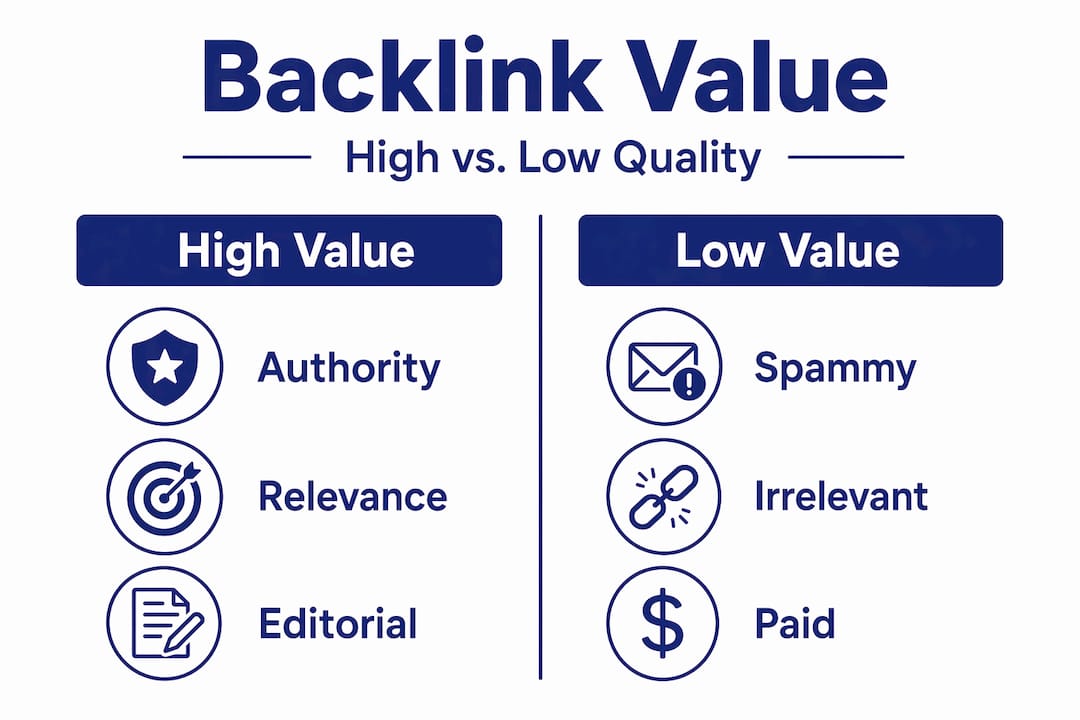
| Factor | High Value | Low Value |
|---|---|---|
| Domain authority | High-authority, established site | New or low-authority domain |
| Topical relevance | Same or closely related niche | Unrelated industry or topic |
| Link placement | Embedded in editorial body content | Footer, sidebar, or link directory |
| Link attribute | Dofollow from credible source | Dofollow from spam site |
| Anchor text | Natural, descriptive phrase | Over-optimized or keyword-stuffed |
Dofollow vs. nofollow: the modern reality
Most people treat dofollow links as the only links worth pursuing. That view is outdated. Google’s link attributes are treated as hints, not hard commands. A nofollow link from a high-traffic source can still influence rankings indirectly, and AI search systems largely ignore the nofollow attribute entirely when deciding what sources to cite.
Sponsored links should carry the "rel="sponsored"attribute. User-generated content links should carryrel=“ugc”`. Getting these labels right protects you from algorithmic scrutiny. Misusing them can signal manipulation.
Anchor text matters more than most people think
The clickable text of a link tells search engines what your linked page is about. If ten sites link to you using the exact same keyword phrase as anchor text, that looks unnatural. A healthy anchor text profile mixes branded anchors (your company name), generic phrases (“click here,” “read more”), and descriptive phrases that reflect the content without being forced. Over-optimization here is one of the more common ways sites attract manual review.
Pro Tip: Before building new links, run your existing backlink profile through an audit tool. You may find toxic or spammy links already pointing to your site that are quietly dragging down your authority. Disavowing those first can make your new link-building efforts far more effective.
Backlink benefits beyond search rankings
One of the most overlooked parts of any backlink strategy for SEO is the value that has nothing to do with where you rank on a results page. Backlinks generate real business outcomes through multiple channels.
Referral traffic from backlinks tends to be highly targeted. When someone clicks a link from an article in your industry, they already have context for what they are about to find. That intent alignment typically produces lower bounce rates and higher engagement compared to cold organic traffic.

Backlinks also build brand recognition. When your site appears in editorial content on respected platforms, readers absorb that association even if they do not click. Over time, this contributes to the E-E-A-T signals that influence how Google evaluates your content quality.
The most forward-thinking reason to prioritize quality backlinks in SEO right now is AI search. Platforms like ChatGPT Search, Perplexity, and Google Gemini pull from sources they assess as credible. Research across 1,000 domains confirms a positive relationship between backlink strength and AI search visibility. A nofollow link from Wikipedia or a citation in a major publication can influence whether an AI platform references your business in a response, regardless of whether it passes traditional link equity.
A natural backlink profile that mixes dofollow editorial links with nofollow citations from forums, directories, and media outlets is not just acceptable. It is a positive signal. A profile made up entirely of dofollow links raises red flags with Google’s spam detection systems.
- Wikipedia links are nofollow but signal legitimacy and can influence AI citations
- Reddit mentions drive real traffic and contribute to brand presence in AI-indexed content
- Press coverage builds E-E-A-T even when links carry nofollow or sponsored attributes
- Industry directories with nofollow links still contribute to local citation strength
You can explore how traditional SEO and AI strategies work together to maximize both ranking and AI visibility.
Building quality backlinks in 2026
The mechanics of building backlinks for traffic and authority have not changed as much as people claim. What has changed is the threshold for what works. Shortcuts that produced results in 2015 now produce penalties. Here is a grounded approach to earning links that hold value.
-
Create content worth citing. Original research, data-driven guides, and authoritative how-to content earn editorial links naturally. If your content is genuinely the best answer to a specific question, sites will reference it without being asked.
-
Guest posting with purpose. Publishing articles on relevant, authoritative sites in your niche builds both links and brand exposure. The key word is relevant. A guest post on a tangentially related site has a fraction of the value of one on a directly aligned platform. Pitch topics you are genuinely qualified to write about.
-
Digital PR and resource pages. Getting cited in press coverage, industry roundups, or resource lists is one of the most efficient ways to earn high-authority links. Tools like HARO (now Connectively) connect journalists with sources. Responding to media requests in your area of expertise puts your brand in front of publications that have real authority.
-
Fix broken links. Find pages on authoritative sites in your niche that link to dead content. Reach out with a replacement. This takes more effort but has a very high success rate because you are solving a problem for the site owner.
-
Audit your existing profile regularly. Toxic or manipulative links can cancel out your legitimate efforts. Use Google Search Console and a dedicated backlink tool to monitor what is linking to you. When you find clearly spammy or irrelevant links, use Google’s Disavow Tool to remove their influence.
-
Prioritize contextual placement. A link buried in a footer or a list of 200 links carries minimal weight. Backlinks embedded in editorial content on relevant, authoritative sites carry the highest value. When doing outreach, always aim for in-body placement.
For new sites, earning even a handful of editorial backlinks from established sources in your niche is one of the fastest ways to get indexed and start building domain authority from the ground up. You can find approaches to free backlink sources that work well for early-stage sites without a large outreach budget.
Pro Tip: When you land a high-quality backlink, check whether that linking page also has internal links you can follow to identify other link opportunities within the same site. One good relationship often opens several doors.
My perspective on backlinks in 2026
I have spent years working with business owners who come to us convinced that their ranking problems are a volume issue. They want more links, faster. What I have actually found, across hundreds of campaigns, is that the problem is almost never volume. It is almost always quality and context.
The sites that recover the fastest from ranking drops are the ones with clean, editorially earned link profiles. The ones that stagnate are usually sitting on a mix of aged links from link networks, irrelevant directory submissions, and over-optimized anchor text that made sense in 2012.
What I tell every client now: a single link from a respected publication in your niche, with natural anchor text and contextual placement, is worth more than 50 links from generic blogs. And that is before you factor in AI search, where the quality of your citations determines whether platforms like Perplexity mention your business at all.
The nofollow link angle is something I find most marketers still undervalue. We have seen clients earn AI citations and measurable referral traffic from nofollow links on high-traffic platforms. If you are writing off any link because it lacks a dofollow attribute, you are leaving real visibility on the table.
Build backlinks the way you would want someone to recommend your business: authentically, in context, and from sources that people actually trust. That approach never goes out of style, and it ages far better than anything engineered to game an algorithm.
— Mike
Ready to build authority that actually ranks
If this article clarified one thing, it is that smart link building is not about volume. It is about earning the right links, from the right sources, with a strategy that holds up over time. At Battleseo, we specialize in doing exactly that for independent business owners who want to compete in their local market and show up in AI-driven search results. Our authority backlink services are built around editorial placement, topical relevance, and a link profile designed to signal trust to both Google and AI platforms. If you want to see how this fits into a broader strategy, explore our local SEO services to understand how backlinks, citations, and on-page optimization work together.
FAQ
What is the role of backlinks in SEO?
Backlinks act as third-party endorsements that signal trust and authority to search engines. Pages with more links from relevant, authoritative sites tend to rank higher for competitive search terms.
Do backlinks still help SEO in 2026?
Yes. Backlinks remain one of the top ranking factors across Google and other search engines. Their influence now extends to AI search platforms like ChatGPT and Perplexity, which use backlink authority to assess source credibility.
What makes a backlink high quality?
High-quality backlinks come from authoritative, topically relevant sites and are placed within editorial body content. Anchor text should be natural and descriptive, not keyword-stuffed.
Can nofollow links improve SEO?
Nofollow links do not pass traditional link equity, but they contribute to brand visibility, referral traffic, and AI search citations. A balanced profile that includes nofollow links from reputable sources is healthier than a purely dofollow profile.
How many backlinks do I need to rank?
There is no fixed number. Research shows a strong correlation between referring domain count and ranking position, but a smaller number of high-authority, relevant links consistently outperforms a large volume of low-quality ones.