
TL;DR:
- SEO tactics that relied on keyword stuffing and low-quality content can now lead to profile suspensions and ranking drops.
- Businesses must focus on accurate, authentic profiles, genuine reviews, consistent NAP data, and valuable content to thrive post-2026 update.
SEO tactics that worked two years ago can now get your business suspended from Google Maps entirely. Google’s March 2026 Core Update triggered a wave of Google Business Profile suspensions across the U.S., hitting locksmiths, movers, and contractors especially hard, all because of keyword stuffing practices that once seemed harmless. If you’re still running SEO the way you did in 2023 or 2024, you’re not just losing ground. You’re actively putting your local visibility at risk. This guide explains what changed, why old tactics now backfire, and exactly what you should do instead.
Table of Contents
- What changed in SEO: The 2026 Google core update, explained
- Why sticking with outdated tactics now hurts your business
- The new playbook: Smart, ethical SEO strategies for 2026
- How to apply updated SEO tactics: Step-by-step for business owners
- Our take: Why continuous SEO adaptation beats shortcuts every time
- Ready to future-proof your local SEO?
- Frequently asked questions
Key Takeaways
| Point | Details |
|---|---|
| Google updates change the rules | Sticking to old SEO tactics now carries real risks, including losing your Google profile or ranking. |
| Ethical SEO is now essential | Genuine reviews, accurate data, and authentic content are required to rank and maintain trust. |
| Systems beat shortcuts | Compounding gains come from aligning business profiles, reviews, and ongoing content updates. |
| Take action regularly | Set a quarterly schedule to audit your SEO tactics and adapt to new Google updates or risks. |
What changed in SEO: The 2026 Google core update, explained
With this context, let’s clarify exactly what caused such a dramatic shakeup in local search.
Google’s March 2026 Core Update was one of the most disruptive algorithm shifts in recent memory for local businesses. The update rolled out between March 27 and April 8, 2026, and the numbers tell the story clearly. According to Quasa’s detailed analysis, 80% of top 3 URLs changed positions, and a staggering 90.7% of the top 10 results were reshuffled. That kind of volatility is rare even by Google’s standards.
The core focus of this update was quality and authenticity. Google doubled down on E-E-A-T, which stands for Experience, Expertise, Authority, and Trust. In practice, that means Google is now actively rewarding businesses that demonstrate real-world credibility and punishing those that rely on manufactured signals.
What specifically got penalized:
- Keyword stuffing in business names and Google Business Profile categories
- Thin or AI-generated content that lacks genuine insight
- Inconsistent business information across the web
- Profiles that show little activity or engagement over time
- Spammy link building tactics and artificial citation patterns
Here’s a snapshot of how the update shifted the landscape for different business types:
| Business type | Before March 2026 | After March 2026 |
|---|---|---|
| Locksmiths | High map pack visibility | Major suspensions and ranking drops |
| Movers | Relied on keyword-heavy profiles | Lost map pack positions significantly |
| Contractors | Used AI-generated service pages | Experienced sharp traffic declines |
| Legal and medical | Strong E-E-A-T signals | Maintained or improved rankings |
| Local retailers | Mixed results | Improved if profiles were accurate |
For independent business owners, the clearest lesson is this: Google no longer tolerates workarounds. The algorithm update strategies that once gave you a quick edge now carry serious, measurable risk.
“The March 2026 Core Update represents a fundamental shift. Google isn’t just rewarding good content. It’s actively filtering out businesses that use manipulative tactics to game local rankings.”
Understanding this shift is the first step. Acting on it is what separates businesses that thrive in local search from those that quietly disappear from page one.
Why sticking with outdated tactics now hurts your business
Now that you know what changed, let’s look at the dangers of ignoring these shifts.
The risks are concrete and immediate. Google’s 2026 local SEO overhaul directly caused suspensions of small business Google Business Profiles across the country. A suspended profile means you vanish from Google Maps, lose your “near me” visibility, and stop receiving calls and direction requests from potential customers. For service-area businesses like plumbers or electricians, that can mean losing dozens of leads per week overnight.

Here’s a direct comparison of old versus new SEO tactics and what each means for your business today:
| Old tactic | New reality in 2026 |
|---|---|
| Stuffing keywords in your business name | Triggers suspension and profile removal |
| Publishing AI-generated content in bulk | Flagged as spam, loses ranking |
| Building hundreds of low-quality backlinks | Penalized by spam filters |
| Leaving your profile inactive for months | Demoted in local pack rankings |
| Using fake or incentivized reviews | Violates policy; risks permanent removal |
| Ignoring business hours and address accuracy | Reduces trust signals across all platforms |
The most common outdated tactics and why they’re dangerous:
-
Keyword stuffing your business name. Adding keywords like “Best Plumber Chicago Emergency 24/7” to your Google Business Profile name is a direct violation of Google’s guidelines. After the March 2026 update, profiles doing this were among the first suspended.
-
Publishing thin AI content. Generating 50 service pages with minimal variation using AI tools may feel productive. But Google’s quality filters now detect and penalize this content aggressively.
-
Neglecting review management. Not asking for reviews and not responding to the ones you receive signals low engagement. Low engagement is now penalized faster than it was before.
-
Ignoring citation accuracy. Inconsistent name, address, and phone number (NAP) data across directories confuses Google and weakens your authority signals.
-
Buying backlinks from link farms. Low-quality link schemes have been penalized for years, but the 2026 update made the enforcement stricter and faster.
Recovering from a suspension can take weeks or months. Prevention is far easier. Start with your Google Business Profile engagement tips and make sure your profile reflects the quality standards Google now expects.
Pro Tip: The fastest way to restore trust after an issue is to gather genuine reviews from real customers, correct all business information, and remove any keyword stuffing from your profile name and description. Do those three things first before anything else.
The path toward modern SEO optimization requires letting go of the shortcuts that used to work. That’s not a comfortable message, but it’s the honest one.
The new playbook: Smart, ethical SEO strategies for 2026
To move beyond the risks, here are the strategies that now actually work, and why they matter long-term.
The businesses gaining ground after the March 2026 update aren’t doing anything mysterious. They’re being consistent, accurate, and genuinely helpful to their customers. According to recent enforcement data, small businesses depend on Google for 50 to 60 percent of their leads. That makes your Google presence too important to gamble with outdated tactics.
What’s working right now in local SEO:
- Accurate, complete business profiles. Fill in every field in your Google Business Profile: service areas, business hours, phone number, website, and high-quality photos. Completeness signals credibility.
- Genuine review generation. Build a simple system to ask satisfied customers for reviews after every job. Even five new reviews a month compounds into a powerful trust signal over time.
- Consistent NAP data. Audit your citations across Yelp, Apple Maps, Bing Places, and industry directories. Your name, address, and phone number should match exactly everywhere.
- Authentic, experience-based content. Write blog posts and service pages that reflect your actual expertise. Specific, experience-driven content outperforms generic AI output every time.
- Active profile management. Post Google Business Profile updates at least twice a month. Answer questions in the Q&A section. Respond to every review, positive or negative.
- Local link building. Earn mentions and backlinks from local news sites, chambers of commerce, and community organizations. These carry significant local authority signals.
One of the clearest insights from the 2026 update is that systems beat sprints. Businesses that built sustainable routines around their top local SEO tips came through the update stronger, while those chasing quick wins got knocked back.
“Ethical SEO isn’t slower. It compounds. Every genuine review, every accurate citation, every useful piece of content builds on the last one. Shortcuts reset that progress.”
Think of optimizing your Google Business Profile as the foundation, and content marketing for SEO as the structure you build on top of it. Together, they create a presence Google trusts and promotes.
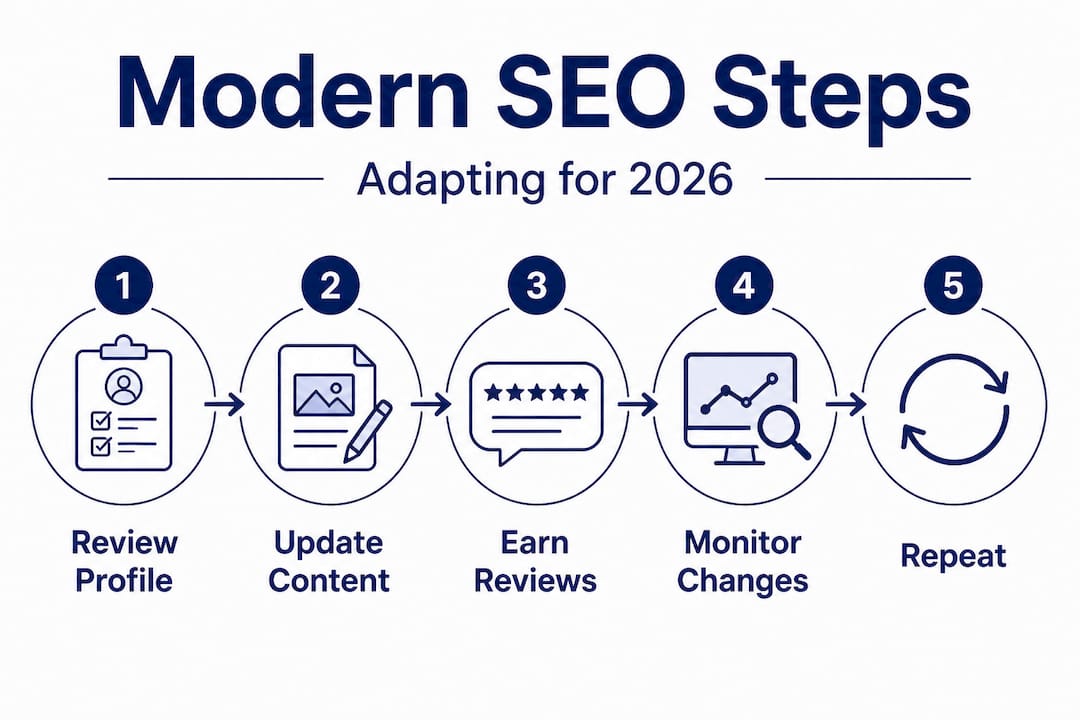
Pro Tip: Set a recurring monthly reminder to check your business hours, update your photos, and respond to any unanswered reviews. This 20-minute routine sends consistent activity signals to Google that keep your profile competitive.
How to apply updated SEO tactics: Step-by-step for business owners
With best practices in mind, let’s break down your next steps into an easy action plan.
You don’t need to overhaul everything at once. You need a clear sequence that addresses the highest-risk issues first and builds toward long-term strength. Since small businesses depend on Google for half or more of their inbound leads, every step in this list protects real revenue.
Your 2026 local SEO action plan:
-
Audit your Google Business Profile. Log in and review every field. Look specifically for keyword stuffing in your business name, description, and categories. Remove anything that reads as manipulative rather than informative.
-
Correct and standardize your business information. Check your business name, address, phone number, and website URL. Then verify they match across all major directories: Yelp, Apple Maps, Bing, Foursquare, and any industry-specific platforms.
-
Remove or rewrite thin content. Review your website’s service pages and blog posts. Any page that’s under 300 words, duplicated, or clearly AI-generated without expert review should be updated or consolidated.
-
Activate a review request system. After every completed job or sale, send a follow-up text or email asking the customer to leave a Google review. A simple, direct message works best. Don’t offer incentives. Just ask genuinely.
-
Publish one original content piece per month. Write about a real question a customer asked you, a project you completed, or a local issue relevant to your service. Keep it specific, honest, and useful.
-
Monitor algorithm changes monthly. Subscribe to SEO news sources and check your Google Search Console data regularly. Drops in impressions or clicks often signal a new update before you notice it in calls or leads.
-
Use AI-powered SEO tips to identify gaps. Tools like Google Search Console, Semrush, and AI assistants can help you spot outdated tactics, flag keyword cannibalization, and surface content opportunities you might miss manually.
-
Respond to every review within 48 hours. Both positive and negative reviews deserve a real response. This signals to Google that your business is active and engaged, which directly influences your local pack ranking.
Pro Tip: Schedule a quarterly SEO review on your calendar. Each quarter, check your business profile for accuracy, review your top-performing content, and assess whether your review count is growing. This keeps you proactive rather than reactive when the next update hits.
Following this sequence gives you a practical, low-risk path to stronger local visibility. You’re not chasing the algorithm. You’re building the kind of presence that the algorithm is designed to reward.
Our take: Why continuous SEO adaptation beats shortcuts every time
Finally, let’s step back and reconsider what really moves the needle for local business SEO in 2026.
There’s a tempting mental model that SEO is something you “do once” and then maintain on autopilot. You hire someone, they optimize your profile and website, and then you check in every few years. That model is broken, and the March 2026 update is the clearest proof yet.
Here’s the uncomfortable truth: most businesses that got suspended or lost significant rankings in early 2026 had made deliberate choices in the past. They stuffed keywords because it worked. They bought links because it was cheaper than earning them. They published AI content in bulk because it seemed like a shortcut to volume. Those choices delivered short-term gains and then became time bombs.
The businesses that weathered the update, and many that actually gained traffic during it, had built habits rather than hacks. They asked for reviews consistently. They kept their profiles updated. They published real content from real experience. None of it was glamorous. All of it compounded.
We’ve seen this pattern repeat every time Google releases a significant update. The gap between businesses that adapt and businesses that don’t grows wider with each cycle. SEO in 2026 is not a project with a finish line. It’s an ongoing operating standard, similar to how you handle customer service or financial recordkeeping.
Leveraging the benefits of AI in SEO is one area where adaptation matters more than ever. AI tools used well, with expert oversight, can help you identify gaps, monitor competitors, and automate safe optimizations. But AI used carelessly just produces the kind of thin content that Google is now penalizing at scale.
The businesses that win long-term treat SEO feedback as ongoing research and development. Every rankings shift tells you something. Every review teaches you something about your customer’s language. Every piece of content either builds authority or wastes your time. Treat it that way.
Ready to future-proof your local SEO?
If the March 2026 update has you questioning whether your current SEO strategy is built to last, you’re asking exactly the right question. Updating your approach isn’t just about avoiding penalties. It’s about positioning your business to capture more leads, more consistently, as search continues to evolve.
At Battle SEO, we specialize in local SEO services built specifically for independent business owners who want sustainable, ethical growth. Our Local Command Directive™ framework covers everything from Google Business Profile optimization to authority backlinks and AI search visibility. You can also explore our AI search optimization guide to see how we approach modern search visibility, or start with our practical resource to unlock local SEO and get your business found where it matters most.
Frequently asked questions
What’s the biggest risk of not updating my SEO tactics in 2026?
You risk suspension or lost visibility due to Google’s stricter spam and quality enforcement, especially in local search. Google Business Profile suspensions hit thousands of U.S. small businesses in early 2026 due to keyword stuffing and spammy practices.
How often should I update my SEO tactics?
Review your local SEO strategy at least every quarter and after major Google updates to stay compliant and visible. The March 2026 update caused 80% of top 3 URLs to change, showing how quickly rankings can shift.
What are safer alternatives to keyword stuffing for local SEO?
Focus on genuine reviews, complete and accurate business data, authentic content, and ongoing profile activity to boost ranking safely. Ethical SEO practices restore and protect rankings better than any shortcut.
Is AI-generated content still effective for SEO?
Only high-quality, expert-supervised AI content is effective. Generic AI spam is directly penalized after the recent updates. Google’s algorithm now prioritizes authentic E-E-A-T content over volume-driven AI output.
Recommended
- Keeping Up with Algorithm Changes in the SEO Arms Race
- How To Conduct an SEO Gap Analysis to Outpace Competitors
- Why Combining Traditional SEO with AI Strategies Gives You a Competitive Edge
- Why use AI for SEO? Boost local visibility and stay ahead
- 2026 digital ad trends: 5 strategies for SMEs – Palmador Blog