
TL;DR:
- ChatGPT SEO, or Generative Engine Optimization, focuses on earning citations in AI responses by optimizing Bing-indexed, structured, and authoritative content. Success relies on verifying crawlability, building brand signals, and emphasizing fact density over keywords, with Bing becoming the primary search index for AI models. Most marketers overlook Bing and technical accessibility, but strong entity signals and proper schema are essential for AI visibility and competitive advantage.
ChatGPT SEO is defined as the practice of optimizing your website’s content, technical signals, and authority to be cited in AI-generated answers by platforms like ChatGPT, Perplexity, and Gemini. The formal academic term for this discipline is Generative Engine Optimization, or GEO. Where traditional SEO earns you a ranked link in Google’s results, GEO earns you a citation inside a synthesized AI answer. That distinction changes almost everything about how you structure content, build authority, and measure results. For digital marketers and business owners, understanding this shift is no longer optional. AI-powered search is where a growing share of discovery happens, and your competitors are already paying attention.
What is ChatGPT SEO and how does it differ from traditional SEO?
Traditional SEO is built around ranking in Google’s search engine results pages. You target keywords, earn backlinks, and optimize on-page signals so Google’s algorithm places your page above competitors. ChatGPT SEO, by contrast, is about being extracted rather than ranked. AI models like ChatGPT synthesize information from multiple sources and present a single answer. Your goal is to be one of the sources that answer draws from.
The mechanics are meaningfully different. ChatGPT SEO shifts emphasis toward semantic clarity, entity relationships, and content that AI models can parse and attribute with confidence. Google rewards relevance and authority measured through links and engagement signals. AI models reward fact density, clear structure, and trusted entity recognition.
Here is a direct comparison of the two approaches:
| Factor | Traditional SEO | ChatGPT SEO (GEO) |
|---|---|---|
| Primary goal | Rank on Google SERPs | Be cited in AI-generated answers |
| Key signals | Backlinks, keywords, engagement | Fact density, structure, entity authority |
| Primary index | Google Search | Bing (via GPTBot and BingBot) |
| Content format | Keyword-optimized pages | Structured, extractable, schema-tagged content |
| Measurement | Rankings, organic traffic | AI citation frequency, Bing visibility |
Several practical differences stand out for marketers making the transition:
- Bing replaces Google as the primary index. ChatGPT Search pulls live web data from Bing, not Google. High Google rankings do not guarantee AI visibility.
- GPTBot crawlability is non-negotiable. If your robots.txt blocks GPTBot or BingBot, ChatGPT cannot access your content regardless of how authoritative it is.
- Entity recognition matters more than keyword density. AI models identify your brand as a trusted entity through signals like Wikipedia mentions, LinkedIn profiles, and consistent NAP (name, address, phone) data.
- Citations and statistics outperform keyword repetition. Fact-rich content with verifiable data points is far more likely to be extracted than content built around keyword frequency.
Key components of an effective ChatGPT SEO strategy
Optimizing for AI citation requires work across three layers: technical accessibility, content structure, and off-site authority. Neglect any one of them and the other two lose much of their impact.

1. Confirm GPTBot and BingBot can crawl your site.
Check your robots.txt file and verify that neither GPTBot nor BingBot is blocked. Submit your sitemap to Bing Webmaster Tools and confirm your pages are indexed. This is the foundation. Without it, no content tactic will help.
2. Structure content for extractability.
Structured content with clear headers and numbered lists is up to 3 to 5 times more likely to be cited in AI responses. Write in short, declarative paragraphs. Use H2 and H3 headings that mirror the exact questions your audience asks. Avoid burying your key claim three paragraphs in.
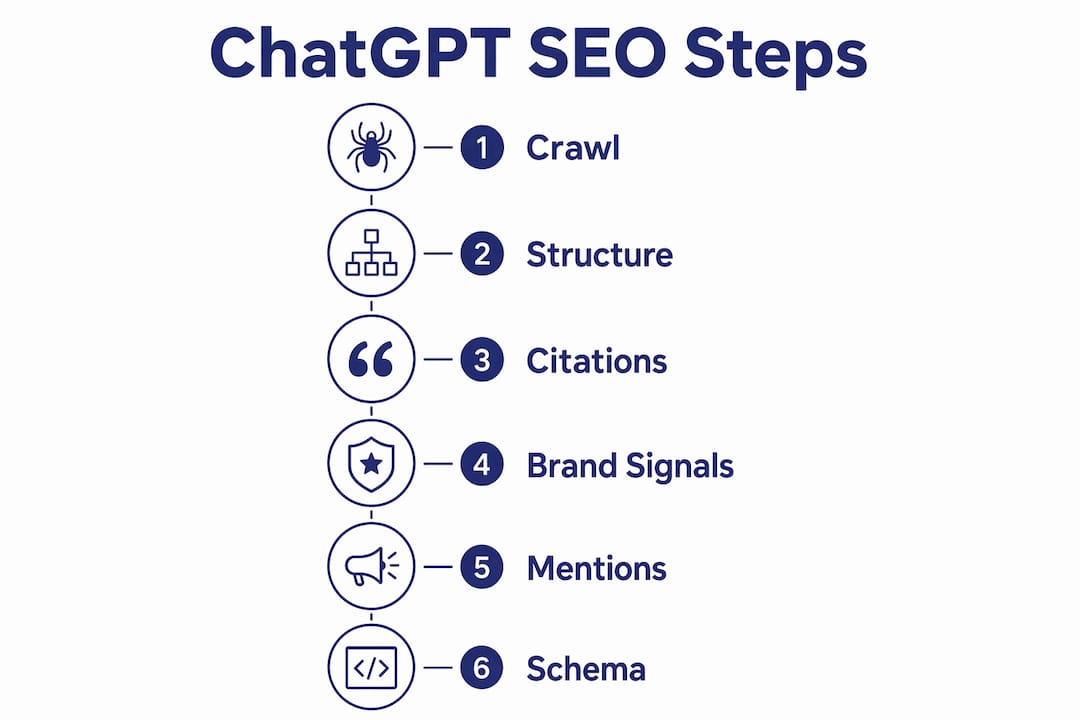
3. Increase fact density with authoritative citations.
Fact density with citations can boost AI response inclusion by up to 40%, outperforming keyword-heavy content. Reference real statistics, name credible sources, and link to primary research. Every factual claim you substantiate is a signal that your content is trustworthy enough to cite.
4. Build brand entity signals.
AI models recognize brands as entities, not just websites. Strengthen your entity profile by maintaining an accurate Google Business Profile, building a LinkedIn company page, earning mentions on Wikipedia or Wikidata, and accumulating consistent reviews across platforms like Google and Yelp.
5. Earn third-party mentions on community platforms.
Mentions on platforms like Reddit and Quora increase the probability of AI-generated citations by up to 4 times. These platforms carry strong human-validation signals that AI models treat as social proof. A single well-placed answer on Reddit that references your brand can meaningfully lift your citation probability.
6. Implement FAQPage and structured data schema.
Schema markup helps AI models parse your content with precision. FAQPage schema, in particular, maps directly to the question-and-answer format that AI assistants prefer when generating responses.
Pro Tip: Run a quick search in ChatGPT for your primary service category and city. If competitors appear in the answer and you do not, that gap tells you exactly where your entity authority and content structure need work.
Why Bing indexing is the hidden lever in ChatGPT SEO
Most SEO teams spend 95% of their effort on Google and treat Bing as an afterthought. That approach creates a blind spot in AI search visibility that is getting more expensive to ignore.
ChatGPT Search uses Bing’s index as its primary web data source. This means your Bing authority signals, not your Google rankings, predict how often ChatGPT cites your content in live web answers. A business that ranks on page one of Google but has thin Bing presence will consistently lose AI citations to a competitor with stronger Bing signals.
Optimizing exclusively for Google risks missing AI-driven visibility opportunities entirely. The practical steps to close this gap are straightforward:
- Claim and verify your Bing Webmaster Tools account. This is the Bing equivalent of Google Search Console and gives you direct indexing data, crawl reports, and keyword performance for Bing.
- Submit your XML sitemap to Bing directly. Do not assume Bing will discover your pages organically. Proactive submission accelerates indexing.
- Check your IndexNow implementation. IndexNow is a protocol supported by Bing that notifies search engines of new or updated content in real time. It is one of the fastest ways to get fresh content into Bing’s index.
- Monitor Bing’s crawl errors separately from Google Search Console. BingBot and Googlebot sometimes encounter different issues on the same site. A crawl error in Bing Webmaster Tools that you have not noticed could be silently suppressing your AI visibility.
- Build citations and backlinks from Bing-indexed sources. Links from pages that Bing trusts carry more weight for ChatGPT citation than links from pages Bing has not indexed or does not prioritize.
Pro Tip: Search your brand name directly in Bing. If your website does not appear in the top three results for your own brand, you have a Bing authority problem that will directly suppress your ChatGPT visibility.
How to measure your website’s performance in ChatGPT SEO
Measuring AI search visibility requires a different toolkit than traditional SEO. Google Analytics and Google Search Console tell you nothing about how often ChatGPT cites your content. You need to build a separate verification workflow.
Start with Bing Webmaster Tools. It shows you which pages Bing has indexed, how BingBot is crawling your site, and which queries are driving Bing traffic. Since Bing is the primary data source for ChatGPT Search, Bing performance data is the closest proxy you have for AI citation potential.
Validate your schema markup using Google’s Rich Results Test and Schema.org’s validator. Both tools confirm whether your structured data is correctly formatted and parseable. Errors in FAQPage or Organization schema reduce the precision with which AI models can extract and attribute your content.
ChatGPT cannot reliably audit your website because it does not render pages and relies on pattern matching. Any SEO grade or score ChatGPT generates during an audit is an estimate, not a measurement. Use PageSpeed Insights, Google Search Console, and Screaming Frog for technical diagnostics. Use ChatGPT for drafting and ideation, not for confirming whether your site is technically sound.
A practical verification workflow combines these steps:
- Query ChatGPT and Perplexity directly for your service category and location. Note which sources appear in citations.
- Cross-reference those cited sources against your Bing Webmaster Tools data to identify the content patterns they share.
- Use Screaming Frog to audit your own site for crawlability issues, missing schema, and thin content pages.
- Set a monthly cadence to check Bing indexing coverage and update your sitemap submission if new content has been published.
This workflow will not give you a single citation score, but it gives you the directional data needed to make smart optimization decisions.
Key takeaways
ChatGPT SEO, formally known as Generative Engine Optimization, requires Bing indexing, structured content, and entity authority to earn citations in AI-generated answers.
| Point | Details |
|---|---|
| GEO is the formal term | ChatGPT SEO is the informal name for Generative Engine Optimization, the practice of earning AI citations. |
| Bing is the primary index | ChatGPT Search pulls from Bing, so Bing Webmaster Tools management is a direct lever for AI visibility. |
| Fact density beats keywords | Authoritative citations and statistics improve AI inclusion rates far more than keyword repetition. |
| Structure drives extractability | Structured content with clear headers and schema markup is 3 to 5 times more likely to be cited by AI. |
| ChatGPT cannot audit your site | Use PageSpeed Insights and Screaming Frog for technical diagnostics. ChatGPT is for drafting, not measuring. |
Where I think most marketers are getting this wrong
I have worked with enough business owners to see the same mistake play out repeatedly. They treat ChatGPT SEO as a content volume problem. They publish more articles, run more prompts through AI writing tools, and expect citations to follow. They do not.
The real leverage is in authority signals and technical accessibility, not content quantity. A single well-structured page with verified schema, strong Bing indexing, and consistent entity mentions across Reddit, LinkedIn, and Google Business Profile will outperform ten thinly sourced blog posts every time. Building outward from that base is how you compound AI visibility over time.
The other mistake I see is ignoring the combination of traditional and AI strategies. Traditional SEO and ChatGPT SEO are not competing priorities. Google rankings still drive the majority of web traffic for most businesses. The marketers who win are the ones who treat Bing optimization and entity building as additions to their existing SEO foundation, not replacements for it.
One more thing worth saying plainly: do not let ChatGPT audit your own site. I have seen business owners share AI-generated SEO reports as if they were diagnostic data. They are not. ChatGPT does not render your pages. It cannot see your JavaScript, your Core Web Vitals, or your actual crawl errors. Use real tools for real diagnostics, and use AI for what it is actually good at: drafting, ideation, and content structuring.
— Mike
Ready to get your business cited in ChatGPT?
AI search is not a future trend. It is where your customers are finding answers right now. If your business is not showing up in ChatGPT, Perplexity, or Gemini responses, you are losing ground to competitors who have already made the shift.
Battleseo specializes in exactly this. The Local Command Directive™ framework combines Bing optimization, entity building, structured content, and authority backlinks to position your business as the cited source in AI-generated answers for your market. Battleseo works with only one business per service category per market, so your spot is exclusive. Explore the AI search optimization guide to see what a full AI visibility strategy looks like, or check out local SEO services to get started.
FAQ
What is ChatGPT SEO in simple terms?
ChatGPT SEO is the practice of optimizing your website so AI assistants like ChatGPT cite it when answering user questions. The formal academic term is Generative Engine Optimization, or GEO.
Does Google SEO help with ChatGPT visibility?
Google SEO provides a partial foundation, but ChatGPT Search uses Bing’s index as its primary data source. Strong Google rankings do not guarantee AI citation if your Bing presence is weak.
What content format works best for AI citations?
Structured content with clear headers, numbered lists, and schema markup is 3 to 5 times more likely to be cited in AI responses than unstructured prose.
Can ChatGPT audit my website for SEO issues?
No. ChatGPT cannot render pages and relies on pattern matching, so any audit scores it generates are estimates. Use PageSpeed Insights, Google Search Console, or Screaming Frog for accurate technical diagnostics.
How do third-party mentions affect ChatGPT SEO?
Mentions on platforms like Reddit and Quora can increase AI citation probability by up to 4 times, according to research on community platform signals. These mentions act as human-validated social proof that AI models factor into source selection.