
TL;DR:
- Competitive analysis helps businesses identify market gaps and understand their position relative to rivals.
- Focusing on actionable insights and continuous monitoring improves decision-making and enhances market presence.
Competitive analysis is the process of systematically examining your rivals’ strategies, strengths, and weaknesses to gain insights that strengthen your market standing. Every business owner and marketer who skips this process is essentially navigating without a map. The U.S. Small Business Administration confirms that competitive analysis identifies market share, entry barriers, and untapped niches, making it foundational to resource allocation and growth planning. Understanding why analyze competitors matters is not a theoretical exercise. It is the clearest path to knowing where you win, where you lose, and where the market has been left wide open.
Why analyze competitors: the core business case

The primary reason to study competitors is not to copy them. The goal is to find positions in the market that rivals cannot credibly claim. Winning analysis focuses on locating gaps and unique value claims, not on mirroring what others already do well.
The benefits of competitor analysis fall into four clear categories:
- Market gap discovery. Rivals rarely serve every customer segment equally well. Analyzing their offerings reveals underserved groups you can target directly. A local HVAC company, for example, might find that every competitor ignores Spanish-speaking homeowners in its service area.
- Stronger product and service decisions. When you see which features customers praise or criticize in competitor reviews, you get free product research. You learn what to build, what to skip, and what to price differently.
- Sharper marketing messaging. Competitor analysis builds better marketing strategies by revealing how rivals advertise and engage customers. That knowledge lets you craft differentiated messaging that speaks directly to what the market is missing.
- Faster, data-driven decisions. When your team already knows the competitive terrain, you spend less time debating context and more time acting on clear signals.
Pro Tip: Use a competitor gap analysis framework to map each rival’s strengths and weaknesses against your own before your next planning cycle. Even a one-page summary beats a blank whiteboard.
How does competitive analysis help you understand your market position?
Knowing where you stand relative to rivals is the foundation of any positioning decision. Without that reference point, your pricing, messaging, and product roadmap are all guesses.
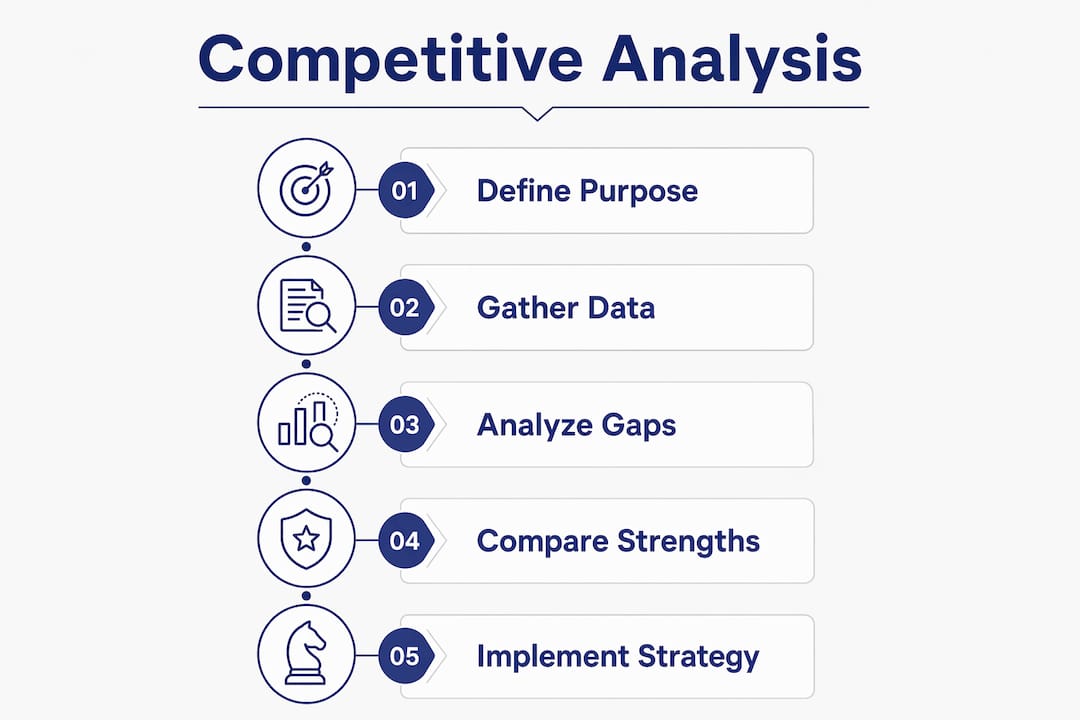
Here is a practical four-step process for using competitive analysis to clarify your market position:
- Map your offerings against competitors’. List your core products or services alongside those of your top three to five rivals. Note where you match, where you exceed, and where you fall short. This comparison reveals your actual differentiation, not just the differentiation you assume you have.
- Audit competitor pricing and brand messaging. Review their pricing pages, ad copy, and social media tone. Pricing tells you what the market currently accepts. Brand messaging tells you what emotional territory rivals have already claimed.
- Identify where competitor weaknesses create openings. A rival with poor customer service reviews is signaling an opportunity. A competitor with thin content on a high-value topic is leaving search traffic on the table. These gaps are your entry points.
- Apply a SWOT framework to your findings. Organize what you learn into Strengths, Weaknesses, Opportunities, and Threats. A SWOT analysis turns raw competitive data into a clear picture of where you should invest and where you should defend.
The value of competitor research at this stage is concrete. You stop positioning your business based on internal assumptions and start positioning it based on where you rank on Google, where competitors appear on Maps, and what AI platforms show when customers search your category. That shift alone changes how you write ads, set prices, and train your sales team.
What modern strategies improve competitive analysis effectiveness?
The biggest shift in analyzing competitors over the past two years is the move from periodic reports to continuous monitoring. A quarterly report captures a snapshot. Continuous monitoring captures momentum. Real-time intelligence is itself a competitive advantage because it enables proactive responses rather than reactive ones.
Modern competitive analysis now requires tracking rivals across more surfaces than ever before:
- AI search platforms. Competitor visibility on AI platforms like ChatGPT, Perplexity, and Gemini must be part of any complete competitor profile. Prospects form brand opinions on these platforms before they ever visit a website. If a rival appears in AI-generated answers and you do not, you are losing consideration before the conversation starts. Battleseo’s AI search optimization guide covers exactly how to close that gap.
- Social media and content activity. Track which topics rivals publish, which posts generate engagement, and which keywords they target. Content gaps in their strategy are content opportunities for yours.
- Review platforms and customer sentiment. Google Business Profile reviews, Yelp, and industry-specific platforms surface real customer language. That language tells you what buyers actually value, which is often different from what brands claim they value.
The speed advantage from modern tools is measurable. Organizations using generative AI for competitive analysis shortened deal cycles by 30–50%. That is not a marginal gain. It means faster responses to market shifts, quicker campaign pivots, and less time spent on manual research.
Pro Tip: Check the AI SEO trends for 2026 to understand which AI platforms your competitors are appearing on and which ones remain wide open.
How often should you conduct competitive analysis?
Review frequency depends on how fast your market moves, but industry standards recommend conducting competitive reviews every quarter to annually. Markets with frequent product launches or heavy digital advertising warrant quarterly reviews. Stable, slow-moving industries can sustain semi-annual or annual cycles.
The table below shows how review frequency maps to business context:
| Review cycle | Best for | Key focus |
|---|---|---|
| Monthly | High-growth or high-ad-spend markets | Pricing changes, new ad campaigns, content shifts |
| Quarterly | Most small and mid-size businesses | New entrants, messaging updates, keyword gaps |
| Semi-annual | Stable or niche industries | Market share shifts, product launches, brand positioning |
| Annual | Mature markets with slow change | Full SWOT refresh, long-term trend analysis |
Regular competitor analysis reveals changing tactics, new entrants, and emerging threats that a one-time effort will never catch. The businesses that treat competitive analysis as an ongoing practice, not a one-time project, are the ones that spot threats early and move on opportunities before rivals do. Consistent updates also prevent the common mistake of building strategy on stale data, which is especially dangerous when a new competitor enters your local market or a platform algorithm shifts.
Key Takeaways
Competitive analysis is the most direct way to identify market gaps, sharpen your positioning, and make faster decisions with real data behind them.
| Point | Details |
|---|---|
| Define your purpose first | Focus on finding positions rivals cannot claim, not on copying their moves. |
| Use SWOT to organize findings | Map competitor data into Strengths, Weaknesses, Opportunities, and Threats for clear action. |
| Include AI platform visibility | Track competitor presence on ChatGPT, Perplexity, and Gemini, not just websites and social media. |
| Review on a consistent schedule | Quarterly reviews catch new entrants and tactic shifts before they affect your revenue. |
| Limit findings to what you can act on | Isolate two or three critical implications from each review to avoid analysis paralysis. |
The part most businesses get wrong about competitive research
Here is what I see consistently with business owners who come to Battleseo after doing competitive analysis on their own: they produce exhaustive reports and then do nothing with them.
I have reviewed 40-page competitor breakdowns that sat untouched for six months. The team spent weeks gathering data, organized it beautifully, and then got paralyzed by the volume of it. Focusing excessively on exhaustive mapping leads to paralysis. The fix is not a better spreadsheet. The fix is committing to two or three findings per review cycle and acting on those before you look at anything else.
The second mistake I see is businesses so focused on rivals that they lose sight of their own strengths. Competitive analysis should sharpen your positioning, not make you chase every move a competitor makes. If a rival launches a new service, that is data. It is not necessarily a directive for you to follow.
The third blind spot is AI search visibility. Most business owners I talk to have never checked whether their competitors appear in ChatGPT or Perplexity answers for their core service keywords. That is a significant gap. Prospects increasingly form opinions through AI-generated responses before they ever search on Google. If your rival shows up there and you do not, you are behind before the race starts.
My advice: keep your analysis focused, act on it quickly, and make AI platform visibility a standard part of every review cycle. Small research budgets are enough if your team consistently acts on focused insights rather than chasing completeness.
— Mike
How Battleseo helps you turn competitor insights into local visibility
Understanding your competitive position is only half the equation. Acting on it with the right search presence is what actually moves the needle.
Battleseo works with independent business owners to build the kind of local and AI search visibility that competitive analysis reveals you need. Through the Local Command Directive™ framework, covering Google Business Profile optimization, authority backlinks, citation building, and on-page SEO, Battleseo positions clients as the dominant local authority in their niche. If your competitive review shows rivals outranking you on Google Maps or appearing in AI-generated answers, local SEO services from Battleseo are built to close that gap. Battleseo takes on only one business per service category per market, so your competitive advantage stays yours.
FAQ
What is competitive analysis in business?
Competitive analysis is a structured evaluation of your rivals’ strategies, strengths, weaknesses, and market positions. The U.S. Small Business Administration defines it as a core component of business planning that identifies market share, entry barriers, and growth opportunities.
How does studying competitors improve my marketing?
Analyzing competitors’ advertising and customer engagement reveals what messaging the market already hears. That knowledge lets you craft differentiated campaigns that speak to what rivals are not saying.
How often should I update my competitive analysis?
Industry standards recommend reviews every quarter to annually, depending on how fast your market changes. High-growth or high-ad-spend markets benefit from monthly monitoring.
Should I track competitors on AI search platforms?
Competitor visibility on AI platforms like ChatGPT, Perplexity, and Gemini is now a required part of any complete competitor profile. Prospects form brand opinions on these platforms before visiting any website.
What is the biggest mistake in competitive analysis?
The most common mistake is producing exhaustive reports without acting on them. Effective analysis isolates two or three critical findings per review cycle and drives immediate decisions from those findings alone.