
TL;DR:
- SEO thought leadership combines original expertise with SEO strategies to establish authority and trust. It surpasses generic content by focusing on proprietary insights, first-hand data, and unique perspectives. Building consistent, distributed content around genuine experience helps brands rank higher and become recognized industry leaders.
SEO thought leadership is the strategic fusion of original, expert-driven insights with SEO techniques to build authority, earn trust, and rank for the topics that matter most to your audience. The industry term for this practice is “authority content marketing,” but SEO thought leadership captures exactly what it does: it puts recognized expertise at the center of your search strategy. Unlike standard keyword-focused content, this approach signals to both Google and AI platforms like ChatGPT and Perplexity that your brand is the definitive source in your niche. Google’s E-E-A-T framework (Experience, Expertise, Authoritativeness, and Trustworthiness) rewards this kind of content directly. For marketing professionals and business owners, understanding this distinction is the first step toward building a digital presence that compounds over time.
What is SEO thought leadership, and how does it differ from regular SEO content?
SEO thought leadership is defined as the practice of transforming genuine expertise into content that satisfies both search algorithms and human readers. It goes beyond placing keywords on a page. The goal is to become the source people cite, link to, and return to when they need answers.
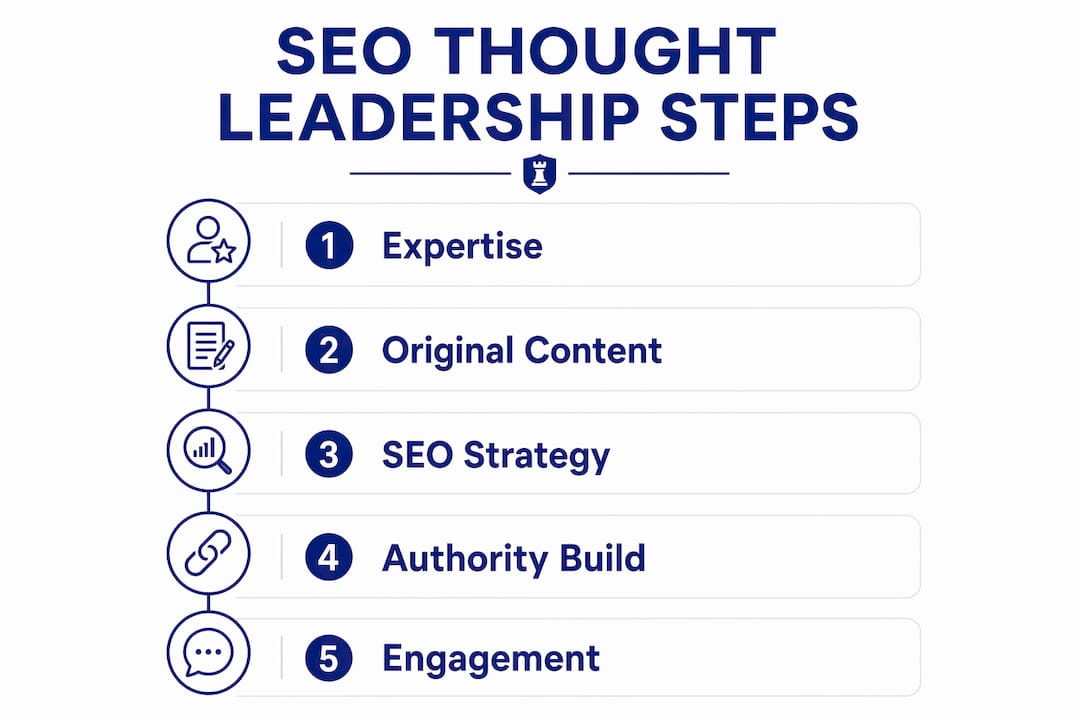
Traditional SEO content focuses on keyword density, meta tags, and on-page signals. Thought leadership content focuses on original perspectives, proprietary data, and insights that no competitor can replicate. The difference is not just philosophical. It is measurable in rankings, backlinks, and brand recognition.
| Traditional SEO Content | SEO Thought Leadership |
|---|---|
| Keyword-driven topics | Expert-driven topics |
| Generic information | Original insights and proprietary data |
| Targets search volume | Targets search intent and trust |
| Replicable by competitors | Unique to your experience and expertise |
| Ranks by optimization | Ranks by authority and relevance |
Generic AI-generated content has flooded search results. Google and AI search platforms now prioritize SME-led content over generic rewrites. The algorithm increasingly asks not just what is being said, but who is saying it.
Here is what separates thought leadership content from filler:
- It contains a point of view that can be agreed with or challenged.
- It references first-hand experience, original research, or proprietary frameworks.
- It addresses questions your audience has not yet learned to search for.
- It earns citations from other publications without outreach campaigns.
- It builds the author’s personal brand alongside the company’s domain authority.
Pro Tip: If your content could have been written by anyone with a Google search and 30 minutes, it is not thought leadership. Ask yourself: what do you know that no one else can say?
How does E-E-A-T connect to SEO thought leadership?
Google’s E-E-A-T framework is the clearest signal that thought leadership and SEO are now inseparable. E-E-A-T stands for Experience, Expertise, Authoritativeness, and Trustworthiness. Google uses these signals to evaluate whether content deserves to rank for high-stakes queries.
Thought leadership content fulfills every layer of E-E-A-T by design. Experience comes from first-hand accounts and real-world application. Expertise comes from recognized credentials and depth of knowledge. Authoritativeness builds through backlinks, citations, and mentions from credible sources. Trustworthiness grows when your content consistently delivers accurate, useful information.
One concept that ties this together is Information Gain. Information Gain refers to the measurable difference between what your content adds versus what already exists on the topic. AI-driven search models reward content that introduces something new. Generic rewrites score low. Original expert insights score high.
- Identify your unique angle. What does your experience reveal that published guides miss?
- Name the expert. Byline content to a real person with verifiable credentials, not a brand account.
- Add first-hand data. Case studies, client results, and proprietary frameworks count as Information Gain.
- Earn backlinks naturally. Authoritative content attracts organic citations from industry publications and blogs.
- Publish consistently. A single strong article builds a spike. A consistent body of work builds authority.
Pro Tip: Link your author bio to a LinkedIn profile with real credentials and published work. Google cross-references author authority signals across platforms, and a thin bio undercuts even the best content.
Thought leadership content also improves click-through rates because it signals credibility in the search result itself. A bylined article from a recognized expert outperforms an anonymous “ultimate guide” in both clicks and dwell time. Both metrics feed back into rankings.

What strategies make SEO thought leadership work in practice?
The most effective SEO thought leadership programs are built around a pillar-cluster content model. One long, authoritative pillar article covers a broad topic in depth. Shorter cluster articles cover specific subtopics and link back to the pillar. This structure builds topical authority, which tells search engines you own a subject area rather than just touching it.
The biggest mistake most businesses make is expecting executives to write the content themselves. Executives have the insights. They rarely have the time or inclination to produce polished SEO content. Short recorded interviews with executives, typically 15 minutes, yield the unique frameworks, contrarian views, and proprietary data that form authentic Information Gain. A skilled content strategist then shapes that raw material into publishable articles.
Distribution is equally critical. Original thought leadership content needs to reach audiences before those audiences have developed search habits around the topic. That means syndicating beyond your company blog.
- Adapt pillar content into LinkedIn posts that link back to the full article.
- Pitch guest columns to industry publications where your audience already reads.
- Repurpose key insights into short video or podcast formats.
- Submit original research to trade publications for earned media coverage.
Executive LinkedIn profiles linked to your main domain amplify both personal and domain authority simultaneously. A post from a named executive with 5,000 relevant followers drives more referral traffic and trust signals than a brand account post with the same follower count.
Effective thought leadership also balances empathy with data. Content that only presents data feels cold. Content that only validates feelings lacks authority. The combination, showing you understand the reader’s situation and then delivering evidence-backed guidance, builds the kind of trust that converts readers into clients.
Pro Tip: Build a “contrarian view” into at least one article per quarter. Challenge a widely accepted belief in your industry with data. These articles earn the most backlinks and social shares because they give people something worth arguing about.
How do you measure the impact of SEO thought leadership?
Measuring thought leadership requires tracking signals beyond basic keyword rankings. Rankings for high-intent and long-tail queries are the first indicator. If your content starts appearing for specific, nuanced questions in your niche, your authority is growing.
Backlink quality matters more than backlink volume. A single link from a respected industry publication outweighs 50 links from low-authority directories. Track domain authority improvements monthly using tools like Ahrefs or Moz. Watch for new referring domains, not just total link counts.
Engagement metrics reveal whether your content is actually resonating. Time on page, scroll depth, comments, and social shares all signal that readers find the content worth their attention. A thought leadership article that earns 200 comments has done something a keyword-optimized listicle rarely achieves.
Branded search volume is one of the most underrated indicators. When more people search directly for your name, your executive’s name, or your proprietary framework, your thought leadership is working. Google Search Console shows branded query trends over time. Growth in branded searches signals that your content is building real recognition, not just traffic.
Finally, track leads and conversions influenced by thought leadership content. Use UTM parameters and multi-touch attribution to connect content consumption to pipeline. Buyers who read three or more thought leadership articles before contacting you are typically higher quality leads with shorter sales cycles.
Key Takeaways
SEO thought leadership builds lasting authority by combining genuine expert insights with SEO strategy, making your brand the trusted source both search engines and real buyers turn to first.
| Point | Details |
|---|---|
| Definition matters | SEO thought leadership fuses original expertise with SEO to satisfy E-E-A-T and rank for high-intent queries. |
| Differentiation is the edge | Proprietary data, contrarian views, and named experts separate thought leadership from generic content. |
| Distribution drives discovery | Syndicate content on LinkedIn and industry sites before search habits form around your topic. |
| Measurement goes beyond rankings | Track backlink quality, branded search growth, and content-influenced conversions alongside keyword positions. |
| Interviews unlock real insights | Short executive interviews produce the authentic Information Gain that AI and Google reward most. |
Why I think most businesses are doing this backwards
Most marketing teams I talk to are still building their content calendar around keyword volume. They find a high-traffic keyword, write an article targeting it, and wait for rankings. That approach worked well in 2018. It is increasingly ineffective now.
The businesses that are winning in search right now are the ones that started with expertise and worked backward to SEO. They identified what their leadership team genuinely knows better than anyone else, extracted those insights through structured interviews, and built content around those perspectives. The SEO layer came second, not first.
The common pitfall I see is treating thought leadership as a one-time campaign rather than an ongoing program. One strong article does not build authority. A consistent body of work does. Think of it like building outward from a base. Each new article reinforces the ones before it, and the cluster grows stronger over time.
The other mistake is limiting distribution to the company blog. Most of your audience does not visit your blog regularly. They are on LinkedIn, reading industry newsletters, and listening to podcasts. Getting your insights in front of them where they already spend time is what turns content into authority. Pair that with a content marketing authority strategy and you have a compounding asset, not a one-time traffic spike.
My honest advice: stop chasing keywords you cannot own and start documenting what you actually know. That is the content that earns links, builds trust, and shows up when buyers are ready to make a decision.
— Mike
Ready to build authority that actually ranks?
Thought leadership content works best when it is paired with a technical SEO foundation that gets it found. At Battleseo, we combine content authority strategies with local SEO services that position independent businesses as the dominant voice in their market. Our Local Command Directive™ framework covers everything from authority backlinks and Google Business Profile optimization to on-page SEO and Digital PR.
If you are a business owner or marketing professional ready to stop competing on keywords and start competing on authority, Battleseo works with one business per category per market. That exclusivity means your investment builds your position, not your competitor’s. Explore our AI search optimization guide to see how we help businesses get found across Google, ChatGPT, Perplexity, and Gemini.
FAQ
What is SEO thought leadership in simple terms?
SEO thought leadership is the practice of publishing original, expert-driven content that builds your authority in search results. It combines genuine expertise with SEO strategy to make your brand the trusted source both algorithms and buyers prefer.
How does thought leadership improve search rankings?
Thought leadership satisfies Google’s E-E-A-T criteria by demonstrating real experience, expertise, and trustworthiness. Content backed by recognized experts and first-hand data earns higher-quality backlinks and stronger engagement signals, both of which improve organic rankings.
What is Information Gain in SEO?
Information Gain is the measurable difference between what your content adds and what already exists on a topic. AI-driven search models and Google reward content that introduces new insights, data, or perspectives rather than restating what competitors have already published.
How do you become an SEO thought leader?
Start by extracting unique insights from your own experience or your executive team through short recorded interviews. Publish those insights in bylined articles, distribute them on LinkedIn and industry sites, and build a pillar-cluster content structure around your core topics.
How is thought leadership different from content marketing?
Content marketing is the broader practice of creating content to attract and retain an audience. Thought leadership is a specific type of content marketing that centers on original expert perspectives. All thought leadership is content marketing, but not all content marketing qualifies as thought leadership.