
TL;DR:
- AI ranking predicts the likelihood that AI answer engines will cite your content. It depends on passage structure, credibility, and topical focus rather than traditional search position. Focusing on answering questions clearly and building topical authority enhances your chances of being cited by AI systems.
AI ranking is defined as the probability that an AI answer engine, such as ChatGPT, Perplexity, or Google AI, will cite your content in a synthesized response. This is not a position on a results page. It is a selection decision made by a machine reading your content for extractable, credible passages. Understanding what is AI ranking matters now because AI search visitors convert at 23 times the rate of traditional organic visitors. That single fact changes how you should think about your content strategy in 2026.
What is AI ranking and how does it differ from traditional SEO?
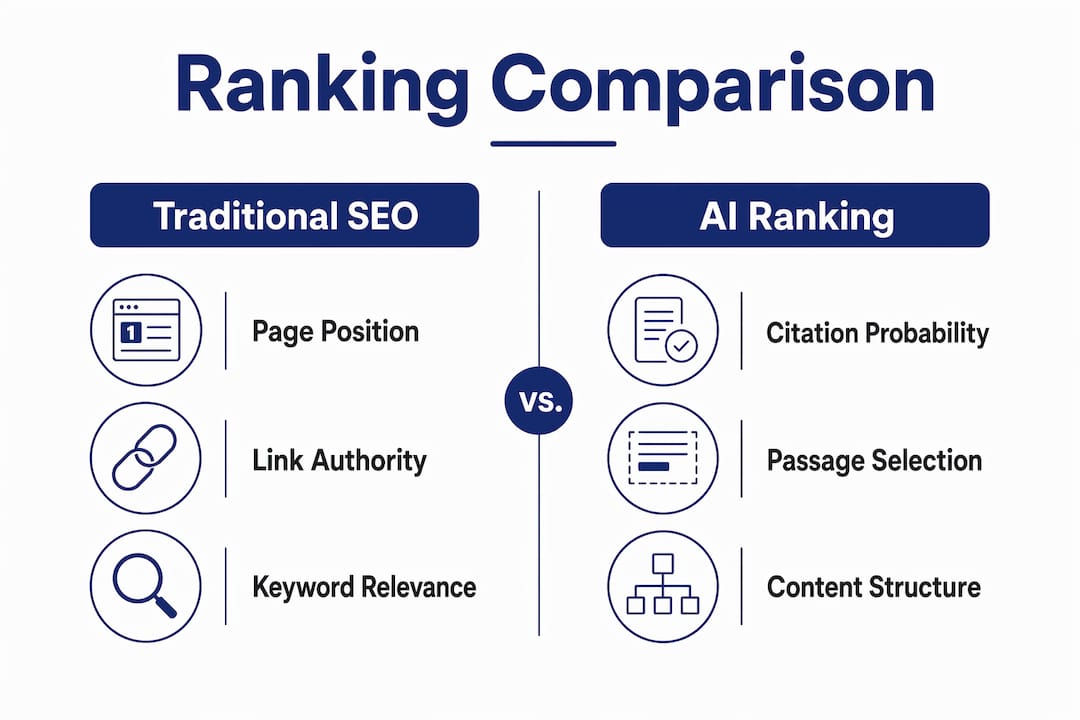
AI ranking and traditional search engine ranking solve different problems. Traditional SEO ranks entire pages by link authority, domain trust, and keyword relevance. AI ranking, by contrast, selects specific passages from indexed content to synthesize a direct answer. The industry term for this process is answer engine optimization (AEO), and it operates on fundamentally different logic than Google’s PageRank.

The clearest proof of this difference is the overlap between the two systems. Only about 20% of pages surfaced by Google are also cited by AI engines. That means 80% of what Google ranks highly never gets cited by ChatGPT or Perplexity. Domain authority, the metric most SEO professionals track obsessively, correlates with AI citations at just r=0.18. It explains less than 4% of the variance in citation outcomes.
AI engines use a process called retrieval-augmented generation (RAG). The system pulls evidence passages from indexed documents and assembles them into a synthesized answer. It does not rank your page first and then read it. It reads your page for extractable claims and either selects them or skips them. This is why AI ranking is a binary selection process, not a hierarchy.
Pro Tip: Think of AI ranking less like climbing a ladder and more like passing an audition. Either your content gets selected for the answer, or it does not. Position two does not exist.
| Factor | Traditional SEO | AI Ranking (AEO) |
|---|---|---|
| Core metric | Page position (1–10) | Citation probability |
| Primary signal | Backlinks and domain authority | Passage extractability and credibility |
| Stability | Relatively stable rankings | Fluctuates per query run |
| Overlap with competitor | High (same SERP) | Low (different selection logic) |
| Optimization target | Entire page | Individual passages and structured data |
What factors influence AI citation probability?
Content structure is the single most controllable factor in AI ranking. AI search engines index content at the passage level, treating pages as collections of independently citable claims. Pages with 12 high-quality, self-contained passages consistently outperform pages with fewer structured sections. Each passage should be 60–100 words, answer one specific question, and stand alone without requiring surrounding context.
Title-query overlap is the second major factor. Optimizing title-query overlap raised citation rates from 26% to 100% in a test of 815,000 query-page pairs. That is not a marginal improvement. It means your page title should directly mirror the question a user is likely to ask, not a clever headline designed for human curiosity.
Beyond structure, AI systems apply E-E-A-T filters. E-E-A-T, which stands for experience, expertise, authoritativeness, and trustworthiness, is a critical filter for AI citation beyond traditional SEO relevance. Practically, this means:
- Named authors with verifiable credentials on every article
- Clear publish and update dates visible on the page
- Outbound links to credible, authoritative sources
- Consistent topical focus across your site, not scattered content
Topical authority outweighs domain authority in AI ranking. A local plumbing company that publishes 30 tightly focused articles on pipe repair will outperform a general home services site with 500 loosely related posts. Depth in one subject signals expertise to AI systems far more effectively than breadth.
Implementing FAQPage JSON-LD schema gives AI models a direct shortcut to your structured answers. Schema markup does not guarantee citation, but it removes friction from the extraction process. Combined with named authors and clear dates, it signals that your content is organized, credible, and easy to parse.
Pro Tip: Write every section of your content as if it could be lifted out of the page and read in isolation. If a passage only makes sense with the paragraphs around it, rewrite it until it stands alone.
How do you optimize your content for AI ranking?
Optimizing for AI citation requires a specific sequence of actions. You cannot skip the foundational steps and expect results from the advanced ones.
-
Earn a Google top-10 position first. Top 3 Google pages get cited up to 7.82 times more than pages ranked 11–30. Google ranking is the eligibility gate. You do not need to rank first, but you need to rank. Without Google visibility, most AI engines will never index your content at all.
-
Write answer-first content. Lead every section with a direct answer to the implied question. Expand with evidence in the following sentences. AI systems extract the first clear, complete answer they find. Burying your main point in paragraph three means it often gets skipped.
-
Atomize your content into self-contained passages. Pages with multiple atomic passages allow AI to extract and cite more evidence. Each passage should cover one idea completely. Use subheadings to signal topic shifts. Avoid long, dense paragraphs that blend multiple claims together.
-
Add FAQ schema to every key page. Structured data acts as a shortcut that improves extractability and citation likelihood. Use FAQPage JSON-LD on service pages, blog posts, and landing pages. This is one of the fastest technical changes you can make.
-
Build topical authority through content clusters. Publish a series of tightly related articles on your core subject. Link them together. AI systems recognize consistent topical depth and weight it heavily when selecting citation sources. A single great article rarely outperforms a well-organized cluster.
-
Update content regularly and show the date. Credibility signals such as named authors and clear publish dates are non-optional for AI citation likelihood. Undated content reads as untrustworthy to AI systems. Refresh your top pages quarterly and make the update date visible.
-
Measure citation frequency, not rank position. AI search engines do not have stable positions but fluctuate in citation probability. Run the same queries across multiple sessions and track how often your brand or content appears. That frequency distribution is your real AI ranking metric.
Pro Tip: Pair your content cluster strategy with AI SEO trends for 2026 to stay ahead of how AI engines are evolving their selection criteria.
Common misconceptions about AI ranking that hurt marketers
The biggest mistake marketers make is treating AI ranking like traditional positional SEO. They assume that ranking number one on Google automatically means they will be cited by ChatGPT or Perplexity. That assumption is wrong, and it leads to wasted effort.
Here are the most damaging misconceptions:
- “AI ranking works like Google ranking.” It does not. Citation probability distributions replace fixed positions, and fewer than 1 in 100 AI query runs produce identical brand lists. There is no stable “position one” in AI search.
- “High domain authority guarantees AI citations.” Domain authority explains less than 4% of AI citation variance. A newer site with better-structured, more credible content will outperform an older high-authority site with poor passage structure.
- “Keyword density drives AI visibility.” AI ranking rewards content optimized for easy understanding and extraction rather than keyword density. Stuffing a page with your target phrase does not increase citation probability.
- “Traditional rank tracking tools measure AI performance.” They do not. Standard SEO tools track Google positions. They have no visibility into how often ChatGPT, Gemini, or Perplexity cite your content. You need separate tracking methods for AI citation frequency.
- “AI engines discover new content.” AI engines are synthesis systems, not discovery engines. They pull from already-indexed sources. If your content is not indexed and ranking on Google, it is largely invisible to AI answer engines as well.
Understanding these distinctions is the first step toward building a content strategy that actually works for AI-driven search.
Key Takeaways
AI ranking is a citation probability metric, not a position, and optimizing for it requires structured content, E-E-A-T signals, and Google eligibility working together.
| Point | Details |
|---|---|
| AI ranking is binary | Content is either selected for citation or it is not. There is no “position two.” |
| Google ranking is the entry gate | Pages ranked outside the top 30 on Google are rarely cited by AI engines. |
| Passage structure drives selection | Self-contained 60–100 word passages with clear answers outperform dense, unstructured content. |
| Domain authority barely matters | Domain authority explains less than 4% of AI citation variance. Topical depth matters far more. |
| Measure citation frequency | Track how often your brand appears across multiple AI query runs, not a fixed rank position. |
Why I think most marketers are still optimizing for the wrong thing
I have watched a lot of businesses pour budget into climbing from position four to position two on Google while their AI citation rate sits at zero. That is not a criticism. It reflects how fast the search environment has shifted. The instinct to chase a rank position is deeply ingrained, and it made complete sense for the past 20 years.
What I have found working with independent business owners is that the shift to AI citation optimization is less about learning new tactics and more about changing the question you ask. Instead of “where do I rank for this keyword,” the question becomes “does my content answer this question clearly enough to be selected?” That reframe changes everything from how you write titles to how you structure individual paragraphs.
The businesses I see gaining ground in AI search are not necessarily the ones with the biggest budgets or the strongest backlink profiles. They are the ones who have built genuine topical depth in a focused area, kept their content clean and credible, and treated every page as a potential citation source rather than a traffic destination. Combining that approach with solid traditional and AI SEO strategies is what produces durable results.
AI ranking does not replace traditional SEO. It adds a second layer of visibility that converts at a dramatically higher rate. The marketers who treat both as complementary systems, rather than competing ones, are the ones building real competitive advantages right now.
— Mike
How Battleseo helps you get cited in AI search
AI citation is not an accident. It is the result of deliberate content structure, credibility signals, and technical optimization working together. Battleseo specializes in exactly this work for independent business owners who want to be found on ChatGPT, Perplexity, and Gemini, not just Google.
Battleseo’s AI search optimization services are built around the same principles covered in this article: passage-level content structure, E-E-A-T credibility signals, schema markup, and topical authority development. The agency takes on only one business per service category per market, so your competitors cannot access the same system. If you are ready to move from chasing Google positions to building real AI citation presence, explore Battleseo’s AIO services and see what a focused AI ranking strategy looks like for your market.
FAQ
What is AI ranking in simple terms?
AI ranking is the likelihood that an AI answer engine like ChatGPT or Perplexity will cite your content when answering a user’s question. It is measured by citation frequency, not page position.
How does AI ranking differ from Google ranking?
Google ranking orders pages by link authority and keyword relevance. AI ranking selects specific passages based on extractability, credibility, and topical relevance. Only about 20% of top Google pages are also cited by AI engines.
What is the most important factor in AI ranking?
Content structure is the most controllable factor. Pages with multiple self-contained, answer-first passages of 60–100 words each consistently earn higher citation probability than unstructured content.
Does domain authority help with AI ranking?
Domain authority has very little impact on AI citation. Research shows it explains less than 4% of the variance in AI citation outcomes. Topical depth and content quality are far stronger predictors.
How do I track my AI ranking performance?
Run the same target queries across ChatGPT, Perplexity, and Google AI Mode in multiple sessions and record how often your brand or content appears. Citation frequency across query runs is the correct metric, not a fixed rank position.