
TL;DR:
- Authority backlinks are editorial links from trusted, relevant websites that signal credibility to search engines and AI platforms. Building a strong link profile involves auditing, creating link-worthy content, personalized outreach, optimizing internal links, and ongoing monitoring over 6 to 18 months. Focused strategies, high-value assets, and continuous internal and external link management are essential for sustainable ranking growth.
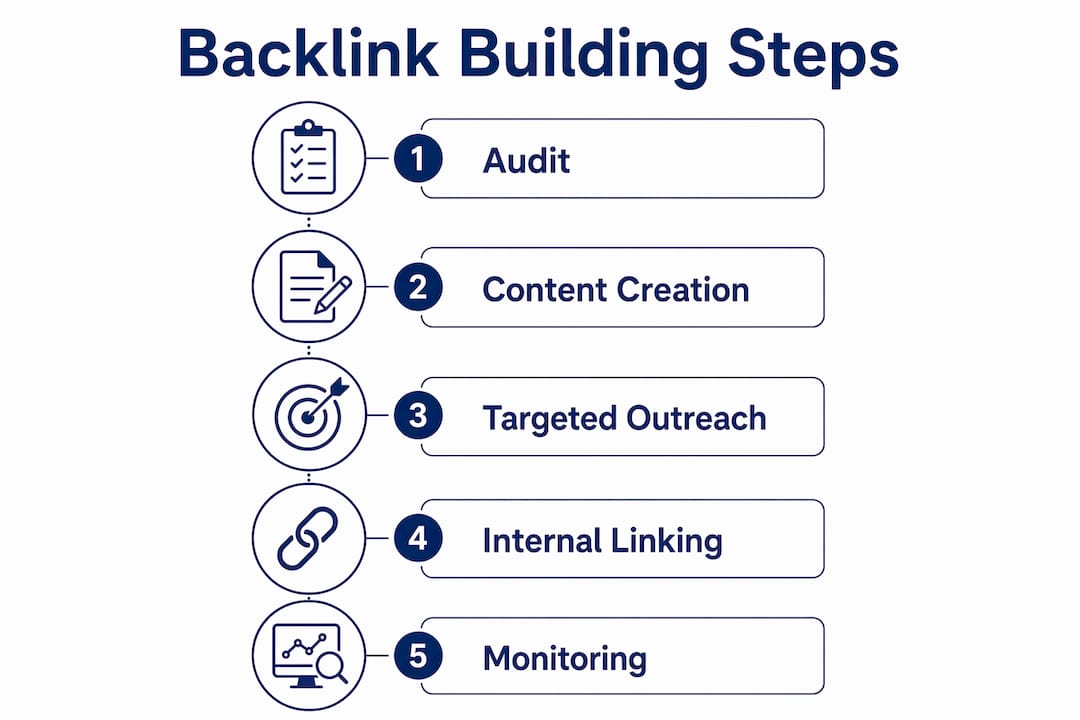
Authority backlinks are editorial links from trusted, topically relevant websites that signal credibility to both search engines and AI platforms like ChatGPT and Perplexity. The authority backlink building steps covered in this guide follow a 6-step cycle that includes auditing, content creation, prospecting, outreach, internal linking, and monitoring. Skip any step and you leave ranking potential on the table. Follow the full process and you build the kind of link profile that compounds over time, not one that collapses after the next algorithm update.
What are the authority backlink building steps that actually work?
The process starts with knowing exactly where you stand. Before you pitch a single editor or publish a single piece of content, you need a clear picture of your current backlink profile. That means running a full audit using tools like Ahrefs, Semrush, or Moz to map every inbound link by source, anchor text, and topical relevance.
Most SEO professionals make the same mistake here. They sort by Domain Authority and call it done. Professional audits use a 100-point tiered scoring system that weights topical relevance at 15% and requires a threshold of 80–100 points before approving a link. That means a link from a DA 40 site in your exact niche can outperform a DA 80 site with no topical connection.

Your audit should answer three questions. Which existing links are genuinely helping you? Which are neutral or harmful? And where are the gaps your competitors are filling that you are not? Gap analysis tools inside Ahrefs and Semrush let you compare your backlink profile against two or three competitors side by side, revealing the exact sites linking to them but not to you.
| Audit Metric | Why It Matters |
|---|---|
| Topical relevance score | Measures how closely the linking site’s content matches your niche |
| Trust signals | Evaluates editorial standards, spam score, and link neighborhood quality |
| Anchor text distribution | Identifies over-optimization risks and natural link patterns |
| Referring domain growth | Tracks whether your profile is growing, stagnant, or shrinking |
Pro Tip: Export your full backlink list and filter for links from sites that have not published new content in 12 months. Those links are losing value fast. Prioritize replacing them with links from actively maintained, editorially driven sites.
What types of content attract high authority backlinks?
Link-worthy content has one defining characteristic: it gives other writers a reason to cite you. Generic blog posts do not earn links. Original data, industry surveys, definitive guides, and utility tools do. Digital PR tactics like original research and industry surveys generate the highest-impact backlinks, earning dozens of editorial links from a single campaign.
Before you launch broad outreach, build two or three high-value “link magnet” assets. These are the pieces that justify your outreach and earn natural links over time, reducing the manual effort required to scale. Think of them as the foundation you build outward from.
The most effective link magnet formats in 2026 include:
- Original research reports with proprietary data your niche cannot find elsewhere
- Industry surveys that aggregate insights from practitioners and get cited by journalists
- Definitive how-to guides that cover a topic more thoroughly than any existing resource
- Free utility tools like calculators, templates, or diagnostic checklists
- Data visualizations that make complex statistics easy to share and embed
Topical relevance is the filter that determines which of these formats works for your specific niche. A financial services firm publishing a free mortgage calculator earns links from personal finance blogs and news outlets. That same firm publishing a general productivity guide earns almost nothing. Match the asset to the audience that already links within your space.
Pro Tip: Before creating a new link magnet, search your target keyword in Google and check the backlink profiles of the top three results using Ahrefs. The sites linking to them are your warmest prospects. Build content that gives those same sites a better resource to cite.
You can also explore how content marketing builds authority over the long term, which reinforces the link magnet strategy with a broader publishing cadence.
How to build a targeted outreach strategy for authoritative links
Outreach is where most link building campaigns fail. The failure is almost always a relevance problem, not a volume problem. Personalized outreach to 40–60 highly relevant prospects consistently yields better response and link acquisition rates than blasting 500 generic emails.
Here is the step-by-step outreach process that produces results:
-
Build your prospect list. Use Ahrefs Content Explorer or Semrush’s Link Building Tool to find sites that have linked to similar content in your niche. Filter for sites with active editorial teams and recent publishing activity. Target 40–60 sites per campaign.
-
Score each prospect. Apply the topical relevance and trust criteria from your audit. Links from topically relevant sites outperform higher-DA sites with irrelevant content. Prioritize niche fit over raw authority scores.
-
Choose your link acquisition method. Guest posts work well when you have a strong content team and can deliver genuine value to the host site’s audience. Niche edits (adding your link to an existing, already-indexed article) are faster and often more effective for building contextual relevance. Digital PR campaigns are the highest-ceiling tactic for earning editorial links at scale.
-
Write personalized outreach emails. Reference a specific article the editor published. Explain exactly why your content adds value to their readers. Keep the email under 150 words. Never use a template that starts with “I hope this email finds you well.”
-
Follow up once, not three times. A single follow-up after five to seven business days is professional. More than that damages your sender reputation and burns the relationship.
-
Track everything in a CRM or outreach tool. Platforms like Pitchbox, Hunter.io, and BuzzStream let you manage sequences, track open rates, and log responses without losing prospects in a spreadsheet.
Pro Tip: When pitching niche edits, find articles on your target site that already rank on page one for a keyword related to your content. Editors are far more likely to add your link to a performing article than to a buried post.
For a deeper look at how Digital PR fits into this process, Battleseo’s guide on Digital PR for SEO covers the full campaign structure.
How does internal linking amplify the value of acquired backlinks?
Acquiring a backlink is only half the job. Link equity only benefits rankings if your internal linking architecture is updated after acquisition. A backlink pointing to a page with no internal links flowing to your pillar content is a dead end. The equity stops there.
The fix is straightforward. Every time you earn a new backlink to a specific page, audit that page’s internal links and add at least two contextual links pointing to your most important pillar or cluster pages. Use descriptive anchor text that reflects the target page’s primary keyword, not generic phrases like “click here” or “learn more.”
Common internal linking mistakes to avoid:
- Orphan pages that receive backlinks but have no internal links pointing to them from the rest of the site
- Over-optimized anchor text that repeats exact-match keywords on every internal link, which triggers over-optimization signals
- Ignoring content clusters by linking only to the homepage instead of distributing equity to supporting cluster pages
- Failing to refresh old content that has accumulated backlinks but now contains outdated information, which reduces the page’s overall authority signal
| Internal Linking Approach | Impact on Link Equity |
|---|---|
| Contextual links to pillar pages | Distributes equity directly to highest-priority ranking targets |
| Breadcrumb navigation | Passes equity upward through site hierarchy efficiently |
| Related content modules | Spreads equity laterally across cluster pages |
| No internal linking update | Equity stalls on the landing page and does not compound |
Battleseo’s detailed breakdown of internal links and authority explains exactly how to structure this for maximum ranking impact.
How to monitor, defend, and scale your link building campaign
A backlink profile without active monitoring degrades over time. Links get removed, sites go down, and toxic links accumulate from spam sources you never solicited. Ongoing health checks and automation are critical for campaign longevity, not optional maintenance tasks.
Set up the following monitoring systems before you scale:
- Google Search Console alerts for sudden drops in referring domains, which signal lost links or manual penalties
- Ahrefs or Semrush backlink alerts that notify you when new links are acquired or existing links are removed
- Brand mention monitoring using tools like Google Alerts or Mention.com to catch unlinked brand mentions you can convert into backlinks
- Toxic link detection through Semrush’s Backlink Audit tool, which flags links from spammy or penalized domains for disavowal
Backlinks now influence brand sentiment and AI-generated summaries beyond traditional rankings. That means a toxic link profile does not just hurt your Google rankings. It can affect how ChatGPT or Perplexity describes your brand in response to user queries.
Scaling comes after stability. Once your monitoring systems are in place and your first campaign has produced measurable results, document your process in a repeatable workflow. Assign prospecting, outreach, and content tasks to specific team members or contractors. Run campaigns in 90-day sprints with clear KPIs: number of links acquired, referring domain growth, and target page ranking movement. The 6-step authority building cycle has a realistic campaign horizon of 6–18 months for tangible authority shifts. Plan accordingly.
Pro Tip: Convert unlinked brand mentions first. These are the easiest wins in any link building campaign. The site already knows your brand, so the outreach is warm, the ask is small, and the conversion rate is significantly higher than cold prospecting.
Key takeaways
Authority backlink building is a structured, multi-step process where topical relevance, personalized outreach, and internal linking work together to produce sustainable ranking gains.
| Point | Details |
|---|---|
| Audit before outreach | Score existing links by topical relevance and trust, not just Domain Authority. |
| Build link magnets first | Create two to three high-value assets before launching broad outreach campaigns. |
| Target 40–60 prospects | Focused, personalized outreach to relevant sites outperforms high-volume generic campaigns. |
| Update internal links post-acquisition | Add contextual internal links after every new backlink to distribute equity to pillar pages. |
| Monitor and defend continuously | Use Ahrefs, Semrush, and Google Alerts to protect profile health and catch toxic links early. |
Why I think most link building advice stops too early
Most guides end at outreach. They treat link acquisition as the finish line. In my experience working with clients through Battleseo’s Local Command Directive™ framework, the real ranking gains come from what happens after the link lands.
The internal linking update. The content refresh. The monitoring workflow that catches a lost link before it becomes a lost ranking. These are the steps that separate a campaign that compounds from one that plateaus after 90 days.
I also think the SEO industry is still underestimating how much topical relevance matters in an AI-driven search environment. AI-powered search platforms now evaluate “topical neighborhoods,” meaning the cluster of sites linking to you signals your domain’s subject matter expertise as much as any on-page signal. A single link from a highly relevant, mid-authority site in your niche can move rankings faster than three links from high-DA sites with no topical connection.
The other thing I see consistently: teams chase volume before they have stable assets. They launch outreach before they have a single piece of content worth linking to. Build the foundation first. Two or three genuinely useful resources will earn more links with less effort than 50 mediocre blog posts ever will.
Patience is not a soft skill in link building. It is a competitive advantage. Most competitors stop at month three. The teams that document their process, run consistent 90-day sprints, and treat link building as a long-term investment are the ones who own their niche by month twelve.
— Mike
Build authority faster with Battleseo’s link-building services
If you want to skip the trial-and-error phase and put a proven process to work immediately, Battleseo manages the full authority backlink building process for you.
From prospect research and personalized outreach to Digital PR campaigns and internal linking audits, the team handles every step of the process. Battleseo takes on only one client per service category per market, so your campaign never competes with another business in your niche. Explore Battleseo’s link-building services to see how professionally managed outreach and Digital PR can accelerate your authority. You can also review the full backlinks in SEO guide to deepen your strategy before getting started.
FAQ
What makes a backlink “authoritative”?
An authoritative backlink comes from a trusted, editorially maintained site with strong topical relevance to your niche. Professional scoring systems require a threshold of 80–100 points across relevance, trust, and authority metrics before a link qualifies as high value.
How many prospects should I target per outreach campaign?
Target 40–60 highly relevant prospects per campaign. Personalized outreach to a focused list consistently outperforms high-volume generic campaigns in both response rate and link acquisition.
How long does authority backlink building take to show results?
Tangible authority shifts typically require a campaign horizon of 6–18 months. Results depend on the competitiveness of your niche, the quality of your link magnet assets, and the consistency of your outreach cadence.
Do backlinks still matter for AI search platforms?
Yes. Backlinks now influence brand sentiment and AI-generated summaries on platforms like ChatGPT and Perplexity, extending their value well beyond traditional Google rankings.
What is the difference between a guest post and a niche edit?
A guest post is a new article you write and publish on another site, with your link included in the content. A niche edit adds your link to an existing, already-indexed article on the host site, which is often faster and delivers immediate contextual relevance.