
TL;DR:
- Content marketing involves creating and sharing valuable content to attract and engage target audiences. It is a long-term system that builds trust, improves organic search traffic, and converts readers into customers by aligning content with buyer journey stages. Combining content marketing with local SEO enhances visibility and attracts local customers effectively.
Content marketing is defined as a strategic approach to attracting and engaging a specific audience by creating and sharing valuable, relevant content rather than pushing direct sales messages. Brands like Salesforce, HubSpot, and Mailchimp have built entire growth engines around this model. Instead of interrupting people with ads, content marketing earns attention by solving real problems. A well-executed blog post, video series, or email newsletter builds the kind of trust that a 30-second ad simply cannot. This guide explains what content marketing involves, how it differs from traditional advertising, and how you can apply it to grow your business.
What does content marketing involve?
Content marketing involves creating and distributing content across multiple channels, including articles, social media posts, videos, podcasts, and email newsletters. The process has four core phases: planning, creation, distribution, and measurement. Each phase feeds the next, and skipping any one of them weakens the whole effort.

Planning means identifying your audience, their questions, and the keywords they search. Creation means producing content that genuinely answers those questions. Distribution means getting that content in front of the right people through the right channels. Measurement means tracking what worked and adjusting your approach.
Content types span a wide range of formats:
- Blog posts and articles: Drive organic search traffic and establish expertise
- Videos: Build personal connection and explain complex topics quickly
- Podcasts: Reach audiences during commutes and downtime
- Infographics: Simplify data-heavy topics into shareable visuals
- Social media posts: Maintain visibility and spark conversation
- Email newsletters: Nurture existing subscribers with consistent value
- Webinars: Generate leads while delivering in-depth education
Each format serves a different purpose and fits different stages of the buyer’s journey. A blog post works well for awareness. A detailed case study works better when a prospect is close to a decision.
Pro Tip: Match your content format to the sales funnel stage. Awareness content (blog posts, social media) should educate. Consideration content (comparison guides, webinars) should evaluate. Decision content (case studies, testimonials) should convert. Mixing these up wastes effort and confuses your audience.
How is content marketing different from traditional advertising?
Content marketing differs from traditional advertising by focusing on educating or entertaining rather than interrupting with promotional messages. Traditional advertising pushes a message at people whether they want it or not. Content marketing pulls people in by offering something genuinely useful.
The distinction matters because consumer behavior has shifted. People skip ads, use ad blockers, and ignore banner placements. They do not ignore content that answers a question they are already asking. That is the core advantage of the inbound model that content marketing is built on.
| Factor | Content marketing | Traditional advertising |
|---|---|---|
| Approach | Inbound, audience-initiated | Outbound, brand-initiated |
| Goal | Build trust and long-term loyalty | Drive immediate awareness or sales |
| Format | Articles, videos, podcasts, newsletters | TV spots, print ads, display banners |
| Cost over time | Compounds in value as content ages | Stops working when budget stops |
| Audience relationship | Relationship-focused, educational | Transactional, interruptive |
| Measurement | Traffic, engagement, leads, conversions | Impressions, reach, frequency |
The compounding value column in that table is worth pausing on. A well-written blog post published today can still rank on Google and attract new readers three years from now. A paid ad delivers results only while the budget runs. That asymmetry is why content marketing has become a core growth strategy for businesses of every size.
What are the essential strategies for content marketing success?
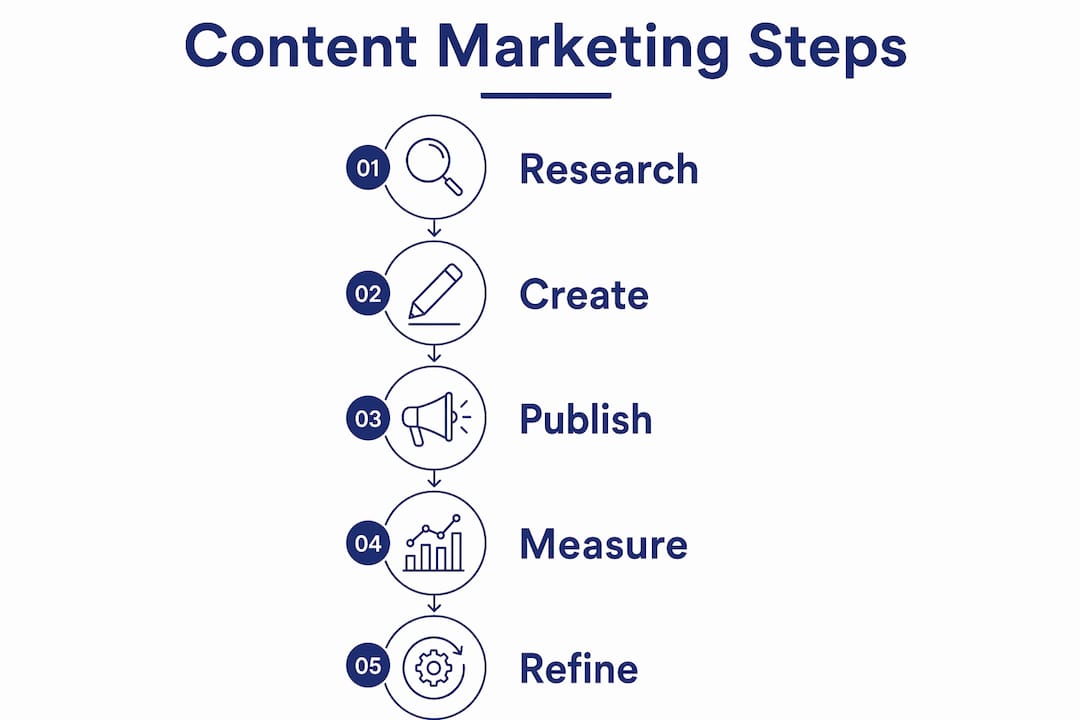
Effective content marketing is a continuous, iterative process of planning, creating, publishing, measuring, and refining performance over time. The businesses that see real results treat it as a system, not a one-time project.
Research before you create
Start with keyword research and audience analysis. Tools like Google Search Console, Ahrefs, and Semrush reveal what your audience is already searching for. Align your content topics to those searches. This is not about gaming an algorithm. It is about meeting your audience where they already are.
Consistency beats volume
Publishing one well-researched article per week outperforms publishing five thin posts. Consistent, valuable content aligned with business goals is what separates content marketing from mere frequent posting. Frequency without quality produces noise, not authority.
Promotion is not optional
Creating high-quality content alone is not enough without effective promotion to reach your audience. Distribution through social media, email, and paid amplification ensures your content actually gets seen. Think of content creation and content promotion as two equally important jobs.
Key metrics to track across your content program:
- Organic traffic: Are more people finding you through search?
- Engagement rate: Are readers spending time with your content?
- Lead generation: Is content converting visitors into contacts?
- Conversion rate: Are leads moving toward a purchase?
- Return visits: Are readers coming back for more?
Pro Tip: Avoid the trap of posting regularly without a measurable goal attached to each piece. Every article, video, or email should have a clear purpose: attract new visitors, nurture existing leads, or convert prospects. If you cannot state the goal in one sentence, rethink the content before you create it.
How can businesses apply content marketing to attract and convert customers?
Content marketing attracts and converts customers by aligning content with audience interests and buyer journey stages across the sales funnel. The practical application is simpler than most business owners expect. It starts with understanding your customer’s questions at each stage of their decision process.
Think of the buyer journey in three stages. At the awareness stage, your customer knows they have a problem but does not yet know the solution. At the consideration stage, they are evaluating options. At the decision stage, they are ready to choose. Each stage requires different content.
A local plumber, for example, might publish an awareness article titled “Why Is My Water Pressure Low?” That article attracts homeowners with a problem. A consideration piece might compare DIY fixes versus professional repair. A decision piece might showcase customer reviews and a clear call to book a service. That sequence is content marketing working as a system.
Content marketing also supports SEO by building brand authority and nurturing trusted relationships, which drives long-term search ranking improvements. Every piece of content you publish adds to your site’s authority and increases your chances of appearing in search results.
Here is a sequential process for implementing content marketing in your business:
- Define your audience. Write out the specific problems, questions, and goals of your ideal customer. Be specific enough that you could describe one real person.
- Map content to the funnel. Assign content topics to awareness, consideration, and decision stages. Do not create content without knowing which stage it serves.
- Build a content calendar. Plan at least four weeks ahead. Consistency requires a schedule, not inspiration.
- Create and publish. Write, record, or design content that genuinely answers your audience’s questions. Prioritize depth over length.
- Promote across channels. Share each piece through email, social media, and any paid channels that fit your budget.
- Measure and refine. Review performance monthly. Double down on what drives traffic and leads. Cut or revise what does not.
You can also use engaging content strategies to improve both reader retention and search rankings simultaneously. The two goals are not in conflict. Content that genuinely helps readers tends to rank better because search engines reward engagement signals.
Key Takeaways
Content marketing is a long-term system that builds trust, drives organic traffic, and converts readers into customers by delivering consistent, audience-focused value across every stage of the buyer journey.
| Point | Details |
|---|---|
| Core definition | Content marketing attracts audiences through valuable content rather than direct sales messages. |
| Four key phases | Plan, create, distribute, and measure every piece of content you publish. |
| Not the same as posting | Frequent posting without measurable goals is not content marketing. It is noise. |
| Funnel alignment matters | Match content format and topic to the awareness, consideration, or decision stage. |
| Promotion is required | Great content that nobody sees delivers no results. Distribution is half the job. |
Why most businesses get content marketing backwards
Most business owners I work with start content marketing the same way: they publish a few blog posts, see little traffic after a month, and conclude it does not work. That conclusion is wrong, but the frustration is understandable.
The real issue is that they are treating content marketing as a campaign rather than a system. A campaign has a start date and an end date. A system compounds over time. The businesses that win with content are the ones that commit to a 12-month plan, measure results monthly, and adjust based on data rather than gut feeling.
The second mistake I see constantly is confusing content creation with content marketing. Writing an article is creation. Making sure that article reaches the right people through search, email, and social media is marketing. You need both. One without the other is incomplete.
The third thing I have learned from working with independent business owners is that the best content is almost always the most specific content. A general article about “how to improve your website” will not rank or convert. An article titled “How Plumbers in New London, CT Can Get More Calls from Google” will. Specificity is what separates content that builds authority from content that disappears into the internet.
Track three metrics above everything else: organic traffic growth month over month, the number of leads generated from content, and the conversion rate of those leads. If those three numbers are moving in the right direction, your content program is working. If they are not, the content or the promotion strategy needs to change.
— Mike
Content marketing and local SEO working together
Content marketing does not exist in isolation. For independent business owners, it works best when paired with a strong local SEO foundation.
At Battleseo, we help business owners build content programs that do more than fill a blog. Our content marketing services are built around your specific market, your audience’s real search behavior, and the buyer journey stages that matter most for your business. We combine that with local SEO optimization to make sure your content gets found by the right people in your area. If you are ready to build a content system that drives real visibility and real customers, Battleseo works with a limited number of clients per market each month.
FAQ
What is the simplest definition of content marketing?
Content marketing is the practice of creating and sharing valuable, relevant content to attract and engage a specific audience, building trust that leads to profitable customer actions over time.
How is content marketing different from blogging?
Blogging is one content format. Content marketing is the full system of planning, creating, distributing, and measuring content across multiple formats and channels to achieve specific business goals.
What types of content are used in content marketing?
Content marketing uses blog posts, videos, podcasts, infographics, social media posts, email newsletters, and webinars. The right format depends on your audience and the stage of the buyer journey you are targeting.
How long does content marketing take to show results?
Content marketing is a long-term strategy. Most businesses begin to see meaningful organic traffic growth within three to six months of consistent, well-promoted publishing. Authority and compounding returns build over 12 months and beyond.
Does content marketing help with SEO?
Yes. Consistent valuable content builds brand authority and increases organic visibility, which directly supports long-term search ranking improvements on Google and other search engines.