
TL;DR:
- Entity SEO focuses on optimizing websites around clear, identifiable concepts like brands or products that search engines recognize as distinct entities. This approach emphasizes building topical authority, structured data, and consistent identity signals to improve AI-driven search visibility and rich result inclusion. Implementing ongoing practices such as schema markup, content updates, and external profile alignment enhances your brand’s presence across traditional and AI-based search platforms.
Entity SEO is the practice of optimizing your website and content around unique, identifiable concepts that search engines recognize as distinct entities, such as brands, products, and people, rather than relying solely on keyword matching. Google defines an entity as a singular, well-defined thing or concept, and these entities have become the atomic units powering both Google’s Knowledge Graph and AI search platforms like ChatGPT and Perplexity. Tools like Semrush, Ahrefs, and Clearscope have all acknowledged the growing weight of entity signals in modern search. If you are still building your SEO strategy entirely around keyword density and exact-match phrases, you are optimizing for a search engine that no longer exists. Understanding how content marketing supports SEO is the first step, but entity clarity is what makes that content legible to AI systems.
What is entity SEO, and how is it different from keyword SEO?
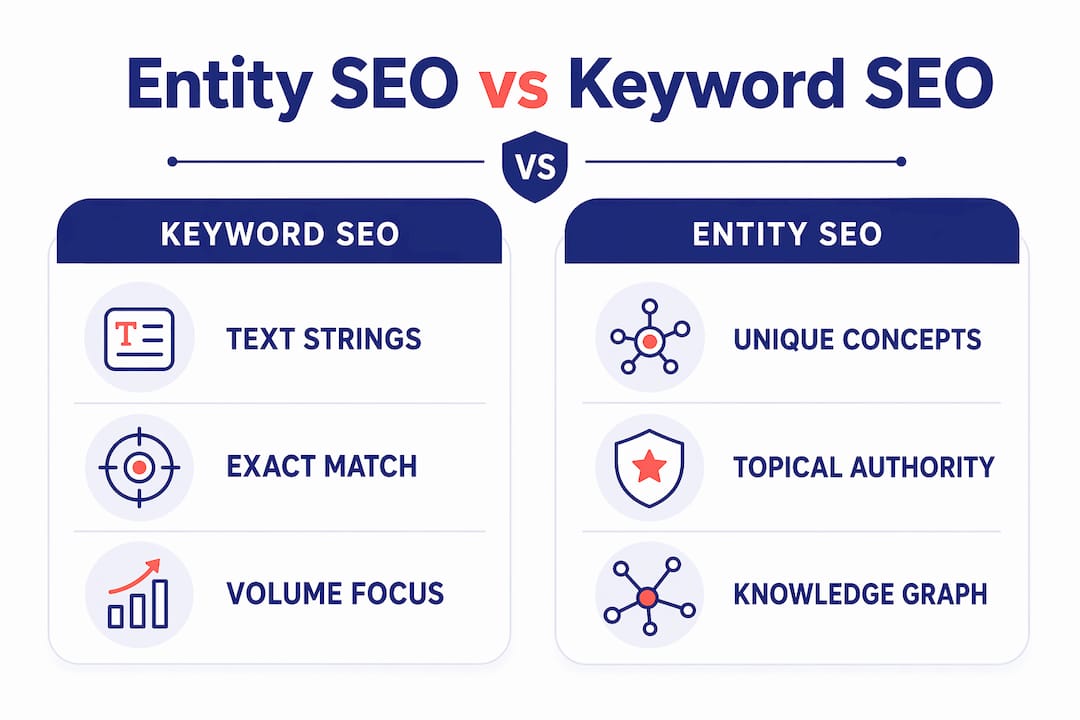
Entity-based SEO and traditional keyword SEO operate on fundamentally different logic. Keywords are text strings. Entities are the underlying concepts those strings represent, and the distinction matters enormously for how modern search engines process and rank content.

Consider a practical example. The keyword “apple” is ambiguous. The entity “Apple Inc.” is not. Entities are unique and distinguishable, with defined attributes and relationships. Tesla the company and Nikola Tesla the inventor share a name but are entirely separate entities with different Wikidata Q-IDs, different Knowledge Graph nodes, and different semantic relationships. Search engines use these distinctions to deliver precise answers, not just text matches.
The table below captures the core differences that shape how you should approach your SEO strategy:
| Dimension | Keyword SEO | Entity SEO |
|---|---|---|
| Core unit | Text string | Unique concept with attributes |
| Search engine logic | Pattern matching | Semantic understanding |
| Optimization target | Exact-match phrases | Topical authority and identity clarity |
| AI citation potential | Low without entity signals | High with Knowledge Graph connectivity |
| Disambiguation | None | Defined via schema, Wikidata, sameAs links |
Entity SEO shifts focus from keyword matching to building topical authority, with each page centered on one canonical entity reinforced by aligned schema and page elements. AI-based search engines seek dense retrieval of semantic meaning, which requires unambiguous entity definitions and thorough topical coverage. Keyword SEO alone cannot satisfy that requirement.
The practical implication is this: ranking for a keyword cluster is no longer enough. You need search engines to understand what your brand, product, or content represents within a broader semantic network.
How do search engines and AI recognize entities?
Search engines do not read your content the way a human does. They extract meaning through a layered technical process that begins with entity recognition and ends with Knowledge Graph placement.
Here is how that process works, step by step:
- Named Entity Recognition (NER). Search engine crawlers use NER algorithms to identify mentions of people, organizations, locations, and products within your content. These mentions are then mapped to known entity IDs in databases like Wikidata or Google’s own Knowledge Graph.
- Entity linking and disambiguation. Once an entity mention is detected, it is linked to a unique identifier. This is where the Tesla example becomes critical. Without additional context or structured signals, a crawler may misattribute your content to the wrong entity entirely.
- Structured data processing. Schema markup significantly improves entity recognition and increases the chances of appearing in rich results. Google prefers explicit, machine-readable schema.org markup over inference from unstructured text. Organization, Person, and Product schema types are the most impactful starting points.
- Identity signal corroboration. Google cross-references your on-page entity claims against external sources. Consistent Name-Address-Phone (NAP) data, LinkedIn profiles, Crunchbase listings, and Wikidata entries all serve as corroborating signals that reinforce entity confidence.
- AI retrieval and citation. AI systems like Perplexity and ChatGPT retrieve passages grounded in entities and only cite pages where the entity is clearly defined and connected to the Knowledge Graph. Pages optimized only for keywords may rank in traditional search but will be bypassed entirely in AI-generated answers.
Pro Tip: Add the sameAs property to your Organization schema and point it to your Wikidata entry, LinkedIn company page, and Crunchbase profile. This single addition gives Google multiple corroboration points to confirm your entity identity without any guesswork.
The underlying principle is that search engines and AI systems are building a map of reality. Your job is to make sure your brand, products, and content appear on that map with accurate coordinates.
How to implement entity SEO effectively
Implementing SEO entity optimization is not a one-time task. It is an ongoing discipline that touches your content strategy, technical setup, and off-site presence simultaneously. The following practices form the foundation of a working entity SEO framework.
- Open every entity-focused page with a verbatim definition sentence. Using the format “Entity] is a [category] that…” signals to AI passage retrieval systems exactly what the page covers. [Verbatim definition sentences improve passage retrieval for AI answers and increase the likelihood of direct citation. This is one of the highest-leverage changes you can make today.
- Implement schema.org structured data with sameAs links. Effective entity SEO requires structured data using Organization, Person, and Product schema types, with sameAs links pointing to authoritative external profiles. Consistency in NAP data and brand descriptions across platforms prevents entity splitting, which is the fragmentation of your identity across multiple unconnected nodes.
- Build topical clusters around related entities. Each cluster should have a central pillar page for the primary entity and supporting pages for related entities. This architecture reinforces semantic relevance and signals topical depth to both traditional search engines and AI retrieval systems. Battleseo’s approach to building long-term online authority through content clusters directly supports this model.
- Maintain identity consistency across all online profiles. Your brand name, description, and contact details should be identical on Google Business Profile, LinkedIn, Crunchbase, Yelp, and any other platform where your entity appears. Inconsistencies create doubt in the Knowledge Graph and reduce your entity confidence score.
- Use Google’s Knowledge Graph API, Semrush, and Ahrefs for entity discovery. These tools help you identify which entities you already rank for, which related entities you should target, and where gaps exist in your topical coverage.
- Update content regularly to maintain freshness signals. Content older than 12 months drops in AI citation rates significantly. Recent updates with consistent entity signals are favored by AI retrieval systems, making content maintenance a direct ranking factor in entity SEO.
Pro Tip: Before publishing any new page, run a quick entity audit using the Google Knowledge Graph API search tool. If your brand or topic does not return a clear Knowledge Graph result, that is your signal to strengthen your schema markup and external profile consistency before the page goes live.
What are the real benefits of entity SEO?
The benefits of entity SEO extend well beyond traditional ranking improvements. When your entities are clearly defined and well-connected, you gain advantages across multiple dimensions of search visibility.
“Top brands succeed by treating themselves as verifiable entities within public knowledge graphs, reflecting a transition from ‘optimizing strings’ to ‘optimizing for reality’ in AI search.” Source: Frase.io
This shift from strings to reality is not philosophical. It has measurable consequences for your search performance:
- Broader query cluster coverage. When Google understands your entity and its relationships, your content becomes eligible for a wider range of semantically related queries, not just the exact phrases you targeted. A well-defined entity for a local law firm, for example, can surface across queries about specific practice areas, attorney names, and related legal concepts without separate keyword targeting for each.
- AI citation inclusion. AI search systems only cite pages where the entity is clearly defined and connected to the Knowledge Graph. Entity-optimized pages appear in ChatGPT, Perplexity, and Google AI Overviews at a significantly higher rate than keyword-only pages.
- Rich result eligibility. Schema markup tied to well-defined entities increases your chances of earning featured snippets, knowledge panels, and other rich results that dominate above-the-fold search real estate.
- Brand disambiguation and trust. Clear entity signals tell search engines exactly who you are, preventing your brand from being confused with competitors or unrelated entities. This directly improves click-through rates and brand recognition in search results.
- Sustainable topical authority. Entities supplement content quality by providing structural context and relationships that help AI models fit your content into broader topical ecosystems. This is authority that compounds over time rather than eroding with algorithm updates.
Understanding AI SEO trends for 2026 makes clear that entity optimization is not a future consideration. It is the current standard for visibility in AI-driven search.
Common mistakes that undermine entity SEO
Even experienced SEO professionals make implementation errors that dilute or actively harm entity signals. Knowing what to avoid is as important as knowing what to do.
- Treating entities as a replacement for quality content. Entities augment content relevance by providing structural context. They do not substitute for depth, accuracy, or genuine expertise. Schema markup on thin content still produces thin results.
- Inconsistent identity data across platforms. A brand listed as “Battle SEO” on Google Business Profile, “BattleSEO” on LinkedIn, and “Battle SEO LLC” on Crunchbase creates three separate entity candidates in the Knowledge Graph. This fragmentation reduces confidence and can suppress rich result eligibility entirely.
- Stuffing irrelevant entities into content. Adding entity mentions that have no genuine relationship to your content does not strengthen your entity graph. It creates noise that AI systems learn to discount. Entity authority grows through genuine mentions and co-citations alongside relevant entities in trusted third-party content, not forced or artificial linking.
- Neglecting sameAs profile maintenance. Profiles go stale. A Wikidata entry with outdated information or a Crunchbase profile with an old address actively undermines your entity consistency signals. Schedule quarterly audits of all external profiles.
Pro Tip: Strategic co-citation through authentic mentions in trusted industry discussions naturally builds entity authority and dense semantic relationships. Prioritize earning mentions in industry publications, podcast transcripts, and authoritative directories over building artificial links.
Key takeaways
Entity SEO is the foundational layer of modern search visibility, requiring clear entity definitions, consistent identity signals, and structured data to earn rankings and AI citations.
| Point | Details |
|---|---|
| Entities vs. keywords | Entities are unique concepts with attributes; keywords are text strings without inherent meaning. |
| Schema markup priority | Organization, Person, and Product schema with sameAs links are the highest-impact technical changes. |
| AI citation requirement | AI systems only cite pages where entities are clearly defined and connected to the Knowledge Graph. |
| Identity consistency | Inconsistent NAP data across platforms fragments your entity and reduces search engine confidence. |
| Content freshness matters | Content older than 12 months drops in AI citation rates; regular updates with entity signals are favored. |
Why entity clarity is the SEO investment most brands are still ignoring
I have worked with enough businesses to see the same pattern repeat. They invest heavily in content volume and backlink acquisition, then wonder why their AI search visibility is flat. The answer is almost always entity clarity, or the lack of it.
Most brands are invisible to AI systems not because their content is poor, but because search engines cannot confidently identify who they are. Without a clear entity node in the Knowledge Graph, even excellent content gets passed over for AI citations in favor of a competitor whose schema is simply better organized.
What I find most interesting is how durable entity investments are. A well-structured Organization schema with verified sameAs links does not decay the way a keyword ranking does. It compounds. Every new piece of content you publish reinforces the same entity, and every external mention adds another corroboration point. You are building outward from a base rather than starting over with each algorithm update.
The brands I see winning in AI search right now are not the ones with the most content. They are the ones that adapted their SEO strategies early to treat their online presence as a verifiable entity rather than a collection of keyword-targeted pages. That shift in thinking is the real competitive advantage.
— Mike
Ready to build your entity SEO foundation?
Entity SEO is not a theoretical concept. It is the technical and strategic layer that determines whether your brand gets cited by ChatGPT, surfaces in Google AI Overviews, or earns a Knowledge Panel. Battleseo helps independent businesses and local brands build exactly this foundation through schema markup implementation, identity consistency audits, and topical cluster development.
If you want your business to appear where your customers are actually searching, including AI platforms, Battleseo’s AI optimization services are built for that outcome. For local businesses specifically, the Local SEO services include entity-level optimization as part of the full Local Command Directive™ framework. Spots are limited to 12 new clients per month, and only one business per category per market is accepted.
FAQ
What is entity SEO in simple terms?
Entity SEO is the practice of optimizing your content and website so search engines can clearly identify and understand the unique concepts, brands, and people your site represents. It moves beyond keyword matching to build semantic clarity within Google’s Knowledge Graph.
How is entity SEO different from traditional SEO?
Traditional SEO targets text strings and exact-match phrases. Entity-based SEO targets the underlying concepts those phrases represent, building topical authority and identity signals that AI search systems use to generate citations and rich results.
What schema types matter most for entity SEO?
Organization, Person, and Product schema types are the highest priority. Each should include a sameAs property linking to authoritative external profiles like Wikidata, LinkedIn, and Crunchbase to help search engines confirm your entity identity.
Does entity SEO affect AI search visibility?
AI systems like Perplexity and ChatGPT only cite pages where the entity is clearly defined and connected to the Knowledge Graph. Without entity optimization, your content may rank in traditional search but will be bypassed in AI-generated answers.
How often should you update entity-optimized content?
Content older than 12 months drops in AI citation rates significantly. Quarterly reviews of both on-page content and external profile consistency are the minimum standard for maintaining strong entity signals.