

TL;DR:
- Voice search optimization involves structuring content, schema markup, and local SEO to align with natural spoken queries. It focuses on featured snippets, question-based content, and mobile performance to improve voice assistant visibility and local ranking. Consistent implementation and regular updates are essential to maintain voice search presence in 2026.
Voice search optimization is the process of structuring your website content and technical setup so voice assistants and AI tools can confidently select and read your answers aloud. Google Assistant, Siri, and Amazon Alexa now handle a significant share of daily search queries, and the businesses that show up in those spoken results are not winning by accident. They have built their content around how people actually talk, not just how they type. This guide breaks down the core strategies, technical requirements, and local SEO techniques that make voice search optimization work in 2026, with practical steps you can apply immediately.
What is voice search optimization and why does it matter?
Voice search optimization is the discipline of aligning your website content, technical structure, and local presence with the way people phrase spoken queries. The industry term for this practice sits under the broader umbrella of conversational SEO, but voice search optimization has become its own distinct specialty because the ranking signals differ meaningfully from standard text search.

The importance of voice search comes down to intent and format. When someone types a query, they might enter “best pizza downtown.” When they speak the same query, they say “Hey Google, where’s the best pizza place near me open right now?” That shift from fragment to full sentence changes everything about how you need to write and structure content.
Voice queries are conversational and phrased as complete questions, which means content optimized for voice must mirror that natural language pattern. A page that answers “What are the hours for [business name]?” in a direct sentence will outperform a page that buries that information in a paragraph of marketing copy.
Voice assistants also pull answers from a narrow set of sources. 70% of voice search results are pulled from featured snippets, which means position zero on Google is the primary target for any voice search SEO strategy. If your content does not earn a featured snippet, your chances of being read aloud drop sharply.
For digital marketers and business owners, the practical implication is clear. Optimizing for voice search is not a separate project from your existing SEO work. It is the next layer of precision built on top of a solid content and technical foundation.
What are the core strategies for voice search optimization?
The most effective voice search techniques center on four areas: content phrasing, structured data, local SEO, and page performance. Each one addresses a different part of how voice assistants find, evaluate, and deliver answers.
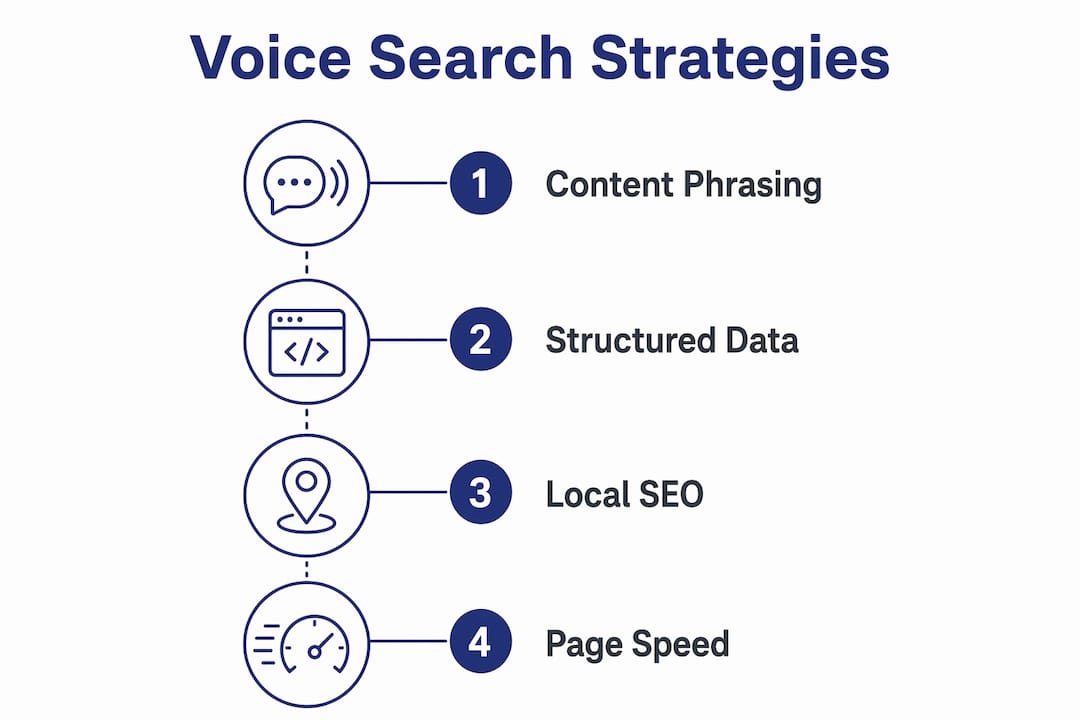
Write content that mirrors spoken questions
Voice queries mostly start with question words: who, what, where, when, why, and how. Your content should use those same question words as headings, then answer directly in the first sentence beneath each heading. Think of it as writing for a person who will hear your answer read aloud. If the sentence sounds awkward when spoken, rewrite it.
Content written to be read aloud easily is favored by voice assistants. Short, declarative sentences in a natural tone consistently outperform dense, jargon-heavy paragraphs. Aim for answers between 40 and 60 words for any question you want a voice assistant to read.
Use structured data as a labeling system
FAQPage, HowTo, and LocalBusiness schema are the most reliable schema types for voice search results. Treat schema markup as an explicit instruction set for voice assistants, telling them exactly which text to extract and read aloud. FAQPage schema maps each question to a precise answer, making it straightforward for Google Assistant to pull the right content. You can learn more about implementing these correctly in Battleseo’s guide on schema markup for SEO.
- Use FAQPage schema for any page with question-and-answer content
- Use HowTo schema for step-by-step instructional content
- Use LocalBusiness schema for your business name, address, phone, and hours
- Validate all schema using Google’s Rich Results Test before publishing
Speakable schema is more limited in scope and is not yet widely supported. Prioritizing the three schemas above delivers more consistent results across Google Assistant, Siri, and Alexa.
Prioritize local SEO and mobile performance
Businesses with accurate and consistent local listings rank better for voice search local queries. Your Google Business Profile must be complete, verified, and updated regularly. NAP data (name, address, phone number) must match exactly across every directory where your business appears.
Page speed and mobile usability are direct ranking signals for voice search because most voice queries originate from mobile devices. A site that loads in under two seconds on mobile is not just a technical nicety. It is a prerequisite for voice search visibility.
Pro Tip: Run your site through Google PageSpeed Insights and Google’s Mobile-Friendly Test before implementing any other voice search optimization steps. Technical barriers at the foundation will undermine every content improvement you make above them.
How does voice search optimization differ from traditional SEO?
The table below captures the most significant differences between voice search optimization and traditional text-based SEO. Understanding these distinctions helps you allocate effort correctly rather than applying the same tactics to both channels.
| Factor | Traditional SEO | Voice search optimization |
|---|---|---|
| Query format | Short keyword phrases | Full conversational questions |
| Content structure | Keyword-rich paragraphs | Direct answers near the top of the page |
| Primary ranking target | Position 1 in SERPs | Featured snippet (position zero) |
| Local intent weight | Moderate | High, especially for “near me” queries |
| Schema markup priority | Helpful but optional | Critical for extraction and spoken delivery |
| Device context | Desktop and mobile | Predominantly mobile and smart speakers |
Voice search queries are longer and more specific than typed queries. A user searching by voice is often further along in the decision process, which is why businesses optimizing for local voice queries see higher conversion rates than those targeting generic search terms. That specificity is an advantage if your content is structured to capture it.
Traditional SEO factors like backlinks and domain authority still matter. Voice assistants do not ignore authority signals. They simply layer conversational content requirements and schema on top of those existing signals. A high-authority site with poorly structured content will lose voice search placements to a lower-authority site that answers questions clearly and directly.
Pro Tip: Audit your top ten traffic pages and identify which ones answer a specific question. Add a direct, 50-word answer at the top of each page before any other content. This single change is the fastest path to featured snippet eligibility and voice search visibility.
What technical aspects must you optimize for voice search?
Technical optimization for voice search follows a clear sequence. Work through these steps in order, since each one builds on the previous.
-
Audit page speed on mobile. Use Google PageSpeed Insights to identify your Core Web Vitals scores. Target a Largest Contentful Paint under 2.5 seconds and a Cumulative Layout Shift score under 0.1. A fast, mobile-optimized website is the baseline requirement for voice search ranking.
-
Confirm mobile usability. Run every key page through Google’s Mobile-Friendly Test. Fix any issues with tap targets, font sizes, or viewport configuration before moving to content changes.
-
Implement and validate structured data. Add FAQPage schema to any page with question-and-answer content. Add LocalBusiness schema to your homepage and contact page. Use Google’s Rich Results Test to confirm each schema type validates without errors.
-
Check crawlability. Open Google Search Console and review the Coverage report. Any pages blocked by robots.txt or returning errors cannot be indexed or selected for voice answers.
-
Optimize for HTTPS. Voice assistants strongly favor secure sites. If your site still serves any pages over HTTP, resolve this before any other optimization work.
-
Structure content for extraction. Place the direct answer to any question within the first two sentences beneath a question-format heading. Voice assistants extract content from the top of sections, not from the middle of paragraphs.
Pro Tip: After implementing schema markup, submit your updated pages for indexing through Google Search Console’s URL Inspection tool. This accelerates the time between implementation and when Google recognizes the new structured data.
How can you measure and track voice search success?
Direct voice search analytics do not exist in any standard platform today. Google Search Console does not segment voice queries from typed queries in its current reporting interface. This is the most common frustration among marketers new to voice search SEO, and it is worth addressing directly: you measure voice search performance through proxy metrics, not direct data.
The most reliable proxies are:
- Featured snippet rankings. Track which of your pages hold featured snippets using tools like Semrush or Ahrefs. Featured snippet ownership is the single strongest predictor of voice search visibility.
- Local pack appearances. Monitor your Google Business Profile insights for search and map views. Rising local pack visibility correlates directly with voice search recommendation frequency.
- Question-format query impressions. In Google Search Console, filter queries by question words (who, what, where, when, why, how). Rising impressions for these queries indicate your content is aligning with voice search patterns.
- Conversion tracking from local queries. If you use call tracking or form analytics, segment conversions from mobile users. Voice search users who convert typically do so immediately after the search, so mobile conversion rates are a useful signal.
Measurement of voice search requires iterative testing and adaptation because assistant algorithms change frequently. Set a monthly review cadence. Update any page that has lost a featured snippet within 30 days of the drop. The AI search optimization guide from Battleseo covers how these proxy metrics apply across AI platforms like ChatGPT and Perplexity as well.
What local SEO techniques amplify voice search results?
Local intent drives a disproportionate share of voice queries. “Where is,” “near me,” and “open now” are among the most common voice search phrases, and the businesses that capture those queries share a consistent set of local SEO practices.
Google Business Profile and NAP consistency
Your Google Business Profile is the single most important local signal for voice search. Complete every field: business category, service areas, hours, photos, and the Q&A section. Local presence and review velocity are increasingly pivotal signals for voice recommendation. A business with 50 recent reviews will consistently outperform a competitor with 200 older reviews in voice assistant recommendations.
NAP data must be identical across Google Business Profile, Yelp, Apple Maps, Bing Places, and every industry directory where your business appears. Even minor inconsistencies (abbreviating “Street” as “St.” in one listing but not another) create conflicting signals that reduce your voice search ranking confidence.
| Local signal | Why it matters for voice search |
|---|---|
| Google Business Profile completeness | Primary data source for Google Assistant local answers |
| NAP consistency across directories | Reduces conflicting signals that lower ranking confidence |
| Review recency and volume | Drives recommendation frequency for “best near me” queries |
| LocalBusiness schema on website | Confirms business data directly to search engine crawlers |
| Location-specific page content | Captures city and neighborhood-level voice queries |
Use location-specific keywords naturally in your page content and blog posts. A plumber in Austin, Texas should have content that references specific neighborhoods, landmarks, and service areas. This local SEO content strategy is what separates businesses that appear in voice results from those that do not.
Key takeaways
Voice search optimization succeeds when conversational content, structured data, and local SEO work together as a single integrated system rather than separate tactics.
| Point | Details |
|---|---|
| Featured snippets are the primary target | 70% of voice answers come from position zero, making snippet optimization the highest-priority task. |
| Schema markup is non-negotiable | FAQPage, HowTo, and LocalBusiness schema tell voice assistants exactly what to extract and read aloud. |
| Local SEO drives voice conversions | Consistent NAP data and fresh reviews directly influence voice assistant recommendations for local queries. |
| Proxy metrics replace direct analytics | Track featured snippet rankings, local pack appearances, and question-format query impressions in Google Search Console. |
| Technical performance is the foundation | Mobile usability and page speed must be resolved before content or schema changes deliver results. |
Voice search is not a separate channel. Treat it like one anyway.
I have worked with enough business owners to know the most common mistake in voice search optimization: treating it as a bolt-on project rather than a content philosophy. Teams spend weeks adding schema markup to pages that still open with a paragraph about the company’s founding story. The schema does nothing if the content beneath it does not answer a question directly.
The businesses I see winning voice search in 2026 have one thing in common. They write for a listener, not a reader. Every page answers a specific question in the first two sentences. Every local listing is verified and updated. Every schema type is validated and live. None of this is complicated, but it requires discipline and consistency that most competitors skip.
The other thing I would caution against is chasing Speakable schema before you have FAQPage and LocalBusiness schema fully implemented. Speakable is still limited in application, and the time investment rarely pays off compared to the fundamentals. Build outward from a solid base. Get your Google Business Profile complete, get your featured snippets locked in, and get your page speed under two seconds. Everything else is refinement.
Voice search is also not static. Google Assistant, Siri, and Alexa update their ranking logic regularly. The businesses that maintain their voice search visibility are the ones that review their proxy metrics monthly and update content when rankings shift. Set that review cadence now, before you need it.
— Mike
How Battleseo can help you capture voice search traffic
Battleseo specializes in local SEO and AI search optimization for independent business owners, and voice search visibility is built into every engagement. The Local Command Directive™ framework covers Google Business Profile optimization, citation building, schema implementation, and on-page content structuring. These are exactly the signals that determine whether a voice assistant recommends your business or your competitor’s. If you want expert help getting your local presence and structured data working together, Battleseo’s local SEO services are built for that outcome. Battleseo takes on only one business per service category per market, so your competitive advantage is protected from day one.
FAQ
What is voice search optimization in simple terms?
Voice search optimization is the practice of structuring your website content and local listings so voice assistants like Google Assistant, Siri, and Alexa can find and read your answers aloud. It combines conversational content writing, schema markup, and local SEO into a single strategy.
How does voice search work differently from typed search?
Voice queries are longer, phrased as full questions, and carry stronger local intent than typed queries. Voice assistants pull answers primarily from featured snippets and Google Business Profile data rather than scanning a list of blue links.
Which schema types matter most for voice search?
FAQPage, HowTo, and LocalBusiness schema are the most effective for voice search visibility. These schema types give voice assistants clear instructions on which content to extract and read aloud, making them more reliable than Speakable schema in current practice.
How do I measure voice search performance?
Direct voice search data is not available in standard analytics platforms. Track featured snippet rankings, local pack appearances, and question-format query impressions in Google Search Console as proxy metrics for voice search performance.
Why is local SEO so important for voice search?
A large share of voice queries carry local intent, including phrases like “near me” and “open now.” Businesses with complete Google Business Profiles, consistent NAP data across directories, and strong review velocity rank higher in voice assistant recommendations for local queries.