
TL;DR:
- AI search shifts focus from rankings to being cited in AI-generated answers.
- Entity clarity and consistent, factual content improve AI visibility and citations.
- AI citation volatility requires building durable assets like profiles, reviews, and credible content.
Ranking on page one used to be the whole game. You chased keywords, built links, and watched your position climb. But something fundamental has shifted. AI-powered search tools like ChatGPT, Perplexity, and Google’s AI Overviews don’t just list links anymore. They generate answers, and they cite the businesses they trust most. If your business isn’t being mentioned inside those answers, you’re invisible to a growing share of potential customers, no matter where you rank on a traditional results page.
Table of Contents
- How AI is transforming SEO: Key shifts every business owner should know
- The new mechanics of AI-driven search: From keywords to clarity and recommendations
- Why local businesses can’t ignore AI: Impacts on Google, reviews, and discoverability
- The biggest advantages: How AI streamlines, automates, and measures modern SEO
- Adapting to change: What AI volatility means and how to future-proof your SEO
- A smarter path forward: Why betting on durable assets outperforms chasing AI rankings
- Get better local visibility with expert AI SEO support
- Frequently asked questions
Key Takeaways
| Point | Details |
|---|---|
| New SEO success metrics | AI cares about how often your business is cited and recommended, not just your search ranking. |
| Entity clarity is vital | Clear, structured information about your business helps AI engines surface you in search. |
| Focus beyond keywords | AI considers your reviews, business profile, and context to match user intent. |
| Automate and adapt | AI can save time on SEO tasks but you should monitor results since citations change often. |
| Durable strategies win | Investing in factual, useful business assets helps you stay visible even as AI search evolves. |
How AI is transforming SEO: Key shifts every business owner should know
The rules of search have changed, and the change is bigger than most business owners realize. For years, success in SEO meant landing on page one and earning clicks. That model still matters, but it’s no longer the complete picture.
AI-driven search introduces a fundamentally different success metric. As Search Engine Land explains, AI SEO (often called GEO) shifts the goal from rankings and clicks to whether AI systems cite, mention, or recommend your brand inside generated answers. Think about what that means in practice. A potential customer asks ChatGPT, “What’s the best HVAC company near me?” The AI doesn’t show ten blue links. It generates a paragraph recommending two or three businesses by name. If yours isn’t one of them, that customer moves on without ever seeing your website.
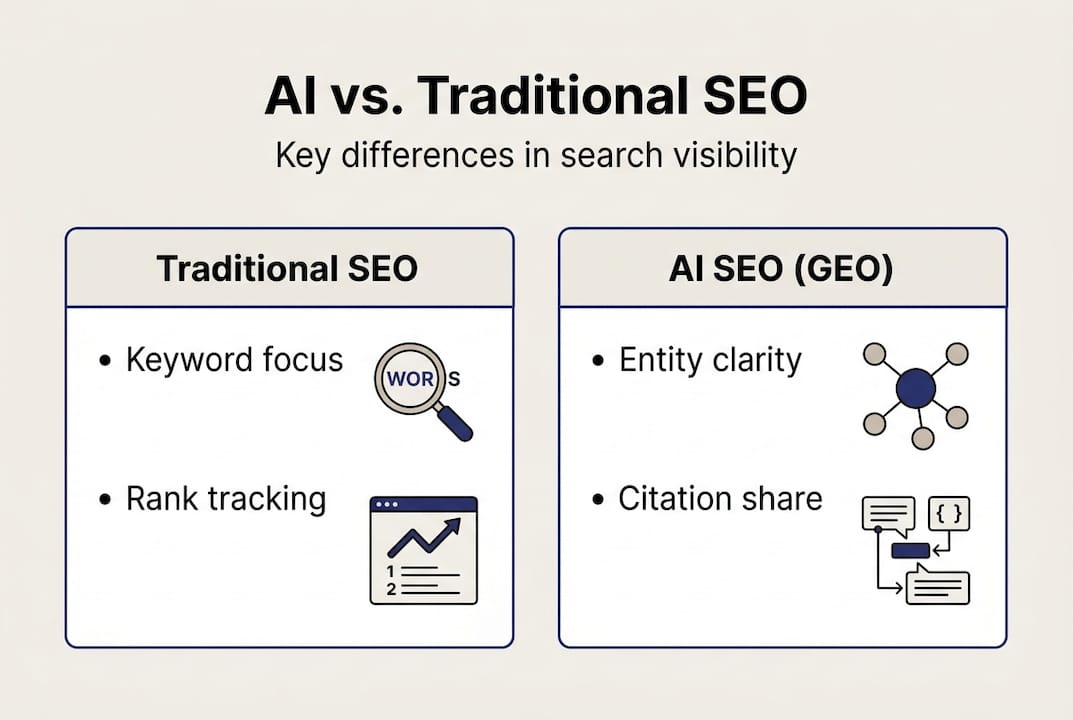
This concept is called Generative Engine Optimization, or GEO. It’s the practice of structuring your content, business data, and online presence so that AI engines can easily identify, understand, and cite your business in their responses. GEO doesn’t replace traditional SEO. It builds on top of it. But it requires a different mindset, one focused on clarity and authority rather than keyword density alone.
Here’s a side-by-side look at how the two approaches differ:
| Traditional SEO | AI-driven SEO (GEO) |
|---|---|
| Ranks pages for specific keywords | Gets cited in AI-generated answers |
| Measures success by position and clicks | Measures success by citation frequency and share of voice |
| Focuses on keyword placement | Focuses on entity clarity and extractable content |
| Targets search engine crawlers | Targets AI language models and generative engines |
One of the most important concepts in GEO is entity clarity, which means making sure AI systems can definitively identify who you are, what you do, and where you operate. AI engines don’t just scan for keywords. They look for content that is easy to extract and reuse, meaning factual, structured, and consistent information across every platform where your business appears.
For independent business owners, this is actually good news. You don’t need a massive content budget to win at GEO. You need accuracy, consistency, and clarity. Those are achievable goals. Learning more about combining traditional SEO and AI is a strong starting point, and future-proofing your SEO with AI gives you a framework for staying ahead as the landscape continues to evolve.
The new mechanics of AI-driven search: From keywords to clarity and recommendations
Understanding how AI engines actually process and surface business information helps you make smarter decisions about where to invest your time. The process looks very different from traditional search crawling.
Here’s how AI systems typically evaluate and recommend a local business:
- Gather structured data. AI engines pull information from your Google Business Profile (GBP), your website, third-party directories, and review platforms. Inconsistent data across these sources creates confusion and reduces your chances of being cited.
- Assess entity clarity. The AI checks whether it can clearly identify your business as a distinct entity with a defined name, category, location, and service area. Ambiguity hurts you here.
- Evaluate content extractability. AI visibility depends on entity clarity and making content easy to extract and reuse. That means clear sentences, factual claims, and well-organized page structure.
- Check authority signals. Backlinks, mentions in credible publications, and consistent citations across the web all signal that your business is trustworthy and worth recommending.
- Generate a response. The AI synthesizes everything it found and produces an answer, citing the sources it found most reliable and clear.
One thing that surprises many business owners is how volatile AI citations can be. The Semrush AI Visibility Index tracked 2,500 prompts and found 40 to 60 percent volatility in cited sources from month to month. That means a business that appears in AI answers today might not appear next month, and vice versa. This isn’t a reason to panic. It’s a reason to focus on durable assets rather than short-term wins.
Pro Tip: Write your business descriptions, service pages, and GBP content as if you’re answering a question directly. Self-contained, factual paragraphs are far easier for AI engines to extract and cite than vague marketing copy.
Exploring AI optimization methods gives you concrete tactics for structuring your content this way. And understanding the broader evolution of search engines helps you see why these mechanical shifts are permanent, not temporary.
Why local businesses can’t ignore AI: Impacts on Google, reviews, and discoverability
Local businesses face a specific challenge in the AI era. You’re not just competing for keyword rankings. You’re competing to be the business an AI recommends when someone nearby asks for help.

AI systems interpret intent rather than simply matching keywords, and they use information from your Google Business Profile, reviews, and structured business descriptions to decide what to recommend. This changes the stakes for every piece of content you publish about your business.
Here’s what that means practically for your local visibility:
- Your GBP description matters more than ever. A vague, keyword-stuffed description doesn’t help AI systems understand what you actually do. Write clearly about your services, your service area, and what makes your business the right choice.
- Review text is now SEO content. When customers mention specific services, locations, or outcomes in their reviews, AI engines pick up on that language. Encourage detailed, specific reviews rather than generic five-star ratings.
- Consistency across platforms is non-negotiable. If your business name, address, and phone number differ between your GBP, your website, and Yelp, AI systems may struggle to confirm your entity and skip you in favor of a competitor with cleaner data.
- Photos and attributes add context. AI engines increasingly use structured attributes like “women-owned,” “open late,” or “free parking” to match businesses with specific customer needs. Fill out every relevant attribute in your profile.
- Response patterns signal engagement. Responding to reviews and questions on your GBP shows AI systems that your listing is active and managed, which contributes to overall trustworthiness signals.
Pro Tip: Audit your Google Business Profile right now and look for incomplete fields. Categories, service descriptions, business hours, and Q&A sections are all data points AI engines use when forming recommendations. Every blank field is a missed opportunity.
Optimizing your Google Business Profile for AI visibility is one of the highest-impact moves an independent business owner can make without a large budget. The data is already there. You just need to make it clear and complete.
The biggest advantages: How AI streamlines, automates, and measures modern SEO
Beyond visibility, AI tools offer real operational benefits for independent business owners who are running lean. Here’s where the practical advantages stack up quickly.
AI automates time-consuming SEO tasks. AI SEO can reduce time and operational costs by automating parts of SEO workflows, including drafts, metadata variations, and internal link suggestions. For a business owner who handles marketing alongside everything else, that’s significant. Tasks that used to take hours can now take minutes.
Here are the most impactful automation wins for independent operators:
- Meta tag generation. AI tools can draft title tags and meta descriptions for every service page on your site, saving hours of repetitive work.
- Content outlines and drafts. Feed an AI tool your service list and target city, and it can produce a solid first draft of a location-specific service page in minutes.
- Internal link mapping. AI can analyze your site structure and suggest which pages should link to each other, improving both user experience and crawlability.
- Review response templates. Consistent, thoughtful review responses are important for GBP performance. AI can help you draft personalized responses at scale.
- Citation auditing. Some AI-powered tools can scan your business listings across directories and flag inconsistencies that hurt your entity clarity.
The measurement framework is shifting too. GEO measurement uses citation frequency and share of voice across AI answers, which is especially useful when clicks are reduced because AI answers the question directly without requiring a click-through. This is a meaningful shift. Instead of asking “where do I rank for this keyword,” you start asking “how often does AI recommend my business when someone asks a relevant question?”
Tracking your share of voice in AI answers requires different tools than traditional rank trackers. Some platforms now offer AI visibility monitoring specifically for this purpose. Staying current on navigating SEO algorithm changes helps you adapt your measurement approach as these tools mature.
Adapting to change: What AI volatility means and how to future-proof your SEO
Volatility is the defining characteristic of AI search right now. Google’s AI Overviews expanded rapidly and then pulled back in 2025, which means local visibility strategies must be adaptable across query types, not only informational searches. What works today may shift tomorrow, and that’s not a flaw in the system. It’s the nature of generative AI at this stage.
The AI citation outputs are volatile and vary by prompt and query type, so a smart AI SEO plan should expect fluctuations and focus on durable assets rather than chasing one-time rankings. Here’s what durable looks like in practice:
- Entity clarity across every platform. Your business name, description, and category should be identical and unambiguous on your website, GBP, Yelp, Facebook, and every relevant directory.
- Factual, extractable content blocks. Write service pages and blog posts with clear, factual paragraphs that answer specific questions. Avoid fluffy introductions and get to the point quickly.
- Multi-platform presence. AI engines pull data from many sources. A business that appears consistently across Google, Bing, Apple Maps, and industry directories is far more likely to be cited than one that only maintains a single profile.
- Authority signals from credible sources. Mentions in local news, industry publications, and community websites build the kind of authority that AI engines trust.
- Consistent content publishing. Regular, relevant content signals that your business is active and engaged, which matters to both traditional and AI search systems.
Pro Tip: Don’t treat AI SEO as a separate project from your regular SEO. The same actions that improve your Google rankings, completing your GBP, earning quality backlinks, and publishing factual content, also improve your AI citation rate. Build one strong foundation and both systems benefit.
Thinking about balancing paid and organic strategies also becomes important in this environment, especially when organic AI visibility can fluctuate and paid placements offer more predictable exposure during volatile periods.
A smarter path forward: Why betting on durable assets outperforms chasing AI rankings
Here’s a perspective that most SEO conversations miss. Business owners often treat rankings and citations as the goal. They’re not. They’re indicators. The real goal is consistent, qualified exposure to people who are ready to buy.
Traditional rankings can disappear overnight after an algorithm update. AI citations are even more fluid, shifting 40 to 60 percent month to month. Chasing either one as a primary metric puts you on a treadmill. What doesn’t disappear is a well-built entity: a business with a complete, consistent profile, genuine reviews that describe real outcomes, factual content that answers real questions, and authority earned through credible mentions.
We’ve seen businesses obsess over their AI citation rate while neglecting the basics that actually drive citations in the first place. The contrarian truth is this: the businesses that show up most consistently in AI answers aren’t the ones gaming the system. They’re the ones that made it easy for AI to trust them.
Treat AI as your assistant, not your judge. Build the assets it can easily cite, clear descriptions, factual service pages, complete profiles, and the citations will follow. Check out top SEO tips for visibility to see how these fundamentals translate into specific, actionable steps you can take this week.
Get better local visibility with expert AI SEO support
Knowing what to do and having the bandwidth to do it consistently are two different things. Independent business owners are already stretched thin, and keeping up with both traditional SEO and AI optimization requires real expertise.
At Battle SEO, we specialize in exactly this combination. Our local SEO services are built around the same durable assets we’ve described throughout this guide: GBP optimization, citation building, authority backlinks, and on-page clarity. Our AI optimization support layers on the GEO strategies that help your business get cited on ChatGPT, Perplexity, and Gemini. If you’re ready to stop guessing and start building visibility that lasts, our AI and SEO experts are here to help you take the next step.
Frequently asked questions
How does AI help with local SEO?
AI improves local SEO by interpreting customer search intent and using your Google Business Profile, reviews, and business descriptions to surface your business in recommendations rather than just matching keywords.
What is entity clarity and why does it matter for AI SEO?
Entity clarity means defining your business so AI can easily identify and summarize you. AI visibility depends on entity clarity and content that is easy to extract, making your business far more likely to appear in AI-generated answers.
How often do AI search results change which businesses are cited?
AI-generated citations are highly volatile. The Semrush AI Visibility Index tracked 2,500 prompts and found 40 to 60 percent of cited sources change from month to month.
Can AI actually save me time or money on SEO?
Yes. AI tools automate SEO workflows including drafting metadata, suggesting internal links, and creating content variations, which meaningfully reduces time and operational costs for independent operators.
Should I still care about rankings if AI is changing SEO?
Rankings still matter, but GEO measurement now includes citation frequency and share of voice in AI answers, giving you a more complete picture of how often your business is actually being recommended to potential customers.