
TL;DR:
- An SEO framework is a repeatable system that combines technical SEO, content strategy, and AI readiness to boost website visibility at scale. Small businesses can build their own effective frameworks using simple tools like content templates, technical checklists, and appropriate JavaScript rendering choices. Implementing a consistent, layered approach ensures long-term growth, scalable results, and adaptation to evolving AI search behaviors.
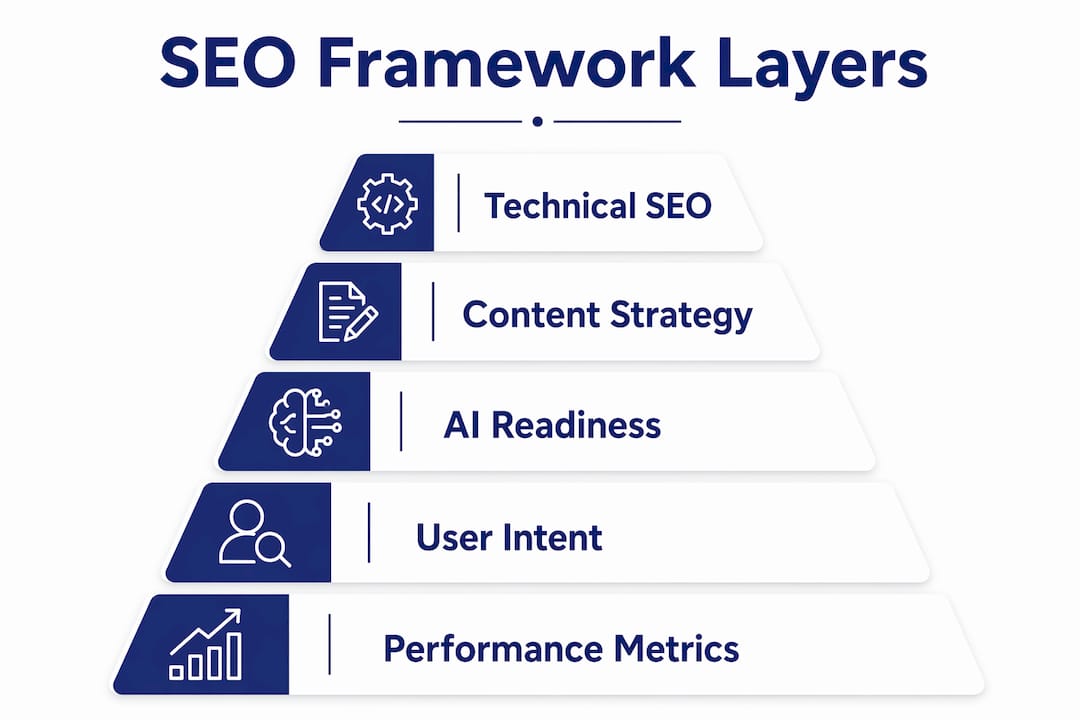
An SEO framework is a structured, repeatable system that combines technical SEO, content strategy, and AI readiness to improve your website’s visibility consistently and at scale. Without one, you are essentially making isolated decisions that rarely compound into lasting results. Marketing professionals and small business owners who understand why use SEO frameworks gain a clear operational advantage: they stop chasing rankings and start building a system that produces them. Tools like The SEO Framework plugin, JavaScript frameworks such as Next.js and Nuxt, and emerging generative engine optimization (GEO) practices all fall under this umbrella, and each plays a distinct role in how search engines and AI platforms discover your content.
Why use SEO frameworks for technical SEO foundations

Technical SEO is the floor everything else stands on. If search engines cannot crawl and index your pages efficiently, no amount of great content will move the needle. SEO frameworks address this by enforcing a consistent set of technical standards across your entire site, not just the pages you remember to check.
What crawlability actually means for your site
Crawlability refers to how easily a search engine bot can access, read, and understand your pages. Sitemaps speed up indexing, but internal linking with descriptive anchor text remains the primary mechanism that guides crawlers through your site architecture. A sitemap tells Google where your pages are; internal links tell it why those pages matter and how they relate to each other. The SEO Framework plugin automates sitemap generation and search engine pinging, removing a manual task that many small business owners simply forget.
Page speed is the other non-negotiable. Core Web Vitals scores in the “Good” range reduce bounce rate and improve ranking potential, and frameworks enforce the discipline of keeping scripts and styles lean. Canonical URLs, structured metadata, and proper heading hierarchies round out the technical hygiene that frameworks make repeatable rather than occasional.
Pro Tip: Run PageSpeed Insights on your three highest-traffic pages right now. If any score below 75 on mobile, your technical foundation is costing you rankings before a single content decision is made.
The table below compares three rendering approaches and their SEO implications, which is a decision that sits at the heart of any technical SEO framework.
| Rendering method | SEO impact | Best use case |
|---|---|---|
| Client-Side Rendering (CSR) | Poor: initial HTML is often empty, crawlers miss content | Single-page apps where SEO is not a priority |
| Server-Side Rendering (SSR) | Strong: full HTML delivered on first request | Dynamic sites needing real-time data and strong indexing |
| Static Site Generation (SSG) | Excellent: pre-built HTML, fastest load times | Content-heavy sites, blogs, local business pages |
The takeaway here is direct: your rendering choice is an SEO decision, not just a developer preference. Frameworks that enforce SSR or SSG give you a structural advantage before you write a single word of content.
How SEO frameworks align content strategy with search intent
Content and SEO are not separate disciplines. Aligning SEO and content teams helps target buyer journey stages effectively and improves search visibility in ways that neither team can achieve working in isolation. SEO interprets what users are searching for; content builds the authority and trustworthiness signals that make your site worth ranking. A framework creates the shared operating system that keeps both teams moving in the same direction.
For small business owners who wear both hats, this alignment happens through checklists, templates, and content governance rules that remove guesswork from the publishing process. You are not deciding from scratch each time whether a page needs a meta description, a schema tag, or an internal link to a related service page. The framework decides that for you, and you execute.
The practical benefits of content-SEO alignment within a framework include:
- Keyword targeting by funnel stage. Frameworks map content types to awareness, consideration, and decision queries so you are not accidentally writing three blog posts that compete with each other.
- E-E-A-T signal consistency. Google’s Experience, Expertise, Authoritativeness, and Trustworthiness signals are built through author bios, citations, and structured content. A framework makes these standard, not optional.
- Content governance for teams. When multiple contributors publish to your site, a framework enforces quality standards that protect your domain authority.
- Promotional content integration. Case studies, landing pages, and product content fit into a framework alongside editorial content, so your SEO strategy covers the full site rather than just the blog.
Pro Tip: Build a one-page content brief template that includes target keyword, search intent classification, required internal links, and schema type. Completing it before writing any piece of content is the single fastest way to operationalize your content marketing strategy.
How JavaScript framework choice affects your SEO
This is the section most marketing guides skip, and it is one of the most consequential decisions a business makes when building or rebuilding a website. CSR-only apps produce empty initial HTML, which means many crawlers, including AI agents, never see your content at all. The page loads beautifully in a browser, but the crawler gets a blank shell.
Websites using Next.js, Nuxt, and SvelteKit deliver full HTML on the first byte, which is the gating metric SEO experts use when evaluating framework choices. Next.js is the standard recommendation for React-based applications. Nuxt serves the same role for Vue. Astro is the best option for content-heavy sites that need near-zero JavaScript overhead. Each of these frameworks supports SSR or SSG out of the box, which means the SEO foundation is built into the architecture rather than bolted on afterward.
| JavaScript framework | Rendering support | SEO suitability | Ideal for |
|---|---|---|---|
| Next.js | SSR + SSG | Excellent | React apps, e-commerce, SaaS |
| Nuxt | SSR + SSG | Excellent | Vue apps, content sites |
| Astro | SSG (partial hydration) | Excellent | Blogs, local business sites |
| SvelteKit | SSR + SSG | Excellent | Performance-critical apps |
| Create React App | CSR only | Poor | Internal tools, no SEO need |
Migrating from a pure CSR setup to an SSR or SSG framework takes four to six weeks and requires planning for URL changes and redirects. That timeline is worth it. The SEO baseline improvement from serving fully rendered HTML affects every page on your site simultaneously, which no amount of content optimization can replicate. If you are building a new site in 2026, this decision should be made before you choose a theme or write a headline.
Why AI search visibility is now part of every SEO framework
Search behavior has shifted in a way that makes traditional ranking-only strategies incomplete. Over 60% of Google searches now end without a click because users receive answers directly from AI-powered results. That statistic means a top-three ranking no longer guarantees traffic. It means your content must be structured so that AI systems can extract, cite, and surface it as an answer.
This is where generative engine optimization (GEO) and answer engine optimization (AEO) enter the picture. Both are layers built on top of your foundational SEO, not replacements for it. The steps to make your content AI-visible within a framework follow a clear sequence:
- Strengthen your technical foundation first. AI visibility relies on semantic HTML and schema markup that matches the actual rendered content. A weak foundation caps the potential of every AI optimization you add on top.
- Implement structured data and schema markup. FAQ schema, HowTo schema, and LocalBusiness schema give AI crawlers explicit signals about what your content means, not just what it says.
- Create AI-readable content files. Plain-text summaries, structured FAQs, and clearly labeled content sections help platforms like ChatGPT, Perplexity, and Gemini extract accurate answers from your pages.
- Maintain a consistent entity footprint. Your business name, location, services, and expertise signals should appear consistently across your site, your Google Business Profile, and third-party citations.
“AI-driven search changes require a new layered SEO approach where traditional SEO foundations are enhanced by AI visibility optimizations to remain competitive.” — AI SEO Services research
Ignoring AI-focused SEO in 2026 is not a neutral choice. It is a decision to become less visible as the platforms your customers use to find answers continue to shift. The good news is that a well-built SEO framework already handles most of the prerequisites. You are adding a layer, not rebuilding from scratch. For a deeper look at how these shifts affect your strategy, the Battleseo guide on adapting your SEO strategies in 2026 covers the practical implications in detail.
Key takeaways
SEO frameworks deliver consistent, scalable visibility by integrating technical SEO, content alignment, and AI readiness into a single repeatable system.
| Point | Details |
|---|---|
| Technical foundation first | Crawlability, Core Web Vitals, and sitemaps must be solid before content or AI layers add value. |
| Rendering choice is SEO | Next.js, Nuxt, and Astro serve full HTML at first byte; CSR-only frameworks leave crawlers with empty pages. |
| Content and SEO must align | Frameworks coordinate keyword targeting, E-E-A-T signals, and content governance across all contributors. |
| AI visibility requires structure | Schema markup, semantic HTML, and consistent entity signals make content extractable by ChatGPT, Perplexity, and Gemini. |
| Frameworks scale with you | A repeatable system compounds over time; isolated SEO decisions do not. |
The part most businesses get wrong about SEO frameworks
I have worked with enough small business owners to know that the word “framework” triggers one of two reactions: either they assume it is something only enterprise teams with dedicated developers can use, or they assume they already have one because they installed an SEO plugin. Both assumptions cost them.
The reality is that a framework does not need to be complex to be effective. What it needs to be is consistent. The businesses I see struggle most with SEO are not the ones with bad content or slow sites. They are the ones making good decisions inconsistently. They optimize one page carefully and ignore the next ten. They set up schema markup once and never audit it again. They pick a JavaScript framework based on what their developer prefers without asking a single question about how it handles rendering.
Starting simple is the right move. A basic framework for a small business might be nothing more than a content brief template, a monthly technical audit checklist, and a decision to build on Next.js or WordPress with The SEO Framework plugin. That is enough to produce compounding results if you execute it every time. The SEO audit checklist Battleseo publishes is a practical starting point for building that repeatable process.
The AI layer is where I see the most hesitation right now, and I understand why. GEO and AEO feel abstract compared to “rank for this keyword.” But the underlying work is not abstract at all. It is schema markup, clean HTML, and consistent business information. If your technical foundation is solid, adding AI visibility is a few structured data additions and a content audit. If your foundation is weak, no amount of AI optimization will save you. Fix the floor before you worry about the ceiling.
— Mike
How Battleseo helps you build a framework that works
Battleseo works with independent business owners who need an SEO framework that covers all three layers: technical SEO, content alignment, and AI search visibility. The Local Command Directive™ framework handles Google Business Profile optimization, authority backlinks, citation building, and on-page SEO as a coordinated system, not a checklist of one-off tasks. If you are ready to move from isolated SEO decisions to a repeatable process that builds visibility month over month, explore Battleseo’s local SEO services or the AI search optimization guide to see how the framework applies to your market.
FAQ
What is an SEO framework, exactly?
An SEO framework is a structured system that organizes technical SEO, content strategy, and AI visibility practices into a repeatable process. It replaces ad hoc decisions with consistent standards that scale as your business grows.
Why does JavaScript framework choice matter for SEO?
CSR-only JavaScript frameworks deliver empty initial HTML, which means crawlers cannot index your content. Frameworks like Next.js and Nuxt serve full HTML on the first request, making every page immediately crawlable.
How do SEO frameworks help with AI search visibility?
AI visibility depends on semantic HTML and schema markup that matches rendered content. An SEO framework enforces these standards consistently, making your content extractable by platforms like ChatGPT, Perplexity, and Gemini.
Are SEO frameworks only for large businesses?
No. A small business framework can be as simple as a content brief template, a monthly audit checklist, and a consistent rendering approach. The value comes from repeating the same quality standards every time, not from the complexity of the system.
How often should you audit your SEO framework?
A technical audit should run monthly to catch crawl errors, speed regressions, and schema issues. A content and keyword alignment review every quarter keeps your framework current with search intent shifts and algorithm updates.