
TL;DR:
- AI-driven local search favors clear, answer-first content matching user intent over traditional authority signals.
- Maintaining a consistent, optimized Google Business Profile and structured data is essential for AI citation and ranking.
- Building topical content clusters and tracking AI citation performance helps future-proof local business visibility.
Imagine a potential customer asking ChatGPT for the best HVAC company in your city. Your competitor shows up. You don’t. That scenario is playing out right now across every local market in America, and it’s accelerating fast. 45% of consumers now use AI tools for local business recommendations, up from just 6% the previous year. The rules of local discovery have shifted, and the businesses that adapt first will own the advantage. This guide walks you through exactly what to do.
Table of Contents
- What you need to optimize for AI-driven local search
- Step-by-step: Structuring local content for AI extraction and recommendation
- Semantic relevance and intent: The new keys to AI local ranking
- Going broader: ‘Query fan-out’ and topical coverage for maximum AI inclusion
- How to test, measure, and adapt your AI search results
- Why local AI optimization means thinking bigger than SEO
- Ready to future-proof your local business? Get expert help with AI optimization
- Frequently asked questions
Key Takeaways
| Point | Details |
|---|---|
| AI visibility is essential | More than 45 percent of consumers now use AI tools for local business recommendations, making AI optimization critical. |
| Answer-first content wins | Direct, succinct answers and conversational headings increase your odds of being cited by AI systems. |
| Prioritize semantic relevance | AI favors businesses whose content matches searcher intent rather than just strong authority signals. |
| Optimize for query expansion | Cover related sub-questions to increase chances of showing up for AI’s broader, synthesized answers. |
| Test, measure, adapt | Long-term, experiment-driven strategies are required to secure and maintain AI search visibility. |
What you need to optimize for AI-driven local search
With the opportunity clear, the next step is setting up your digital foundation for AI search. Before you can win AI-driven recommendations, you need the right assets in place. Think of it as building a foundation before adding floors. Skip this step and your content optimization efforts won’t hold.
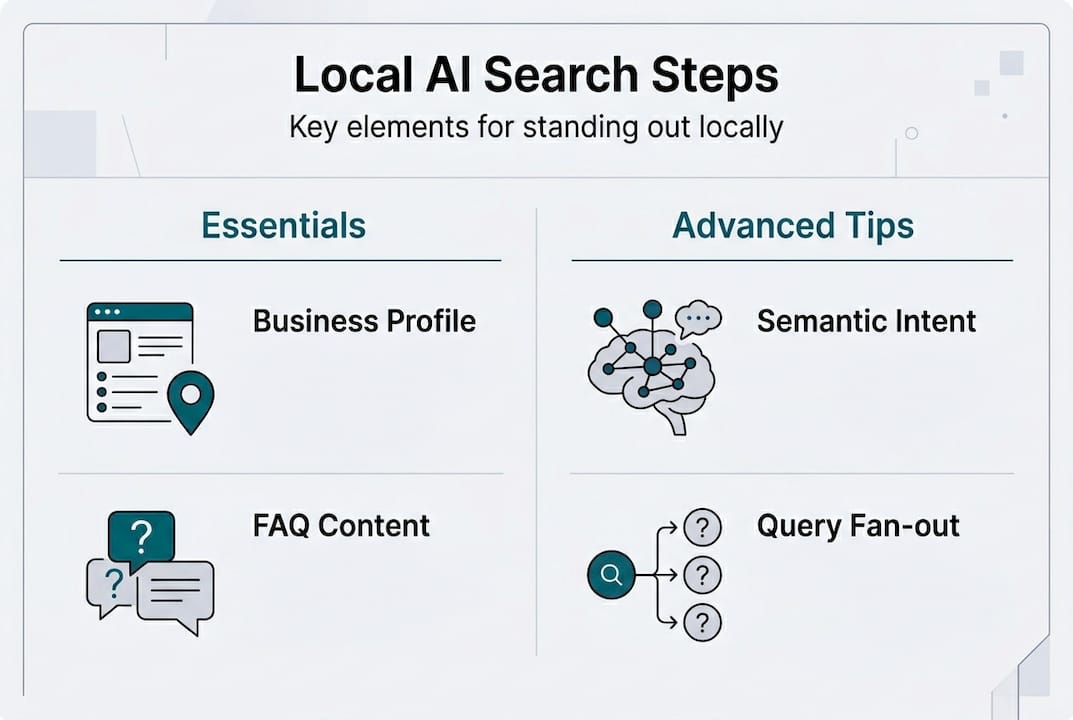
Local AI search SEO requires strong Google Business Profile (GBP) coverage and consistency because different AI surfaces may lean on GBP and structured local data differently. That means your name, address, and phone number must match exactly across every directory, your business categories must be specific, and your GBP must be actively maintained with fresh photos and responses to reviews.
Here are the core assets every local business needs before optimizing for AI search:
- Google Business Profile with complete, verified, and regularly updated information
- LocalBusiness schema markup on your website to make your data machine-readable
- Consistent NAP (Name, Address, Phone) across all major directories and citations
- FAQ content on key service pages, structured to answer real customer questions
- Review volume and recency on Google, Yelp, and industry-specific platforms
- An AI optimization overview that connects your traditional SEO signals to modern AI platforms
Beyond the essentials, some assets give you a meaningful edge without being strictly required.
| Must-have assets | Nice-to-have extras |
|---|---|
| Verified Google Business Profile | Video content on GBP and YouTube |
| LocalBusiness + FAQ schema | Podcast mentions or audio content |
| Consistent citations (NAP) | Local press coverage and Digital PR |
| Service and location pages | Neighborhood-specific landing pages |
| Review management system | AI-specific content experiments |
| On-page structured content | Competitor gap analysis reports |
FAQ and Q&A content deserves special attention. AI systems are built to answer questions. When your website already contains clear, direct answers to the questions your customers ask, you’re essentially giving AI the exact content it needs to cite you. Focus on improving GBP engagement alongside your on-site FAQ strategy for the strongest combined effect.
Pro Tip: Don’t overlook reputation signals. AI systems increasingly use review consistency and sentiment as trust indicators when deciding which businesses to recommend. A business with 200 recent, positive reviews will outperform a competitor with 20 reviews, even if the competitor has a flashier website.
Step-by-step: Structuring local content for AI extraction and recommendation
With your basics in place, it’s time to tune your content to speak directly to AI systems. The way you organize information on your website determines whether AI can extract and cite it confidently. Disorganized content gets skipped. Clear, answer-first content gets quoted.
Structuring “answer-first” local content for AI extraction means providing clear direct answers early, using question-based conversational headings, and using structured data to make the content machine-readable. Here’s how to apply that in practice:
- Lead with the answer. Every service page should open with a one or two sentence direct answer to the most common question about that service. Don’t bury the key information three paragraphs down.
- Use question-based headings. Replace generic headings like “Our Services” with specific questions like “What does a furnace tune-up include?” This mirrors how people ask AI tools for information.
- Add LocalBusiness schema to every location page. This tells AI systems your business name, address, hours, and service area in a format they can read without interpreting your prose.
- Implement FAQ schema on service pages. Mark up your Q&A content with proper FAQ schema so search engines and AI platforms can extract individual answers cleanly.
- Write for voice and conversational queries. Phrases like “near me,” “open now,” and “best [service] in [city]” should appear naturally in your content, not forced.
- Update content regularly. Fresh content signals to AI that your information is current and trustworthy, which matters for time-sensitive queries like hours and availability.
“The businesses that get cited by AI aren’t necessarily the biggest. They’re the ones that made it easiest for AI to find a clear, direct answer and connect it to a real local business.”
When adapting to AI search, pay close attention to how AI is impacting local search behavior overall. The shift toward conversational queries means your content needs to mirror how real people talk, not how marketers write.

Pro Tip: Pull your Google Search Console data and filter for question-based queries that include “how,” “what,” “where,” and “best.” These are the exact phrases AI tools use when generating local recommendations. Build content around your top 10 and watch your citation rate grow.
Semantic relevance and intent: The new keys to AI local ranking
While clear answers are vital, how your content fits a user’s search intent is now the critical ranking factor. Traditional local SEO rewarded authority: the business with the most backlinks and reviews often won. AI-driven local ranking works differently.
For “near me” scenarios, LLM selection and ranking may depend more on semantic relevance and intent matching than on traditional local authority signals alone. In plain terms, that means AI cares more about whether your content actually answers the specific question being asked than whether you have the most domain authority in your market.
| Factor | Traditional local SEO | AI-driven local ranking |
|---|---|---|
| Primary signal | Domain authority + backlinks | Semantic relevance + intent match |
| Content format | Keyword-dense pages | Answer-first, conversational content |
| Review role | Strong ranking factor | Supporting trust signal |
| Schema importance | Helpful but optional | Near-essential for AI extraction |
| Freshness | Moderate impact | High impact for AI recommendations |
| Local citations | Core ranking factor | Foundational but not sufficient alone |
Actionable ways to improve your intent signals right now:
- Map content to specific intent stages. A user searching “emergency plumber near me” has different intent than someone searching “how much does a water heater replacement cost.” Write separate pages for each.
- Use contextual internal linking. Link your service pages to relevant blog posts and FAQ content. This creates a web of context that helps AI understand your topical authority.
- Refresh older pages with current information. Update service descriptions, pricing ranges, and local references at least quarterly to maintain content freshness.
- Monitor local trends. Expert local SEO insights consistently point to intent alignment as the defining factor separating businesses that get cited from those that don’t.
When combining SEO with AI strategies, remember that traditional trust factors like reviews and mentions still play a supporting role. They’re not irrelevant. They just no longer carry the weight they once did when AI is deciding which business to recommend for a specific query.
Going broader: ‘Query fan-out’ and topical coverage for maximum AI inclusion
Winning one spot isn’t enough. Let’s cover how to earn visibility for a whole cluster of questions. One of the most important concepts in AI search optimization is query fan-out, and most local business owners have never heard of it.
AI systems can spread a single user query into multiple related sub-queries, so local pages may need broader, tightly connected coverage within a topic rather than single-keyword targeting. When someone asks an AI “who is the best dentist in Austin for families,” the AI may simultaneously check for pediatric services, insurance acceptance, patient reviews, office hours, and location proximity. If your content only addresses one of those angles, you lose the broader recommendation.
Here’s how to build topical coverage that captures query fan-out:
- Identify your seed topics. Start with your core services and list every question a customer might ask before, during, and after hiring you.
- Map related sub-queries. For each seed topic, brainstorm the adjacent questions AI might check. Use tools like AlsoAsked or Google’s “People Also Ask” section.
- Create interconnected content clusters. Each cluster should have a main pillar page and several supporting pages that link back to it and to each other.
- Avoid content silos. If your plumbing services page and your water heater page don’t link to each other, AI can’t easily see that they’re related.
| Seed query | AI-expanded sub-queries |
|---|---|
| “Best HVAC company near me” | “How much does AC repair cost?” / “Is [company] licensed?” / “Emergency HVAC service available?” |
| “Family dentist in [city]” | “Does [practice] accept Medicaid?” / “Pediatric dentist hours” / “New patient specials” |
| “Local bakery for custom cakes” | “Wedding cake pricing” / “Gluten-free options” / “Order lead time” |
Understanding AI’s broader impact on local search makes it clear why single-keyword optimization is no longer sufficient. You need to cover the full topic, not just the headline phrase.
Pro Tip: Use a simple spreadsheet to track which of your pages appear when you manually query AI tools like ChatGPT or Perplexity with your target questions. Do this monthly and note which pages gain or lose citations. That data will tell you exactly where to focus next. You can also explore the multi-location SEO playbook for strategies on scaling topical coverage across multiple service areas.
How to test, measure, and adapt your AI search results
With your AI-ready content live, let’s ensure your business actually shows up and keeps improving. Publishing optimized content is only half the work. The other half is building a feedback loop that tells you what’s working and what needs adjustment.
Treating local SEO as an experimentation system with hypotheses, control groups, and sufficient time is the right approach because local signals propagate slowly and tests can be contaminated by site-wide changes or external events. In other words, don’t change five things at once and expect to know which one moved the needle.
What to measure and how:
- GBP query data: Check your Google Business Profile Insights weekly for search query trends and direction changes
- AI citation tracking: Query ChatGPT, Perplexity, and Google’s AI Overviews directly with your target phrases and record whether your business appears
- Organic click-through rates: Monitor Search Console for changes in impressions and clicks on your key local pages
- Review velocity: Track how many new reviews you’re receiving per month and whether sentiment is trending positive
- Schema validation: Use Google’s Rich Results Test regularly to confirm your structured data is error-free
| Experiment element | What to do |
|---|---|
| Variable | Change one content or schema element at a time |
| Control | Keep other pages unchanged during the test period |
| Duration | Run each test for at least 6 to 8 weeks |
| What to avoid | Avoid site-wide changes during active tests |
| Success metric | Define your target outcome before you start |
Staying updated with algorithm changes is also essential during this testing phase. AI platforms update their ranking behavior frequently, and what works today may need adjustment in three months.
Pro Tip: Run each experiment for at least 6 to 8 weeks before drawing conclusions. Local SEO signals take time to propagate through Google’s systems and into AI training data. Shorter tests produce misleading results that can send your strategy in the wrong direction.
Why local AI optimization means thinking bigger than SEO
Here’s a perspective that most SEO articles won’t give you: optimizing for AI isn’t primarily a technical challenge. It’s a business credibility challenge.
The businesses that consistently earn AI recommendations aren’t winning because they found a clever schema trick or stuffed the right keywords into their headings. They’re winning because they built genuine topical depth, maintained consistent and accurate data across every platform, and invested in their reputation over time. AI systems are getting better at detecting thin content, inconsistent information, and manufactured signals. The shortcuts that worked in 2018 are liabilities now.
What we see working for independent business owners is a shift in mindset. Instead of asking “how do I rank for this keyword,” the better question is “am I the most trustworthy, clearly explained, and well-documented answer to this customer’s question in my market?” When you can honestly say yes, AI tends to agree.
Learning how to get ChatGPT recommendations for your business is a useful tactical exercise. But the deeper lesson is that AI rewards the same things your best customers reward: clarity, consistency, and genuine expertise. Build those into your business presence and the optimization follows naturally.
Ready to future-proof your local business? Get expert help with AI optimization
Implementing everything in this guide takes time, expertise, and consistent follow-through. That’s exactly where Battle SEO comes in.
We specialize in helping independent business owners dominate their local market through both traditional and AI-driven search. Our AI optimization services are built specifically for businesses that want to appear in ChatGPT, Perplexity, and Google’s AI results, not just the standard map pack. Combined with our local SEO services and multi-location SEO solutions, we cover every layer of your local search presence. We take on only one business per category per market, so your spot is protected. If your category is still open in your area, now is the time to act.
Frequently asked questions
What is the single most important factor for AI search optimization?
Semantic relevance drives local LLM ranking more strongly than traditional local SEO authority signals, so providing direct, answer-focused content aligned with user intent is now the top priority.
How can I check if AI systems cite my business?
Query AI platforms like ChatGPT, Perplexity, and Google’s AI Overviews directly using your target phrases, and benchmark how your business appears in those AI-generated responses on a monthly basis.
Is Google Business Profile still necessary for AI SEO?
Yes. Strong GBP coverage and consistency remain foundational because many AI platforms draw directly on this structured local data when generating business recommendations.
How long before optimization changes impact AI-driven local search?
Local SEO signals propagate slowly, so you should run tests for at least 6 to 8 weeks before measuring results to avoid drawing conclusions from short-term fluctuations.
Do reviews matter as much for AI recommendations?
Yes. AI systems use structured, consistent business data including review signals to assess trustworthiness, and consistent positive reviews continue to influence which businesses get recommended.