

TL;DR:
- Effective business listing optimization enhances visibility, ranking, and customer engagement on Google.
- Key elements include NAP consistency, precise categories, quality photos, and weekly profile updates.
- Ongoing maintenance and attentive responses significantly outperform one-time setups for local search success.
You claim your Google Business Profile, fill in your address and phone number, and wait for customers to roll in. Weeks pass. Nothing. The frustrating reality is that simply creating a listing is not the same as optimizing one. Most independent business owners stop at step one, leaving enormous visibility on the table while fully optimized competitors capture every nearby search. This guide breaks down exactly what business listing optimization means, what it requires, and how you can apply it to drive more calls, more clicks, and more customers walking through your door.
Table of Contents
- What is business listing optimization?
- Essential elements to optimize your business listing
- Common misconceptions and advanced strategies
- Maintaining your business listing for ongoing success
- A fresh perspective on business listing optimization
- Take your local visibility to the next level
- Frequently asked questions
Key Takeaways
| Point | Details |
|---|---|
| Consistency is key | Synced business info across all listings builds trust and search power. |
| Optimization goes beyond basics | Photos, keyword-rich descriptions, and correct hours help listings rank and engage. |
| Continual updates drive results | Posting weekly and leveraging new features keep your profile competitive. |
| Myths can hurt visibility | Avoid common traps like updating just once or offering review incentives. |
What is business listing optimization?
Business listing optimization is the process of refining every element of your online business profile so that search engines understand who you are, what you offer, and who you serve. It goes far beyond entering a name and address. A truly optimized listing signals relevance and authority to Google’s local search algorithm, which determines whether your business appears in the coveted local pack, the map results that show up before organic search results.
Think of your Google Business Profile as a storefront window. An unoptimized window is foggy and bare. An optimized one is clean, well-lit, and stocked with exactly what passersby are looking for. The difference in foot traffic is not subtle.
The benefits of optimization are concrete and measurable. Businesses with fully optimized profiles rank higher in local searches, earn more clicks from Google Maps, and convert more profile visitors into actual customers. Google rewards completeness and engagement, so every field you fill in and every update you post contributes to your overall ranking strength.
Here are the core elements that define a well-optimized business listing:
- NAP consistency: Your Name, Address, and Phone number must be identical across every directory and platform where your business appears.
- Category selection: Your primary category tells Google what your business does. Secondary categories expand your relevance for related searches.
- Photos: High-quality, geo-tagged images build trust and improve engagement. Aim for at least 10 to 25 photos to start.
- Business description: A keyword-rich description with your most important terms in the first 250 characters signals relevance to both Google and searchers.
- Hours of operation: Accurate hours, including holiday adjustments, prevent lost customers and negative reviews from frustrated visitors.
- Engagement features: Messaging, booking links, and Q&A sections increase interaction and signal an active, customer-focused business.
- Regular posts: Weekly updates keep your profile fresh and demonstrate ongoing activity to Google’s algorithm.
As the U.S. Chamber of Commerce notes, core mechanics include ensuring NAP consistency across directories, selecting precise primary and secondary categories, adding geo-tagged photos, writing keyword-optimized descriptions, setting accurate hours, enabling features like messaging and booking, and posting weekly updates.
“An optimized listing is not just a digital business card. It is an active marketing asset that works for you around the clock.”
For a broader foundation, exploring local SEO tips will help you understand how your listing fits into a wider strategy for local search dominance.
Essential elements to optimize your business listing
With a definition in mind, let’s look at the most impactful ways to optimize your listing. Each element below builds on the last, so treat this as a sequential process rather than a checklist you can tackle in any order.
-
Verify and standardize your NAP. Before anything else, confirm that your business name, address, and phone number are exactly the same on your Google Business Profile, your website, Yelp, Facebook, and every other directory. Even minor differences like “St.” versus “Street” can confuse Google and dilute your local ranking signals.
-
Choose your primary category with precision. If you run a plumbing company, “Plumber” is your primary category, not “Home Services” or “Contractor.” The more specific your primary category, the more relevant searches you will appear in. Add secondary categories for services like “Drain Cleaning Service” or “Water Heater Installation” to capture additional search queries.
-
Upload at least 10 to 25 geo-tagged photos. Photos are one of the most underused optimization tools available. Geo-tagged images, meaning photos with location data embedded in the file, reinforce your geographic relevance to Google. Include exterior shots, interior shots, team photos, and images of your work or products. Update your photo library at least once a month.
-
Write a keyword-optimized business description. Your description has a 750-character limit, but Google only shows the first 250 characters before cutting off. Front-load your most important keywords and service details into those first 250 characters. For example, a dentist in Austin might open with: “Austin’s trusted family dentist offering teeth whitening, Invisalign, and emergency dental care in the heart of South Austin.”
-
Set accurate hours and update for holidays. Nothing frustrates a potential customer more than showing up to a closed business that Google said was open. Update your hours for every major holiday and any seasonal changes. This single action prevents negative reviews and builds customer trust.
-
Enable messaging, booking, and Q&A. These features increase the number of ways customers can engage with your listing directly from search results. More engagement signals to Google that your profile is active and valuable.
-
Post weekly updates. Think of Google Posts as mini social media updates that live directly on your profile. Promote a sale, announce a new service, share a seasonal tip. Weekly posting frequency keeps your profile fresh and gives Google new content to index.
Pro Tip: Front-load your most important keyword phrase in the very first sentence of your business description. Google uses those early characters heavily when determining relevance for local queries.
Here is a quick comparison of what separates an optimized listing from an unoptimized one:
| Element | Unoptimized listing | Optimized listing |
|---|---|---|
| NAP consistency | Varies across directories | Identical everywhere |
| Photos | 0 to 3 generic images | 10 to 25 geo-tagged images |
| Business description | Generic or blank | Keyword-rich, 250 chars front-loaded |
| Categories | One broad category | Precise primary plus relevant secondaries |
| Hours | Basic hours only | Full hours including holidays |
| Posts | None or sporadic | Weekly updates |
| Features | Messaging off, no booking | Messaging on, booking link active |
For deeper tactics on keeping your profile active and visible, the Google Business Profile tips guide covers engagement strategies in detail. If you want to strengthen your listing’s technical foundation on your website, a solid schema markup SEO guide explains how structured data reinforces your local signals.

Common misconceptions and advanced strategies
After covering the fundamentals, it’s vital to bust some myths and deepen your understanding. Many business owners make the same avoidable mistakes, and a few of those mistakes can quietly undermine months of effort.
Misconception 1: Your Google Business Profile is enough on its own.
Some SEO practitioners argue that a perfectly optimized GBP is all you need. Others insist that citation building, meaning getting your business listed consistently across dozens of directories, is equally critical for local prominence. The truth sits in the middle. Your GBP is the foundation, but citations act as corroborating evidence for Google. They confirm that your business is real, established, and located where you say it is. Quality matters more than quantity here. Twenty accurate, authoritative citations beat 200 inconsistent ones.
Misconception 2: More citations always means better rankings.
Chasing citation volume without fixing existing inconsistencies is a common trap. If your business name is listed differently across 50 directories, adding 50 more won’t help. Fix the inconsistencies first, then build outward from a clean base. As research on GBP optimization confirms, a well-optimized profile alone can deliver 50% or more additional views compared to an unoptimized one, which means getting the basics right has a measurable payoff before you even touch citations.
Misconception 3: Service-area businesses should always hide their address.
This is a genuine debate. If you operate a service-area business (SAB), like a mobile dog groomer or a home cleaning service, you may prefer to hide your physical address for privacy. The tradeoff is real: a hidden address can limit your ability to appear in the top-three local pack results for searches near your location. A visible address strengthens proximity signals. There is no perfect answer, but you should make the decision deliberately, not by default.
Here are the most common mistakes to avoid:
- Ignoring citation inconsistencies across directories like Yelp, Apple Maps, and Bing Places
- Offering incentives for reviews, which is a direct violation of Google’s policies and can result in penalties or suspension
- Using keyword stuffing in your business name field, which Google can flag and remove
- Leaving the Q&A section unmonitored, allowing inaccurate answers from strangers to mislead potential customers
- Failing to respond to negative reviews, which signals to searchers that you don’t care about customer experience
Pro Tip: Monitor your Q&A section weekly. Anyone can answer questions on your GBP, not just you. Set up alerts and answer every question yourself to control the narrative and add more keyword-rich content to your profile.
As local search increasingly feeds into AI-driven business recommendations on platforms like ChatGPT and Perplexity, a well-maintained and authoritative listing becomes even more critical. AI models pull from structured, consistent data sources, and your GBP is one of them.
Maintaining your business listing for ongoing success
Optimization is not a one-time event, so staying proactive is key. A listing that was perfectly optimized six months ago can degrade quickly if hours change, a phone number updates, or a competitor starts outposting you with fresh content.
The businesses that sustain strong local rankings treat their GBP like a living asset, not a set-it-and-forget-it form. Here is a practical maintenance schedule to follow:
-
Weekly: Post a Google update (promotion, tip, announcement, or event). Check for new reviews and respond to every one. Monitor the Q&A section for new questions or inaccurate third-party answers.
-
Monthly: Audit your photos and add new ones. Review your business description for accuracy. Check your NAP consistency across your top five to ten citation sources. Look at your profile insights to see which queries are driving views and clicks.
-
Seasonally and for holidays: Update your hours at least two weeks before any holiday or seasonal change. Add a Google Post announcing the change so customers see it immediately. Review your service list to reflect any seasonal offerings.
-
Quarterly: Run a full citation audit using a tool like BrightLocal or Whitespark. Identify and fix any inconsistencies. Check that your primary and secondary categories still reflect your current services accurately.
As research reinforces, posting weekly updates and enabling features like messaging and booking are among the most impactful ongoing actions you can take for engagement and visibility.
“Consistency over time is the real competitive advantage. Most businesses optimize once and walk away. The ones that stay visible are the ones that keep showing up.”
| Maintenance task | Frequency |
|---|---|
| Post a Google update | Weekly |
| Respond to reviews | Weekly |
| Monitor Q&A section | Weekly |
| Add new photos | Monthly |
| Audit NAP consistency | Monthly |
| Update holiday hours | Before each holiday |
| Full citation audit | Quarterly |
| Review category accuracy | Quarterly |
To put this into practice, start by boosting GBP engagement with a consistent posting routine this week. Even one post per week compounds into a significant visibility advantage over a competitor who posts nothing.
A fresh perspective on business listing optimization
Most advice you’ll find on this topic treats optimization like a checklist. Fill in every field, hit publish, and you’re done. We’ve worked with enough independent business owners to know that rigid, volume-focused advice often backfires. Chasing 300 citations when your core 20 are inconsistent is like painting a house with a cracked foundation. It looks productive but solves nothing.
The real edge in local search comes from attentiveness, not volume. The business owners who consistently outperform their competitors are the ones who notice when their hours are wrong, respond to every review within 24 hours, and treat their listing as a direct reflection of their customer experience. That kind of adaptability cannot be automated or outsourced entirely.
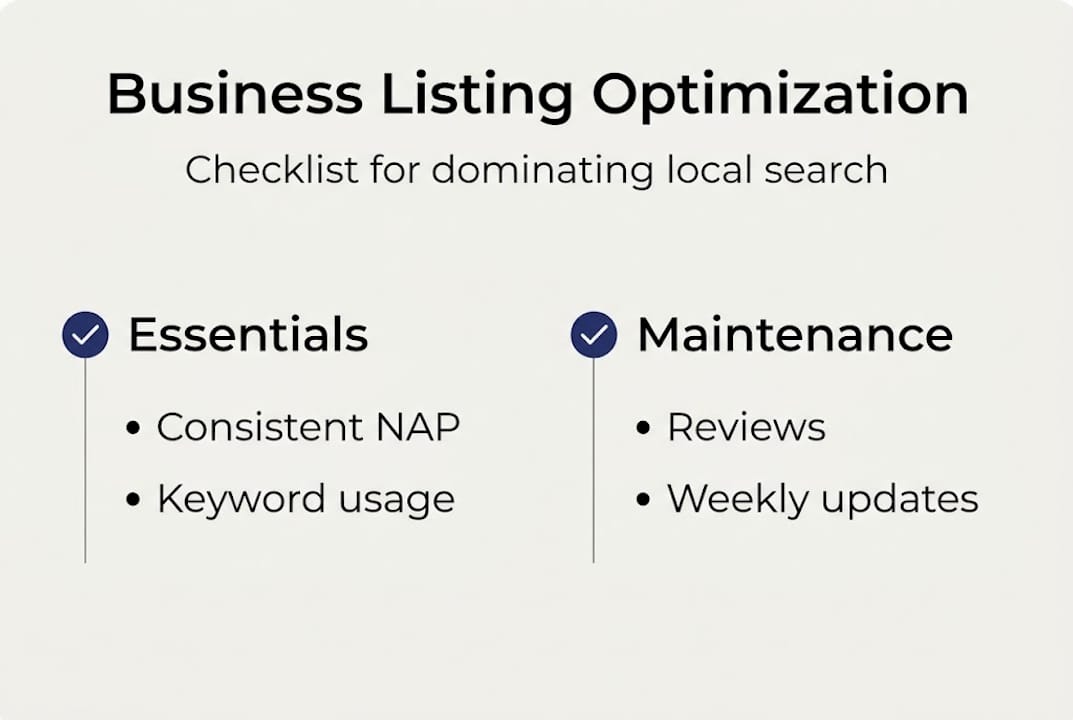
We’ve also seen businesses over-invest in profile completeness while ignoring the signals that actually drive conversions, like photo quality, review response rate, and post frequency. Small, consistent improvements compound over weeks and months in ways that a single optimization sprint never will.
The lesson is simple: build a clean foundation, then stay in the game. Explore local SEO strategies to keep building outward from that base with intention.
Take your local visibility to the next level
If you’re ready to strengthen your online presence after applying these strategies, expert help is available. Business listing optimization is one piece of a larger local search puzzle, and getting every piece working together is where real results happen.
At Battle SEO, our Local SEO services are built specifically for independent business owners who want to become the dominant authority in their local market. We handle everything from Google Business Profile optimization and citation building to content strategy and Digital PR, all under our proprietary Local Command Directive™ framework. For hands-on guidance on keeping your profile active and converting, our best GBP engagement tips guide is a strong next step. We only take on one business per category per market, so if your niche is open, now is the time to move.
Frequently asked questions
How often should I update my business listing?
Update your listing at least once a week for best results, and immediately whenever key information changes like hours, phone numbers, or services. Weekly updates are among the most impactful ongoing actions for engagement and visibility.
Does listing optimization matter if I already have customers?
Yes. Optimized profiles drive new searches and customer actions well beyond what word-of-mouth alone can generate. Optimized profiles can deliver 50% or more additional views compared to unoptimized ones, meaning there is always untapped reach available.
What is the downside of hiding my address for privacy?
Hiding your address as a service-area business may prevent your listing from appearing in top-three local pack results. A hidden address limits proximity signals that Google uses to rank businesses for nearby searches.
Is it okay to offer incentives for reviews?
No. Offering discounts, gifts, or any reward in exchange for reviews is a direct violation of Google’s policies. Incentivized reviews risk penalties, profile suspension, or removal of legitimate reviews from your listing.
What are the top mistakes to avoid when optimizing?
Avoid inconsistent business information across directories, too few photos, and skipping weekly updates. Fixing inconsistencies first, uploading at least 10 to 25 photos, and posting regularly are the three actions with the highest return on effort.