

TL;DR:
- Effective SEO content begins with thorough research, understanding search intent, and strategic planning before writing. Incorporating natural keywords, logical heading structures, and valuable internal and external links enhances rankings and readability. Regular review, metadata optimization, and content updates are crucial for maintaining and improving search performance over time.
Most content creators write solid articles that nobody reads. You spend hours researching, drafting, and editing, then publish to silence. The problem usually isn’t your writing. It’s that you skipped the strategic groundwork that search engines require before a single word is typed. Knowing how to write SEO content means understanding search intent, preparing properly, executing with precision, and measuring what matters. This guide covers all four stages with specific, practical techniques so your next piece has a real shot at ranking.
Table of Contents
- Key Takeaways
- How to write SEO content that search engines trust
- Preparing before you write
- Writing content that works for readers and rankings
- Reviewing, optimizing metadata, and measuring performance
- Common mistakes that kill SEO content performance
- My honest take after years in search
- Ready to put your SEO content strategy to work?
- FAQ
Key Takeaways
| Point | Details |
|---|---|
| Search intent comes first | Study the SERP before writing to understand what format and angle Google is already rewarding. |
| Keyword research drives structure | Select primary and secondary keywords by volume, difficulty, and relevance before building your outline. |
| On-page elements compound results | Meta titles, headings, and internal links work together to signal relevance and improve click-through rates. |
| Human editing is non-negotiable | AI-generated drafts must be rewritten with personal voice and verified facts to avoid ranking penalties. |
| Content needs consistent updates | Refreshing older content with new data and better structure maintains rankings over time. |
How to write SEO content that search engines trust
SEO content writing is the practice of producing articles, pages, and posts that satisfy both what a human reader needs and what a search engine requires to confidently rank your page. In 2026, those two goals are closer aligned than ever. Google’s systems have become sophisticated enough that writing genuinely helpful content for real people is the most reliable path to ranking well.
The foundational shift worth understanding is this: keyword density is no longer the focus. What matters now is whether your content precisely matches the intent behind a search query. That means reading the SERP before you write, not after.
What on-page SEO actually involves:
- Your primary keyword placed naturally in the title, introduction, at least one H2, and throughout the body
- Heading structure (H2, H3) that organizes content logically and uses semantic variations of your keyword
- Internal links that connect related content on your site and distribute authority
- External links to credible sources that build trust with both readers and search engines
- Multimedia elements like images, tables, and lists that improve time-on-page and readability
- Meta title and meta description written to earn clicks, not just rank
Understanding your audience is just as critical as understanding Google’s algorithm. Before you open a doc, ask yourself: what does this person actually want to know? What problem brought them to search? What would make them stay on your page instead of hitting the back button? The answers shape everything from your headline to your final paragraph.
Pro Tip: Before writing anything, search your target keyword and read the top three results. Note the format (list, guide, comparison), the approximate length, and the questions they answer. That SERP is Google telling you what it thinks users want. Write to match and exceed that standard.
Preparing before you write
Good SEO content starts before the first sentence. Rushing to write without solid keyword research and SERP analysis is one of the most common reasons content fails to rank. Effective planning and outlining aligned with search intent consistently produce better content and better rankings than winging it.
Here is a repeatable preparation process you can use for every piece you publish:
-
Identify your primary keyword. Use a keyword research tool to find a term with enough monthly search volume to matter and a difficulty score you can realistically compete for. New sites should target lower-competition long-tail keywords first, then build outward from that base.
-
Choose three to five secondary keywords. These are related terms, questions, and synonyms your audience uses. They fill out your content naturally and signal topical authority to search engines without forcing your primary keyword into every paragraph.
-
Analyze the SERP thoroughly. Look at the top five results. What content type is Google favoring: articles, listicles, or videos? How long are the top-ranking pieces? What questions do they answer in their headings? This analysis tells you the format and depth you need to match.
-
Note the content gaps. Find questions the top results do not fully answer. Those gaps are your opportunity to add something more useful than what already exists.
-
Build a structured outline. Map your H2s and H3s based on what the SERP shows users want, layered with the gaps you identified. Your outline is your content’s blueprint.
The table below shows how to evaluate keyword candidates before committing to one as your primary target:
| Keyword | Monthly volume | Difficulty | Search intent | Worth targeting? |
|---|---|---|---|---|
| how to write seo content | High | Medium | Informational | Yes |
| seo content writing tips | Medium | Low | Informational | Yes (secondary) |
| seo copywriting agency | Low | High | Commercial | No (for content) |
| best practices for seo writing | Medium | Low | Informational | Yes (secondary) |
| how to optimize content | Medium | Medium | Informational | Yes (secondary) |
Choosing the right keyword before you write saves you from publishing a well-crafted article that never gets seen because it targets a term nobody searches or one you cannot compete for yet.
Writing content that works for readers and rankings
Execution is where most writers either win or lose the ranking battle. The structure and craft decisions you make during writing determine whether Google sees your content as authoritative and whether readers stay long enough to act.
Start with an introduction that hooks quickly. Place your primary keyword naturally within the first 100 words, not because Google counts words mechanically, but because early placement signals clear relevance. Avoid stating the obvious. Get to the value fast.

Heading structure matters more than most writers realize. Semantic keyword usage in H2 and H3 headings signals topical relevance to search engines and makes your content far easier to scan. Instead of repeating your exact primary keyword in every subheading, use question-based and long-tail variations. For example, if your primary keyword is “how to write SEO content,” a strong H3 might read “what makes a compelling SEO introduction” or “how headings affect your search rankings.”
Here are the key execution principles that separate ranking content from content that disappears:
- Write for humans first. Use conversational language, tell short stories where relevant, and give concrete examples over abstract advice.
- Keep paragraphs to three or four sentences maximum. White space improves readability, and readability improves time-on-page.
- Use first-person narratives and dated examples to demonstrate E-E-A-T. Google rewards content that shows genuine experience and expertise.
- Use clear, descriptive titles over clever or jargon-heavy ones. Readers click what they understand immediately.
- Place internal links where they add context, not just to distribute link equity. A link to a related piece should feel like a natural next step for the reader, like this guide on writing content for SEO.
- Include at least one external link to a credible, authoritative source per major section.
- Use tables and lists strategically. They improve scannability and often get pulled into featured snippets.
Sentence length variation matters too. Short sentences punch. Longer sentences give you room to explain nuance and context in a way that feels thorough without becoming academic. Alternating between the two keeps readers engaged without fatigue.
Pro Tip: After writing your first draft, read it out loud. Any sentence that makes you stumble or catch your breath is a sentence that needs restructuring. Your reader’s brain works the same way your voice does.
Reviewing, optimizing metadata, and measuring performance
Writing the article is only two-thirds of the job. The final third is where many creators leave ranking potential on the table.
Meta titles and descriptions are your billboard on the SERP. Get them right and your click-through rate improves even if your ranking stays the same. Optimal meta title length is 50 to 60 characters, with your primary keyword placed near the front. Meta descriptions should run 105 to 160 characters and give readers a clear reason to click. Think of the description as a one-sentence argument for why your page answers their question better than the others.
Page speed is a ranking factor you cannot ignore. A site that loads in one second achieves a 40% conversion rate, while the same site at three seconds drops to 29%. Speed optimization is a technical task, but content creators should at least compress images and avoid embedding bloated third-party scripts unnecessarily.
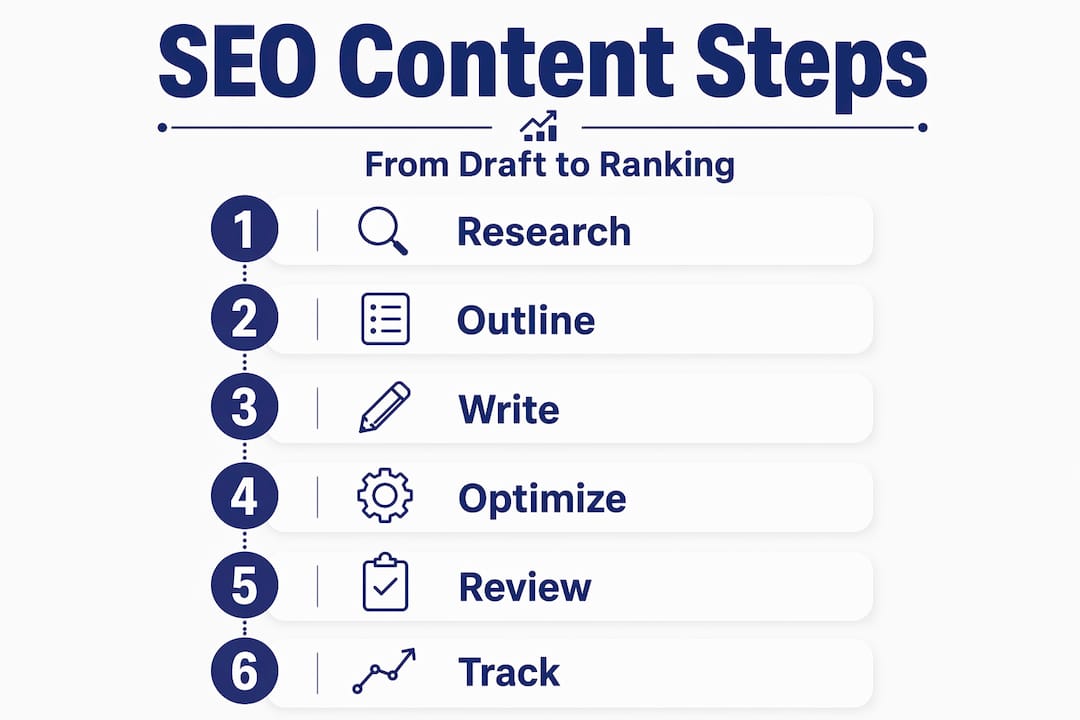
Use these steps to review every piece before publishing:
- Read for flow and grammar, then check keyword placement for naturalness
- Confirm your meta title and description are within character limits and include the primary keyword
- Test your page load speed using Google’s PageSpeed Insights
- Verify all internal and external links resolve correctly
- Check heading hierarchy: one H1, logical H2s, H3s nested beneath them
After publishing, tracking performance is what turns a one-time success into a repeatable system. Monitor organic impressions, click-through rates, and average ranking position in Google Search Console. Look for pages that rank in positions four through fifteen. Those are your best candidates for a content refresh because they are close to high visibility with a targeted update.
Refreshing content means adding new data, improving the introduction, expanding thin sections, and updating any outdated examples. Search engines reward pages that stay current and consistently improve.
Common mistakes that kill SEO content performance
Even experienced writers make errors that quietly tank their content’s performance. Knowing what to avoid is as useful as knowing what to do.
- Keyword stuffing. Forcing your primary keyword into every paragraph reads unnaturally and triggers algorithmic penalties. Write the keyword where it fits, then let semantic variations carry the rest.
- Publishing raw AI drafts. AI-generated content requires heavy human editing for voice, accuracy, and authenticity to avoid penalties. Use AI to generate outlines or first drafts, then rewrite with your own perspective and verified facts.
- Skipping the SERP. Writing without studying what already ranks means you might produce the wrong content type entirely. A listicle when Google wants a guide, or 800 words when the SERP is dominated by 2,000-word pieces.
- Neglecting internal links. Internal linking builds topical authority and keeps readers engaged longer. Each piece you publish should link to at least two or three related pages on your site.
- Forgetting the meta description. Leaving the meta description blank means Google writes it for you, and Google rarely picks the most compelling angle.
Pro Tip: Set a quarterly content audit calendar. Pull your top 20 pages from Google Search Console sorted by impressions, then review those ranking between positions 5 and 20. A few structural and content improvements often move those pages into the top three without starting from scratch.
My honest take after years in search
I have reviewed hundreds of content strategies across industries, and the single biggest mistake I see is writers treating SEO as a layer you add after writing instead of a process you build from before you write. The planning phase is where rankings are won or lost. By the time you are drafting, most of the critical decisions should already be made.
What also changed my results significantly was combining AI tools with disciplined human editing. I use AI to speed up outlining and spot structural gaps, but I never publish a draft I have not fully rewritten in a human voice with real examples and verified data. The AI-generated content that fails is almost always the stuff someone published without reading it carefully first.
The other lesson I would share is patience with the verification phase. Most people check analytics once, see modest numbers, and give up. The pages I have seen perform best over time are the ones that got updated four or six months after publication based on actual search data. You are not writing a finished product. You are writing the first version of something you will improve.
If you are just getting started, the local SEO content ideas guide on the Battleseo blog is worth reading. It shows how the same principles apply when you are writing for a specific geographic audience, which is often the fastest path to visible rankings for businesses.
— Mike
Ready to put your SEO content strategy to work?
Understanding the principles behind great SEO content is a strong start. Executing consistently across every piece you publish is a different challenge entirely, especially when you are managing campaigns, clients, or a full content calendar on top of the writing itself.

Battleseo helps independent business owners and marketing teams build SEO content that actually drives traffic and leads. From local SEO services designed to put your business at the top of regional searches, to AI-powered strategies that get you found on platforms like ChatGPT and Perplexity, the Battleseo team handles the complexity so you can focus on running your business. If you want to see what a fully managed content marketing approach looks like in practice, start there. Or explore the AI search visibility guide to understand how search is evolving and where your next opportunity is.
FAQ
What is SEO content writing?
SEO content writing is the process of creating articles, pages, or posts that satisfy user search intent while including strategic keyword placement and on-page signals that help search engines rank the content. The goal is to serve the reader first while giving search engines the context they need to surface your page.
How do I find the right keywords for my content?
Use a keyword research tool to identify terms with relevant search volume, manageable competition, and alignment with your business goals. Select one primary keyword and three to five secondary keywords before building your content outline.
How long should an SEO article be?
Length should match what the top-ranking content for your keyword already shows. Study the SERP and match the depth of the best-performing results. There is no universal word count. Some queries reward 800 words, others require 2,500 or more.
Does AI-generated content hurt SEO rankings?
Publishing unedited AI-generated drafts can lead to ranking penalties because the content lacks personal voice, accuracy, and authentic expertise. Use AI as a drafting assistant, then rewrite thoroughly before publishing.
How often should I update existing SEO content?
Review your content every three to six months using Google Search Console data. Pages ranking between positions 5 and 20 are strong candidates for updates that can push them into higher visibility without rebuilding from scratch.