

TL;DR:
- Multi-location SEO involves optimizing each business location separately to enhance local visibility and attract nearby customers. Implementing unique, locally relevant content and verified profiles prevents duplicate content penalties and strengthens each site’s authority. Ongoing management, proper website structure, and strategic internal linking are essential for scalable growth and sustained local dominance.
If you own two or more business locations and you’re copying your SEO approach from one to the next, you’re likely losing customers you never knew you had. Multi-location SEO is the practice of optimizing each business location separately so that people in each area can find the right branch at the right time. It sounds straightforward, but most independent business owners treat it like a copy-paste job, and that’s exactly where visibility breaks down. This guide walks you through what multi-location SEO actually involves, why a tailored approach matters, and how to build a system that scales.
Table of Contents
- Why multi-location SEO matters for your business
- Core components of an effective multi-location SEO strategy
- Avoiding pitfalls: how to prevent duplicate content and ranking suppression
- Designing scalable website architecture and internal linking for multiple locations
- Ongoing management: monitoring, reputation, and scaling multi-location SEO
- Our take: the real reason multi-location SEO fails most businesses
- Ready to build local authority across every location?
- Frequently asked questions
Why multi-location SEO matters for your business
Understanding multi-location SEO starts with understanding how local search actually works. Google does not show the same results to someone in Austin that it shows to someone in Chicago, even if they type the same search query. Local results are filtered by proximity, relevance, and the strength of each location’s individual signals. That means your Dallas branch and your Memphis branch are competing in entirely different arenas, against different businesses, for different customers.
As Search Engine Land explains, multi-location SEO ensures that each business branch can be discovered by its local community, growing visibility and revenue. That’s not just a technical observation. It has real dollars attached to it.
Here’s what a well-executed multi-location strategy accomplishes:
- Each location builds its own local authority and relevance signals
- Customers find the branch closest to them, not just your homepage
- Your brand stays consistent while still speaking to each local market
- Foot traffic and calls increase at the location level, not just site-wide
“The businesses that win in local search aren’t the ones with the best overall website. They’re the ones that show up as the most relevant answer for each specific community they serve.”
That last point matters more than most owners realize. A unified brand with locally tuned presence is not a contradiction. It’s actually the goal. You can keep your brand voice and visual identity consistent while making each location page feel genuinely connected to its neighborhood. Our multi-location SEO playbook breaks down how that balance works in practice.
Core components of an effective multi-location SEO strategy
After understanding why multi-location SEO matters, we now examine the essential building blocks of a strong strategy. Think of it as building outward from a solid base. If the foundation is weak, every location you add amplifies the problem.
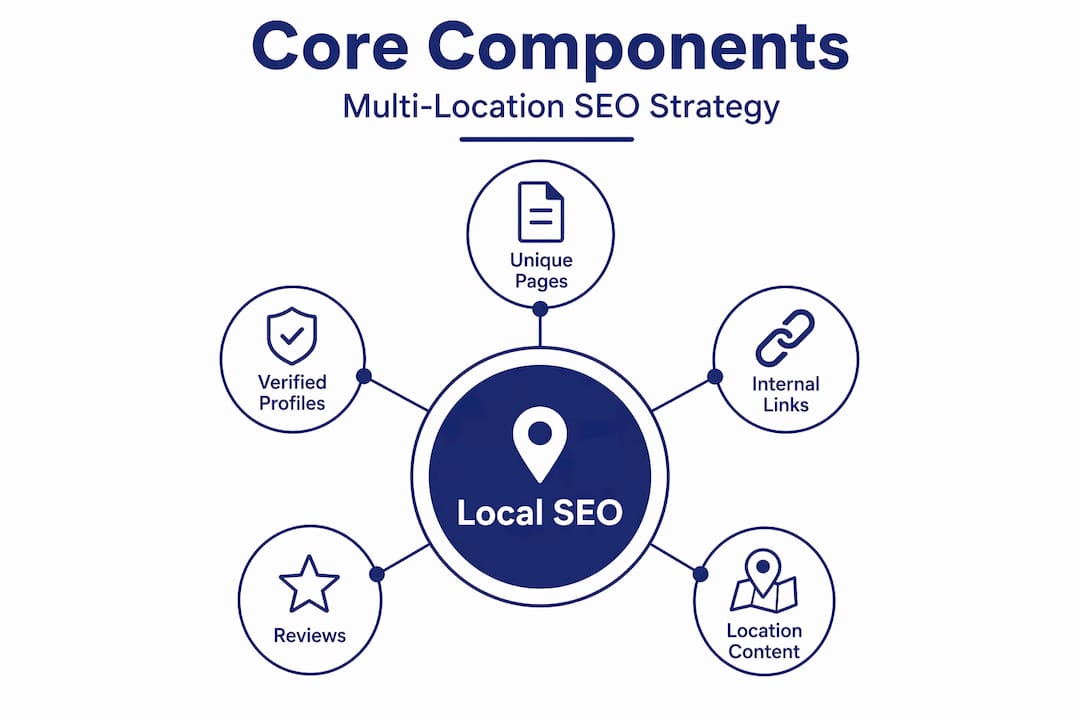

Unique location-specific landing pages and correctly linked Google Business Profiles are the foundation of any working multi-location setup. Both elements are non-negotiable.
Here’s what each location needs to function independently in local search:
- A dedicated landing page with content written specifically for that market
- A verified Google Business Profile with accurate Name, Address, and Phone (NAP) information
- Location-specific keywords woven naturally into page titles, headers, and body content
- Schema markup (structured data) that identifies the location clearly to search engines
- Self-referencing canonical tags so search engines understand which page is authoritative
Google’s guidelines are clear: each physical location should have its own verified profile, and that profile must reflect real-world details accurately. A mismatch between your website address and your Google Business Profile address is enough to suppress your visibility in local map results.
Setting up these profiles correctly is one of the highest-return tasks in local SEO. Our breakdown of Google Business Profile tips walks through verification, category selection, and profile completeness in detail.
For the technical structure, here’s how to approach it step by step:
- Choose your URL structure before building any location pages (subdirectories are usually best)
- Create a unique landing page for each location using locally relevant content
- Verify each Google Business Profile and link it to the correct location page
- Add LocalBusiness schema markup to each page with accurate address and contact data
- Set self-referencing canonical tags so each page claims its own authority
Pro Tip: Do not add a location page until you have enough unique content to fill it honestly. A page with 200 words of generic text and a swapped city name will hurt you more than having no page at all.
For a complete look at how these components fit together, the multi-location SEO playbook is a good next read.
Avoiding pitfalls: how to prevent duplicate content and ranking suppression
With the core elements outlined, it’s crucial to understand the mistakes that undermine multi-location SEO before they cost you rankings you’ve already earned.
The most common mistake is template pages. You build a great location page for your first branch, then copy it fifteen times, swapping only the city name. It feels efficient. Google sees it differently.
Simply swapping the city name on template pages triggers Google’s filters and suppresses visibility. Your pages end up competing with each other, and in many cases, none of them rank well because none of them stand out.
Here’s how to make each location page genuinely distinct:
- Feature the local team by name with real photos and brief bios
- Include customer testimonials sourced from that specific location
- Mention community involvement, local events, or partnerships near that branch
- List services that are unique to or most popular at that location
- Reference nearby landmarks or neighborhoods to add geographic context
“Thin content isn’t just a technical penalty risk. It’s a trust signal to your customer. If your Raleigh page feels like your Phoenix page with different text, visitors notice, and they leave.”
Beyond content, the technical side also needs attention. Canonical tags should point to the page itself, not to a parent page or homepage. Internal links should connect each location page to related service pages and nearby location pages, reinforcing geographic relevance throughout the site.
Pro Tip: Run a content audit across all your location pages once per quarter. Flag any two pages that share more than 40 percent of the same body text, then rewrite the weaker one with locally sourced details.
Differentiation also builds user trust well beyond search rankings. When a customer in Tucson lands on your Tucson page and sees a team photo, a local review, and a reference to a neighborhood they recognize, conversion rates go up. The work pays off twice.
Our multi-location SEO playbook includes content frameworks for building out location pages that pass both the Google test and the human test.
Designing scalable website architecture and internal linking for multiple locations
Having covered how to avoid duplicate content, let’s explore the best technical frameworks for scalability and SEO clarity. The architecture you choose now determines how easily you can add a tenth or twentieth location later without rebuilding from scratch.
Scaling multi-location SEO requires smart technical architecture like subdirectories and hub-and-spoke internal linking patterns. Here’s how the main options compare:
| Structure | Example | Best for | Trade-offs |
|---|---|---|---|
| Subdirectory | example.com/locations/austin | 2-50 locations | Best for consolidating domain authority |
| Subdomain | austin.example.com | Large franchise networks | Splits authority; harder to manage |
| Separate site | austinplumbing.com | Distinct brands per market | Expensive; duplicate effort multiplied |
For most independent business owners, subdirectories win. Every backlink your site earns benefits all location pages at once, because they all share the same root domain.
Internal linking structure matters just as much as URL format. A hub-and-spoke model works well here. Your main locations overview page (the hub) links to every individual location page (the spokes). Each location page then links back to the hub and to nearby locations where relevant. This creates clear crawl paths for search engines and gives users an intuitive way to explore.
Key internal linking practices for multi-location sites:
- Link each location page from the main navigation or a locations hub page
- Add links to neighboring location pages where geography makes them relevant
- Link from location pages to relevant service pages on your site
- Use descriptive anchor text like “our Memphis office” rather than generic phrases
Pro Tip: Add an internal link from each service page back to the location pages that offer that service. This two-way linking reinforces both geographic and topical relevance.
Before committing to any structure, map out your expected location count for the next two years. If you’re planning to grow past 20 locations, make decisions now that will still work at 40. For a ready-to-use framework, our multi-location SEO plan outlines exactly how to structure and scale.
Ongoing management: monitoring, reputation, and scaling multi-location SEO
After establishing architecture, ongoing operational excellence is what keeps multi-location SEO effective over time. Setup is just the start. What separates businesses that maintain strong local rankings from those that slide back is consistency at the location level, every month.
Multi-location SEO is ongoing; brands must monitor each branch’s performance, manage reviews, update Google Business Profiles, and maintain clear access permissions. There is no “set it and forget it” version of this.
Here’s a practical monthly management routine:
- Pull ranking and traffic data for each location individually, not just site-wide
- Check Google Business Profile completeness and update any outdated information
- Respond to new reviews at every location within 48 hours
- Audit competitor rankings for your top two or three keywords per location
- Flag any locations where traffic or rankings dropped and investigate the cause
Poor access controls between corporate managers and local staff create SEO inconsistency that compounds over time. A local manager who updates a Google Business Profile address without coordinating with the main team can create a NAP mismatch that takes months to clean up.
To prevent that, maintain a clear governance model:
- Define who can edit each Google Business Profile (usually central control is safer)
- Use a shared access system for tracking reviews across all locations
- Document your brand standards for how each location page should be updated
- Schedule a quarterly content review for every location page to keep them current
Pro Tip: Use your GBP engagement tips checklist monthly. Consistent photo uploads, post activity, and Q&A management signal active, trusted businesses to both Google and potential customers.
Reputation management is also location-specific. A negative review pattern at your Cincinnati branch doesn’t just affect Cincinnati. If your brand reputation at that location dips, it can influence how Google treats your overall brand authority. Address problems at the source before they spread. Our guide on how to optimize your Google Business Profile covers reputation signals in detail.
Our take: the real reason multi-location SEO fails most businesses
Most businesses do not fail at multi-location SEO because of bad strategy. They fail because of underestimated effort. The assumption is that if one location is ranking well, the system is working. But local SEO at the location level is not a byproduct of a good overall site. It requires dedicated attention to each market.
Here’s the uncomfortable truth: a single well-optimized, actively managed location will outrank a chain of twenty poorly maintained locations every time. Google rewards relevance and recency. An independent shop in Denver that responds to every review, posts weekly on their Google Business Profile, and has a detailed location page with local team photos will beat a national brand whose Denver branch is on autopilot.
We’ve also seen independent business owners skip multi-location SEO entirely because it feels overwhelming to manage. That instinct is understandable, but the cost is real. Every month without proper optimization is a month your competitors are collecting customers who should have found you first.
The fix is not to do everything at once. Start with your highest-revenue location. Get that page right, verify and fully complete the Google Business Profile, build local citations, and earn a few reviews. Then replicate that process outward. Building location by location with real care produces better results than launching twenty thin pages simultaneously.
Ready to build local authority across every location?
If you’re managing multiple locations and want each one to rank and convert in its local market, the work ahead is real but very achievable. At Battle SEO, we work exclusively with independent business owners to build dominant local presence through our Local Command Directive™ framework, covering everything from Google Business Profile optimization to authority backlinks and AI search visibility.

We take on only one business per service category per market, which means if you work with us, we’re focused entirely on making you the most visible business in your niche locally. We also cap new client onboarding at 12 per month to protect the quality of every engagement. If you want a clear, location-by-location plan built around your specific markets, explore our multi-location SEO playbook or reach out directly to start a conversation.
Frequently asked questions
What is multi-location SEO and why is it important?
Multi-location SEO is the practice of optimizing your online presence so each business location ranks well in local search, helping nearby customers find the right branch at the right time rather than a competitor nearby.
How do I avoid duplicate content penalties in multi-location SEO?
Swapping the city name on template pages triggers Google’s filters and causes ranking suppression, so each location page needs genuinely unique content including local team details, testimonials, and specific services.
What is the best website structure for multi-location SEO?
For most businesses managing 2-50 locations, subdirectories are the best choice because backlinks benefit the entire domain and the structure is far easier to manage than subdomains or separate sites.
How do I manage Google Business Profiles effectively for multiple locations?
Google’s guidelines state that you should not create more than one profile per physical location and that all information must stay consistent and accurate across every profile you manage.
Is multi-location SEO a one-time setup or ongoing process?
It’s an ongoing process. Brands must monitor each location’s rankings, respond to reviews, maintain updated Google Business Profiles, and enforce consistent governance to sustain and grow search visibility as locations expand.