
TL;DR:
- Organic ranking is the unpaid position a web page earns on search engine results pages based on relevance, quality, and authority signals. It is an ongoing process influenced by content quality, backlinks, technical SEO, and user experience, not keyword stuffing or budget alone. Tracking overall visibility and click-through rates provides a more accurate measure of success than focusing on a single keyword position.
Organic ranking is defined as the unpaid position a web page earns on a search engine results page (SERP) based on relevance, quality, and authority rather than advertising spend. Search engines like Google evaluate hundreds of signals algorithmically to determine which pages best satisfy a user’s query. Understanding organic ranking is the foundation of any serious SEO strategy. Tools like Google Search Console, HubSpot’s SEO Software, and Shopify’s built-in SEO features all exist because organic search positions directly drive traffic, leads, and revenue without ongoing ad costs.
What is organic ranking and how does it work?
Organic ranking is the industry term for what many marketers also call “natural” or “earned” search placement. Google’s philosophy is clear: rankings are earned, not assigned, with every page evaluated on whether it best satisfies user needs. This means no amount of budget can buy your way into organic results. You have to earn them.
The process works like this. A user types a query into Google. Google’s algorithm scans its index and scores billions of pages against that query using signals covering content quality, authority, technical performance, and user experience. The pages that score highest appear first. Rankings fluctuate constantly because competitors publish new content, Google refines its algorithm, and user behavior shifts. What earned you position three last month may not hold that spot next month.

This dynamic nature is what separates organic ranking from a one-time task. It is an ongoing process of earning and defending your position by consistently delivering the most relevant, trustworthy answer to a given search query.
What factors affect organic ranking on search engines?
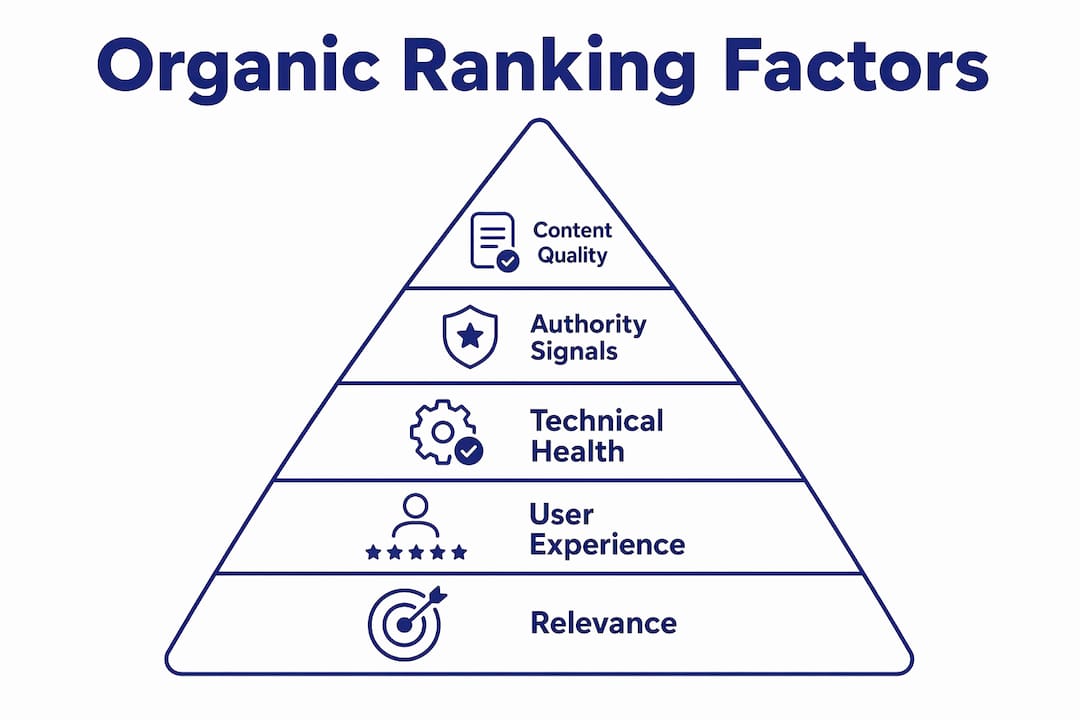
Google’s algorithm evaluates relevance, trustworthiness, and user satisfaction through multiple integrated signals, not just keyword matching or domain age. Business owners often assume that simply having a website for many years gives them an advantage. It does not. Here are the primary organic ranking factors that actually move the needle:
- Content quality and relevance: Your content must directly answer the user’s query with depth, accuracy, and clarity. Thin pages that skim the surface rarely rank well for competitive terms.
- Backlinks and authority signals: Links from reputable, relevant websites signal to Google that your content is trustworthy. A single link from an authoritative industry publication outweighs dozens of low-quality directory links.
- Technical SEO: Site architecture, crawlability, structured data, and clean URL structures all affect how well Google can index and understand your pages.
- Mobile optimization and page speed: User experience factors including mobile responsiveness and page speed are direct ranking factors in Google’s algorithm. A slow, mobile-unfriendly site loses ground regardless of content quality.
- Search intent alignment: Google matches pages to the underlying intent behind a query, whether informational, navigational, commercial, or transactional. A product page will not rank for an informational query no matter how well-written it is.
- User experience signals: Bounce rate, time on page, and click-through rate from the SERP all feed back into how Google perceives your page’s value.
One common misconception worth addressing: keyword density is not a meaningful ranking factor in 2026. Stuffing a target phrase into every paragraph signals low quality, not relevance. Write for the reader first.
Pro Tip: Treat organic ranking as a three-legged stool: content quality, authority signals, and technical health. Neglect any one leg and the whole structure becomes unstable. Audit all three before deciding where to focus your effort.
How does organic ranking differ from paid search results?
Organic results are algorithmically ranked unpaid listings, while paid results are ads selected through Google Ads’ advertising auction and labeled with a “Sponsored” tag. Both appear on the same SERP, but they operate through entirely different systems and serve different strategic purposes.
| Factor | Organic results | Paid results |
|---|---|---|
| Cost per click | No direct cost | Charged per click via Google Ads |
| Placement control | Earned through algorithm | Purchased through bid auction |
| Labeling on SERP | No label | “Sponsored” or “Ad” label |
| Time to appear | Weeks to months | Immediate after campaign launch |
| Sustainability | Long-term if maintained | Stops when budget runs out |
| Trust perception | Higher user trust | Lower trust for some audiences |
Organic traffic tends to be more cost-effective and sustainable, while paid traffic delivers immediate visibility. The practical implication is that paid search is useful for new businesses or time-sensitive promotions, while organic ranking builds compounding value over time. A page that ranks organically for a high-volume keyword generates traffic every day without additional spend.
Organic results also appear in multiple formats beyond standard blue links. Google surfaces video carousels, local map packs, featured snippets, image results, and People Also Ask boxes, all of which are organic placements driven by the same algorithmic signals. Understanding this range of organic result formats expands your opportunity set well beyond the traditional ten blue links.
What are the modern metrics to measure organic search success?
Tracking a single keyword’s rank is the most common measurement mistake business owners make. Organic search visibility is a more reliable metric because it reflects how often your website appears in unpaid results across all relevant queries, not just one target phrase. This holistic view gives you a far more accurate picture of your actual search presence.
Google Search Console is the primary free tool for measuring organic performance. Its Performance report surfaces four core metrics for every URL and query combination:
| Metric | What it measures | Why it matters |
|---|---|---|
| Clicks | Actual visits from organic results | Directly tied to traffic and revenue potential |
| Impressions | How often your page appears in results | Signals visibility even without clicks |
| CTR (click-through rate) | Clicks divided by impressions | Reveals title and meta description effectiveness |
| Average position | Weighted average rank across queries | Useful for trend diagnosis, not exact rank |
Average position is a weighted average across impressions and queries, which means a page ranking first for one query and tenth for another will show an average position near 5.5. That number alone tells you very little. Combine it with impressions and CTR to get useful insight.
SERP features like AI Overviews, featured snippets, and local packs also affect visibility. A page sitting at position four may receive fewer clicks than expected if an AI Overview or featured snippet occupies the top of the page. Positions 1 through 3 receive 60% of clicks, which means moving from position eight to position four can substantially increase your traffic even without reaching the top spot.
Pro Tip: Filter your Search Console Performance report by page, then sort by impressions. Pages with high impressions but low CTR are your fastest wins. Rewriting the title tag and meta description for those pages often produces measurable traffic gains within weeks.
How can businesses and marketers improve their organic ranking?
Improving organic ranking requires a structured approach that addresses content, authority, and technical performance simultaneously. Here is a practical sequence that works for most business websites:
-
Audit your existing content. Use Google Search Console to identify pages with strong impressions but weak CTR. These pages already have Google’s attention. Improving their titles, meta descriptions, and on-page content is faster than building new pages from scratch.
-
Create content aligned with search intent. Every page should target a specific query type. Informational queries need educational content. Transactional queries need product or service pages with clear calls to action. Mismatching content type to intent is one of the most common reasons pages fail to rank. Battleseo’s guide on writing content for SEO covers this in depth.
-
Build authoritative backlinks. Reach out to industry publications, local news outlets, and relevant directories. Digital PR, guest posts, and original research are the most reliable link-building methods in 2026. One link from a trusted domain carries more weight than fifty low-quality links.
-
Fix technical SEO issues. Run a crawl using tools like Screaming Frog or Ahrefs to identify broken links, duplicate content, missing meta tags, and slow-loading pages. Technical problems act as a ceiling on your rankings regardless of content quality.
-
Optimize for mobile and page speed. Google uses mobile-first indexing, meaning it evaluates the mobile version of your site for ranking purposes. A page that loads in under two seconds on mobile performs significantly better than one that takes five seconds.
-
Track visibility, not just rank. Monitoring visibility and CTR trends is more actionable than watching a single keyword position. Use Search Console alongside an SEO analytics framework to track progress across your full keyword footprint.
-
Stay current with algorithm changes. Google updates its algorithm thousands of times per year. Major updates like core updates and spam updates can shift rankings significantly. Keeping pace with algorithm update strategy is not optional for businesses that depend on organic traffic.
Key takeaways
Organic ranking is earned through content quality, authority signals, and technical health working together, and measured most accurately through visibility and CTR rather than single keyword position.
| Point | Details |
|---|---|
| Organic ranking defined | Unpaid SERP placement earned through relevance, quality, and authority signals. |
| Top ranking factors | Content quality, backlinks, technical SEO, mobile performance, and search intent alignment all matter. |
| Organic vs. paid | Organic builds sustainable traffic over time; paid delivers immediate but temporary visibility. |
| Best measurement approach | Track clicks, impressions, CTR, and visibility in Search Console rather than chasing a single rank. |
| Fastest improvement tactic | Rewrite title tags and meta descriptions for high-impression, low-CTR pages first. |
What I’ve learned from watching rankings obsess the wrong people
Most business owners I work with come to Battleseo fixated on one number: their rank for one keyword. I understand the instinct. It feels concrete. But in practice, I’ve watched companies celebrate a jump from position six to position three on a keyword that generated zero additional revenue because the SERP was dominated by an AI Overview that absorbed all the clicks.
The shift I push every client to make is from rank to visibility. Your organic footprint, meaning how many queries you appear for and how often users actually click, tells a far more honest story than any single position. A business ranking on page two for fifty relevant queries is often in better shape than one ranking first for a single vanity keyword with low commercial intent.
The other lesson I keep coming back to is patience combined with precision. Organic ranking is not a sprint. It builds outward from a base of solid content and trusted authority. The businesses that win long-term are the ones that treat SEO as an ongoing investment rather than a project with a finish line. They audit regularly, update content that has slipped, and build links consistently rather than in bursts. That steady, deliberate approach is what separates durable organic visibility from short-lived ranking spikes.
— Mike
Ready to build your organic presence with Battleseo?
Understanding organic ranking is the first step. Executing a strategy that actually moves your rankings requires the right framework and consistent effort.
Battleseo works exclusively with independent business owners to build dominant organic search presence through the Local Command Directive™ framework, covering technical SEO, authority backlinks, Google Business Profile optimization, and content strategy. Because Battleseo takes on only one business per category per market, your investment goes toward outranking competitors rather than competing with other clients. If you are ready to turn organic visibility into real business growth, explore Battleseo’s local SEO services or get started with the local SEO visibility guide to see what is possible for your market.
FAQ
What is organic ranking in simple terms?
Organic ranking is the position your web page earns in search engine results without paying for placement. Google determines this position algorithmically based on content quality, authority, and relevance to the user’s query.
How long does it take to improve organic ranking?
Most websites see measurable ranking improvements within three to six months of consistent SEO work, though competitive markets can take longer. Quick wins like optimizing title tags for high-impression pages can produce results in weeks.
What is the difference between organic and paid search results?
Organic results appear without direct payment and are earned through algorithmic evaluation, while paid results are labeled “Sponsored” and purchased through Google Ads. Organic results generally earn higher user trust and deliver more sustainable traffic over time.
Does domain age affect organic ranking?
Domain age is not a meaningful ranking factor. Google evaluates content quality, relevance, and authority signals regardless of how long a domain has existed. A newer site with strong content and quality backlinks will outrank an older site with poor content.
What is the best free tool to track organic ranking?
Google Search Console is the most reliable free tool for tracking organic performance. It provides clicks, impressions, CTR, and average position data at the URL and query level, making it the standard starting point for any organic ranking analysis.