
TL;DR:
- Local SEO optimizes your online presence to appear in nearby customer searches and the local pack.
- Consistent NAP information, active profile management, and quality reviews are vital for local search rankings.
- Ongoing effort and local engagement build long-term visibility, surpassing quick-fix tactics.
Right now, potential customers in your area are searching for exactly what you offer, and many of them are choosing a competitor instead. Not because that competitor is better, but because they show up in local search results and you don’t. Google’s local algorithm ranks businesses based on relevance, distance, and prominence, and if you haven’t optimized for those three factors, you’re essentially invisible to in-market buyers who are ready to spend money today. This guide breaks down what local SEO actually means, what drives results, and how you can start taking back that visibility.
Table of Contents
- What is local SEO and why does it matter?
- The core elements of a winning local SEO strategy
- Common mistakes that kill local search visibility
- How to take action: Building your local SEO game plan
- The hidden reality: What most guides won’t tell you about local SEO
- Partner for local SEO growth: Get expert help
- Frequently asked questions
Key Takeaways
| Point | Details |
|---|---|
| Local SEO boosts visibility | It helps your business appear when customers search locally, putting you ahead of competitors who skip it. |
| Google’s 3 key factors | Relevance, distance, and prominence determine local rankings, so focus on all three for better results. |
| Consistency is essential | Keep your business name, address, and phone number consistent everywhere to build trust with Google and customers. |
| Avoid common pitfalls | Errors like abandoned listings, duplicate pages, or thin content can damage your local presence quickly. |
| Take action with a plan | A clear local SEO strategy turns knowledge into real customer growth for your business. |
What is local SEO and why does it matter?
Local SEO is the practice of optimizing your online presence so your business appears when people search for products or services near them. It’s different from standard organic SEO, which focuses on ranking nationally or globally for broad keywords. Local SEO is specifically about showing up for searches that have geographic intent, whether that intent is stated explicitly or implied by the searcher’s location.
Think about the searches people make every single day:
- “pizza near me”
- “plumber in Springfield”
- “best dentist in Austin”
- “emergency HVAC repair open now”
- “dog groomer near downtown”
Every one of those searches triggers what Google calls the local pack, sometimes referred to as the map pack. This is the block of three business listings that appears at the top of search results, complete with a map, star ratings, phone numbers, and directions. That map pack gets a significant share of clicks before users ever scroll to the organic results below it. If your business isn’t in those three spots, you’re missing a large portion of motivated, nearby customers.
Google’s local algorithm is built around three core ranking factors, and understanding them is the foundation of everything else you’ll do in local SEO:
| Ranking factor | What it means | What influences it |
|---|---|---|
| Relevance | How well your business matches the search query | Categories, keywords, services listed in your profile |
| Distance | How close your business is to the searcher | Physical location, service area settings |
| Prominence | How well-known and trusted your business is online | Reviews, backlinks, citations, engagement |
“How well your local Google Business Profile matches what someone is searching for, how far you are from the search location, and how well-known your business is online all factor into local search ranking.” — Google Business Profile Help
Organic SEO and local SEO share some overlap, particularly around content quality and backlinks, but local SEO has its own distinct signals. A business with a strong local SEO presence can outrank a larger national competitor for searches in its city or neighborhood. That’s a real competitive advantage for independent business owners. Explore GBP engagement tips to see how active profile management directly influences your prominence score.
Now that you understand what local SEO is, let’s explore the core factors that drive local search results for your business.
The core elements of a winning local SEO strategy
With a baseline understanding, the next step is putting the core elements in place for a strong foundation. Local SEO isn’t a single tactic. It’s a system of interconnected signals that work together to tell Google your business is real, relevant, and trusted.
Here’s a step-by-step starting point for any independent business owner:
- Claim and verify your Google Business Profile (GBP). This is non-negotiable. Your GBP is the single most important local SEO asset you have. Claim it, verify it, and fill out every field completely, including business category, hours, services, and photos.
- Optimize your GBP with accurate, keyword-rich descriptions. Write a business description that naturally includes the services you offer and the areas you serve. Don’t stuff keywords, but be specific and clear.
- Ensure NAP consistency everywhere online. NAP stands for Name, Address, and Phone number. These three pieces of information must be identical across your website, GBP, social profiles, and every directory listing. Even minor differences like “St.” versus “Street” can create confusion for Google and erode trust with potential customers.
- Build citations on authoritative directories. Get your business listed on Yelp, Bing Places, Apple Maps, and industry-specific directories. Consistent citations reinforce your legitimacy.
- Add local signals to your website. Include your city and service area in your page titles, headers, and content. Embed a Google Map on your contact page. Create a dedicated contact page with your full NAP.
- Collect and respond to reviews. Reviews are a direct prominence signal. Ask satisfied customers to leave a Google review, and respond to every review, positive or negative. This shows engagement and builds trust.
- Post regularly to your GBP. Google Posts are short updates you can add directly to your profile. They signal activity and give you another opportunity to include relevant keywords.
NAP inconsistencies and abandoned profiles are among the most common reasons businesses lose local rankings. An incomplete or outdated listing doesn’t just fail to help you, it can actively work against you by sending mixed signals to both Google and potential customers.

Pro Tip: Never abandon your GBP, even if you think it’s not working. An outdated listing with wrong hours, old photos, or no responses to reviews signals neglect to both Google and potential customers. A neglected profile is worse than a missing one.
For ideas on what to publish to support your local presence, check out these local SEO content ideas that actually drive real customer inquiries. You can also go deeper with a full local SEO content marketing strategy to build long-term authority.
Common mistakes that kill local search visibility
Understanding best practices is essential, but knowing what NOT to do can save you from costly setbacks. Many business owners put in real effort on local SEO but unknowingly make mistakes that cancel out their progress.
Here are the most frequent errors and how to fix them:
- Inconsistent NAP across directories. Fix it by auditing every listing and standardizing your information.
- Neglected or unclaimed GBP. Claim your profile and commit to keeping it updated.
- Duplicate listings. Multiple GBP entries for the same location confuse Google. Merge or remove duplicates.
- Thin or templated location pages. Pages that swap out only the city name and repeat the same content don’t rank. Each page needs unique, locally relevant content.
- Not hiding your address as a service-area business. If you don’t serve customers at a physical location, you must hide your address in GBP and define your service areas instead.
- Ignoring reviews. Not responding to reviews, especially negative ones, signals low engagement and can deter new customers.
- Keyword stuffing in GBP. Adding irrelevant keywords to your business name in GBP violates Google’s guidelines and can result in suspension.
Here’s a quick comparison of what to avoid versus what actually works:
| Common mistake | Recommended approach |
|---|---|
| Same content on every location page | Unique, locally relevant content per page |
| Address visible for service-area business | Hide address, define service areas in GBP |
| Ignoring or deleting negative reviews | Respond professionally to every review |
| Inconsistent business name across listings | Standardize NAP across all platforms |
| One GBP for multiple locations | Separate GBP per physical location |
| Keyword-stuffed business name in GBP | Use your real, legal business name only |
Multi-location businesses and service-area businesses face unique challenges here. Each physical location needs its own GBP and its own dedicated location page on your website. Without that separation, your locations compete against each other in search results, a problem called keyword cannibalization.
Pro Tip: If you operate in multiple cities but from one office, don’t create fake location pages with no real local content. Instead, create genuine service-area pages that describe your work in those communities, include local references, and link to relevant local resources.
For businesses managing multiple locations, the multi-location SEO playbook covers the full strategy, and this multi-location SEO plan gives you a structured approach to scaling your visibility across markets.
How to take action: Building your local SEO game plan
After learning the pitfalls, it’s time to get proactive with a straightforward action plan. The good news is that local SEO doesn’t require a massive budget or a team of specialists to get started. What it requires is consistency and attention to the right details.
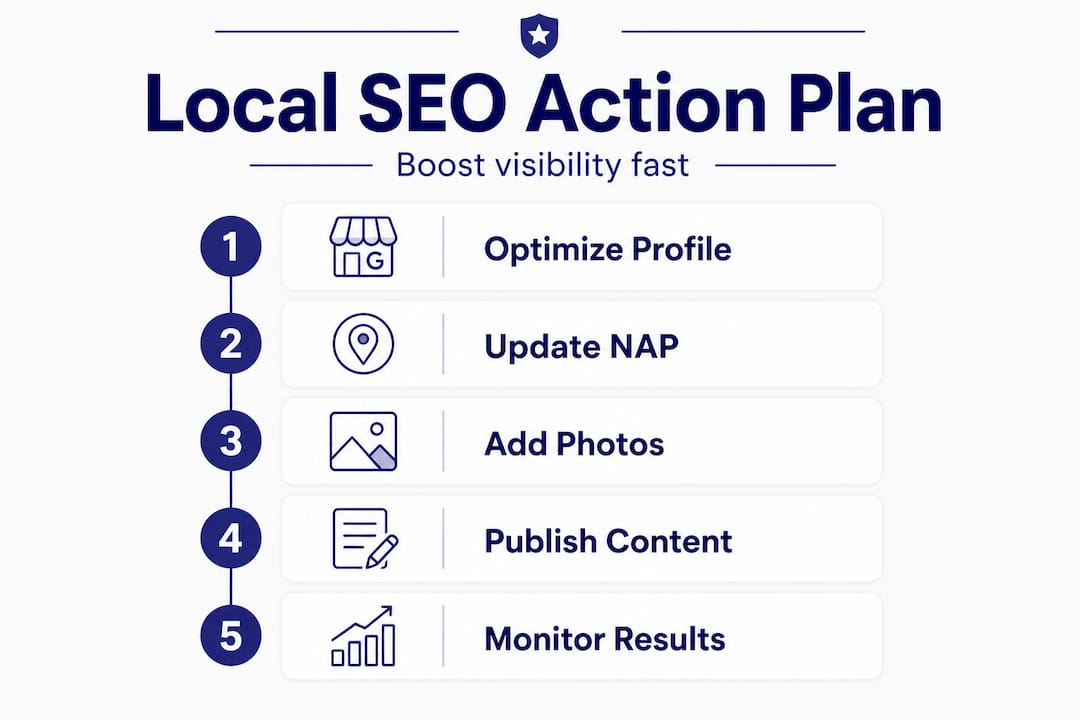
Follow this sequence to build your local SEO foundation:
- Audit your current presence. Search your business name and check every listing that appears. Note any inconsistencies in NAP, outdated information, or duplicate listings.
- Claim and fully complete your GBP. Select the most accurate primary category, add all relevant secondary categories, write a strong description, upload quality photos, and set accurate hours including holiday hours.
- Fix NAP inconsistencies. Update every directory listing to match your GBP exactly. Use a tool like BrightLocal or Moz Local to find all existing citations.
- Build new citations. Submit your business to the top 20 to 30 local directories. Prioritize high-authority platforms like Yelp, Apple Maps, and industry-specific directories.
- Create or improve your location pages. Each page should include unique content about your services in that area, local testimonials or case studies, an embedded Google Map, and your full NAP.
- Launch a review strategy. Ask every satisfied customer for a Google review. Make it easy by sending a direct link to your GBP review page. Respond to all reviews within 48 hours.
- Optimize for AI search platforms. Increasingly, customers are finding local businesses through AI-powered tools like ChatGPT, Perplexity, and Gemini. Structured data, consistent citations, and authoritative content all help your business appear in these results.
Thin, templated location pages are one of the most common reasons businesses fail to rank in multiple service areas. Google can detect when content is nearly identical across pages, and it deprioritizes those pages in favor of pages that offer genuine local value. A well-crafted location page that mentions specific neighborhoods, references local landmarks, or includes a genuine customer story from that area will consistently outperform a generic template.
To go deeper on optimizing your listing for maximum local visibility, read our guide on how to optimize your business listing. And if you want to extend your reach beyond Google into AI search platforms, the AI search optimization guide walks you through exactly what’s needed to stand out in that emerging landscape.
The hidden reality: What most guides won’t tell you about local SEO
Here’s something most checklists leave out: local SEO is not a setup-and-forget system. It’s an ongoing investment in your business’s reputation and relevance. We see business owners complete the initial optimization steps, get a small rankings boost, and then stop. Six months later, they wonder why a competitor overtook them.
The businesses that hold top local rankings over time aren’t just technically optimized. They’re actively present online. They post updates. They respond to every review. They earn new backlinks because they’re doing newsworthy things in their communities. They update their content when services change or new locations open. They treat their GBP like a living storefront, not a set-it-and-done task.
There is no such thing as overnight local SEO success. What looks like a sudden ranking jump is almost always the result of months of consistent signals finally reaching a tipping point.
A lot of business owners get distracted by shiny objects, new tools, AI hacks, or tactics that promise fast results with minimal effort. Some of those tactics can provide a short-term lift. But the businesses that dominate local search for years are the ones that focus on fundamentals: a strong reputation built through genuine customer relationships, unique and helpful content, and a consistent online presence that mirrors real-world credibility.
The uncomfortable truth is that your competitors who outrank you aren’t necessarily smarter or better resourced. They’re just more consistent. That’s actually good news, because consistency is something any business can commit to. Building your local authority through content marketing for local SEO is one of the most sustainable ways to stay ahead without chasing every new trend.
Partner for local SEO growth: Get expert help
Knowing what to do is the first step. Executing it consistently, across every platform, while running your business, is where most owners run into real challenges.
At Battle SEO, we work exclusively with independent business owners who want to become the dominant local authority in their market. Our Local Command Directive™ framework covers everything from Google Business Profile optimization and citation building to Digital PR and AI search visibility. Because we only take on one business per category per market, every client gets our full focus and a strategy built around their specific competitive landscape. If you’re ready to stop losing customers to competitors who simply show up better online, explore our local SEO services or check out our guide on how to stand out locally in both traditional and AI-powered search.
Frequently asked questions
What’s the difference between organic SEO and local SEO?
Organic SEO targets national or global rankings for broad keywords, while local SEO focuses on appearing in search results for queries tied to a specific geographic area, primarily through Google’s local ranking factors of relevance, distance, and prominence.
Why do NAP inconsistencies hurt my local rankings?
When your business name, address, or phone number varies across listings, Google struggles to verify your information as accurate, which reduces trust and can lower your visibility. Even small differences like “St.” versus “Street” are enough to create confusion.
How do I rank in multiple cities or service areas?
Multi-location businesses need a separate Google Business Profile and a unique, content-rich location page for each city or service area to avoid cannibalization and give each location the best chance to rank independently.
Is it better to hide my address if I don’t have a storefront?
Yes. Service-area businesses without a public-facing location should hide their address in Google Business Profile and clearly define the service areas they cover, which aligns with Google’s guidelines and improves how your listing appears in relevant searches.
How often should I update my Google Business Profile?
Update it immediately any time your hours, address, phone number, or services change. Beyond that, add new photos, publish Google Posts, and respond to reviews on a regular basis to signal that your business is active and engaged.