
TL;DR:
- Images are essential ranking factors in Google search, influencing both content relevance and user engagement. Proper optimization, including descriptive alt text, advanced formats, and structured data, enhances visibility in AI-driven search results and image traffic. Continual image audit and integration into overall content strategy are critical for maintaining and improving rankings.
Images are a direct ranking factor in Google search, not a decorative afterthought. The role of images in SEO is to signal content quality, drive organic traffic through Google Images, and improve the user engagement metrics that search algorithms measure. Image search drives approximately 20% of all Google searches, reaching 40% in visual industries like real estate, food, and retail. That is a massive traffic channel most small business owners ignore entirely. Comprehensive image optimization can yield a 10–25% organic traffic gain within 60–90 days. Google Search Central, Core Web Vitals, and modern formats like WebP and AVIF are all part of this picture.
How do images influence search rankings and user behavior?
Google treats images as quality signals that reflect the overall relevance and authority of a page. A well-chosen, properly labeled image tells Google that the surrounding content is carefully crafted and topically focused. High-quality, relevant images signal to Google that content is carefully crafted and increase page topical authority. That matters because Google’s ranking algorithm weighs dozens of on-page signals simultaneously.

The indirect SEO benefits of images are just as significant as the direct ones. Images improve user engagement metrics such as dwell time, scroll depth, and bounce rate. Each of those metrics feeds back into how Google evaluates page quality over time. A page that keeps visitors reading longer is a page Google ranks higher.
Here is what well-optimized images do for your rankings:
- Dwell time: Relevant images give readers a reason to pause and process content, extending time on page.
- Bounce rate: Pages with visual content hold attention better than walls of text, reducing early exits.
- Scroll depth: Images placed throughout an article pull readers further down the page.
- Image search traffic: Properly indexed images appear in Google Images, creating a second traffic channel beyond standard web search.
- AI search inclusion: Multi-modal AI platforms like Google’s AI Overviews and Perplexity increasingly pull image metadata into generated answers.
“User retention and engagement driven by optimized images are as important to SEO as traditional ranking factors.” — getclarityseo.com
The shift toward AI-powered search makes image metadata more valuable than ever. Platforms like ChatGPT, Gemini, and Perplexity parse structured data and alt text to understand visual content. If your images lack proper metadata, they are invisible to these systems. That is a competitive gap you can close faster than most traditional SEO work.
What are the technical best practices for optimizing images?
Technical image SEO is where most of the measurable gains live. The steps below are ordered by impact, not complexity.
-
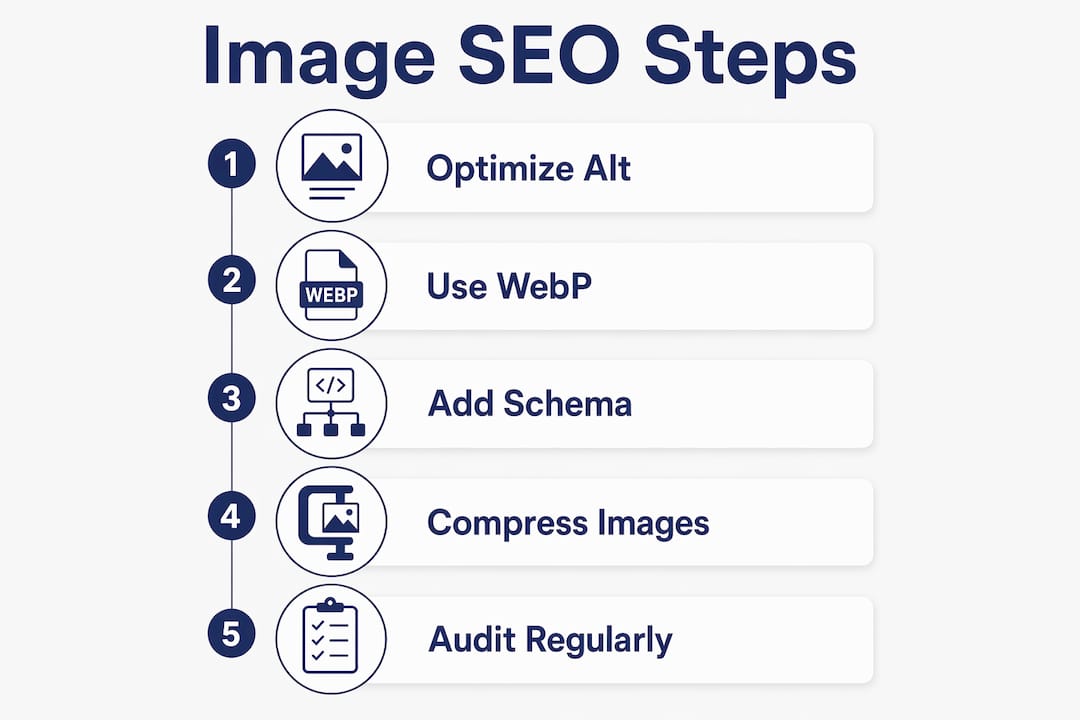
Switch to WebP or AVIF formats. Images account for nearly 50% of the average web page’s total weight. WebP and AVIF cut that weight by 50–80% compared to JPEG or PNG without visible quality loss. Faster pages score better on Core Web Vitals, which directly affects rankings.
-
Compress aggressively before uploading. Tools like Squoosh, ShortPixel, and Imagify compress images without degrading visual quality. Compression should happen before the image hits your CMS, not after.
-
Implement responsive images with
srcset. Serving a 2,000-pixel image to a mobile screen wastes bandwidth and slows load time. Thesrcsetattribute tells browsers to load the right image size for each device. -
Specify image dimensions in your HTML. Declaring width and height attributes prevents layout shifts as the page loads. Layout shifts hurt your Cumulative Layout Shift (CLS) score, one of Google’s Core Web Vitals metrics.
-
Write descriptive, contextual alt text. Google uses alt text to understand images and incorporates them as a proxy for page content quality. Alt text should describe what is in the image and connect naturally to the surrounding topic. “Photo of a woman” is not alt text. “Local bakery owner arranging sourdough loaves in New London, CT” is.
-
Add ImageObject structured data. Using ImageObject structured data markup significantly increases the chances of images being featured in AI-generated answers. Schema.org’s ImageObject type lets you declare the image URL, caption, description, and creator, giving search engines richer context.
-
Apply lazy loading only below the fold. Reserve
loading="lazy"for images that appear after the initial viewport. Never apply it to your hero image or any above-the-fold visual.
Pro Tip: Run your site through Google PageSpeed Insights before and after image optimization. The “Opportunities” section will show exactly how much load time your images are adding, giving you a clear before-and-after benchmark.
The table below summarizes the most impactful image optimization techniques and their primary SEO benefit:
| Technique | Primary SEO Benefit |
|---|---|
| WebP / AVIF format | Reduces page weight, improves load speed |
| Descriptive alt text | Improves indexing and AI search inclusion |
| ImageObject schema | Increases AI answer and rich result eligibility |
Responsive srcset |
Improves mobile performance and Core Web Vitals |
| Lazy loading (below fold only) | Preserves Largest Contentful Paint score |
Which image SEO mistakes hurt your rankings?
Most image SEO problems are not technical failures. They are habits that quietly drain your search performance over time.
- Generic or missing alt text. Leaving alt text blank or writing “image1.jpg” makes your images invisible to Google. Google reads alt text to understand images and uses them as a proxy for page quality. Every missing alt tag is a missed ranking signal.
- Uncompressed, oversized files. Poor image performance negatively affects Core Web Vitals scores, including Largest Contentful Paint and Cumulative Layout Shift, which lower rankings. A single 4MB hero image can tank your LCP score on its own.
- Lazy loading above-the-fold images. Lazy loading above-the-fold images harms Largest Contentful Paint and should be avoided. Google measures LCP as a core ranking signal, so delaying your hero image load is a direct ranking penalty.
- Overusing generic stock photos. Royalty-free stock images from sites like Shutterstock or Getty Images appear on thousands of other pages. Google recognizes duplicate visual content and treats it as a low-quality signal. Original photography or custom graphics perform significantly better.
- Ignoring OCR alignment. Google’s OCR capabilities allow it to read text embedded in images. If your infographic says “Best Coffee in Austin” but your alt text says “coffee shop image,” that mismatch creates a confusing signal. Alt text and surrounding copy must align with any text visible inside the image itself.
Pro Tip: Audit your existing images with a tool like Screaming Frog SEO Spider. Filter by missing alt text and oversized files. Fixing those two issues alone on an established site often produces measurable ranking improvements within weeks.
How do you build image SEO into your broader strategy?
Image SEO produces the best results when it is part of your regular content workflow, not a one-time cleanup project. Image optimization is shifting from a one-time task to a continuous workflow that is now central to AI-powered search visibility. That shift requires a process, not just a checklist.
Here is how to integrate image SEO into your day-to-day marketing work:
- Optimize at the point of creation. When you write a new blog post or update a service page, compress and label every image before publishing. Retrofitting is slower and often incomplete.
- Create and submit an image sitemap. An image sitemap tells Google exactly which images exist on your site and where to find them. Google Search Console accepts image sitemaps directly. This is especially valuable for e-commerce sites and portfolios where images are the primary content.
- Align image topics with your keyword strategy. If a page targets “local plumber in Hartford, CT,” your images should show plumbing work in that context. File names, alt text, and captions should all reinforce the same topical signal.
- Monitor image-driven traffic in Google Search Console. The Search Console “Search type: Image” filter shows which images generate impressions and clicks. Use that data to identify what is working and replicate it.
- Use internal linking to amplify image SEO. Pages with strong internal link equity get crawled more frequently. Linking to image-rich pages from your high-authority pages helps Google discover and index those images faster. Battleseo covers this in depth in its guide on content marketing and SEO.
For small business owners, the most practical starting point is your Google Business Profile. Photos on your GBP listing directly influence local search visibility. Uploading original, geotagged images of your business, team, and products gives Google location context that stock photos cannot provide. Pair that with AI search optimization practices and you build a compounding visibility advantage.
Pages meeting Core Web Vitals thresholds with optimized images experience 24% fewer abandonments. Fewer abandonments mean more conversions and stronger engagement signals for Google. That is the full loop: better images lead to better performance, which leads to better rankings, which leads to more traffic.
Key takeaways
Optimizing images for search requires consistent attention to alt text, file format, structured data, and load performance across every page you publish.
| Point | Details |
|---|---|
| Images drive real traffic | Image search accounts for up to 20% of all Google queries, making it a primary traffic channel. |
| Alt text is non-negotiable | Descriptive, contextual alt text is how Google reads and ranks your images. |
| Format and compression matter | WebP and AVIF reduce page weight by 50–80%, directly improving Core Web Vitals scores. |
| Structured data boosts AI visibility | ImageObject schema increases eligibility for AI-generated answers on platforms like Gemini and Perplexity. |
| Optimization is ongoing | Treat image SEO as a continuous workflow, not a one-time fix, to stay competitive in AI-driven search. |
Why most businesses are still getting image SEO wrong
I have audited hundreds of websites over the years, and the pattern is almost always the same. The business owner spent real money on a professional website, uploaded beautiful photos, and then never touched the images again. No alt text. No compression. No schema. The images look great to human visitors and are essentially invisible to Google.
The uncomfortable truth is that most image SEO advice focuses on the easy stuff: rename your files, add alt text, done. That was sufficient in 2018. In 2026, Google’s multi-modal algorithms and AI search platforms like Gemini and Perplexity are parsing image metadata at a level of sophistication that rewards structured, consistent, and contextually aligned image data.
What I have found actually works is treating every image as a content asset with its own SEO brief. Before I publish an image, I ask: Does the file name match the page topic? Does the alt text describe the image and reinforce the keyword context? Is there an ImageObject schema block? Is the file under 100KB in WebP format? That five-second mental checklist has produced more ranking improvements for clients than most technical audits.
Small business owners have a real advantage here. You can move faster than large organizations. A local restaurant that uploads original, geotagged food photos with proper alt text and schema will outrank a chain that relies on generic stock imagery. The playing field is more level than most people realize, and images are one of the fastest ways to tip it in your favor.
— Mike
Ready to turn your images into a local SEO asset?
Image SEO is one piece of a larger local search strategy. When your images are optimized, your site loads fast, and your content signals authority, Google and AI platforms both take notice.
At Battleseo, we help independent business owners build that kind of visibility from the ground up. Our local SEO services cover everything from on-page optimization and image strategy to Google Business Profile management and AI search visibility. If you want to see how image SEO fits into a complete local search plan, our guide on unlocking local SEO visibility is a strong next step. We work with one business per category per market, so your gains stay yours.
FAQ
What is the role of images in SEO?
Images improve SEO by enhancing content relevance, driving traffic through Google Images, and improving user engagement metrics like dwell time and bounce rate. Properly optimized images with descriptive alt text also help Google understand page content and increase eligibility for AI-generated search answers.
How does alt text affect image SEO?
Alt text is the primary signal Google uses to understand what an image depicts and how it relates to the surrounding content. Missing or generic alt text makes images invisible to search engines and eliminates their ranking contribution entirely.
Do image file formats really impact rankings?
Yes. WebP and AVIF formats reduce file size by 50–80% compared to JPEG or PNG, which directly improves Core Web Vitals scores like Largest Contentful Paint. Pages that meet Core Web Vitals thresholds experience 24% fewer user abandonments, which strengthens ranking signals.
What is ImageObject schema and why does it matter?
ImageObject schema is structured data markup from Schema.org that provides search engines with detailed information about an image, including its URL, caption, and creator. Adding this markup significantly increases the chances of your images appearing in AI-generated answers on platforms like Google, Perplexity, and ChatGPT.
How often should you audit your image SEO?
Image SEO should be reviewed as part of every content update and at least quarterly for existing pages. As AI search algorithms evolve, metadata standards and format recommendations shift, making continuous optimization the most reliable path to sustained visibility.