

TL;DR:
- Search queries are the exact words or spoken requests users input into search engines to find information or complete tasks. They reflect real user language and intent, unlike marketer-chosen keywords, and are essential for creating targeted, effective content strategies. Analyzing query data helps businesses understand customer needs, improve rankings, and drive conversions by aligning content with authentic user questions.
A search query is defined as the exact word, phrase, or spoken request a user inputs into a search engine to find information, complete a task, or reach a specific destination. Unlike keywords, which are marketer-selected targets, search queries are raw user input that is often informal, conversational, and full of misspellings. Google, Bing, and AI-powered platforms like Perplexity and ChatGPT all process these queries to deliver ranked results. Understanding what a search query is, and how to analyze it, is one of the most direct paths to improving your online visibility and content strategy.
What is a search query and why does it matter?
A search query is the precise signal a user sends to a search engine at the moment of need. It captures real intent in real language, which is why it carries more strategic weight than any keyword list a marketer builds in isolation. Queries are user-generated, often messy, and reflect how people actually think and speak rather than how brands want to be found.
The definition of search query differs from the standard SEO term “keyword” in one critical way. Keywords are abstractions. A query is a live data point. When someone types “best emergency plumber near me open now” into Google, that is a search query. The keyword a plumber’s SEO team targets might simply be “emergency plumber.” The gap between those two phrases is where most content strategies fail.
For businesses, this distinction matters because content built around real query language connects more directly with the people searching. For individuals, understanding how queries work helps you search smarter and find better results faster.
What are the different types of search queries?
Search queries are categorized by intent into four primary types: informational, navigational, transactional, and commercial. Each type reflects a distinct user goal, and misidentifying that goal is the leading reason content fails to rank.
| Query Type | User Intent | Example Query |
|---|---|---|
| Informational | Learn or research a topic | “how does local SEO work” |
| Navigational | Reach a specific website or page | “Battleseo local SEO guide” |
| Transactional | Complete a purchase or action | “hire local SEO agency now” |
| Commercial | Compare options before deciding | “best local SEO services 2026” |
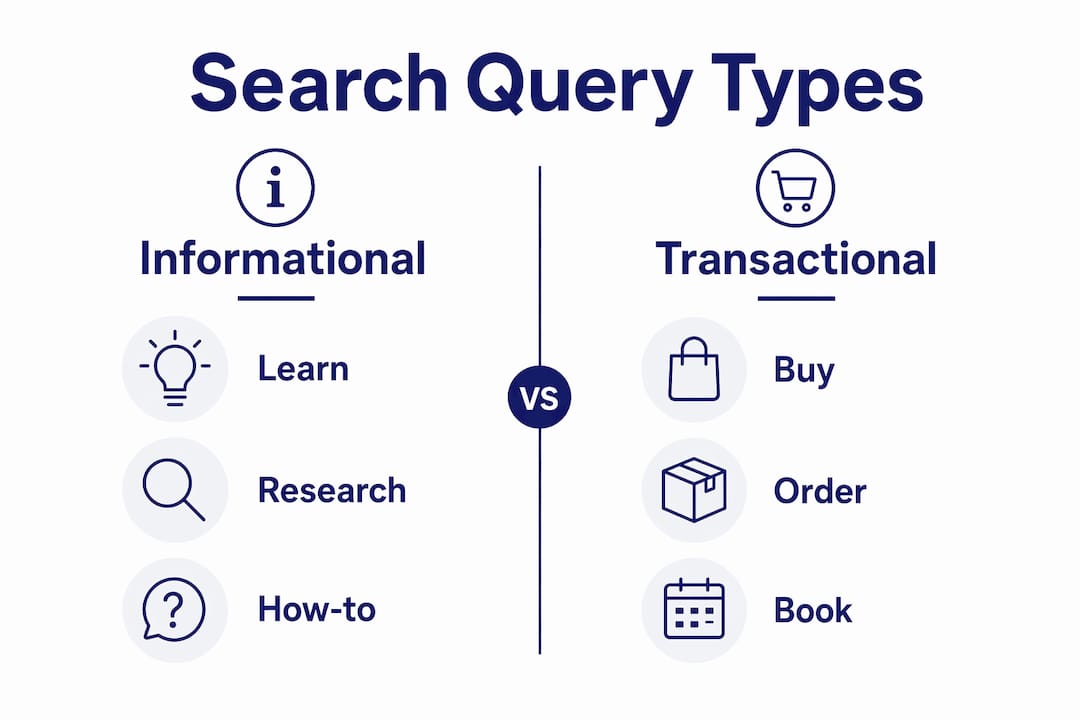
Informational queries dominate search volume. Most people searching online are in research mode, not buying mode. Navigational queries are brand-specific and high-intent but low-opportunity for competitors. Transactional queries signal purchase readiness, making them the most valuable for conversion-focused pages. Commercial queries sit between research and purchase, and they respond well to comparison content, reviews, and case studies.
Matching your content type to the correct query intent is not optional. A product page targeting an informational query will almost never rank because Google recognizes the mismatch between what the user wants and what the page delivers. You can explore how SEO content types align with each intent category to build a more targeted content plan.
Pro Tip: Before writing any new page, identify the query type first. If the top-ranking results for your target query are all blog posts, a product page will not outrank them regardless of how well it is optimized.
How do search queries differ from keywords?
Keywords are marketer-chosen targets; search queries are what users actually type. That distinction shapes every decision in a content strategy. Keywords represent intent groups, while queries capture the exact, natural language a real person used at a specific moment.
Here is why that gap matters in practice:
- Keywords are clean. Marketers choose them based on volume and competition data from tools like Google Search Console or Semrush.
- Queries are messy. They include typos, filler words, question formats, and local modifiers like “near me” or city names.
- Keywords are static. A keyword list changes when a marketer updates it. Query data changes every day as user behavior shifts.
- Queries reveal real language. The phrases customers use in queries often differ significantly from the language on a brand’s website.
- Keywords miss long-tail opportunities. Query data surfaces specific, low-competition phrases that keyword tools often underreport.
The practical implication is clear. Relying only on keyword tools means you are optimizing for your assumptions about customers, not their actual words. Query analysis reveals customer language that keyword research alone cannot surface, giving you a direct line into how your audience thinks and what they actually need.
Pro Tip: Export your Google Search Console query report monthly and compare it to your keyword list. Any query driving clicks but not mapped to a dedicated page is a content gap worth filling.
How do search engines process search queries?
Search engines convert a user’s query into ranked results through a multi-step process that goes far beyond simple word matching. This processing includes semantic interpretation, intent detection, and real-time ranking adjustments. Google’s systems, for example, use models like BERT and MUM to understand the meaning behind a query, not just its literal words.
The table below outlines the core stages of query processing:
| Stage | What Happens | Why It Matters |
|---|---|---|
| Query Parsing | The engine breaks the query into tokens and identifies key terms | Sets the foundation for retrieval |
| Semantic Interpretation | Algorithms infer meaning, context, and likely intent | Handles synonyms, misspellings, and conversational phrasing |
| Index Retrieval | The engine pulls candidate pages from its index | Determines which pages are even eligible to rank |
| Ranking | Pages are scored and ordered by relevance and authority | Decides what the user actually sees |
| Re-ranking | Personalization, location, and device signals adjust results | Explains why two users get different results for the same query |
Google handles misspellings automatically, correcting “plummber near me” to “plumber near me” without the user noticing. It also interprets conversational phrasing from voice search, so “who fixes leaky pipes in Austin” maps to the same intent as “Austin plumber.” Understanding how search engines rank results helps you create content that aligns with each stage of this process rather than fighting against it.
The re-ranking stage is where local businesses gain a significant advantage. Location signals mean a well-optimized local business can outrank a national competitor for queries with geographic intent, even if the national site has more overall authority.
How to analyze search queries for better SEO results
Analyzing search queries is the process of turning raw user input into a strategic content roadmap. The goal is to understand what your audience actually wants, then build content that delivers it precisely. Here is a practical step-by-step approach:
-
Collect query data. Pull reports from Google Search Console, which shows the exact queries triggering impressions and clicks for your site. Supplement this with data from tools like Google Analytics 4 and your site’s internal search logs.
-
Clean the data. Remove bots, trim whitespace, and group synonyms before drawing any conclusions. Raw query logs contain noise that will skew your analysis if left unfiltered.
-
Cluster related queries. Group queries that share the same intent and similar top-ranking results. Clustering similar queries prevents content cannibalization, where multiple pages on your site compete against each other for the same search.
-
Assign intent labels. Tag each cluster as informational, navigational, transactional, or commercial. This tells you what content format to create for each group.
-
Prioritize by conversion signal, not volume. A small-volume query with high click-through rates can be more valuable than a high-volume query with low engagement. Focus on queries where users take action after clicking.
-
Validate with behavior data. After publishing, monitor bounce rate, scroll depth, and page interactions to confirm your content matches what the query actually demanded. High bounce rates signal a mismatch between content and intent.
This process turns query data into a content plan grounded in real user behavior rather than assumptions. Connecting content marketing to SEO becomes far more effective when every piece of content starts with a validated query cluster rather than a keyword guess.
Pro Tip: Build a proprietary query taxonomy specific to your business. Categorize queries by product line, service area, and intent stage. This creates alignment between your marketing and sales teams and makes content planning repeatable.

What are the common pitfalls in search query optimization?
Query optimization fails most often not from lack of effort but from predictable, avoidable mistakes. Knowing what to watch for saves you from wasting months on content that will never rank.
The most common pitfalls include:
- Over-segmentation. Creating a separate page for every slight query variation dilutes your SEO authority. Clustering related queries into a single page consistently outperforms a fragmented approach.
- Ignoring noise in query logs. Bot traffic, internal searches, and branded queries mixed into your analysis will distort your understanding of real user intent.
- Misreading intent. Targeting a transactional keyword with a blog post, or an informational query with a product page, guarantees poor performance regardless of content quality.
- Chasing volume over relevance. High-volume queries are competitive and often vague. Specific, lower-volume queries with clear intent convert at higher rates.
- Keyword stuffing. Repeating a query phrase unnaturally throughout a page signals manipulation to Google and degrades the reading experience. Semantic relevance, achieved through related terms and thorough topic coverage, is the correct approach.
- Skipping post-click analysis. Publishing content and never checking behavioral signals means you have no feedback loop. Query optimization is iterative, not a one-time task.
The shift toward AI-powered search on platforms like Perplexity and ChatGPT adds another layer. These platforms interpret queries conversationally and pull answers from authoritative, well-structured content. Adapting your strategy for AI search platforms means writing content that answers questions directly and completely, not just content that ranks on Google.
Key takeaways
Search query analysis is the most direct method for aligning your content with real user intent, and it consistently outperforms keyword-only strategies when applied with behavioral data.
| Point | Details |
|---|---|
| Definition of search query | A search query is the exact phrase a user inputs into a search engine, distinct from marketer-defined keywords. |
| Four intent types | Informational, navigational, transactional, and commercial queries each require a different content format to rank. |
| Query vs. keyword gap | Queries reveal real customer language that keyword tools alone cannot surface. |
| Analysis process | Collect, clean, cluster, and prioritize queries by conversion signal before creating content. |
| Behavioral validation | Bounce rate and scroll depth confirm whether your content actually matches the query intent after publishing. |
What query data has taught me about real SEO
Working with local businesses across markets in New London, CT and Harker Heights, TX, I have seen the same pattern repeat: business owners optimize for the keywords they think their customers use, and then wonder why their traffic does not convert. The answer is almost always in the query data they have never looked at.
Google Search Console is sitting there with months of real customer language, and most businesses never open the Search Results report. When we pull that data for a new client, we routinely find queries driving clicks that have zero dedicated content on the site. That is not a keyword gap. That is a direct conversation your customer started that you never answered.
The other thing I have learned is that user behavior after the click tells you more than the query itself. A page ranking for the right query but showing a 90% bounce rate is not a ranking problem. It is a content mismatch problem. Fix the content to match what the query actually demands, and the ranking usually improves on its own.
Treat every search query as a direct question from a potential customer. Answer it completely, in plain language, and you will outperform competitors who are still guessing.
— Mike
Put your query insights to work with local SEO
Understanding search queries is the first step. Turning that understanding into local search visibility is where the real growth happens. Battleseo builds local SEO strategies around the exact queries your customers are using, not generic keyword lists.

From Google Business Profile optimization to authority content built around real query clusters, Battleseo’s Local Command Directive™ framework positions your business as the dominant local authority in your market. If you are ready to stop guessing and start ranking for the queries that actually drive customers through your door, explore local SEO for your business and see what a query-first strategy looks like in practice.
FAQ
What is the definition of a search query?
A search query is the exact word, phrase, or spoken request a user enters into a search engine like Google or Bing. It differs from a keyword in that it captures raw, natural user language rather than a marketer-selected target term.
What are the four types of search queries?
The four types are informational, navigational, transactional, and commercial. Each reflects a distinct user goal, from researching a topic to completing a purchase.
How does a search query differ from a keyword?
Keywords are chosen by marketers to target specific topics; search queries are what users actually type or speak. Queries are often conversational, include misspellings, and reveal real customer language that keyword tools frequently miss.
How do search engines process a query?
Search engines parse the query, interpret its semantic meaning, retrieve candidate pages from their index, and then rank results based on relevance and authority. Platforms like Google also apply personalization and location signals during re-ranking.
Why is search query analysis important for businesses?
Query analysis reveals the exact language your customers use when they need your product or service. Aligning your content with real query data improves rankings, increases click-through rates, and produces content that converts rather than just attracts traffic.