
TL;DR:
- Effective SEO in 2026 focuses on optimizing content quality, technical health, and backlinks together to improve rankings. Prioritizing these core factors and aligning content with search intent ensure consistent visibility and authority in search results. Building a solid foundation and refining efforts based on attribution analysis lead to sustained search success.
A ranking factor is any measurable criterion a search engine uses to evaluate and order webpages in search results. Google’s algorithm weighs hundreds of these signals simultaneously, from backlinks and Core Web Vitals to content quality and searcher engagement, to decide which pages earn the top spots. For digital marketers and business owners, understanding what is ranking factor means understanding what actually moves the needle in search. The good news: you do not need to master all 200+ signals. Research shows that a small cluster of factors drives the vast majority of ranking outcomes.
What are the top ranking factors in SEO for 2026?
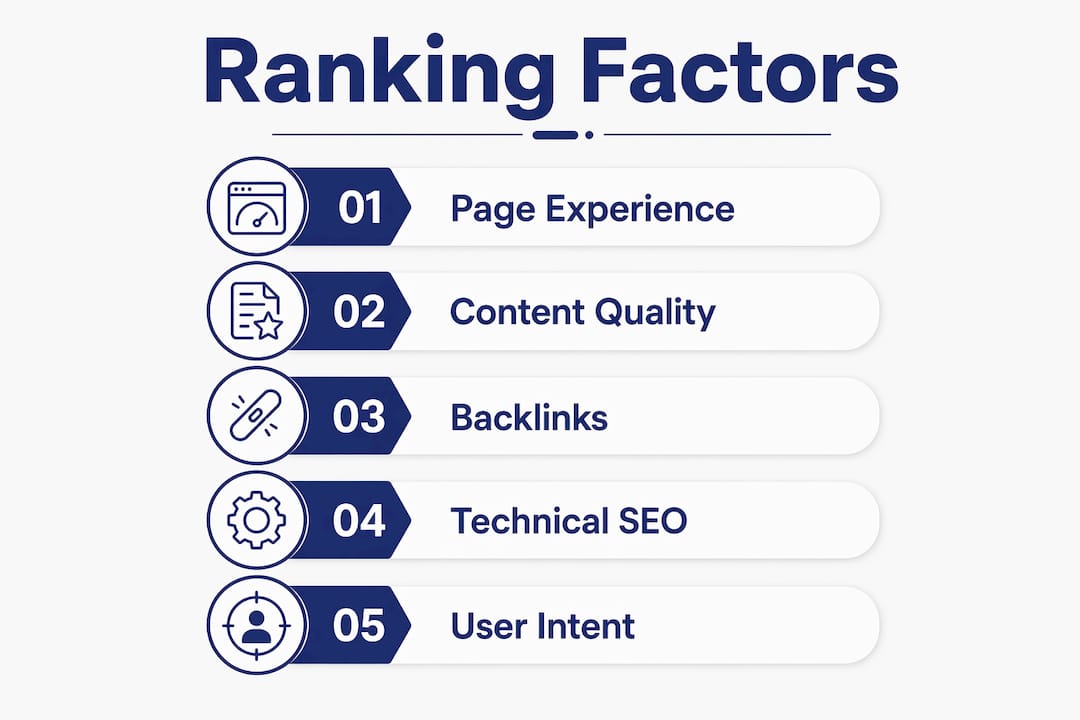
Five factors account for roughly 75% of ranking potential for any given webpage: content quality, keyword in the title tag, backlinks, topical expertise, and searcher engagement signals. That concentration matters because it tells you exactly where to focus your time and budget.
Here is how those top SEO ranking factors break down by estimated algorithmic weight:
- Content quality (23%): Google rewards depth, accuracy, and relevance over volume. A 1,200-word article that fully answers a specific question outperforms a 3,000-word article that circles the topic without resolution.
- Keyword in the title tag (14%): The title tag remains the clearest signal of page relevance. Placing your primary keyword near the front of the title consistently correlates with stronger rankings.
- Backlinks (13%): Number one results carry 3.8 times more backlinks than pages ranked two through ten. That gap reflects how much Google still treats links as votes of authority.
- Topical expertise (13%): Google’s Helpful Content system and E-E-A-T guidelines reward sites that demonstrate consistent, deep knowledge in a subject area. A single great article on a thin site carries less weight than the same article on a site with 40 related, well-sourced pieces.
- Searcher engagement signals (12%): Click-through rate, dwell time, and pogo-sticking (when users click back to search results immediately) all feed into how Google calibrates rankings over time.
A separate Q2 2026 study found that page experience metrics now carry the largest single influence on rankings at 28%, with content quality at 25% and backlinks at 22%. The two studies use slightly different methodologies, but both confirm the same hierarchy: experience, content, and authority are the three pillars.
Pro Tip: Keyword density is no longer a meaningful lever. Keyword density on top pages has dropped to around 0.04% as of 2026. Write for semantic depth and topical coverage, not keyword repetition.

How do ranking factors work together in google’s algorithm?
Ranking factors do not operate in isolation. A page with high-quality content but low domain authority rarely ranks well, which means authority, content, and technical health must work together. Think of it as a three-legged stool: weaken any one leg and the whole structure becomes unstable.
Google’s evaluation sequence moves through three broad layers. First, it checks relevance: does this page match the searcher’s query and intent? Second, it assesses quality: is the content accurate, deep, and trustworthy? Third, it measures user experience: does the page load fast, display correctly on mobile, and keep users engaged?
A practical example: a local law firm publishes a detailed, well-sourced article on personal injury claims. The content is excellent, but the site has no backlinks, loads slowly on mobile, and lacks HTTPS. That article will likely sit on page three or four despite its quality. Add 15 authoritative backlinks, fix the Core Web Vitals, and switch to HTTPS, and the same article can move to page one. The content did not change. The supporting factors did.
“High-quality content, authoritative backlinks, and technical health must be optimized together for maximum ranking impact.” — HubSpot, Google’s Known Ranking Factors
Aligning content with search intent is the connective tissue between all these layers. A page optimized for the wrong intent, say, a product page targeting an informational query, will underperform regardless of its technical quality or backlink count. Google reads intent signals from the query itself and compares them against what users actually click and stay on.
Pro Tip: Before publishing any page, search your target keyword and study the top five results. Note the format (list, guide, product page), the depth, and the angle. Match the intent pattern before you write a single word.
What technical and user experience factors affect rankings?
Technical SEO factors function as the foundation that allows your content and authority to perform. HTTPS, Core Web Vitals, and mobile friendliness are baseline requirements that enable visibility rather than primary ranking drivers on their own. Miss them and you create a ceiling on how far your other efforts can take you.
Core web vitals: the three metrics that matter
Google’s Core Web Vitals measure real-world page experience across three dimensions:
| Metric | What It Measures | Target Threshold |
|---|---|---|
| LCP (Largest Contentful Paint) | How fast the main content loads | Under 2.5 seconds |
| INP (Interaction to Next Paint) | How quickly the page responds to user input | Under 200 milliseconds |
| CLS (Cumulative Layout Shift) | Visual stability as the page loads | Score under 0.1 |
Top-ranking pages are 10% more likely to pass all Core Web Vitals than pages ranked ninth. That gap compounds across thousands of queries and represents real traffic differences at scale.
Mobile friendliness is no longer optional. Google uses mobile-first indexing, meaning it crawls and evaluates the mobile version of your site first. A page that looks great on desktop but breaks on a phone is effectively invisible to a large share of searchers.
HTTPS serves a dual purpose. It is a direct ranking signal and a trust signal that affects user behavior. Visitors who see a “Not Secure” warning in their browser are significantly more likely to leave before engaging with your content, which feeds negatively into your engagement signals.
Page speed ties all of these together. A slow page fails Core Web Vitals, frustrates mobile users, and increases bounce rates. Tools like Google PageSpeed Insights, GTmetrix, and Screaming Frog help you identify and fix the specific bottlenecks dragging your scores down.
How should marketers prioritize ranking factors for best results?
The most common mistake in SEO is treating all ranking factors as equally important. There are over 200 theoretical signals, but chasing all of them spreads your resources thin and produces marginal gains. Attribution analysis helps marketers identify which ranking factors drive their specific business outcomes, enabling targeted efforts over general optimization.
Here is a practical workflow for prioritizing your SEO efforts:
- Audit your technical baseline first. Use Google Search Console and PageSpeed Insights to identify HTTPS issues, Core Web Vitals failures, and mobile usability errors. Fix these before anything else. They are the floor, not the ceiling.
- Map your content gaps. Use tools like Semrush or Ahrefs to find queries where competitors rank and you do not. Prioritize topics where you have genuine expertise and where the search volume justifies the investment. Strong content marketing consistently closes those gaps over time.
- Build authority through backlinks. Focus on earning links from sites that are relevant to your industry, not just high-authority sites in general. A link from a local business association or an industry publication carries more weight for your niche than a generic directory listing. Review the role of backlinks to understand how link quality affects your domain authority.
- Align every page with search intent. Before optimizing for a keyword, confirm what type of result Google rewards for that query. Informational queries need guides. Transactional queries need product or service pages. Navigational queries need branded content.
- Track engagement signals actively. Monitor click-through rates in Google Search Console. A page ranking fifth with a 12% CTR is outperforming a page ranking third with a 4% CTR. Rewrite title tags and meta descriptions to improve CTR before investing in more content or links.
Citing credible sources and improving semantic depth can increase visibility in AI search results by up to 40%. That figure applies equally to traditional Google rankings and to platforms like ChatGPT and Perplexity, where adapting to AI search is becoming a competitive necessity.
Pro Tip: Run a quarterly ranking factor audit. Pull your top 20 pages from Google Search Console, check their Core Web Vitals, backlink counts, and CTR trends, and identify the one factor holding each page back. Fix that one thing per page rather than making broad changes that are hard to attribute.
Key takeaways
Effective SEO in 2026 requires optimizing content quality, technical health, and backlink authority together, because no single factor determines rankings alone.
| Point | Details |
|---|---|
| Content quality leads rankings | Content quality carries roughly 23–25% of ranking weight, making it the single largest controllable factor. |
| Page experience is now critical | Core Web Vitals, mobile friendliness, and HTTPS together influence up to 28% of ranking outcomes. |
| Backlinks still drive authority | Pages in position one carry 3.8 times more backlinks than pages ranked two through ten. |
| Attribution beats broad optimization | Use attribution analysis to find which factors move your specific rankings, not generic best-practice lists. |
| Search intent alignment is non-negotiable | Matching your page format and depth to the searcher’s intent determines whether your content ranks at all. |
What i’ve learned after years of watching rankings shift
The SEO world loves to announce that some factor is “dead” every six months. Backlinks are dead. Keywords are dead. Technical SEO is dead. None of it is true. What actually changes is the weight of each factor and the sophistication with which Google applies it.
What I have seen consistently at Battleseo is that the businesses who win in search are not the ones chasing the latest algorithm update. They are the ones who built a solid foundation and kept improving it. They publish content that genuinely answers questions their customers are asking. They earn links because their content is worth linking to. They keep their sites fast and secure because they respect their visitors.
The shift I pay closest attention to right now is the rise of AI-driven search. Platforms like ChatGPT, Perplexity, and Google’s AI Overviews are pulling from the same signals that traditional search rankings reward: authority, semantic depth, and trustworthiness. If you optimize well for Google, you are already most of the way toward being cited by AI. The strategies for 2026 are not a departure from good SEO. They are an extension of it.
My honest advice: stop worrying about factors you cannot control and double down on the three you can. Write better content than anyone else in your niche. Earn links from sources your audience actually respects. Keep your site technically clean. Do those three things consistently and the rankings follow.
— Mike
How Battleseo helps you win on the factors that matter
If you understand which ranking factors drive results but need expert execution, Battleseo is built for exactly that. The agency’s Local Command Directive™ framework covers the full ranking factor stack: authority backlinks, Google Business Profile optimization, on-page SEO, citation building, and Digital PR. Every client gets a dedicated strategy built around their specific market and category.
Battleseo works with one business per service category per market, which means your competitor cannot use the same playbook. Whether you need to unlock local SEO visibility fast or build a long-term authority strategy, the team applies data-driven attribution to find the ranking factors that move your specific business forward. New client onboarding is capped at 12 per month, so availability is limited.
FAQ
What is a ranking factor in SEO?
A ranking factor is any criterion Google or another search engine uses to evaluate and order webpages in search results. Examples include content quality, backlinks, Core Web Vitals, and mobile friendliness.
How many ranking factors does google use?
Google uses over 200 known ranking signals, but research shows that five factors, including content quality, backlinks, and topical expertise, account for approximately 75% of a page’s ranking potential.
Which ranking factor has the most impact in 2026?
Page experience metrics carry the largest combined influence at 28%, followed by content quality at 25% and backlinks at 22%, according to a Q2 2026 SEO ranking factor study.
Do backlinks still matter as a ranking factor?
Backlinks remain one of the strongest predictors of ranking. Pages in the number one position carry 3.8 times more backlinks on average than pages ranked two through ten.
How do i know which ranking factors to prioritize for my site?
Attribution analysis identifies which specific factors drive rankings and conversions in your niche. Start with a technical audit, then focus on content gaps and backlink quality before optimizing secondary signals.