
TL;DR:
- Directories provide essential trust signals that influence local search rankings and AI verification. They are most effective when listings are consistent, accurate, and targeted in niche directories. Submitting to 30 to 50 vetted directories and maintaining data accuracy boosts visibility and competitiveness in local SEO.
Directories for SEO are curated collections of business and website listings that send critical trust signals to search engines about a business’s legitimacy, location, and relevance. The role of directories in SEO goes well beyond simple link building. Citation signals from directories account for roughly 11% of local search ranking factors, making them a measurable, foundational layer of any local visibility strategy. NAP consistency, which stands for Name, Address, and Phone number, is the core mechanism that makes directory listings valuable. Get it right across enough directories, and Google has the corroborating data it needs to rank and display your business with confidence.
How do directories affect local search rankings?
Directory submissions influence local rankings through three distinct mechanisms: citation volume, NAP consistency, and backlink diversity. Each one compounds the others.

Businesses with 40 or more accurate citations rank 53% higher in local search results than those with fewer. That gap is not marginal. It reflects how heavily Google’s local algorithm weights corroborated business data when deciding which listings to surface in the local pack and Google Maps.
NAP inconsistencies cut in the other direction just as sharply. Minor formatting differences, such as “St.” versus “Street” or a missing suite number, reduce local search visibility by up to 16%. That means a business with 50 directory listings but inconsistent formatting can actually underperform a competitor with 30 clean, uniform listings.
Directory links also diversify your backlink profile in a way that other link building methods rarely achieve. Directory backlinks generate branded or URL anchor text naturally, which dilutes the risk of over-optimization from keyword-heavy anchors elsewhere in your link profile. This is a structural benefit that most SEO professionals undervalue.
For new domains, the indexing benefit is immediate. Googlebot indexes new sites faster when they receive inbound links from authoritative directories, cutting indexing time from weeks down to days. That acceleration matters when a client is waiting to see results.
- Citation volume: Aim for 40+ accurate listings to reach the ranking threshold where citations become a meaningful signal.
- NAP uniformity: Use a standardized data sheet for every submission. One formatting error across dozens of listings compounds quickly.
- Backlink diversity: Directory links naturally supply branded anchors, balancing out aggressive anchor text strategies elsewhere.
- Indexing speed: Authoritative directory links signal legitimacy to Googlebot and accelerate crawling for new domains.
- Quality filter: Directories with no user value beyond SEO, meaning no traffic, no editorial standards, and no discovery function, carry real penalty risk.
Pro Tip: Before submitting to any directory, check its domain authority and whether it drives real organic traffic. A listing on a dead directory is not neutral. It can actively harm your profile.
Niche directories vs. general directories: which drives better SEO results?
Niche directories outperform general directories on every metric that matters for SEO. The data is clear and the logic is straightforward.
Businesses listed in niche-specific directories report 45% higher organic traffic and 22% better conversion rates compared to those relying only on broad general directories. The reason is user intent alignment. A plumber listed in a home services directory reaches visitors actively looking for plumbers. The same listing in a general business directory competes with every other category for attention.
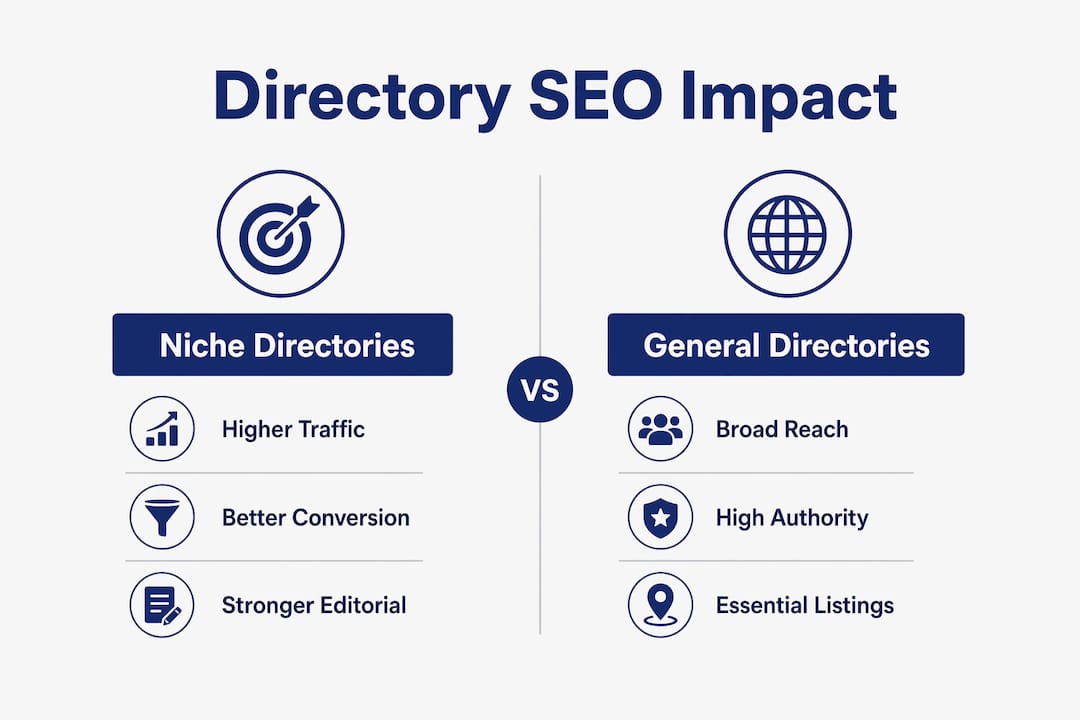
Niche directories also carry stronger editorial signals. Many require proof of licensing, credentials, or category relevance before approving a listing. That editorial curation tells Google the directory itself has standards, which raises the authority weight of the link it passes to your site.
| Factor | Niche directories | General directories |
|---|---|---|
| Relevance to user intent | High, category-specific visitors | Low, broad mixed audience |
| Editorial standards | Often require verification or approval | Typically open submission |
| Link authority signal | Stronger due to topical relevance | Weaker, diluted by category breadth |
| Conversion potential | Higher, pre-qualified visitors | Lower, general browsing traffic |
| Risk of spam association | Low if directory is established | Higher if directory accepts all submissions |
General directories still serve a purpose. Google Business Profile, Yelp, and similar platforms carry enough domain authority and user traffic to justify inclusion. The mistake is treating them as the whole strategy rather than the foundation.
Pro Tip: Map your niche directories before you start submitting. A medical practice, a law firm, and a restaurant each have distinct high-authority vertical directories. Identify the top five for your client’s industry and prioritize those over any general submission.
How is the role of directories shifting in the age of AI search?
Directories have moved from human destination points to structured data sources that AI-powered search engines rely on to verify business legitimacy. This shift changes how you should think about directory management entirely.
Directories now function as structured data maps for AI systems like ChatGPT, Perplexity, and Gemini. When a user asks one of these platforms for a local business recommendation, the AI cross-references corroborated data from multiple directory sources to determine which businesses it can confidently surface. Inconsistent or outdated listings create data conflicts that cause AI systems to deprioritize or omit a business entirely.
The practical implications for SEO professionals are significant:
- Accuracy is now a trust signal for two audiences. Your directory listings must satisfy both Google’s local algorithm and the AI systems pulling structured data for generative search results.
- Outdated information carries compounding risk. A wrong phone number or old address does not just confuse a human visitor. It creates a data conflict that AI systems flag as unreliable.
- Consistent listings build entity authority. When multiple authoritative sources agree on the same business details, AI systems treat that business as a verified entity. That entity status influences AI-generated recommendations.
- Directory profiles need regular maintenance. Submitting once and walking away is no longer sufficient. Quarterly audits of your top 30–50 listings are now a baseline requirement for AI search visibility.
- The shift rewards quality over volume. AI systems weight corroborated data from authoritative sources. Ten accurate listings on high-authority directories outperform 100 listings on low-quality sites.
Pro Tip: Treat your directory listings as a live data layer, not a one-time task. Set a calendar reminder every quarter to audit your top listings for accuracy, especially after any business change like a new phone number, address, or hours update.
Best practices for SEO directory submission in 2026
Effective directory submission in 2026 follows a clear framework: vet before you submit, standardize your data, and maintain what you build.
Submitting to 30–50 high-quality, vetted directories is the optimal range. Beyond that threshold, the returns diminish and the risk of triggering Google’s link spam algorithms increases. Bulk automated submissions that push listings to hundreds of directories in a single batch are a reliable way to earn a penalty rather than a ranking boost.
NAP consistency is the non-negotiable foundation. Create a master data sheet before you submit anywhere. Include your exact business name, address formatted to the character, phone number with area code, website URL, and business category. Use that sheet verbatim for every submission. Even small deviations, like abbreviating “Avenue” to “Ave” in one listing, dilute your local entity signals and reduce the ranking benefit of the entire citation set.
Your Google Business Profile is the anchor of your directory strategy. It is the highest-authority directory listing available to any local business, and every other directory submission should mirror its data exactly. Treat GBP as the source of truth and build outward from there.
- Vet every directory for domain authority, organic traffic, and editorial standards before submitting. A directory with no real visitors and no editorial review is a liability.
- Prioritize category-relevant directories in your industry vertical before filling out general business directories.
- Avoid link farms disguised as directories. The litmus test is simple: does the directory provide genuine discovery, verification, or comparison value to a real user?
- Schedule quarterly audits to catch outdated information before it creates data conflicts in AI search results.
- Integrate directory submissions with your broader local SEO process so citations reinforce your on-page signals and Google Maps optimization simultaneously.
Pro Tip: Check the domain authority and estimated organic traffic of any directory before submitting. Free tools like Ahrefs or Moz’s Link Explorer give you enough data to make the call in under two minutes. If a directory has no traffic and no authority, skip it.
Key Takeaways
Directories remain a foundational SEO signal in 2026, and their value has grown as AI search systems use consistent directory data to verify business legitimacy and generate local recommendations.
| Point | Details |
|---|---|
| Citations drive local rankings | Businesses with 40+ accurate citations rank 53% higher in local search results. |
| NAP consistency is non-negotiable | Formatting errors as minor as “St.” vs. “Street” reduce local visibility by up to 16%. |
| Niche directories outperform general ones | Niche-specific listings produce 45% higher organic traffic and 22% better conversion rates. |
| AI search relies on directory data | Consistent listings across authoritative directories build entity trust for AI-generated results. |
| Quality beats quantity | Submitting to 30–50 vetted directories is optimal; bulk submissions beyond that risk spam penalties. |
Why I think most SEO professionals still undervalue directories
Most practitioners treat directory submissions as a checkbox task. Submit once, move on, never look back. That approach misses what directories actually do for a local SEO campaign.
The real value is not any single listing. It is the cumulative weight of corroborated data across multiple authoritative sources. When Google and AI search platforms see the same business details confirmed across 40+ credible directories, they treat that business as a verified entity. That entity status is what drives consistent local pack appearances and AI-generated recommendations. You cannot replicate that signal with content or backlinks alone.
What I have seen consistently is that the businesses with the cleanest, most consistent directory profiles hold their local rankings through algorithm updates better than those with stronger content but messy citation data. Directories are not glamorous. They do not generate case study material. But they are the stable foundation that everything else builds on.
The AI shift makes this even more pressing. Platforms like ChatGPT and Perplexity are pulling structured data from directories to answer local queries. If your listings are inconsistent or outdated, you are invisible to those platforms regardless of how good your website is. For any business serious about local search dominance, directory accuracy is now a prerequisite, not an afterthought.
— Mike
How Battleseo approaches directory strategy for local businesses
Directory management done well requires precision, consistency, and ongoing attention. Most businesses get the initial submission right and then let their listings drift as phone numbers change, addresses update, or hours shift.
Battleseo builds directory optimization into every local SEO engagement through the Local Command Directive™ framework. That means a standardized citation audit, NAP consistency enforcement across your top directories, and integration with your Google Business Profile so every data source reinforces the same entity signals. For businesses competing in AI-driven search results on platforms like ChatGPT and Gemini, accurate and consistent directory data is now a visibility requirement. If you want to see what a clean, authoritative local SEO strategy looks like in practice, Battleseo works with one business per category per market, so the focus stays entirely on your growth.
FAQ
What is the role of directories in SEO?
Directories provide citation signals, backlinks, and NAP data that search engines use to verify business legitimacy and determine local rankings. Citation signals account for roughly 11% of local search ranking factors.
How many directories should I submit my business to?
Submitting to 30–50 high-quality, vetted directories is the optimal range. Exceeding that threshold with bulk submissions risks triggering Google’s link spam algorithms without meaningful ranking benefit.
Do directories still matter for SEO in 2026?
Directories matter more than ever in 2026 because AI search platforms like ChatGPT and Perplexity use corroborated directory data to verify businesses and generate local recommendations. Accurate listings are now a prerequisite for AI search visibility.
What is NAP consistency and why does it matter?
NAP stands for Name, Address, and Phone number. Inconsistent formatting across directory listings, even minor differences like “Ave” versus “Avenue,” can reduce local search visibility by up to 16%.
Are niche directories better than general directories for SEO?
Niche directories produce stronger results. Businesses listed in industry-specific directories report 45% higher organic traffic and 22% better conversion rates than those relying only on general directories.