

TL;DR:
- Search algorithms are systems that retrieve and rank information from data for search engines. They influence website visibility and are critical for effective SEO strategy. Understanding their types and functions helps improve online ranking results.
A search algorithm is a systematic method for locating specific information within a dataset, and it powers every result you see on Google, Bing, or any AI search platform. Whether you are a digital marketer trying to rank higher or a business owner curious about why your website appears where it does, understanding how these algorithms work gives you a real edge. This guide covers the core definition, the main types, how search engines apply them, and what it all means for your visibility online.

What is a search algorithm, and why does it matter?
A search algorithm is defined as a procedure that retrieves information from discrete or continuous data spaces, chosen based on the structure of the data and prior knowledge about it. That definition comes from computer science, but its implications reach far into digital marketing. Every time someone types a query into Google, a chain of algorithmic decisions determines what they see.
The term “search algorithm” covers two related but distinct ideas. In computer science, it refers to methods like linear search or binary search used to find values in data structures. In digital marketing, it refers to the ranking and retrieval systems that search engines like Google use to decide which web pages appear and in what order. Both meanings matter, and confusing them is one of the most common mistakes marketers make when reading SEO advice.
Information retrieval is the broader field that combines document searching, indexing, and ranking, using probabilistic models to evaluate relevance across large data collections. Search engines are the most visible application of this field. Knowing the science behind them helps you make smarter decisions about your content.
What are the main types of search algorithms?
Search algorithms are categorized by their mechanism: linear, binary, hashing, and specialized families like tree and graph searches. Each type suits different data conditions and performance requirements.
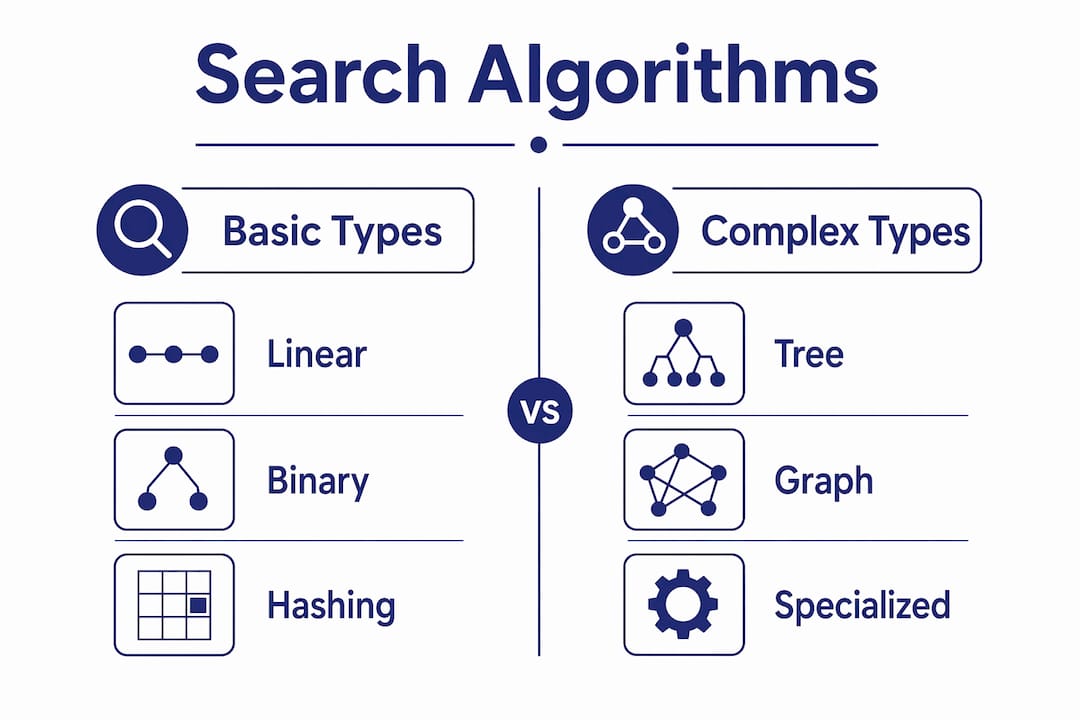
Linear search
Linear search checks each element in a dataset one by one until it finds the target or exhausts the list. It works on unsorted data, which makes it universal. The tradeoff is time complexity of O(n), meaning the time it takes grows directly with the size of the dataset. For small datasets, this is fine. For millions of web pages, it is not.
Binary search
Binary search runs in O(log n) time on sorted data, making it dramatically faster than linear search for large datasets. It works by repeatedly dividing the search space in half, eliminating half the remaining candidates with each step. The catch is that it requires the data to be sorted in advance. Google’s internal indexes are pre-sorted and structured precisely so that faster search methods can be applied at query time.
Hashing
Hashing maps data to a fixed location using a key, enabling near-instant retrieval. Think of it like a library catalog that tells you exactly which shelf a book is on, rather than making you check every shelf. Hash tables power many of the fast lookup operations inside search engine infrastructure.
Tree and graph searches
Tree and graph search methods handle hierarchical or networked data. Search engines use graph-based approaches to analyze link structures between web pages, which directly informs how authority and relevance are calculated.
| Algorithm type | Mechanism | Data requirement | Time complexity |
|---|---|---|---|
| Linear search | Sequential check | Unsorted or sorted | O(n) |
| Binary search | Divide and conquer | Must be sorted | O(log n) |
| Hashing | Key-to-location mapping | Hash table structure | O(1) average |
| Graph search | Node and edge traversal | Networked data | Varies |
Pro Tip: If you are studying SEO, focus less on memorizing algorithm names and more on understanding why pre-sorted, well-structured data enables faster and more accurate retrieval. That principle explains why Google rewards well-organized, clearly structured websites.
How do search algorithms function within online search engines?
Search engines do not search the live web at the moment you submit a query. They search a pre-built internal index, then apply ranking algorithms to order the results. This distinction is critical for anyone working in SEO.
The process runs in four stages:
- Crawling. Automated bots, often called spiders or crawlers, visit web pages by following links. They collect raw page data and send it back to the search engine’s servers.
- Indexing. The search engine analyzes the crawled data and stores it in a massive digital catalog. This catalog is the index. Only indexed pages can appear in search results.
- Ranking. When a user submits a query, the ranking algorithm evaluates indexed pages against hundreds of signals, including keywords, user intent, location, backlinks, and page experience. It then orders results by predicted relevance.
- Serving. The ranked results are delivered to the user, typically in milliseconds.
Retrieval and ranking are separate operations. Retrieval selects candidate pages from the index. Ranking orders those candidates by predicted usefulness. Treating them as one step is a common oversimplification that leads to flawed SEO strategies.
“The index acts as a massive digital catalog to enable fast and relevant searches.” — HowStuffWorks
Understanding how search engines work at this level helps you see why technical SEO matters as much as content quality. A page that cannot be crawled will never be indexed. A page that is indexed but poorly structured will rank low regardless of its content.
Pro Tip: Use Google Search Console to check whether your pages are indexed. The Coverage report shows crawl errors, excluded pages, and indexing status, giving you direct visibility into where the pipeline is breaking down for your site.
What are practical examples and implications of search algorithms in digital marketing?
Search algorithms in digital marketing determine which web pages become visible and how high they rank in search results. The ranking signals Google uses include keyword relevance, content quality, backlink authority, page speed, mobile usability, and user engagement signals like click-through rates and dwell time. Understanding these signals is the foundation of SEO.
Here is where many marketers go wrong:
- Keyword stuffing. Repeating a keyword excessively used to work in early search engines. Modern ranking algorithms penalize it because it signals low-quality content.
- Ignoring search intent. A page optimized for the word “running shoes” will rank poorly if the algorithm determines that users searching that phrase want to buy, not read a history of footwear. Matching intent is now a primary ranking factor.
- Neglecting technical structure. Pages with broken links, slow load times, or poor mobile experience send negative signals to ranking algorithms, regardless of content quality.
- Overlooking backlinks. Google’s algorithm treats backlinks as votes of authority. A page with strong, relevant backlinks from trusted domains ranks higher than an equally good page with none.
Algorithm updates from Google, such as the Helpful Content Update and Core Updates, shift the weight given to different ranking signals. Marketers who understand the underlying SEO ranking factors can adapt faster when updates roll out, rather than scrambling to recover lost rankings.
Pro Tip: Treat every piece of content as an answer to a specific question. Search algorithms are increasingly built to match queries with the most direct, authoritative answer. Pages that answer one question thoroughly tend to outperform pages that cover many topics shallowly.
What are the limitations and nuances of search algorithms?
No single search algorithm works perfectly in every situation. Each type has conditions where it excels and conditions where it fails.
Key limitations to understand:
- Binary search requires sorted data. If your data is unsorted, binary search cannot be applied without a preprocessing step. In search engine terms, this is why indexing must happen before ranking. The index is the sorted, structured dataset that makes fast retrieval possible.
- Linear search is universal but slow at scale. It works on any dataset, but its O(n) complexity makes it impractical for the billions of pages in Google’s index.
- Crawling does not guarantee indexing. Being crawled and being indexed are separate outcomes. A page can be crawled and still excluded from the index due to duplicate content, thin content, or a noindex tag.
- SEO results are delayed. Indexes update incrementally, while ranking algorithms compute results in real-time at query time. This means changes you make to a page today may not appear in search results for days or weeks.
| Limitation | Root cause | Practical implication |
|---|---|---|
| Binary search needs sorted data | Algorithm design requirement | Indexing must precede ranking |
| Crawling gaps | Bot access and crawl budget | Technical SEO affects discoverability |
| Indexing delays | Incremental index updates | SEO changes take time to reflect |
| Ranking volatility | Real-time signal weighting | Algorithm updates shift rankings quickly |
Staying current with algorithm update strategies is not optional for serious marketers. The pipeline has too many moving parts to manage by intuition alone.
Key Takeaways
Search algorithms are the foundation of every search result you see, and understanding how they work at both the computer science and search engine level is the clearest path to better organic visibility.
| Point | Details |
|---|---|
| Core definition | A search algorithm retrieves information from structured data using methods matched to the data type. |
| Types matter | Linear, binary, hashing, and graph searches each suit different data conditions and performance needs. |
| Search engine pipeline | Crawling, indexing, ranking, and serving are four distinct stages, each affecting SEO outcomes. |
| Ranking vs. retrieval | Retrieval selects candidates from the index; ranking orders them by relevance at query time. |
| SEO delay is structural | Index updates are incremental, so on-page changes take days or weeks to appear in rankings. |
Why search algorithms are the most underrated topic in digital marketing
Most marketers treat search algorithms as a black box. They follow SEO checklists without understanding why those tactics work. That gap shows up in their results.
After years of working with independent business owners at Battleseo, I have seen the same pattern repeatedly. A business owner makes a change to their website, waits two days, sees no movement, and concludes the change did not work. What they do not realize is that the crawling and indexing pipeline has not even processed the update yet. Understanding the mechanics of how search engines work changes your relationship with SEO from reactive to deliberate.
The shift toward AI search platforms like ChatGPT, Perplexity, and Gemini adds another layer. These platforms use retrieval-augmented generation, which is essentially a search algorithm feeding a language model. The same principles apply: structured, authoritative, clearly written content gets retrieved and cited. Thin, poorly organized content does not. The fundamentals have not changed. The surfaces where they play out have.
My honest advice is to spend one hour understanding the crawl-index-rank pipeline before you spend another hour on keyword research. That foundation will make every other SEO decision more effective. You can also read Battleseo’s guide on adapting to AI search platforms to see how these principles apply to the newest generation of search tools.
— Mike
How Battleseo helps you rank where it counts
Search algorithms decide who gets found and who stays invisible. Battleseo works exclusively with independent business owners to make sure the algorithm works in your favor, not against you.

Battleseo’s local SEO services are built around the same pipeline logic covered in this article: making sure your pages get crawled, indexed, and ranked for the searches that bring real customers through your door. The Local Command Directive™ framework covers Google Business Profile optimization, authority backlinks, citation building, and on-page SEO. If you want a faster path to local visibility, the local SEO beginner’s guide is a practical starting point with no technical background required.
FAQ
What is a search algorithm in simple terms?
A search algorithm is a step-by-step method for finding specific information within a dataset. In digital marketing, it refers to the system a search engine uses to rank and return relevant web pages for a given query.
What are the main types of search algorithms?
The main types are linear search, binary search, hashing, and graph or tree search. Each type suits different data structures, with binary search being the fastest for sorted data at O(log n) complexity.
How do search algorithms affect SEO?
Search algorithms affect SEO by determining which pages get indexed and how they rank for specific queries. Factors like content relevance, backlink authority, page speed, and user intent all feed into the ranking stage of the pipeline.
Why do SEO changes take time to show results?
SEO changes take time because crawling and indexing systems update incrementally, not in real time. Ranking algorithms compute results at query time, but a page must be re-crawled and re-indexed before new signals are factored in.
What is the difference between retrieval and ranking in search?
Retrieval selects candidate pages from the search index based on a query. Ranking then orders those candidates by predicted relevance using signals like keywords, backlinks, and user behavior. Both steps must work well for a page to appear at the top of results.