
TL;DR:
- Local SEO helps small businesses appear in local search results by optimizing their online presence across directories and Google. Consistent NAP information and active profile management significantly boost visibility, foot traffic, and customer trust. Ongoing maintenance, including updates and review responses, is essential for sustaining and improving local rankings over time.
Picture this: a shop owner in her third year of business, excellent reviews from word-of-mouth customers, and a storefront her neighbors love. But when someone a mile away types “plumber near me” or “bakery open now,” her business is invisible. She’s losing customers not because of her service, but because Google simply doesn’t know enough about her to show her. Local SEO fixes that. This guide walks you through every critical step, from understanding the basics to tracking real results, so you can start attracting nearby customers who are already searching for exactly what you offer.
Table of Contents
- What is local SEO and why does it matter?
- What you need to get started with local SEO
- Step-by-step: Setting up and optimizing your Google Business Profile
- Building local citations and keeping your NAP data accurate
- Tracking your results and what to do next
- Local SEO made simple: What most guides miss
- Ready to grow your local presence? Next steps with Battle SEO
- Frequently asked questions
Key Takeaways
| Point | Details |
|---|---|
| NAP consistency boosts rankings | Keeping your business name, address, and phone identical across 40+ sites can raise your Google Maps visibility by nearly 20 percent. |
| Google Business Profile is key | Claiming and fully completing your profile is the single most effective basic step for local presence. |
| Regular audits prevent data drift | Scheduling monthly or quarterly reviews ensures your information stays accurate everywhere and avoids lost visibility. |
| Ongoing action beats quick fixes | Local SEO rewards businesses who treat it as a regular habit, not a one-time project. |
What is local SEO and why does it matter?
Local SEO (Search Engine Optimization) is the practice of optimizing your online presence so your business shows up in searches performed by people in your geographic area. When someone types “coffee shop in Austin” or “best auto mechanic near me,” Google pulls results that are locally relevant. If your business isn’t optimized for those searches, you won’t show up, even if you’re a block away.
This is different from general SEO, which focuses on ranking for broad, often national or global search terms. To help you unlock local SEO potential, it helps to understand how targeted this strategy really is. The table below shows the key differences:
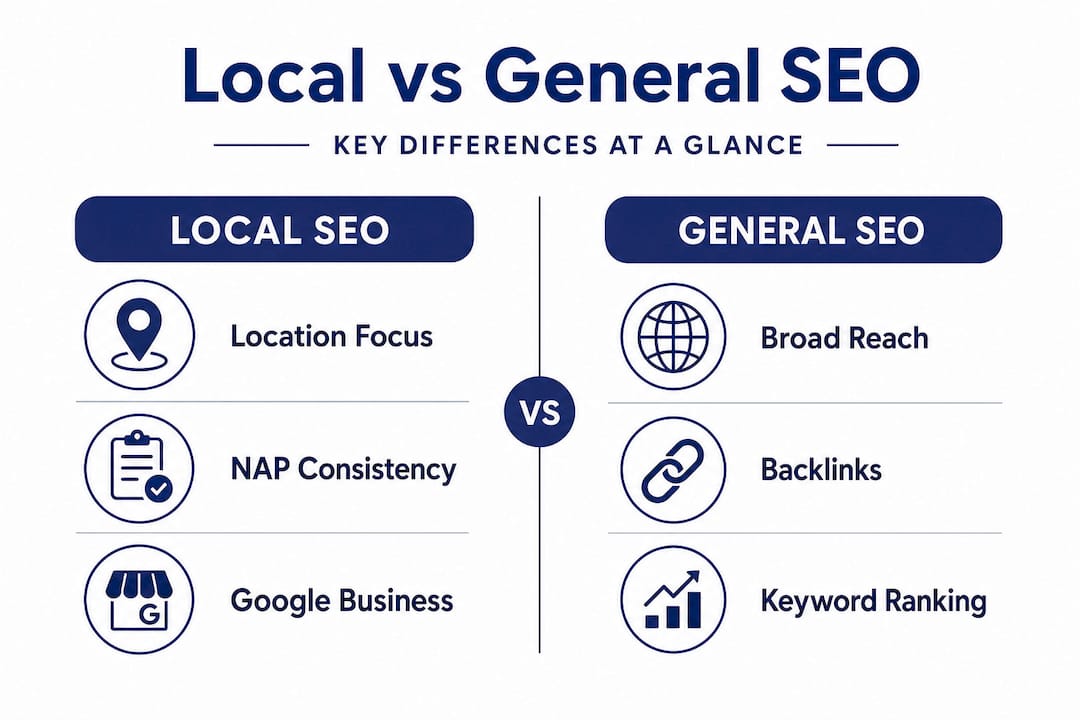
| Factor | Local SEO | General SEO |
|---|---|---|
| Goal | Attract customers in a specific area | Rank for broad, wider-audience keywords |
| Ranking signals | Location, NAP consistency, Google Business Profile | Backlinks, domain authority, content depth |
| Who benefits | Brick-and-mortar shops, service businesses | E-commerce, national brands, media sites |
| Primary tools | Google Business Profile, citations, local reviews | Long-form content, technical SEO, link building |
One of the most foundational elements of local SEO is NAP, which stands for Name, Address, and Phone number. Keeping this data identical across every website and directory that lists your business is critical. Even small inconsistencies, like an abbreviation on one site and the full street name on another, can confuse Google and suppress your rankings.
The numbers back this up. Businesses with accurate NAP data across 40 or more authoritative sources achieved an average of 19% higher Google Maps visibility, per BrightLocal research. That’s a meaningful lift, and it costs nothing but attention and consistency.
Benefits of local SEO at a glance:
- More phone calls from nearby customers who are ready to buy
- Increased foot traffic to your physical location
- Better visibility in Google Maps and local search results
- Stronger trust signals through consistent and accurate business information
- Higher click-through rates from people searching with local intent
This is the foundation of everything you’ll build from here. As a local business SEO guide principle, accuracy comes before everything else.
What you need to get started with local SEO
Now that you know what local SEO is, you need to gather the right materials before you start making changes. Jumping in without preparation leads to inconsistency, which is the one thing local SEO cannot tolerate.
Here’s what you’ll need to collect before moving forward:
- Your official business name exactly as it appears on your business registration
- Your complete address, including suite or unit numbers if applicable
- Your primary phone number, ideally a local number rather than an 800 number
- Your website URL, confirmed and working
- Your business hours, including holiday exceptions
- A Google account you own and can access reliably
- High-quality photos of your storefront, interior, products, or team (at least 10 to start)
- A list of the services or products you offer, written out clearly
The comparison table below shows which tools you can use for free vs. which paid options accelerate the process:
| Task | Free tool | Paid option |
|---|---|---|
| Google Business Profile setup | Google Business Profile | N/A |
| Citation auditing | Google Search (manual checks) | BrightLocal, Whitespark |
| Keyword research | Google Search Console | Semrush, Moz Local |
| Review monitoring | Google Business dashboard | Grade.us, Podium |
| NAP consistency check | Manual spreadsheet | Yext, BrightLocal |
Starting with free tools is completely reasonable for most independent business owners. As your business grows and you see results, paid tools can help you scale faster. Use your SEO audit checklist as a starting reference point for what to track from day one.
One critical thing most guides gloss over: directory data can drift over time without you doing anything. A data aggregator might update an old address, a directory might auto-pull outdated information, or a well-meaning employee might change something. Your listings are never truly “done.”
Pro Tip: Set a recurring calendar reminder every month to log into your top five listings and verify that your NAP information is still accurate. It takes less than 15 minutes and prevents silent ranking drops.
Step-by-step: Setting up and optimizing your Google Business Profile
Your Google Business Profile (GBP) is the single most important local SEO asset you own. It controls how your business appears in Google Search and Google Maps. A well-optimized profile can push you into the “local pack,” the top three map results that appear above all organic search results.
Here’s how to set it up correctly:
- Go to business.google.com and sign in with your Google account.
- Search for your business name to see if a listing already exists. If it does, claim it. If not, click “Add your business.”
- Enter your official business name exactly as it appears on your signage and registration documents.
- Select your primary category carefully. This is the most influential signal Google uses to determine what searches you’re eligible for. Choose the category that most directly describes your core service.
- Add your full address or service area if you go to customers rather than having them come to you.
- Enter your phone number and website URL. Double-check both.
- Set your hours of operation, including special hours for holidays.
- Write a business description (750 characters max) that naturally mentions your primary service and location.
- Upload at least 10 photos. Include your exterior, interior, team, and products. Google rewards profiles that have frequent photo updates.
- Complete the verification process. Google will send a postcard, call, or email to confirm your location.
Profile completeness directly affects which searches you’re eligible to appear for. As the U.S. Chamber of Commerce notes, your GBP categories and profile completeness affect eligibility for the right searches, and your category and identity signals need to align with your services and how customers actually search.
That means if you’re a family dentist but you only select “dentist” as your category and never mention cosmetic services in your description, you may not appear when someone searches “teeth whitening near me” even if you offer it.
Pro Tip: When writing your services section in GBP, use the same language your customers use when they search, not technical jargon. If your customers say “AC repair” rather than “HVAC services,” write it their way.
For more detail on squeezing every ranking signal out of your profile, see our guide on how to optimize Google Business Profile for local success. You can also explore GBP engagement tips to keep your profile active after setup and drive local visibility over time.
Building local citations and keeping your NAP data accurate
A local citation is any mention of your business’s name, address, and phone number on another website. Think of it as a vote of confidence from the broader web that your business exists, is legitimate, and is located where you say it is. Google uses citations as a trust signal when deciding where to rank you.

Citations appear on directories, social platforms, review sites, and local business indexes. The more consistent and widespread they are, the more confident Google becomes about your business’s identity and location.
Top places to create or claim your citations:
- Google Business Profile (primary citation)
- Yelp (high domain authority, widely trusted)
- Facebook Business Page (also acts as a social signal)
- Apple Maps (critical for iPhone users)
- YellowPages (one of the oldest and most referenced directories)
- Bing Places (captures Bing search traffic)
- Foursquare (feeds many other data aggregators)
- Better Business Bureau (adds credibility and authority)
Getting listed on all of these is a good starting point, but the data needs to stay correct. Businesses with accurate NAP data across 40 or more authoritative sources see an average of 19% higher Google Maps visibility. That’s the benchmark you’re building toward.
To dominate local search, your citation profile needs to be both wide (across many platforms) and deep (fully filled out with consistent information). A half-filled listing with a wrong phone number does more harm than having no listing at all.
You can also boost search visibility by targeting industry-specific directories. A restaurant should be on OpenTable and Zomato. A contractor should be on HomeAdvisor and Angi. These niche directories carry extra relevance signals for your specific category.
Pro Tip: Keep a simple spreadsheet with the name of every directory, the URL of your listing, the login email, and the last date you verified the information. When drift happens, and it will, you’ll know exactly where to look.
Tracking your results and what to do next
With your core setup complete, the next step is making sure it’s working and adjusting where needed. Tracking doesn’t require expensive software. The tools built into your Google Business Profile dashboard give you a solid starting point.
Here’s how to monitor your local SEO progress:
- Log into your GBP dashboard monthly and check the “Performance” tab. It shows how many people searched for your business, called you, or asked for directions.
- Search your business category plus your city in Google (try an incognito browser window to get unbiased results). Note where your listing appears in the map pack and regular results.
- Check your review count and rating monthly. Actively encourage happy customers to leave reviews. A steady stream of new reviews signals to Google that your business is active and trusted.
- Review your top-performing search queries in the GBP dashboard. This tells you exactly what terms people used to find you.
- Audit one citation platform per week to catch drift before it accumulates.
The table below summarizes the most impactful ongoing actions and their effects:
| Action | Frequency | Impact on visibility |
|---|---|---|
| Verify NAP across top 5 directories | Monthly | Maintains ranking stability |
| Add new photos to GBP | Monthly | Signals active, relevant business |
| Respond to all new reviews | Within 48 hours | Improves engagement and trust |
| Request reviews from satisfied customers | Ongoing | Boosts ranking in Google Maps |
| Full citation audit | Quarterly | Prevents drift-related ranking loss |
As a reminder, directory data can drift without warning, so scheduled audits are not optional. For additional quick wins you can implement alongside these steps, check out our top local SEO tips that pair well with everything covered here.
Local SEO made simple: What most guides miss
Here’s something we’ve seen repeatedly: business owners do all the right things upfront, get a small ranking improvement, and then move on. Six months later, they’ve slipped back to page two and can’t figure out why. Nothing went wrong. They just stopped maintaining.
Most local SEO guides present setup as the finish line. It’s not. Setup is the starting line. The businesses that consistently rank at the top of local search results are not always the ones with the fanciest websites or the most aggressive marketing budgets. They’re the ones that show up every month, keep their information accurate, add fresh photos, and respond to reviews consistently.
This matters more than most people realize. Google’s local algorithm weighs engagement signals heavily. A profile that receives regular photo updates, earns consistent new reviews, and has business owners responding to those reviews looks alive to Google. A dormant profile, even if it was perfectly optimized a year ago, starts to fade.
We’ve also seen the spreadsheet approach make a significant difference. Keeping a simple document that tracks every directory login, every listing URL, and every date you last audited a platform turns an overwhelming task into a manageable routine. When something drifts, you catch it in 30 minutes instead of three months.
The other thing guides often skip is the trust factor of photos and reviews. Customers deciding between two businesses in the local pack almost always choose the one with more recent photos and more reviews. These aren’t just vanity metrics. They directly affect your click-through rate, which in turn signals to Google that your listing is the most relevant result.
For in-depth local SEO approaches that go beyond the basics, the mindset shift from “done” to “ongoing” is the single most important thing you can take from this guide.
Ready to grow your local presence? Next steps with Battle SEO
Handling local SEO on your own is absolutely possible, and the steps in this guide give you a strong foundation to build from. But if you want to move faster, go deeper, or simply hand off the execution to a team that does this every day, that’s where Battle SEO comes in.
Battle SEO works exclusively with independent business owners, taking on only one client per category per market so your growth never competes with another client we serve. From getting started with local SEO to full-service strategy using our Local Command Directive™ framework, we cover Google Business Profile optimization, citation building, authority backlinks, and AI search visibility. Explore our Local SEO services or get targeted Google Business Profile help to see exactly how we can accelerate your results.
Frequently asked questions
What is NAP consistency and why does it matter for local SEO?
NAP consistency means your business name, address, and phone number are identical across every website and directory. Businesses with consistent NAP data on 40 or more platforms see up to 19% higher Google Maps visibility, so even small discrepancies can cost you rankings.
How do I know if my Google Business Profile is set up correctly?
A complete profile includes verified contact info, the right primary category, a full business description, and at least several photos. Per the U.S. Chamber of Commerce, your category and identity signals must align with your services and how customers search to appear in the right results.
Why do I need to audit my business listings if nothing has changed?
Even if you haven’t touched your listings, directory data can drift when third-party aggregators push outdated information, which quietly erodes your rankings without any action on your part.
How long does it take to see results from local SEO changes?
Most businesses notice improved visibility within 4 to 8 weeks after updating their Google Business Profile and major citation listings, though results vary based on local competition and how many platforms you update.
Is local SEO a one-time fix?
Not at all. Successful local SEO requires regular photo updates, review management, and citation audits because listing data shifts over time and competitors are always working to improve their own rankings.