
TL;DR:
- Local search intent reflects the user’s goal behind geographically focused queries, influencing visible results and conversion opportunities.
- Understanding and matching each intent type—informational, navigational, transactional, or investigational—with tailored content and Google Business Profile strategies is crucial for local SEO success in 2026.
Local search intent is defined as the underlying goal a user has when performing a geographically focused search query, such as finding a nearby service, confirming business hours, or comparing local providers. 46% of all Google searches carry local intent, and 78% of local mobile searches result in an offline purchase within 24 hours. Those two numbers alone explain why understanding local intent is not optional for business owners and marketers. Platforms like Google Maps, Google Business Profile, ChatGPT, and Gemini now all interpret and respond to local intent signals, making this the single most important concept to master for local search optimization in 2026.
What is local search intent, and why does it matter?
Local search intent is the specific purpose behind a user’s location-based query, and it falls into four recognized categories: informational, navigational, transactional, and investigational. The industry term for this concept in SEO is “local search intent,” and it sits within the broader framework of search intent analysis that Google has used to shape its algorithm for years.

Understanding local intent matters because Google does not serve the same results for “best plumber in Austin” as it does for “emergency plumber open now near me.” The first query signals research behavior. The second signals immediate purchase readiness. Treating them identically is the fastest way to lose a customer to a competitor who has aligned their content and Google Business Profile to match the right moment.
Local intent signals include phrases like “near me,” “open now,” city names, neighborhood references, and behavioral cues like map clicks or mobile searches. Each signal tells Google something specific about where the user is in their decision process. Recognizing those signals in your own keyword data is the foundation of every effective local search strategy.
What are the types of local search intent and how do they differ?
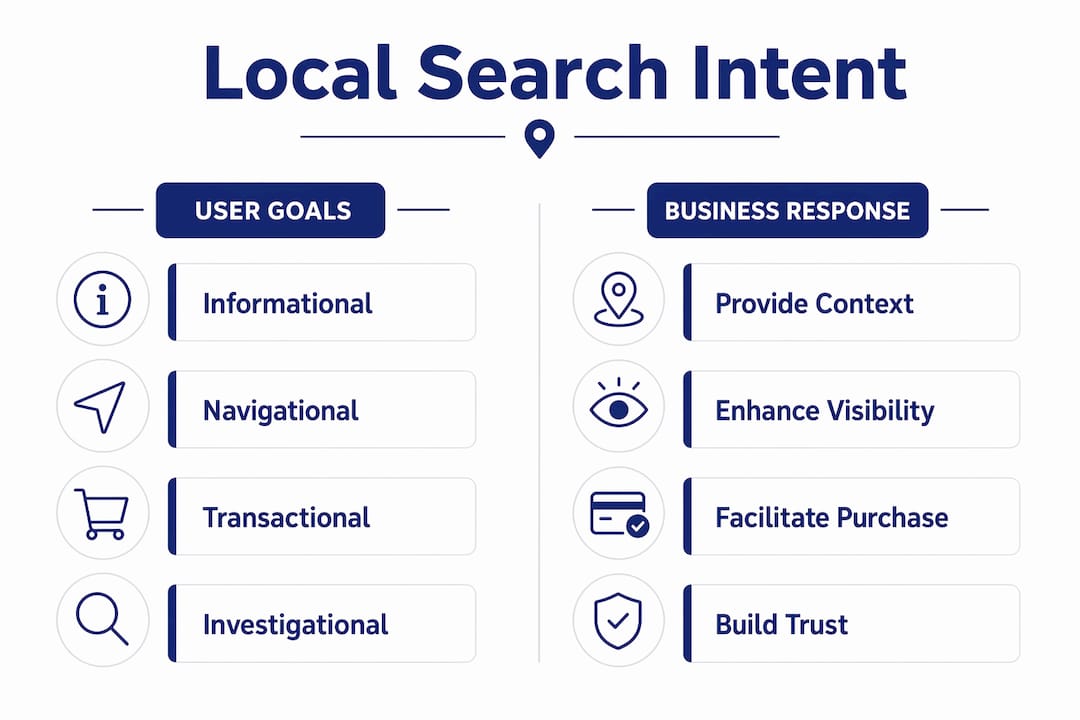
Four main local intent types define how users approach geographically focused searches, and each one demands a different response from your business.
| Intent Type | Example Query | User Goal | Best Business Response |
|---|---|---|---|
| Informational | “How much does a roof repair cost in Denver?” | Learn before deciding | Local blog post, FAQ page, cost guide |
| Navigational | “Mike’s Auto Shop Chicago” | Find a specific business | Accurate GBP listing, branded landing page |
| Transactional | “Book a haircut near me open now” | Act immediately | Booking button, real-time hours, click-to-call |
| Investigational | “Best Italian restaurants in Nashville” | Compare options | Reviews, comparison content, local guides |
Informational intent users are at the top of the decision funnel. They want context, not a sales pitch. A local HVAC company that publishes a guide on “average AC replacement costs in Phoenix” captures this audience before they ever type a transactional query.
Navigational intent is the most direct. The user already knows your business name and just wants to find you quickly. If your Google Business Profile has an outdated address or your website lacks a clear contact page, you lose a customer who was already sold on you. That is a preventable failure.
Transactional intent carries the highest urgency. Phrases like “open now,” “near me,” and “same day” signal that the user is ready to spend money within the hour. Investigational intent sits between research and purchase. The user is comparing options, reading reviews, and building a shortlist. This is where your reputation and review volume do the selling for you.
Pro Tip: Run your top local keywords through Google Search Console and segment them by intent type. You will likely find that your highest-traffic pages are optimized for informational queries while your highest-value customers are searching with transactional intent.
How does local search intent shape Google’s local rankings?
Google’s local search algorithm ranks results based on three core factors: relevance, distance, and prominence. GBP signals carry the strongest impact, with reviews, NAP (name, address, phone) consistency, and category accuracy all feeding directly into how Google interprets your business’s relevance to a given local query.
Relevance measures how well your business profile and website content match the user’s query. Distance is straightforward: Google factors in the user’s physical location relative to your business. Prominence reflects how well-known and trusted your business is, drawing on review volume, backlinks, and citation consistency across directories like Yelp, Apple Maps, and Bing Places.
What has changed significantly in 2026 is the weight Google places on behavioral engagement. Clicks to call, direction requests, and website visits from your Google Business Profile are now treated as strong ranking signals. A business that generates consistent behavioral engagement signals to Google that real users find it relevant and trustworthy.
Review quality has also evolved. Recent reviews and review text semantics carry more ranking influence than old reviews or simple star ratings. Google’s AI reads the actual language in reviews to assess whether your business is genuinely relevant to specific local queries. A plumber with 40 reviews mentioning “emergency leak repair” will outrank a competitor with 200 generic five-star ratings for the query “emergency plumber near me.”
The practical implication is clear: your Google Business Profile is not a static directory listing. It is a live, behavioral data source that Google uses to decide whether you deserve to appear in the local pack for a given intent type.
What are the common mistakes businesses make with local search optimization?
The most damaging mistake in local search optimization is treating all local queries as transactional. Content mismatched to local intent reduces conversions significantly, and yet most small business websites publish only service pages and contact forms, ignoring the informational and investigational stages entirely.
Here are the most common pitfalls Battleseo sees across client audits:
- Publishing long-form blog content for transactional queries. A user searching “dentist open Saturday near me” does not want a 1,500-word article about dental health. They want your hours, address, and a booking button within three seconds.
- Ignoring real-time business information. Outdated hours, a disconnected phone number, or a missing holiday schedule on your Google Business Profile will cost you transactional customers who needed you right now.
- Neglecting review generation. Businesses that do not actively request reviews from satisfied customers fall behind competitors who do, especially as Google’s AI increasingly reads review text for relevance signals.
- Using the same landing page for every local keyword. A page optimized for “best coffee shop in Portland” serves investigational intent. A page for “coffee near me open now” serves transactional intent. They need different content structures, calls to action, and page formats.
Pro Tip: Audit your top five local landing pages and identify which intent type each one actually serves. Then check whether the page format, call to action, and content depth match that intent. Most businesses find at least two or three mismatches immediately.
How can businesses optimize for each local search intent type?
Effective local search strategies require a different tactic for each intent type. Building outward from a strong Google Business Profile foundation, here is how to approach each one.
-
Navigational intent: Keep your Google Business Profile fully updated with accurate hours, address, phone number, and photos. Create a branded landing page on your website that mirrors your GBP information exactly. Consistency between your website and your GBP listing is what Google uses to confirm your business’s identity.
-
Transactional intent: Add a booking button or click-to-call feature to your GBP and your website’s mobile view. Display your “open now” status prominently. If you run promotions, publish them as Google Posts so they appear directly in local search results. Speed and clarity win transactional searches.
-
Investigational intent: Prioritize review generation with a simple, repeatable process. Ask every satisfied customer to leave a review mentioning the specific service they received. Publish comparison content and local guides that position your business as the informed choice. A page titled “Best HVAC Companies in San Antonio: What to Look For” captures investigational searchers and builds authority.
-
Informational intent: Publish locally relevant blog content, FAQs, and community guides that answer the questions your customers ask before they are ready to buy. A landscaping company in Atlanta that publishes “When to overseed your lawn in Georgia” attracts homeowners months before they search for a landscaping service.
-
AI platform optimization: Local SEO now requires presence on AI-assisted platforms, including ChatGPT, Gemini, and Perplexity, in addition to Google Maps. These platforms prioritize quick, factual, and well-sourced local information. Structured data markup, consistent citations, and authoritative content all improve your visibility on AI-generated local answers. Battleseo’s AI search optimization guide covers this in detail for business owners who want to get ahead of this shift.
Monitor your Google Business Profile Insights monthly to track which actions users take after finding you. Direction requests, calls, and website clicks each correspond to different intent types, and the data tells you exactly where to invest your optimization effort next. For a deeper look at how to use ChatGPT and Gemini to improve your local presence, Battleseo’s ChatGPT and Gemini guide is a practical starting point.
Key takeaways
Local search intent is the single most important factor in determining whether your content, listings, and local pages convert nearby searchers into paying customers.
| Point | Details |
|---|---|
| Four intent types exist | Informational, navigational, transactional, and investigational each require a different content and GBP response. |
| Behavioral signals now rank | Clicks to call, direction requests, and profile visits are weighted ranking factors in Google’s local algorithm. |
| Review text quality matters | Google’s AI reads review language for relevance, making specific review text more valuable than star ratings alone. |
| Content must match intent stage | A transactional query needs a booking button, not a blog post. Mismatched formats cost conversions. |
| AI platforms require optimization | Visibility on ChatGPT, Gemini, and Perplexity now supplements Google Maps presence for local search success. |
Why local intent mastery is the competitive edge most businesses overlook
I have worked with dozens of independent business owners across markets in Connecticut and Texas, and the pattern is consistent. Most businesses have a Google Business Profile. Most have a website. Almost none have mapped their content to the four stages of local intent.
The businesses that win local search in 2026 are not the ones with the biggest budgets. They are the ones that understand what a customer actually wants at each moment in their search journey and have built their online presence to meet that moment precisely. A transactional searcher who lands on a long-form blog post will leave. An investigational searcher who finds no reviews will move to the next result. These are not algorithm problems. They are alignment problems.
The emergence of AI-powered local search on platforms like Gemini and Perplexity has raised the stakes further. These platforms pull structured, factual, and well-sourced local information to generate answers. Businesses that have invested in consistent citations, authoritative content, and a complete GBP are already positioned to appear in AI-generated local responses. Businesses that have not are invisible on a growing share of local searches.
My honest observation after years in this space: most local SEO failures are not technical. They are strategic. The business owner who takes the time to understand what drives local searches, and then aligns every page and listing to serve a specific intent type, will outperform competitors who are simply “doing SEO” without that clarity.
— Mike
How Battleseo helps you win local search
Battleseo specializes in local SEO and AI search optimization for independent business owners who want to dominate their local market, not just appear in it.
Our Local Command Directive™ framework covers Google Business Profile optimization, citation building, authority backlinks, review management, and on-page content aligned to each local intent type. We work with one business per service category per market, so your investment goes toward becoming the dominant local authority, not splitting attention across competitors. If you are ready to turn local search intent into a consistent source of customers, explore our local SEO services and see whether your market is still available.
FAQ
What is local search intent in simple terms?
Local search intent is the specific goal a user has when searching for a product, service, or information tied to a geographic location. It tells businesses what a nearby customer wants at that exact moment, whether that is directions, a booking, or a comparison of options.
How many types of local search intent are there?
There are four types: informational, navigational, transactional, and investigational. Each type signals a different stage in the customer’s decision process and requires a different response from your website and Google Business Profile.
Why do local mobile searches convert so quickly?
78% of local mobile searches lead to an offline purchase within 24 hours because mobile users are typically in proximity to a business and ready to act. Transactional intent is especially strong on mobile, which is why click-to-call and real-time hours are non-negotiable for local businesses.
How does Google decide which local businesses to rank?
Google ranks local results based on relevance, distance, and prominence. GBP signals including review text, NAP consistency, and behavioral engagement metrics like direction requests and calls are the most influential factors in 2026.
Do AI platforms like ChatGPT show local search results?
Yes. Local SEO now requires presence on AI-assisted platforms including ChatGPT, Gemini, and Perplexity, which generate local answers from structured, well-cited business information. Businesses with consistent citations and authoritative content are more likely to appear in these AI-generated responses.