
TL;DR:
- AI-driven local search increasingly favors well-structured content, schema markup, and consistent citations over traditional proximity signals. Optimizing for AI involves answer-first paragraphs, question-based headings, schema implementation, and regular content updates with fresh "dateModified` markers to improve visibility. Businesses that adapt now by combining SEO, schema, and citation strategies will gain a significant advantage before AI search becomes the dominant discovery channel.
Your local business might rank on the first page of Google, yet still be completely invisible to customers who ask ChatGPT or Gemini for a recommendation. That gap is growing every month. More people now turn to AI-powered platforms for local suggestions, from “best plumber near me” to “top-rated HVAC company in Austin,” and if your business isn’t structured for AI extraction, you simply won’t come up. This guide gives you a practical, step-by-step path to fix that, covering everything from Google Business Profile setup to schema markup, content structuring, and ongoing verification.
Table of Contents
- What you need to know: How AI impacts local search
- Preparation: Tools and requirements for AI content optimization
- Step-by-step: Optimizing your content for ChatGPT and Gemini
- Verification: Measuring AI visibility and common pitfalls
- Why mastering AI content optimization now sets you apart
- Accelerate your local AI visibility with expert help
- Frequently asked questions
Key Takeaways
| Point | Details |
|---|---|
| AI search changes local SEO | AI platforms like ChatGPT and Gemini prioritize new signals and content structures over basic proximity and reviews. |
| Optimize Google Business Profile | A complete, frequently updated Google Business Profile is crucial for AI-powered recommendations and visibility. |
| Structure content for extraction | Use short, answer-first paragraphs, schema markup, and clear lists to improve AI content extraction and local search rankings. |
| Track and adapt regularly | Measure your AI-driven search visibility and refresh content and citations at least quarterly to stay ahead. |
What you need to know: How AI impacts local search
Now that you see the risks and opportunities, let’s clarify what’s changed with AI-driven search.
Traditional local SEO centered on proximity signals, backlink counts, and keyword density. AI-powered search works differently. Platforms like ChatGPT and Gemini don’t just crawl your site. They pull structured data from indexed sources, synthesize it, and generate a recommendation that may or may not include your business. Getting included requires a different set of signals.
AI SEO and GEO methodologies involve optimizing content for Retrieval-Augmented Generation (RAG) pipelines, focusing on indexability, chunkable self-contained paragraphs, structured data like FAQ and LocalBusiness schema, E-E-A-T signals, and freshness tracked through dateModified. Each of these factors tells an AI model that your content is reliable, current, and extractable. Miss even one, and you may be filtered out.
The distinction matters. Traditional local SEO remains foundational, but it’s insufficient on its own. AI models prioritize semantic relevance over proximity or domain authority. A well-structured page from a newer business can outrank an established competitor with dozens of backlinks if it answers questions more clearly. That’s a real opportunity for independent business owners willing to adapt.
Key differences between traditional SEO and AI-driven search:
| Factor | Traditional SEO | AI-driven search |
|---|---|---|
| Primary signal | Proximity + backlinks | Semantic relevance + structured data |
| Content format | Keywords + meta tags | Chunkable paragraphs + schema |
| Source preference | High domain authority | Third-party corroboration + E-E-A-T |
| Freshness signal | Crawl frequency | dateModified schema field |
| Local data source | Google Maps index | Google Business Profile + citations |
Research from Princeton and Georgia Tech shows that AI SEO boosts visibility by up to 40% when content is properly structured for AI extraction pipelines. That’s not a minor improvement. It’s the difference between showing up and being invisible.
“AI search doesn’t just find information. It selects and synthesizes information. The businesses that get recommended are the ones that make themselves easy to extract, cite, and trust.”
Improving your SEO visibility strategies now, before AI search becomes the dominant discovery channel, gives you a compounding advantage. Understanding AI’s impact on SEO at a foundational level will help you make smarter decisions at every stage of this process.
Preparation: Tools and requirements for AI content optimization
With the essentials in place, you’re ready to execute the AI-first optimization steps.
Before touching a single piece of content, you need your infrastructure in order. Think of this phase as building the foundation. If your Google Business Profile is incomplete or your business name and address are inconsistent across directories, no amount of content optimization will compensate.
Complete Google Business Profile (GBP) optimization is crucial for local AI visibility. Categories, services, photos, posts, reviews, and attributes all matter. Gemini in particular pulls heavily from GBP data when generating local recommendations. If your profile is outdated or missing key details, Gemini may not surface your business at all, even if your website is well-optimized.

Here’s the core toolkit every independent business owner needs before starting:
Essential tools and assets for AI content optimization:
- Google Business Profile (GBP): Fully completed with accurate NAP (Name, Address, Phone), all relevant categories, services, hours, and at least 10 recent photos
- Schema markup generator: Tools like Google’s Structured Data Markup Helper for FAQ and LocalBusiness schema
- Content audit tool: Screaming Frog or a similar site crawler to identify pages lacking structure
- Review management: A system for gathering and responding to reviews on Google, Yelp, and BBB
- Citation tracker: A spreadsheet or tool to verify consistent NAP across 20+ directories
- AI visibility checker: Local Falcon or SOCi for tracking how your business appears in AI-driven local queries
According to HubSpot’s optimization guide, independent US business owners should start with a GBP audit and schema implementation, use ChatGPT and Gemini for rapid local content creation such as city-specific pages, track visibility manually via queries or tools like Local Falcon and SOCi, and prioritize earned local citations over paid links.
Schema types you need for AI search:
| Schema type | Purpose | Priority |
|---|---|---|
| LocalBusiness | Business name, address, phone, hours | Critical |
| FAQ | Structured Q&A for AI extraction | High |
| Review | Displays star ratings in results | High |
| Service | Details about specific offerings | Medium |
| BreadcrumbList | Site structure for crawlers | Medium |
Start your GBP optimization steps by auditing every field in your profile against your website and key directories. Inconsistencies in your address format, even something as minor as “St.” versus “Street,” can fragment your citation profile. For GBP engagement tips that go beyond the basics, consistent posting and Q&A management help signal activity to both Google and AI platforms. To drive local GBP visibility further, request reviews from customers shortly after service delivery while the experience is fresh.
Pro Tip: When testing AI visibility manually, save screenshots of your results in ChatGPT and Gemini on the same dates each month. This gives you a baseline for measuring progress without requiring a paid tracking tool right away.
Step-by-step: Optimizing your content for ChatGPT and Gemini
Execution is key. Let’s break down each crucial step for AI-first optimization.
This is where strategy meets action. Structuring your content for AI extraction isn’t complicated, but it does require consistency across every page. Follow these steps in order and apply them starting with your highest-traffic pages.
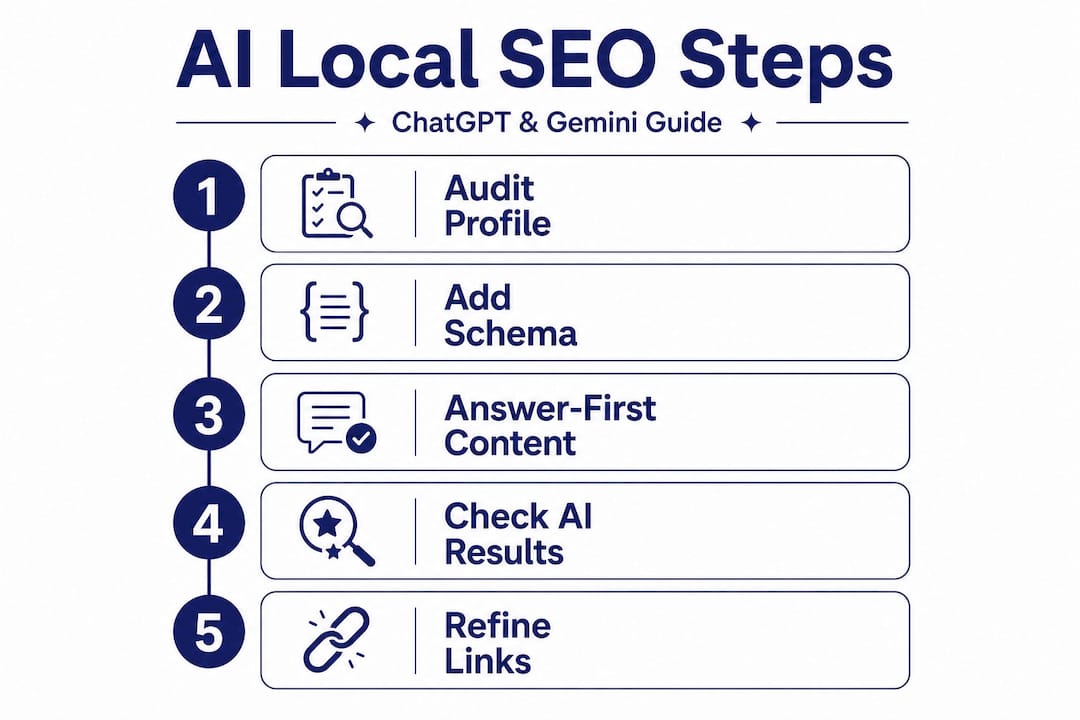
1. Write answer-first paragraphs.
Open every section with a direct answer to the question the heading poses. The first 50 words of a paragraph carry significant weight in AI extraction. Don’t bury the answer below background information. Lead with it.
2. Apply the Island Test to every content chunk.
Ask yourself: if this paragraph were pulled out of context, would it still make sense and provide value? If not, rewrite it so it stands alone. This is the Island Test. AI systems extract isolated chunks and recombine them. Context-dependent writing gets dropped.
3. Structure headings as questions.
Use H2 and H3 headings that mirror how customers actually phrase their queries. “What does an HVAC tune-up include?” performs better for AI extraction than “Our services.” Question-format headings match AI’s query fan-out behavior, where models expand a single prompt into multiple sub-queries.
4. Implement FAQ and LocalBusiness schema.
Add structured JSON-LD schema to every key page. FAQ schema turns your Q&A sections into data that AI models can directly extract. LocalBusiness schema ensures your name, address, phone, and hours are machine-readable, not just visible on the page. Use Google’s Rich Results Test to verify implementation.
5. Use numbered lists, bullet points, and tables.
These formats are far easier for AI to extract and present than dense prose. When describing a process, use a numbered list. When comparing options, use a table. This mirrors how AI models prefer to present information to users.
6. Keep paragraphs short.
Two to three sentences per paragraph is the target. Long blocks of text reduce extractability and hurt readability for both humans and AI systems.
7. Update dateModified on every revision.
AI platforms, especially those using Google’s index like Gemini, weight content freshness. Each time you update a page, modify the dateModified field in your schema and in your page’s HTML head section.
There’s an important edge case to understand. ChatGPT requires Bing indexing and OAI-SearchBot allowance in your robots.txt. Gemini favors the Google ecosystem, including Maps and YouTube. Some fragmented sectors like auto repair show as little as 2.5% overlap between what ChatGPT and Gemini recommend. That means you may need to optimize for both platforms separately. Check your robots.txt file to confirm you’re not blocking either platform’s crawler.
Your AI search optimization tips should address both platforms in parallel. The businesses that combine SEO and AI strategies see the most durable visibility gains because they aren’t reliant on any single platform’s algorithm.
Pro Tip: Run live queries in ChatGPT and Gemini using the exact phrases your customers would use: “best [your service] in [your city]” and “who do you recommend for [your service] near [your city]?” Compare the results monthly. You’ll see improvements much faster than waiting for ranking reports.
Verification: Measuring AI visibility and common pitfalls
Once your actions are implemented, measuring and troubleshooting your results is vital for ongoing success.
Optimizing without measuring is guesswork. The verification phase is where most businesses fall short, not because the work wasn’t done, but because they don’t know what to look for after doing it.
How to track AI-specific local visibility:
| Tracking method | What it measures | Frequency |
|---|---|---|
| Manual AI queries (ChatGPT/Gemini) | Direct appearance in AI results | Monthly |
| Local Falcon grid scans | AI-driven local pack position | Bi-weekly |
| SOCi AI monitoring | Brand mentions in AI outputs | Monthly |
| Google Search Console | Organic traffic trends from structured data | Weekly |
| Citation audit | NAP consistency across directories | Quarterly |
AI favors third-party corroboration over self-published content. That means your presence on Yelp, BBB, local chambers of commerce, and industry-specific directories carries real weight. Build citations on high-authority sites and earn media mentions where possible, because an AI model is far more likely to recommend a business that appears consistently across multiple trusted sources.
Topic clusters matter more than single-keyword pages. Building topic clusters addresses the full range of sub-queries an AI might generate from a single customer prompt. For example, if a customer asks “who’s the best plumber in Dallas,” an AI might generate sub-queries covering emergency plumbing, water heater repair, leak detection, and drain cleaning. If you have a dedicated page for each of those topics that is properly structured, your chances of being pulled into the response increase significantly.
Most common reasons for poor AI visibility:
- Incomplete or inconsistent Google Business Profile
- No FAQ or LocalBusiness schema on key pages
- OAI-SearchBot or Bingbot blocked in robots.txt
- Content written in long, unbroken paragraphs (fails the Island Test)
- No earned citations on third-party directories
- Outdated
dateModifiedfields (content appears stale) - Single keyword focus instead of topic cluster coverage
“AI-specific traffic is doubling monthly, yet it still represents less than 1% of total search traffic for most businesses. That combination means acting now gives you a first-mover advantage before the channel becomes competitive.”
Strengthen your position by building local link building strategies that focus on earned mentions from local news, associations, and community organizations. Pair that with a strong internal linking structure across your own site to help AI crawlers understand your topical authority and site hierarchy.
Why mastering AI content optimization now sets you apart
Having measured your progress, put all the lessons into perspective to drive continuous competitive advantage.
Here’s our honest take after working with independent business owners across dozens of markets: most are still treating AI visibility as a future problem. That’s a mistake. The businesses we see pulling ahead right now aren’t waiting to see how the landscape settles. They’re engineering their content for AI extraction today, and they’re building a lead that will be difficult for slower competitors to close.
The uncomfortable truth is that proximity and reviews alone are no longer enough. AI prioritizes semantic relevance over proximity and domain authority. A business two miles away with a well-structured site and strong third-party citations will beat a closer competitor that hasn’t updated its site in two years. Generative AI doesn’t care how long you’ve been in business. It cares about how well your content answers the questions customers are asking.
At the same time, don’t fall into the trap of over-automating. AI-generated content has a roughly 30% error rate in factual accuracy in some cases. That’s not a small margin. Every piece of content that goes out with your business’s name attached needs a human review. That review also gives you the opportunity to add the kind of specific, local detail that AI can’t generate on its own, the neighborhood context, the real customer story, the service nuance that sets you apart.
What we recommend, grounded in experience working with adapting to AI search strategies, is to schedule quarterly content audits. Check your schema, review your citation profile, run your AI visibility queries, and update your dateModified fields. LLM models retrain regularly, and what ranks well today may require adjustment in six months. Build the habit now and you won’t scramble to catch up later.
Pro Tip: Keep a running log of which queries return your business in AI results and which don’t. The gaps in that log are your content roadmap. Build pages and topic clusters targeting the queries where you’re missing, and you’ll see your AI visibility expand steadily over time.
Accelerate your local AI visibility with expert help
For those who want to accelerate results or remove all the guesswork, professional assistance offers a proven path forward.
Knowing what to do and having the bandwidth to execute it consistently are two very different things. We understand that independent business owners are running operations, managing staff, and serving customers. SEO and AI optimization can fall to the bottom of the list fast.
At Battle SEO®, we handle the full spectrum of AI search optimization services that this guide covers, from schema implementation and content restructuring to GBP audits and citation building. Our Local Command Directive™ framework is purpose-built to position independent businesses as the dominant local authority in their market. We also take on only one business per service category per market, which means when you work with us, we’re fully committed to your visibility, not a competitor’s. Ready to move forward? Start with our GBP local optimization service or explore the full path to unlock local SEO growth.
Frequently asked questions
How do I know if my business appears in ChatGPT or Gemini results?
Search for your business using natural queries in ChatGPT or Gemini, or use tools like Local Falcon and SOCi to track AI-driven local rankings. You can track visibility manually via direct queries or these purpose-built platforms.
What are the most important factors for AI-driven local search ranking?
Key factors include a complete Google Business Profile, chunkable answer-first content, schema markup, earned local citations, and semantic topic clusters. GBP optimization is especially critical since AI platforms pull heavily from that data source for local recommendations.
Do backlinks and reviews still help with AI search results?
Yes, but the emphasis shifts. AI values third-party citations and NAP consistency over self-published content, making authoritative directory listings on Yelp, BBB, and industry sites especially influential.
How often should I update my content for AI visibility?
Update your local content and schema at least quarterly, or whenever you add new services. AI SEO freshness signals depend on the dateModified field and regular content updates to signal that your information is current.
Can I automate AI content optimization or should it be manual?
You can automate schema markup and data sync, but always review AI-generated content manually. Human review is essential because AI-generated content carries roughly a 30% error rate in some scenarios, which can damage your credibility if published unchecked.