
TL;DR:
- Effective SEO leadership now emphasizes business acumen, cross-functional influence, and organizational systems over technical skills alone.
- Successful leaders act as multipliers by enabling autonomous decision-making within their teams and aligning SEO with revenue goals.
Most people still picture an SEO leader as someone who lives inside a keyword research tool, obsesses over crawl budgets, and explains meta tags to confused colleagues. That picture is outdated. What makes an SEO leader today has less to do with technical depth and far more to do with commercial judgment, cross-functional influence, and the ability to turn a scattered organization into a visibility machine. If you manage an SEO team or aspire to lead one, this article breaks down the qualities, systems, and metrics that separate real SEO leadership from skilled SEO practice.
Table of Contents
- Key takeaways
- Core qualities that define effective SEO leaders
- The multiplier model and team enablement
- Systems thinking and organizational design
- Metrics and reporting for executive buy-in
- My honest take on SEO leadership
- Ready to build visibility that actually scales?
- FAQ
Key takeaways
| Point | Details |
|---|---|
| Leadership goes beyond technical skill | Effective SEO leaders translate search performance into business outcomes, not just rankings. |
| Multiplier mindset matters | The best leaders scale their team’s decision-making ability rather than doing the work themselves. |
| Systems thinking beats page optimization | Great SEO leaders redesign organizational workflows so visibility is a shared, cross-department goal. |
| Metrics must speak to the executive | Reports tailored for CEOs and CMOs drive budget and buy-in faster than practitioner dashboards. |
| Adaptability is non-negotiable | Leaders who update their approach as algorithms and AI tools shift protect teams from costly strategic drift. |
Core qualities that define effective SEO leaders
SEO leadership in 2026 involves strategic prioritization, commercial judgment, and persuading stakeholders rather than just executing technical tasks. That shift changes everything about how you should evaluate or develop an SEO leader.
The most important quality is business acumen. An SEO leader who cannot connect organic traffic growth to pipeline, revenue, or customer acquisition cost will always struggle for budget and executive attention. You need to understand how the company makes money, where SEO fits in the revenue model, and how to present that connection clearly to people who do not care about domain authority scores.
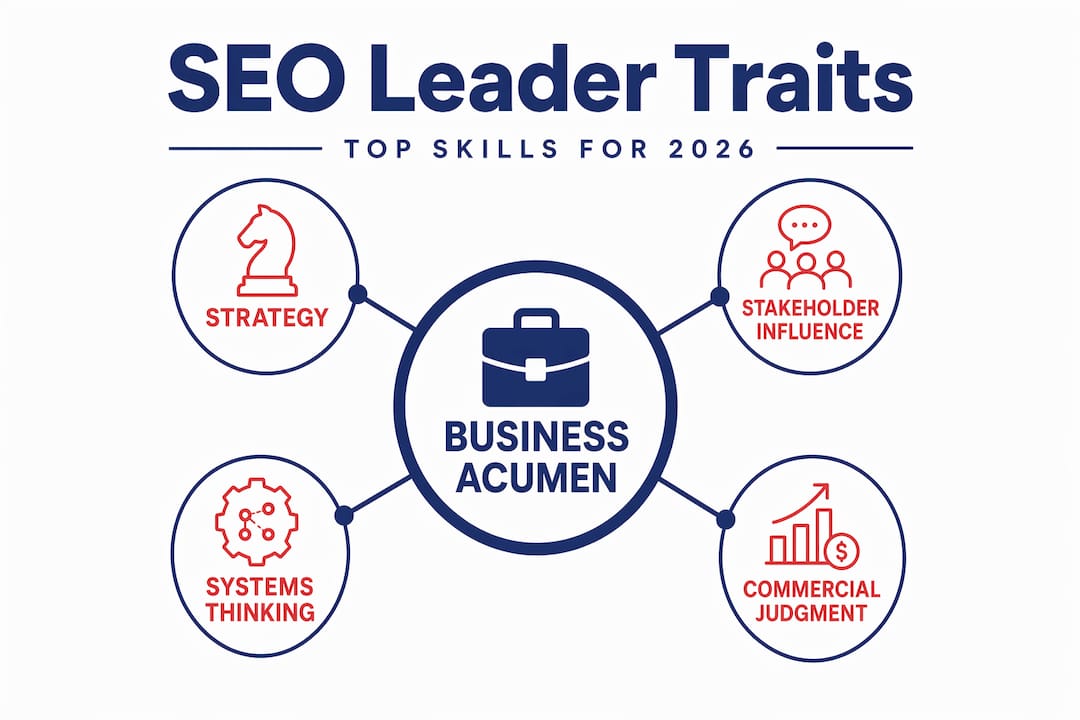
Close behind that is communication. The biggest misconception is that SEO leadership is purely technical. The real work is convincing and aligning cross-departmental stakeholders, from product managers to PR directors, so that SEO requirements actually get implemented. If you can only explain your strategy to people who already understand it, your influence stops at the edge of your own team.
Here are the core attributes that separate effective SEO leaders from strong individual contributors:
- Business goal alignment. They connect SEO priorities directly to revenue, retention, and market share goals rather than chasing traffic for its own sake.
- Adaptability. Algorithm updates, AI-driven search changes, and shifting user behavior require leaders who adapt SEO strategy without panic or paralysis.
- Cross-functional collaboration. Effective leaders build relationships with product, engineering, content, and PR teams so SEO wins compound across the organization.
- Stakeholder communication. They translate technical findings into language that motivates action from non-technical partners.
- Avoidance of vanity metrics. Leaders who report on keyword rankings as a proxy for success miss the signals that actually predict performance shifts before they appear in traffic data.
Pro Tip: Before your next executive presentation, replace every “we ranked #3 for X keyword” bullet point with a revenue or pipeline equivalent. If you cannot make that translation, that is your development priority as an SEO leader.
The multiplier model and team enablement
The shift toward AI-powered workflows has redefined what good SEO leadership looks like at the operational level. Effective SEO leaders in 2026 act as multipliers who enable team autonomy and scale knowledge rather than micromanaging execution. If you are still the person who reviews every brief, approves every content angle, and troubleshoots every technical issue, you are a bottleneck, not a leader.
The multiplier model works like this: instead of scaling output by doing more yourself, you scale it by building a team that makes consistently good decisions without you in the room. The test is simple. Can your team identify a crawlability issue, prioritize it against other work, and present a fix to a stakeholder, all without your involvement? If not, your leadership is creating dependency instead of capability.
How do you get there? Here is a practical sequence:
- Teach the reasoning, not just the task. When you delegate, explain why a task matters, not just how to complete it. Teams that understand the “why” behind their work make better decisions independently.
- Invest automation savings into strategy. The multiplier model reinvests time saved by automation into experimentation, collaboration, and stakeholder education. Use AI tools to eliminate repetitive tasks, then spend that reclaimed time on higher-order thinking with your team.
- Create space for productive failure. Teams that never make a call without your sign-off never build judgment. Give your team real decisions with real consequences, then debrief constructively when the outcome is imperfect.
- Measure leadership by team confidence. Ask yourself regularly: how confidently are my team members challenging assumptions and proposing new directions? Low confidence signals over-dependence. High confidence signals that your multiplier approach is working.
Pro Tip: Track how many decisions your team makes per week without escalating to you. If that number is not growing over time, your leadership development work is not producing results yet.
Systems thinking and organizational design
The most underappreciated quality of great SEO leadership is the ability to think like a systems architect. You are not optimizing pages. You are optimizing how your entire organization produces and signals information to search engines and AI platforms alike.

Modern SEO leaders redesign organizational systems for visibility by embedding SEO requirements into product, PR, and content workflows through shared OKRs. That means a product team launch checklist includes structured data requirements. It means a PR campaign brief includes anchor text and entity coverage goals. It means content calendars are built around query coverage gaps, not just editorial preferences.
The table below shows how this thinking shift plays out in practice:
| Traditional SEO manager | SEO leader as systems architect |
|---|---|
| Optimizes existing pages for target keywords | Designs content workflows that produce visibility-ready assets from the start |
| Flags technical issues to engineering | Embeds SEO requirements into engineering sprint templates |
| Reports on traffic and rankings | Reports on share of voice and organic revenue contribution |
| Works reactively with PR after campaigns | Collaborates with PR pre-launch to ensure brand signals and backlink strategy are aligned |
| Monitors Google Search Console alone | Tracks AI search visibility across ChatGPT, Perplexity, and Gemini alongside traditional search |
This systems-level work is also where SEO leadership becomes critical for AI search. The same cross-functional collaboration that improves Google rankings also strengthens how your brand appears in AI-generated answers, because both depend on consistent entity signals, authoritative backlinks, and structured content. Building this into product and PR workflows is not optional anymore. It is the competitive edge that separates organizations building durable visibility from those chasing the algorithm of the month.
Metrics and reporting for executive buy-in
One of the most practical skills needed for SEO leadership is knowing how to present performance data to people with different priorities. A practitioner cares about impressions, click-through rates, and crawl errors. An executive cares about revenue, market share, and cost efficiency. These are not the same conversation.
Executive SEO leadership requires a succinct one-page summary with six core business-impact metrics: organic revenue contribution, share of voice, cost-per-acquisition from organic, lead volume from organic, content coverage versus competitors, and crawlability health. Notice that keyword rankings do not appear on that list. Rankings are a practitioner input. Revenue contribution is a leadership output.
The reporting approach should also vary by audience. Tailoring communication differently for CEOs, CMOs, and operating partners maximizes your influence and budget outcomes:
- For CEOs: One slide, three numbers. Organic revenue this quarter versus last, share of voice trend, and the projected impact of the next strategic initiative.
- For CMOs: Provide strategic depth. Show how SEO performance interacts with paid, email, and social channels. Connect SEO analytics to the full marketing mix.
- For investors or portfolio managers: Standardized efficiency metrics. Organic traffic cost equivalent, CAC from organic, and year-over-year organic growth rate.
Strong SEO leaders also avoid vanity metrics and focus on leading indicators like crawlability health and query coverage. These signals predict performance shifts weeks before they show up in traffic data, which means a leader who tracks them can protect a project from churn instead of explaining a traffic drop after the fact. Pair that with a regular SEO gap analysis to show executives exactly where opportunity exists relative to competitors, and you have reporting that actually drives decisions.
My honest take on SEO leadership
I have worked with enough SEO teams to know that the hardest part of this job is not understanding Google’s algorithm. It is convincing a product manager that their launch needs structured data, or persuading a CFO that an organic channel deserves a larger budget than the paid channel with a worse CAC. Those conversations require a completely different skill set than technical SEO.
In my experience, the SEO leaders who flame out fastest are the ones who never make the shift from practitioner to multiplier. They stay in the weeds because it feels productive, but their teams stagnate and their organizational influence stays flat. The leaders who build lasting careers are the ones who treat team autonomy as a measurable goal, not a nice-to-have.
The uncomfortable truth about vanity metrics is this: if you are still leading with rankings in your executive reports, you are signaling that you do not understand the business. I have seen strong SEO practitioners lose budget battles because they could not close the attribution gap between traffic and revenue. That gap is where SEO leadership either earns or loses credibility.
As AI accelerates the pace of change in search, the leaders who will stay relevant are the ones who build organizations capable of adapting quickly, not the ones who personally know the most about any given algorithm update. Build systems. Build teams. Build the habit of translating SEO performance into business language every single time.
— Mike
Ready to build visibility that actually scales?
Understanding what makes an SEO leader is one thing. Putting those principles into practice inside a real business is another. At Battleseo, we work with independent business owners and marketing teams to build the kind of local search authority that translates directly into revenue.
Our Local Command Directive™ framework covers everything from Google Business Profile optimization and authority backlinks to AI search visibility on platforms like ChatGPT, Perplexity, and Gemini. If you want your business to show up where decisions are being made, whether on Google Maps or in an AI-generated answer, explore our local SEO services and see how we approach building dominant local visibility for the businesses we serve.
FAQ
What makes an SEO leader different from an SEO manager?
An SEO leader focuses on organizational influence, cross-functional alignment, and business impact, while an SEO manager typically focuses on task execution and team oversight. The distinction is about scope and strategic reach, not just seniority.
What skills are most important for SEO leadership?
The most critical skills are business communication, stakeholder alignment, commercial judgment, and systems thinking. Technical SEO knowledge matters, but SEO leadership success depends on translating that knowledge into decisions that move revenue.
How should an SEO leader present metrics to executives?
Focus on organic revenue contribution, share of voice, and cost-per-acquisition from organic channels. Keep executive reports to one page, and tailor the depth and framing based on whether you are speaking to a CEO, CMO, or investor.
How does AI change the role of SEO leadership?
AI tools automate many execution tasks, which frees up leaders to focus on strategy, experimentation, and stakeholder education. The best leaders use this shift to build more autonomous teams rather than simply accelerating their own output.
How do you become an SEO leader?
Start by developing commercial fluency: understand how the business you serve makes money and where organic search fits in that model. Then practice translating technical findings into business language, and actively build relationships across product, content, and PR teams to expand your organizational influence.