
TL;DR:
- Automated SEO enables small businesses to scale efforts and increase local search visibility efficiently.
- Automation results in faster, larger traffic gains and higher customer actions compared to manual SEO.
- Combining automation with human input maximizes SEO effectiveness and maintains local brand authenticity.
SEO automation isn’t just for enterprise companies with deep pockets and dedicated technical teams. Independent business owners across the US are now using automated SEO strategies to compete at a level that would have taken years of manual effort. AI-optimized sites for SMBs earn 3.2x more traffic and 2.7x more form submissions than those relying on traditional methods alone. That gap is widening every month. This guide breaks down what SEO automation actually means for a local business, shows you exactly where automation delivers the biggest returns, and gives you a practical roadmap for putting it to work without losing the human touch that makes your brand stand out.
Table of Contents
- What does automated SEO mean for independent businesses?
- How automation drives more traffic and customer actions
- The core tasks you should automate (and what requires a human touch)
- Automation for local SEO and how it powers AI search visibility
- The uncomfortable truth: Automation multiplies the gap between action and inaction
- Ready to automate your SEO and win more local customers?
- Frequently asked questions
Key Takeaways
| Point | Details |
|---|---|
| SEO automation delivers results | Automated SEO can multiply your web traffic and leads far faster than manual methods. |
| Programmatic SEO captures local searches | Generating city and service pages at scale lets you reach more nearby customers searching for your services. |
| Balance automation with human strategy | Combine automated tools for scale with your personal insights for local and AI search domination. |
| Adapt early to outpace competition | Embracing automation now helps you stay ahead as AI-driven search continuously evolves. |
What does automated SEO mean for independent businesses?
SEO automation is the practice of using software and systems to handle repetitive, data-heavy optimization tasks that would otherwise consume hours of your time every week. Think of it as setting up a process that runs in the background, continuously auditing your site, tracking your rankings, generating location-specific content, and flagging technical problems before they cost you customers.
For an independent business owner, the concept might sound abstract at first. But in practice, automation handles things like:
- Site audits: Automatically scanning your website for broken links, slow pages, missing meta descriptions, and other technical issues that drag down your rankings
- Keyword rank tracking: Monitoring where your business appears in search results for dozens or hundreds of relevant terms, without you checking manually each day
- City and service page generation: Creating optimized landing pages for every neighborhood, city, or service combination your business targets
- Reporting: Pulling performance data into clear summaries so you always know what’s working
- Content scheduling: Keeping your blog or service pages fresh with consistent updates that signal relevance to search engines
The real breakthrough comes from scale. Manual SEO is effective, but it tops out quickly. A single person can realistically optimize a handful of pages each week. Automation can handle hundreds at once, which is what it takes to capture today’s hyper-local search behavior.
“Programmatic SEO allows generation of city and service pages at scale for local businesses, capturing hyper-local queries that manual efforts simply cannot cover.”
Consider a plumbing company in Texas. With manual SEO, they might optimize pages for three or four cities near their headquarters. With programmatic, automated SEO, that same business can have unique, well-structured landing pages for 50 or more specific locations, each targeting the exact search terms customers in that area use. Each page adds another pathway for local customers to find them.

This scalability is especially critical as AI-powered search platforms like ChatGPT, Perplexity, and Gemini grow in popularity. These platforms pull structured, authoritative local data when answering user questions. Businesses that have a broad base of optimized local content are far more likely to surface as answers. If you want to understand how to adapt to this shift, exploring AI search platform adaptation gives a clear starting point for independent business owners building their strategy.
Automation, in short, gives you the infrastructure to compete across a wider footprint, with more consistency, and at a pace that manual methods simply cannot match.
How automation drives more traffic and customer actions
Numbers tell a clearer story than theory. When local businesses switch from purely manual SEO to automated, AI-enhanced approaches, the results are measurable and often dramatic. Automated blogging yields 22-46% organic session increases within just 90 to 180 days for local business cases, and that’s without factoring in the additional gains from programmatic landing pages or automated technical fixes.
Here’s a direct comparison to illustrate the difference in outcomes:
| SEO approach | Avg. traffic lift (6 months) | Form submissions | Time to impact |
|---|---|---|---|
| Traditional manual SEO | 8-15% | Modest increase | 6-12 months |
| Automated and AI-driven SEO | 22-46%+ | 2.7x more submissions | 90-180 days |
The numbers above reflect what AI-optimized sites for SMBs consistently achieve when automation is applied systematically. The gap isn’t marginal. It’s the difference between slow, incremental gains and compounding growth that builds on itself month over month.
Why does automation produce faster results? Three key reasons:
-
Automated audits identify gaps immediately. Rather than waiting weeks between manual reviews, automated systems flag technical errors, missed keyword opportunities, and content gaps in real time. You fix problems before they have a chance to hurt your rankings.
-
Programmatic content fills local gaps at scale. Each new city or service page you add is another chance to rank. A business with 60 location-specific pages has 60 pathways to the top of local search results. A business with 5 has only 5. Automation makes the 60-page strategy realistic for a small team.
-
Continuous monitoring speeds up iteration. You learn quickly what content is driving clicks and conversions, and automated reporting surfaces those insights without requiring you to dig through data manually. Faster feedback means faster improvement.
The customer action gains are equally important. More form submissions, more phone calls, more bookings. These aren’t just traffic metrics. They are the direct output of getting more people to pages that match their specific intent. Understanding how combining traditional and AI SEO strategies complement each other is key to making the most of this, and the AI optimization benefits for local businesses go well beyond what most owners initially expect.
Pro Tip: Don’t measure success only by traffic volume. Track the actions customers take after landing on your pages. Automated conversion tracking paired with automated content keeps both sides of the equation improving simultaneously.
Automation also frees up your most valuable resource: your time. Instead of managing SEO tasks manually, you redirect your energy toward strategy, customer relationships, and the parts of your business that genuinely require your expertise.
The core tasks you should automate (and what requires a human touch)
Not every SEO task benefits equally from automation. The smartest approach is knowing where to let automation run and where to stay closely involved. This balance is what separates businesses that see real growth from those that get mediocre results from tools alone.
Tasks that are well-suited to automation:
- Technical site audits: Crawl errors, page speed issues, broken redirects, and duplicate content are best caught by automated tools that scan continuously rather than periodically
- Keyword rank tracking: Monitoring position changes across dozens of keywords manually is tedious and time-consuming. Automation handles this daily without fail
- Basic content creation: Blog post drafts, location page templates, and FAQ content can be generated programmatically and then refined
- Local citation management: Keeping your business name, address, and phone number consistent across directories is exactly the kind of repetitive task automation handles well
- Performance reporting: Automated dashboards give you a clear view of traffic, rankings, and conversions without building reports from scratch each week
Tasks that still need your direct involvement:
- Local storytelling and branding: Automation can generate a page about your HVAC services in Austin, but only you know the story of your business, the local landmarks that matter, and the specific language your customers use
- Competitive strategy reviews: Understanding what a key local competitor is doing right requires human analysis and judgment, not just data
- High-value link building: Relationship-based outreach to local publications, partners, and community organizations is nuanced and benefits from a personal approach
- Responding to algorithm shifts: Search algorithms change constantly. For independent US business owners, automating repetitive tasks is essential to compete with larger firms, but layering human strategy ensures you stay agile when AI and local visibility rules evolve
- Customer-facing copy refinement: The final voice on your most important service pages should reflect your brand, not just keyword data
A useful case example: a landscaping company in Connecticut used automated tools to generate and optimize 40 location-specific service pages across the state. They saw a 35% lift in organic traffic within five months. However, the pages that converted best were those where the owner added personal touches, local references, and specific details about projects in each area. Automation built the foundation. Human input turned it into a sales tool.
Pro Tip: Review your automated content at least once a quarter. Search algorithms update frequently, and a strategy that worked in January may need adjustments by summer. Tools for AI search optimization steps and guides on algorithm update strategies can help you stay ahead of those changes.
Automation for local SEO and how it powers AI search visibility
Local SEO and AI search visibility are no longer separate conversations. When someone asks ChatGPT or Perplexity to recommend a business near them, those platforms pull from structured, authoritative content. Businesses that have automated, well-organized local pages are the ones that surface in those answers.
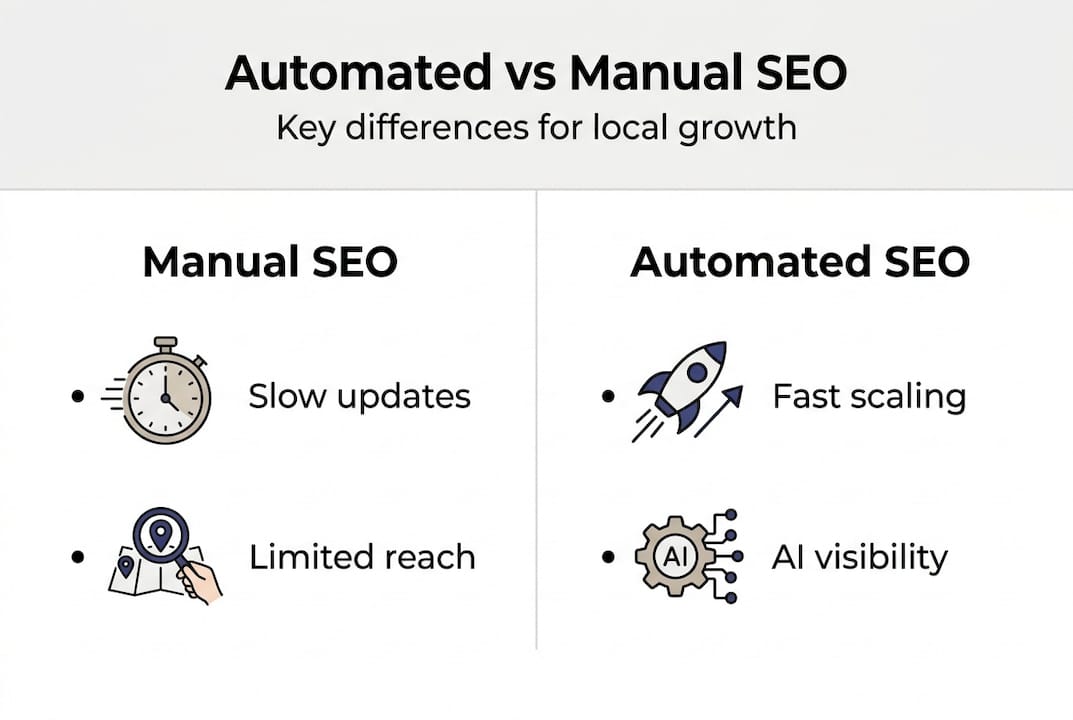
Here’s a side-by-side comparison of what manual versus automated local SEO looks like in practice:
| Task | Manual approach | Automated approach |
|---|---|---|
| Location page creation | 1-3 pages per week, inconsistent | Hundreds of pages generated from structured data |
| Business info updates | Manual edits across platforms, easily missed | Synced automatically across directories |
| Rank monitoring | Checked periodically, gaps in data | Daily tracking across all target keywords |
| Content freshness | Updated when time allows | Scheduled and automated at set intervals |
| AI search optimization | Rarely addressed systematically | Structured data and content automatically formatted for AI platforms |
The path to capturing hyper-local queries that your competitors miss runs directly through programmatic page creation. A roofing company that creates optimized pages for 30 suburbs around their primary city isn’t just targeting more searches. They’re building the kind of content breadth that signals genuine local authority to both Google and AI platforms.
Practical steps to automate your local SEO for AI visibility:
- Map every service and every city or neighborhood you serve into a content matrix
- Use programmatic templates to generate unique, optimized pages for each combination
- Integrate structured data markup so AI platforms can easily parse your business details
- Automate your Google Business Profile updates to keep hours, services, and posts current
- Set up automated rank tracking for both traditional and AI search result appearances
Pro Tip: Use automation tools to keep your business information and service details consistent and current across every page and directory. Even small inconsistencies in your address or phone number can hurt your visibility in both Google and AI search results.
A real estate attorney in a mid-size market applied this approach across 25 city-specific practice area pages. Within six months, they ranked on the first page for more than 60 local search terms and started appearing in AI-generated answer panels. Their consultation requests doubled. Resources like multi-location SEO strategies, local SEO content marketing, and a solid Google Maps SEO guide can walk you through each layer of this process in detail.
The uncomfortable truth: Automation multiplies the gap between action and inaction
Here’s what most SEO content won’t say directly: the businesses falling behind in local search are not failing because they lack effort. They’re failing because effort alone doesn’t scale. A hardworking owner manually updating a few pages each month is still losing ground to a competitor whose automated system is publishing, tracking, and optimizing around the clock.
Automation doesn’t replace the human strategist. It removes the bottleneck between strategy and execution. When you can act on 10 opportunities instead of 1, your competitive advantage compounds faster than any manual approach can match.
The harder reality is timing. Every month you delay, your competitors who have already adopted automation are building more pages, earning more links, and appearing more frequently in AI search visibility results. Catching up becomes progressively more expensive and time-consuming. The businesses that move early get to dominate their local and AI search categories. Those that wait often find the gap has grown too wide to close without significant investment.
This isn’t a warning designed to create urgency for its own sake. It’s a market reality that plays out in every local vertical we see. The question isn’t whether to automate. It’s whether you automate before or after your main competitor does.
Ready to automate your SEO and win more local customers?
As the gap between automated and manual SEO widens, having the right partner matters as much as having the right tools. At Battle SEO, we handle the heavy lifting: automated audits, programmatic local content, AI search optimization, and Google Business Profile management, all tailored to your specific market and category.
Our local SEO services are built specifically for independent business owners who want to compete at a higher level without spending all their time on technical tasks. We take on only one business per service category per market, so when you work with us, we’re fully committed to making you the dominant local authority in your niche. If you’re ready to put automation to work, explore our AI-driven search optimization approach and see what’s possible for your business.
Frequently asked questions
What is the main advantage of automating SEO for small businesses?
The main advantage is significantly increasing traffic and leads while saving time compared to manual SEO methods. AI-optimized sites for SMBs earn 3.2x more traffic and 2.7x more form submissions than those relying on traditional approaches.
Can SEO automation handle local targeting for my business?
Yes, automated SEO can generate service and city pages at scale, capturing more local queries than manual SEO alone. Programmatic SEO allows generation of city and service pages at scale, covering the hyper-local searches that manual work misses.
Is automation enough, or do I still need manual SEO work?
Automation accelerates results for repetitive tasks, but local insights and strategy still require human judgment. The best outcomes come from automating repetitive tasks while applying human strategy for AI and local visibility as algorithms continue to evolve.
How quickly will I see results from automating SEO?
Many businesses see strong organic growth in as little as 90 to 180 days with effective automation in place. Automated blogging yields 22-46% organic session increases within that timeframe for local business cases when applied consistently.