
TL;DR:
- Search rankings are constantly shifting due to algorithm updates, changing user behaviors, and competitor activity, requiring ongoing SEO attention.
- Focusing on unique, people-first content, trust signals, and regular maintenance helps businesses stay visible amid AI-driven search changes.
Ranking well in search today is not a guarantee you will rank well tomorrow. A Google algorithm update, a shift in how people phrase their searches, or even a competitor who refreshes their content regularly can quietly push you down the results page without any warning. For independent business owners, that kind of invisible erosion can mean fewer calls, fewer walk-ins, and fewer online leads. This guide breaks down exactly why SEO requires ongoing attention, what has changed in how people search and how AI discovers businesses, and what practical steps you can take to stay visible and competitive.
Table of Contents
- Why SEO is never ‘set and forget’
- How search and AI are changing discoverability
- The new adaptive SEO workflow: what you actually need to do
- What most people get wrong about adapting SEO
- A practical mindset for lasting SEO success
- Get hands-on help optimizing your local and AI-driven SEO
- Frequently asked questions
Key Takeaways
| Point | Details |
|---|---|
| SEO changes constantly | Ongoing updates to algorithms and user habits mean you must avoid static SEO strategies. |
| AI rewrites the rules | AI-driven search experiences reward unique, people-first content and trust signals over mere keywords. |
| Adaptation is operational | Monitoring indexing, submitting sitemaps, and routine updates are non-negotiable for staying visible. |
| Sustainability beats shortcuts | Focusing on authentic expertise and steady improvement creates lasting search visibility. |
Why SEO is never ‘set and forget’
Many business owners treat SEO like a one-time project. They optimize their website, build a few backlinks, and then move on to other priorities. The problem is that search does not stand still. Algorithm updates can reshuffle rankings overnight, and the businesses that stay on top are the ones that monitor changes and respond quickly.
As a reliable industry resource puts it, SEO strategies must evolve because search behaviors and ranking inputs keep changing, and rankings can drop when algorithms update without warning. That is not a scare tactic. It is the operating reality for anyone relying on organic search to drive business.
Several forces are always in motion beneath the surface of your rankings:
- Algorithm updates from Google can shift what signals matter most. Core updates often reward content depth and expertise while reducing visibility for thin or templated pages.
- Changing user behavior plays a major role. Voice search, mobile-first browsing, and conversational AI queries have changed how people ask questions and what kinds of results they expect.
- Evolving local intent means that searches like “best plumber near me” or “HVAC repair open now” carry signals about urgency and proximity that search engines are getting much better at reading.
- Competitor activity is a constant variable. If your top competitor is publishing new content, earning fresh backlinks, or optimizing their Google Business Profile more consistently than you are, their rankings can climb while yours drift.
Treating SEO as a finished task is like maintaining a storefront once and never cleaning it again. The world keeps changing around it.
The businesses that win over the long term are the ones who build a habit of checking in, adjusting, and improving. That does not mean making changes every week. It means having a regular rhythm of evaluation so you catch problems early and seize new opportunities before your competitors do.
Now that we have highlighted the necessity of ongoing SEO adaptation, let us examine how search changes are rewriting the rules.
How search and AI are changing discoverability
The shift toward AI-powered search is arguably the most significant change to online discoverability in over a decade. Google’s AI Overviews, ChatGPT search, Perplexity, and Gemini are all changing what it means to be “found” online. It is no longer just about appearing on page one. It is about being the source that an AI engine trusts enough to cite, summarize, or reference directly.

Here is how the landscape has changed compared to traditional SEO approaches:
| Signal | Traditional SEO | AI-driven discovery |
|---|---|---|
| Keywords | Exact match and density mattered most | Context, intent, and meaning matter more |
| Backlinks | Volume of links drove authority | Trust, relevance, and source credibility matter |
| Content format | Long pages with keyword repetition | Clear, structured, people-first answers |
| Local signals | Address, phone, category in listings | Reviews, engagement, and authenticity markers |
| Originality | Templated content often ranked fine | Unique perspective and real proof are essential |
The implications are real and immediate. According to Google’s own guidance, succeeding in AI search means focusing on unique, satisfying, people-first content rather than trying to game keywords. That is a significant departure from older SEO tactics where keyword density or link quantity could carry a site to the top.
For independent business owners, the practical takeaway is this: AI search models are increasingly good at identifying commodity content, meaning generic pages that look like dozens of other pages online. If your website explains your services in the same way every competitor does, AI engines have little reason to feature your business over anyone else.
What earns visibility in this new environment comes down to a few key principles:
- Demonstrate real expertise. Publish content that reflects your actual experience, not just reworded information you found elsewhere.
- Answer specific questions your customers actually ask. Think about the questions you hear in consultations or over the phone, and build content around those.
- Use structured formatting. AI engines extract information more easily from well-organized pages with clear headings, bullet points, and concise answers.
- Build genuine authority signals. Reviews, citations, local mentions, and inbound links from credible sources all tell AI models that your business is the real deal.
- Focus on trust, not just traffic. Originality in your content directly impacts how both search engines and AI platforms evaluate your credibility.
Pro Tip: If you want to understand how AI platforms are currently surfacing information in your niche, go to ChatGPT or Perplexity and ask them a question your typical customer would ask. Look at what kinds of sources and answers they surface. That exercise tells you a lot about what type of content performs well in AI-driven discovery.
For a detailed look at how to position your business specifically for these platforms, the AI search optimization guide from Battle SEO is a useful starting point. And if you are wondering specifically about adapting to AI search as an ongoing practice, there is clear guidance on what that process looks like in practice.
With AI reshaping how businesses get discovered, what does an adaptive SEO workflow actually look like?
The new adaptive SEO workflow: what you actually need to do
Knowing that SEO requires ongoing attention is one thing. Having a clear routine to act on is another. The good news is that effective SEO maintenance does not have to be overwhelming. A structured approach with defined checkpoints is far more effective than sporadic bursts of effort.
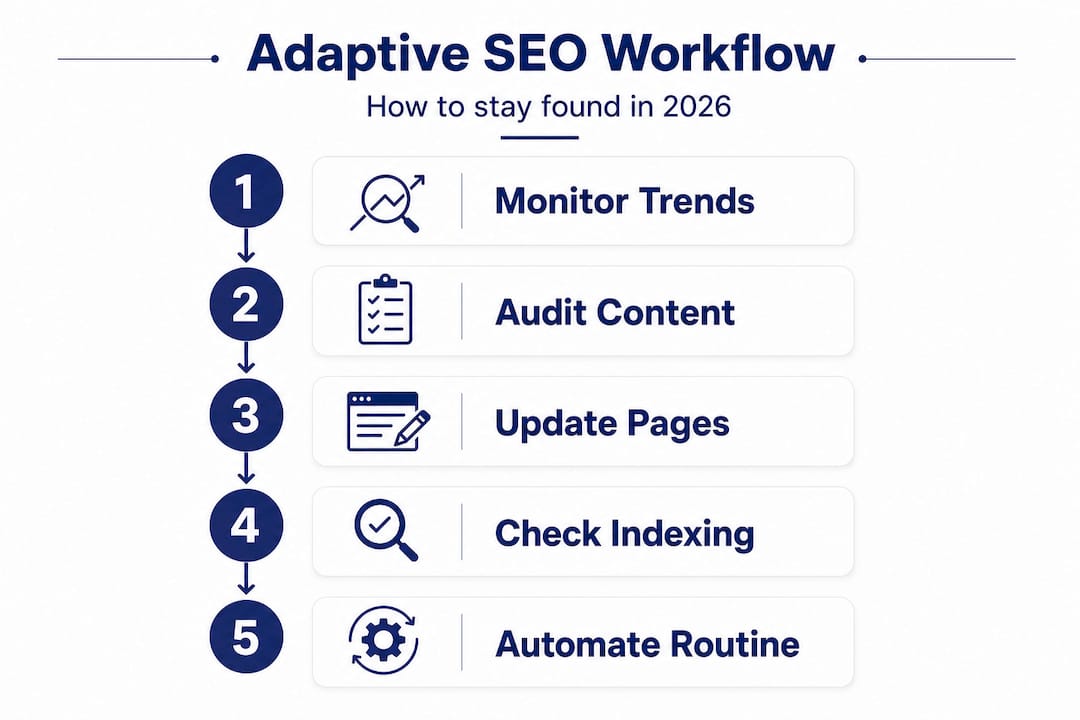
Here is a practical breakdown of what ongoing SEO maintenance actually involves:
| Task | Frequency | Why it matters |
|---|---|---|
| Review Google Search Console for indexing errors | Monthly | Catch dropped or de-indexed pages quickly |
| Submit updated sitemaps after major content changes | As needed | Ensures Google discovers new and revised pages |
| Check canonical tags | Quarterly | Prevents duplicate content from diluting rankings |
| Update high-traffic pages with fresh information | Quarterly | Signals relevance to search engines |
| Request re-indexing for significant page updates | After each update | Speeds up Google recognizing your changes |
| Audit reviews and local citations | Monthly | Keeps trust signals accurate and active |
According to Google Search Console’s indexing guidance, maintaining discoverability after updates requires active operational SEO: monitoring indexing status, submitting sitemaps, and requesting re-indexing after changes. These are not advanced technical tasks. They are basic housekeeping that too many business owners skip entirely.
Here is a step-by-step approach to building that routine:
- Set up Google Search Console if you have not already. It is free and gives you a direct window into how Google sees your site.
- Review the Coverage report monthly. This shows you which pages are indexed and which ones have errors or warnings.
- Submit a new sitemap after any major content additions or restructuring. This helps Google crawl and index your updates faster.
- After updating important pages, request re-indexing through the URL Inspection tool. Do not wait for Google to find the changes on its own.
- Check that your most important pages are not accidentally using duplicate canonical tags pointing to the wrong URL. This is a common technical issue that limits ranking potential.
- Review your content authenticity regularly. Search engines are increasingly good at detecting whether content was written for humans or just for rankings.
Pro Tip: When you update a service page or blog post, add a “last updated” date near the top of the content. This signals freshness to both users and search engines and can improve how the page is perceived by AI models evaluating the timeliness of information.
If you want to take some of the manual effort out of this process, tools exist to help you automate your SEO workflow so monitoring and reporting happen in the background rather than requiring constant manual attention.
Having outlined adaptive SEO routines, let us clarify what makes adaptation actually effective and sustainable.
What most people get wrong about adapting SEO
When business owners do decide to act on their SEO, they often make one of a few predictable mistakes. Understanding these missteps can save you significant time and help you avoid investing effort in approaches that have already lost their effectiveness.
The most common errors include:
- Chasing keyword rankings alone. Many owners focus exclusively on getting to position one for a specific keyword. But with AI Overviews and featured snippets, a page ranked second or third can receive more meaningful traffic than the top result if it answers the question better.
- Assuming link quantity equals authority. Earning fifty low-quality backlinks is far less valuable than earning three links from respected local or industry sources. AI search models are particularly good at evaluating link quality over quantity.
- Neglecting proof signals. Reviews, testimonials, before-and-after results, case studies, and local press mentions are not just marketing tools. They are increasingly critical ranking inputs. Businesses that treat reviews as an afterthought are leaving a major credibility signal on the table.
- Publishing generic content. If your “About” page sounds like every competitor’s “About” page, or your service descriptions use the same phrasing found across the industry, you are essentially invisible in an AI-driven search landscape.
- Reacting to every new trend. The SEO world generates a lot of noise about the latest tactics, tools, and shortcuts. Most of it has a short shelf life. Chasing every new trend often leads to inconsistency, which search engines do not reward.
AI search visibility may require unique, non-commodity content plus proof and trust signals that can be extracted and summarized by AI models, not just traditional ranking signals.
The sustainable path is less exciting than it sounds, but it works. Consistent content marketing built around real expertise, regular maintenance of your Google Business Profile, and an active effort to collect and showcase customer reviews will outperform any shortcut in the long run.
Building trust through your content is not optional anymore. It is the foundation of what makes a business visible in both traditional search results and AI-generated answers.
Armed with realistic expectations, let us distill these lessons into a clear, sustainable SEO mindset for business owners.
A practical mindset for lasting SEO success
Here is an uncomfortable truth most SEO content avoids: the majority of SEO “tricks” that make the rounds on social media and marketing forums are either short-lived, risky, or already obsolete by the time they go viral. Businesses that build their strategy on shortcuts tend to bounce up and down in rankings unpredictably. That volatility is stressful and expensive.
What actually works is less glamorous but far more reliable. Reviewing your web presence every quarter, not every day or in reactive panic, gives you the consistency that search engines reward. It means auditing your highest-traffic pages for accuracy and depth, checking your local citations for consistency, monitoring your reviews and responding to them, and refreshing content that has become outdated.
We have seen independent business owners skip every trend, ignore most of the noise, and quietly dominate their local market by doing one thing: staying committed to a people-first approach. That means writing content that genuinely helps their customers, making their site easy to navigate on any device, and building their reputation through real-world proof. When AI models evaluate who to surface for a local search, that is exactly the kind of business they favor.
The local AI search optimization space is still new enough that business owners who commit to this approach now will establish a significant head start over competitors who are still waiting to see how things shake out. The time to build that foundation is not later. It is now.
Get hands-on help optimizing your local and AI-driven SEO
Knowing what needs to be done and having the bandwidth to do it consistently are two different challenges. Most independent business owners are already stretched thin running their operations, and SEO maintenance easily falls to the bottom of the priority list.
That is exactly where Battle SEO comes in. Our team works exclusively with independent business owners to boost your visibility across both traditional search and AI-powered platforms like ChatGPT, Perplexity, and Gemini. From optimizing your Google Business Profile to building the kind of content and authority signals that AI search rewards, we handle the ongoing work so you do not have to. Explore our local SEO services or start with our detailed AI search optimization guide to see how we approach visibility in 2026 and beyond.
Frequently asked questions
How often should I adapt my SEO strategy?
Review and update your SEO strategy at least every quarter or immediately after major search algorithm updates. Search behaviors and ranking inputs change continuously, so regular check-ins prevent gradual visibility loss.
What is the biggest risk of not adapting my SEO?
Your website or business listing can lose ranking position and disappear from search results, cutting off organic traffic and leads. Rankings can drop without warning when Google rolls out a core update that your static strategy is not prepared for.
Do AI-powered search engines still care about keywords?
AI search cares far more about context, intent, and trustworthiness than keyword density. Google’s own guidance emphasizes people-first, satisfying content over keyword optimization alone.
What are trust signals in SEO?
Trust signals are proof points like customer reviews, testimonials, local authority mentions, and credible backlinks that confirm your business is legitimate and reliable. According to Google’s AI search guidance, being found in AI-driven results may require these proof and trust signals alongside strong content.
How can I check if Google is showing my latest content?
Use Google Search Console to view indexing status and run the URL Inspection tool on recently updated pages. Submitting updated sitemaps and requesting re-indexing after significant changes ensures Google processes your updates quickly rather than on its own crawl schedule.