
TL;DR:
- SEO is a practical and cost-effective strategy for small businesses to increase local visibility.
- Success relies on focusing on content, technical SEO, and building authority over time.
- Consistent efforts and proper optimization can help small businesses outrank larger competitors locally.
Think higher Google rankings are reserved for big-budget corporations with full marketing departments? That belief stops thousands of independent business owners from pursuing one of the most powerful growth tools available to them. Search engine optimization, or SEO, is not a luxury for enterprise brands. It is a practical, measurable strategy that local businesses use every day to attract more customers, generate more calls, and build lasting visibility in their communities. This guide breaks it all down in plain language so you can start moving up search rankings and winning more local customers right now.
Table of Contents
- What is search engine optimization?
- How do search engines work?
- The pillars of effective SEO strategies
- Common SEO mistakes to avoid
- Your first steps for local SEO success
- Breaking the SEO mystique: what business owners really need to know
- Ready to get found? Tap into expert local SEO solutions
- Frequently asked questions
Key Takeaways
| Point | Details |
|---|---|
| SEO drives visibility | Improving your search ranking puts your business in front of more ready-to-buy customers. |
| Understand how search works | Knowing how search engines crawl, index, and rank can help you build a site that gets noticed. |
| Focus on relevance and quality | Helpful, accurate content and a technically sound website are key to sustainable SEO. |
| Avoid quick-fix mistakes | Steer clear of keyword stuffing and shortcuts that can harm your rankings. |
| Take action for local SEO | Simple steps like optimizing your Google Business Profile bring fast wins for local searches. |
What is search engine optimization?
Now that we’ve set the record straight on who SEO is really for, let’s get to the basics.
Search engine optimization is the practice of improving a website’s visibility in unpaid (organic) search results so it attracts more targeted traffic. The word “organic” is key here. Unlike paid ads, where you pay every time someone clicks, organic search traffic comes to you at no direct cost per visit. When someone types “best plumber near me” or “family dentist in Austin” into Google, the results that appear without the “Sponsored” label are organic. SEO is what gets you there.
For independent business owners, this distinction matters enormously. Paid advertising stops the moment your budget runs out. SEO builds on itself over time, creating a compounding return on your investment.
| Traffic type | Cost per click | Longevity | Trust level |
|---|---|---|---|
| Organic (SEO) | $0 | Long-term | High |
| Paid search (PPC) | Ongoing per click | Stops with budget | Moderate |
| Social media ads | Ongoing per click | Short-term | Moderate |
| Direct traffic | $0 | Varies | Very high |
The results of good SEO are concrete and measurable. More calls coming in, more people walking through your door, more form submissions on your website. These are not abstract marketing metrics. They are real business outcomes you can track. Pairing content marketing and SEO is one of the most reliable ways to drive that kind of consistent, qualified traffic to your site over time.
Did you know? Organic search drives more than 50% of all website traffic across industries, making it the single largest source of visitors for most businesses.
How do search engines work?
With a strong foundation of what SEO is, it’s crucial to understand the basics of how Google and other search engines operate.
Search engines work by crawling pages, indexing content, and ranking it for queries using hundreds of ranking factors. Think of it like a massive, constantly updated library. Google sends out automated programs called “crawlers” or “bots” that travel across the web, reading every page they can find. Once a page is read, it gets stored in Google’s index, which is essentially a giant catalog of the web.
When you search for something, Google doesn’t search the live web in real time. It searches its index and returns the most relevant, trustworthy results it can find. Here’s how that process breaks down step by step:
- Crawling. Google’s bots discover your web pages by following links from other sites and from your own sitemap. If your site is hard to crawl, pages may never get indexed.
- Indexing. Once a page is crawled, Google reads the content and stores it. Pages with thin or duplicate content may be skipped or ranked poorly.
- Ranking. Google applies hundreds of signals to decide which pages appear first for a given search. These include content relevance, page speed, mobile usability, backlinks, and the searcher’s location.
- Personalization. Results are also shaped by the user’s search history, location, and device. A search for “coffee shop” in Denver will show different results than the same search in Miami.
Understanding this process gives you a real advantage. When you structure your website with clear page titles, fast load times, and locally relevant content, you are essentially making it easier for Google to understand what you offer and who you serve. Staying current on SEO algorithms is also important because Google updates its ranking systems regularly, and what worked two years ago may not be enough today.

The pillars of effective SEO strategies
Once you know how search engines evaluate sites, see which factors matter most for your SEO success.
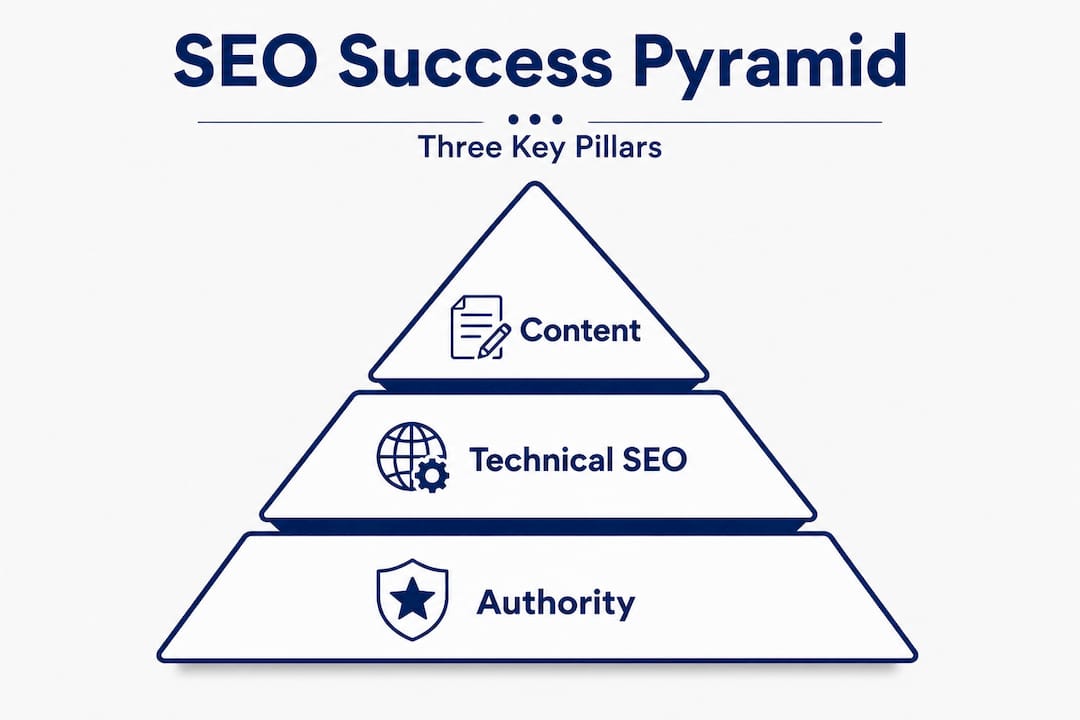
A practical definition for small-business SEO strategy is this: align your website and content with what people search for, ensure search engines can crawl and index it, and build credibility and authority over time. That definition maps directly to three core pillars that every effective SEO strategy rests on.
Content
Content is the foundation. Your website needs to answer the actual questions your customers are typing into Google. That means writing service pages that describe what you do clearly, creating blog posts that address common concerns, and using the specific words and phrases your target audience uses when they search.
Good writing for SEO is not about cramming in keywords. It is about being genuinely useful. A roofing company that publishes a detailed guide on “how to tell if your roof needs replacing” is creating content that earns trust before a customer ever calls. That trust translates into clicks, calls, and conversions.
Technical SEO
Technical SEO covers everything that happens behind the scenes to make your site accessible and fast. If your site takes more than three seconds to load, a large portion of visitors will leave before seeing a single word of your content. Google notices this behavior and factors it into your rankings.
Key technical elements include:
- Page speed. Compress images, minimize code, and use reliable hosting.
- Mobile-friendliness. More than half of all searches happen on mobile devices. Your site must look and work great on a phone.
- HTTPS security. Google favors secure sites. If your URL starts with “http” instead of “https,” that’s a problem to fix today.
- Sitemaps and crawlability. Submit an XML sitemap to Google Search Console so bots can find all your important pages.
Authority
Authority is about how trustworthy and credible your site appears to Google. The primary signal here is backlinks, which are links from other reputable websites pointing to yours. Think of each backlink as a vote of confidence. A local news site mentioning your business, a chamber of commerce listing, or a partner business linking to your services page all contribute to your authority score.
Using internal links for authority within your own site is equally important. Linking from one page to another helps Google understand your site structure and distributes ranking power across your pages.
| SEO pillar | What it covers | Impact level |
|---|---|---|
| Content | Keywords, relevance, usefulness | Very high |
| Technical | Speed, mobile, security, indexing | High |
| Authority | Backlinks, citations, trust signals | Very high |
Pro Tip: Don’t try to tackle all three pillars at once when you’re starting out. Fix your most critical technical issues first, then build content, then pursue authority signals. Building outward from a solid base is far more effective than spreading effort thin across everything simultaneously.
Common SEO mistakes to avoid
Knowing what to do is critical, but understanding what to avoid can save months of frustration and missed opportunity.
Even well-intentioned SEO efforts can backfire when certain mistakes creep in. Here are the most common ones we see independent business owners make, along with how to correct them.
- Keyword stuffing. Keyword stuffing means repeating keywords unnaturally throughout your content, and it is explicitly discouraged by Google. It can lead to heavy penalties that push your site down in rankings rather than up. Write for humans first. If your content reads awkwardly because you’ve forced a phrase in five times, rewrite it.
- Ignoring mobile users. A site that looks great on a desktop but breaks on a phone is losing customers every single day. Test your site on multiple devices and fix any usability issues immediately.
- Slow page load times. Every extra second of load time costs you visitors. Use free tools like Google PageSpeed Insights to identify what’s slowing your site down.
- Inconsistent business information. If your address, phone number, or business name appears differently across Google, Yelp, Facebook, and your website, search engines get confused and your local rankings suffer. Consistency is non-negotiable.
- Unclaimed Google Business Profile. This is one of the most common and costly oversights for local businesses. Your Google Business Profile (GBP) is what shows up in Google Maps and the local results pack. If you haven’t claimed and optimized it, you are invisible to a massive segment of local searchers.
- Stale content. A blog post from 2019 with outdated information signals to Google that your site isn’t being maintained. Review your content regularly and update it to reflect current facts, services, and search trends.
Running a gap analysis for SEO is a smart way to identify where your current content and strategy fall short compared to competitors who are already ranking above you.
Pro Tip: Set a quarterly reminder to audit your top five pages. Check that contact information is accurate, content is current, and internal links still work. Small, consistent maintenance prevents big ranking drops.
Your first steps for local SEO success
Finally, let’s translate this knowledge into action and start boosting your visibility right away.
You don’t need to overhaul your entire website overnight. Local SEO success comes from taking the right steps in the right order. Here’s a prioritized action plan built specifically for independent business owners:
- Claim and optimize your Google Business Profile. Go to Google Business Profile and claim your listing if you haven’t already. Fill out every field: business name, address, phone number, hours, services, photos, and a keyword-rich description. This single step can produce noticeable results within weeks.
- Research what your customers actually search for. Use free tools like Google’s autocomplete, People Also Ask boxes, and Google Search Console to discover the exact phrases your target customers type. These are the keywords your content should target.
- Update your website with clear, local information. Make sure your service areas, hours, and contact details are easy to find on every page. Add your city and region naturally into page titles and descriptions.
- Create helpful local content. Write blog posts, FAQs, and guides that answer questions specific to your community. A landscaping company in Phoenix might write about “best drought-tolerant plants for Arizona yards.” This kind of local SEO content builds relevance and attracts searchers with high intent.
- Monitor your results with Google Search Console. This free tool shows you which search terms are driving traffic to your site, which pages rank, and where you have room to improve. SEO best practices consistently point to Search Console as the most practical starting tool for understanding your actual search performance.
- Build local citations. Make sure your business is listed consistently on directories like Yelp, Bing Places, Apple Maps, and relevant industry directories. Each accurate listing reinforces your credibility with Google.
These steps are not complicated. They are consistent. That consistency is what separates businesses that grow through search from those that stay invisible.
Breaking the SEO mystique: what business owners really need to know
You’ve now got a starter plan, but let’s get candid about what actually works in the real world.
The biggest misconception in SEO is that there’s a secret trick. Business owners get pitched “guaranteed first-page rankings in 30 days” constantly. It’s tempting, especially when you’re busy running a business and just want results. But those promises almost always lead to wasted money, and sometimes to penalties that are genuinely difficult to recover from.
Here’s the uncomfortable truth: there is no shortcut that replaces consistent, honest work. Google’s entire business model depends on showing users the most relevant and trustworthy results. That means the businesses that win in search are the ones that genuinely serve their communities well and communicate that clearly online.
What we’ve seen work, time and again, is this: small businesses that know their audience deeply can outrank national brands in local searches. A national chain selling plumbing services in your city cannot match the specificity, local knowledge, and community trust that you can build. That is a real competitive advantage, and SEO is how you make it visible.
The exclusive local SEO advantage is real. When you stop competing on budget and start competing on relevance and authority within your specific market, the playing field shifts in your favor. SEO is an ongoing investment, not a one-time project. But for independent businesses willing to commit to it, the returns compound in ways that paid advertising simply cannot replicate.
Ready to get found? Tap into expert local SEO solutions
If you’re serious about dominating local search, explore resources that make sustained growth and expert support simple.
At Battle SEO, we work exclusively with independent business owners who are ready to stop being invisible online. Our local SEO services are built around the Local Command Directive™ framework, covering everything from Google Business Profile optimization to authority backlinks and on-page SEO. We take on only one business per category per market, so your competitors can’t use the same strategy against you.
Start with the fundamentals by reading our detailed Google Business Profile tips to maximize your local map visibility. If you want to go further and get your business found on AI platforms like ChatGPT and Perplexity in addition to Google, our AI search visibility guide walks you through exactly how to position yourself for the next generation of search. The opportunity is right in front of you.
Frequently asked questions
Can SEO really help a small local business stand out?
Yes. SEO improves organic visibility and helps both users and search engines understand your content, making it highly effective for local businesses competing against larger brands in specific geographic markets.
How long does it take to see results from SEO?
You may notice initial improvements within several weeks, but sustainable, lasting results typically take three to six months of consistent effort.
Is paying for ads better than investing in SEO?
Paid ads provide immediate visibility, but SEO builds long-term traffic and credibility without ongoing per-click costs, making it a more cost-effective strategy over time.
What is keyword stuffing and why should I avoid it?
Keyword stuffing means overloading a page with keywords to manipulate rankings. Search engines penalize this practice heavily, so always use keywords naturally within genuinely helpful content.
Which tool is best for tracking my SEO progress?
Google Search Console is the best free starting point. SEO best practices consistently recommend it for finding the actual search terms driving traffic to your site and identifying where improvements are needed.