
TL;DR:
- Effective SEO analytics monitoring goes beyond weekly rank checks to detect subtle declines and prevent larger issues. It involves continuous observation of visibility, user experience, and conversions, enabling proactive strategy adjustments. Regularly tracking traditional and AI search metrics ensures sustained online visibility, early problem detection, and maximized business growth.
Most business owners assume SEO analytics means checking where their keywords rank. That assumption costs real money. Understanding why monitor SEO analytics goes far deeper than a weekly rankings check. When you stop watching your data closely, small dips in click-through rates, subtle crawl errors, and gradual drops in organic traffic compound quietly until they become a serious problem. This article breaks down what SEO analytics monitoring actually involves, why it matters to your bottom line, which metrics deserve your attention, and how to turn raw data into decisions that protect and grow your online visibility.
Table of Contents
- Key Takeaways
- Why monitoring SEO analytics matters more than you think
- The real business case for regular SEO monitoring
- Key SEO metrics worth monitoring closely
- How to analyze SEO data and apply what you learn
- Monitoring SEO in the age of AI-driven search
- My honest take on monitoring SEO analytics
- How Battleseo can help you monitor and grow visibility
- FAQ
Key Takeaways
| Point | Details |
|---|---|
| Monitoring prevents compounding losses | Small ranking slips and CTR drops can escalate quickly if you don’t catch them early. |
| Analytics goes beyond rank tracking | Real monitoring connects visibility, user experience, and conversions to revenue impact. |
| Use a three-layer KPI framework | Organize metrics into visibility, experience, and conversion layers to prioritize effort efficiently. |
| AI search needs its own tracking | Citations in AI summaries and brand mentions in AI engines require separate monitoring from traditional SEO. |
| Automation reduces missed signals | Configured alerts and dashboards help you respond fast without manually checking data every day. |
Why monitoring SEO analytics matters more than you think
SEO analytics monitoring is not the same as SEO tracking or SEO reporting, and the difference is significant. Tracking is passive: it records what happened. Reporting tells a story about those records. Analytics monitoring is active. It means continuously watching your data to catch trends, spot anomalies, and decide what to do about them before a small problem becomes a big one.
Think of it this way. Tracking tells you your organic traffic dropped 15% last month. Monitoring tells you it started declining six weeks ago, correlates with a Core Web Vitals failure on your most-visited page, and is concentrated in mobile users from three specific cities. That kind of depth is what turns data into a decision.
There are four distinct concepts worth separating:
- SEO tracking: Collecting raw data points over time (keyword positions, impressions, traffic volume)
- SEO reporting: Organizing and presenting collected data for review, usually weekly or monthly
- SEO analytics: Interpreting data to find patterns, causes, and opportunities
- SEO monitoring: Proactive, continuous observation that triggers action when something changes
Pro Tip: Set up Google Search Console and Google Analytics 4 as your baseline monitoring stack before adding any third-party tools. These two free platforms cover most of what a small or mid-sized business needs to start.
The goal of monitoring is to turn your data into a strategic feedback loop. Continuous data collection supports proactive issue resolution and helps you adapt your strategy before competitors or algorithm changes leave you behind.
The real business case for regular SEO monitoring
Here is where business owners often make a category error. They think SEO is a one-time project: publish optimized content, build some links, and wait for traffic. The reality is that SEO performance rarely crashes overnight. It erodes gradually. A competitor publishes better content on a keyword you rank for. Google adjusts how it weighs page experience signals. An AI search engine starts summarizing your topic without citing you. Each of these events nudges your visibility downward, and none of them trigger an alarm unless you are watching.
The business stakes are concrete. If you generate 40% of your leads through organic search and your traffic drops 20% over three months without detection, you may not connect the revenue shortfall to an SEO issue until it is already deep. Regular monitoring catches those early performance declines before they compound into something that takes six months to recover from.
Knowing your SEO data is moving in the wrong direction two weeks after it starts is a problem you can solve. Knowing two months later is damage you have to undo.
Monitoring also validates your investment. If you are spending on content production, link building, or technical SEO, you need data to confirm those activities are generating actual traffic and conversions, not just ranking improvements on low-volume keywords. Without that feedback, you are spending money based on hope rather than evidence.
Pro Tip: Connect your SEO KPIs directly to a revenue metric, even if loosely. For example: track how many organic visitors convert to leads each month alongside your traffic volume. That pairing gives leadership a number they care about.
Staying ahead of competitors is the third reason monitoring pays off. When a competitor gains three positions on a keyword you both target, you will see your impressions and clicks shift before you notice the ranking change. Spotting that signal early gives you time to respond with a content update or link campaign rather than reacting to a loss already locked in.
Key SEO metrics worth monitoring closely
Organizing SEO measurement into layers focused on visibility, experience, and conversion helps you prioritize effort and budget efficiently. Here is how those three layers break down in practice.
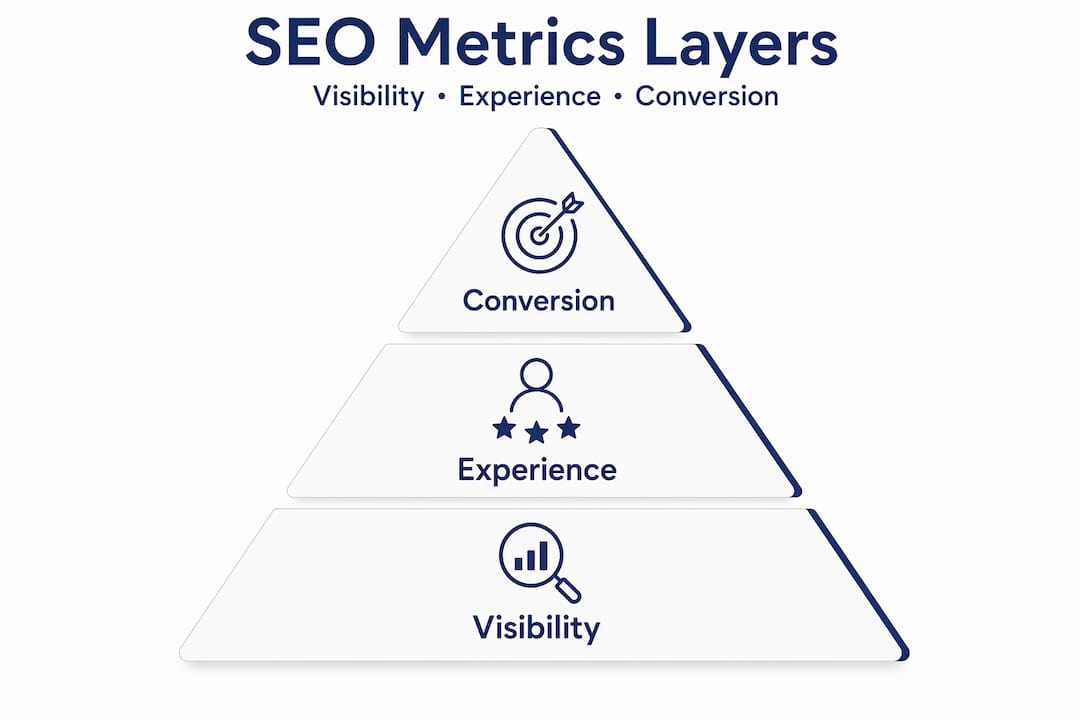
Visibility layer
This is where most people start, and it is a good foundation. Track keyword rankings weekly, not daily. Daily fluctuations are normal and often meaningless. More telling are impressions and organic click-through rate (CTR) in Google Search Console. A drop in impressions signals reduced crawlability or ranking loss. A drop in CTR with stable impressions means your title tags and meta descriptions are losing the competition for clicks.
Google Search Console added weekly and monthly data views in 2025 specifically to help with this. Comparing weekly or monthly aggregates removes the noise of misaligned calendar days and gives you a cleaner signal of directional trends.
Experience layer
Core Web Vitals, bounce rate, time on page, and engagement rate in GA4 tell you what happens after someone clicks. A page with strong rankings but a 90% bounce rate is not delivering value. These metrics help you identify whether an SEO win is actually serving users or just capturing clicks that go nowhere.

Conversion layer
This is where SEO connects to revenue. GA4’s key events marked as conversions allow you to directly correlate organic traffic with form submissions, phone calls, purchases, or any other business goal. Without this layer, you cannot credibly claim that your SEO investment is producing a return.
Pro Tip: If you are using last-click attribution to evaluate SEO, you are likely undervaluing it. Multi-touch attribution models better reflect how SEO assists longer buying cycles, especially for local services or B2B companies.
One important note: choosing metrics aligned to your business goals avoids the trap of tracking everything and understanding nothing. An e-commerce site prioritizes product page rankings and revenue per session. A local service business prioritizes Google Maps visibility, local keyword rankings, and phone call conversions. Match your metrics to your model.
How to analyze SEO data and apply what you learn
Monitoring without a system for acting on what you find is just data collection. Here is a practical approach to turning your SEO analytics into decisions.
- Build a monitoring dashboard. Use Google Search Console, GA4, and one aggregation tool to pull your visibility, experience, and conversion data into a single view. You should be able to assess your SEO health in under ten minutes each week.
- Configure automated alerts. Automated alerts for key metric drops reduce the risk of missing a critical change between your weekly reviews. Set thresholds for traffic, CTR, and Core Web Vitals scores.
- Use anomaly detection to prioritize. When something drops, do not immediately assume the worst. Compare weekly to weekly, not day to day. Confirm the drop is consistent before investing time in a fix.
- Run a monthly SEO gap analysis. Review which keywords competitors are gaining ground on and where your content has opportunities. A structured SEO gap analysis helps you decide where to invest content and link-building efforts next.
- Tie your monthly report to a business number. Show organic leads or revenue assisted by organic traffic alongside traditional SEO metrics. This shifts the conversation from “we rank for more keywords” to “SEO contributed this much to pipeline last month.”
- Integrate with technical audits. Crawl errors, index coverage issues, and page speed problems affect every other metric. Run a technical SEO audit at least quarterly and cross-reference findings with your analytics data to catch cause-and-effect relationships.
Pro Tip: Automate your reporting cadence by scheduling weekly email summaries from Google Search Console and monthly GA4 reports. Automating SEO tasks frees up time for the interpretation and decision-making that actually moves the needle.
Monitoring SEO in the age of AI-driven search
Traditional rank tracking alone is no longer a complete picture of your search visibility. AI answer engines like ChatGPT, Perplexity, and Google’s AI Overviews now respond to queries without sending users to a website at all. If your content is being cited in those answers, great. If it is not, you are losing visibility that does not show up in your standard impressions data.
Tracking AI search visibility means monitoring a different set of signals:
- Citation frequency: How often your brand or content is referenced in AI-generated answers
- Brand mentions in AI summaries: Whether your business appears in location-based or category-based AI results
- Answer accuracy: Whether AI engines describe your services, hours, or expertise correctly
- Visibility trends over time: Are you appearing more or less frequently in AI search results compared to last quarter?
Tracking the right blend of SEO and AEO metrics over time validates the sustainability of your visibility gains across both traditional and AI search platforms. If your keyword rankings are stable but your AI citation frequency is declining, that is an early signal worth acting on. Understanding how AI search platforms affect visibility is now a core part of any complete monitoring strategy.
My honest take on monitoring SEO analytics
I have worked with enough businesses to say this plainly: the ones who treat SEO analytics as a monthly checkbox are the ones who call us in a panic six months later wondering why their traffic fell off a cliff.
In my experience, the problem is not that people do not care about their data. It is that small shifts feel unimportant in the moment. A 5% CTR drop in a given week looks like noise. Over eight weeks, that same pattern is a trend costing you leads. I have seen companies lose top three rankings on their highest-converting keywords and not realize it for three months because nobody was watching the data closely enough to notice the gradual slide.
What I have learned is that the blend matters as much as the volume. You need traditional SEO metrics alongside AI search visibility metrics, not one or the other. I have watched businesses with strong Google rankings start bleeding visibility to AI summaries that never cited them, and they had no idea it was happening because they were only watching their keyword positions.
My strong advice: set up your automated alerts, build a simple weekly dashboard, and review it on a schedule. Not because monitoring is complicated, but because the compounding effect of catching small problems early is enormous compared to diagnosing large ones later. The businesses that protect their SEO gains long-term are the ones that treat monitoring as a standing habit, not a reaction to a crisis.
— Mike
How Battleseo can help you monitor and grow visibility
If you have read this far and realize your current monitoring setup has gaps, that is a good starting point.
At Battleseo, we specialize in local SEO and AI search optimization for independent business owners who want to be the dominant authority in their market. Our approach covers traditional ranking metrics and the emerging AI visibility signals that most agencies are still ignoring. Whether you need help building a monitoring framework, running a technical audit, or getting your business cited in AI-generated answers, we bring a focused, market-exclusive approach to every client. Explore our local SEO services or learn more about our AI optimization services to see how we put these monitoring strategies to work for businesses like yours.
FAQ
What does it mean to monitor SEO analytics?
Monitoring SEO analytics means actively watching your search performance data to catch trends, anomalies, and declines early. It goes beyond reporting by triggering decisions and actions when key metrics shift.
How often should you check SEO performance metrics?
A weekly review of visibility and traffic metrics is sufficient for most businesses. Daily monitoring introduces noise; use automated alerts to flag significant changes between scheduled reviews.
Why track keyword rankings if AI search is changing everything?
Keyword rankings still reflect Google’s organic results, which drive the majority of search clicks today. Track them alongside AI visibility metrics to get a full picture of where you are being found and where you are not.
How do you connect SEO analytics to business revenue?
Set up conversion tracking in GA4 by marking key events like form submissions or phone calls as conversions. Then correlate organic traffic volume with those conversion events monthly to demonstrate SEO’s direct contribution to revenue.
What is the biggest mistake businesses make with SEO analytics?
The most common mistake is checking data only after something goes wrong. SEO performance rarely crashes overnight; it declines gradually, which means regular monitoring is the only way to catch problems before they become costly.