
TL;DR:
- Search engines are now the primary means of discovery online, shifting from link directories to answer providers.
- Understanding their core functions—crawling, indexing, and ranking—is essential for effective visibility, especially as AI-driven systems synthesize direct answers.
Search engines are the single most important gateway to the web, yet most people think of them as simple link directories. That framing is outdated. The role of search engines has shifted from “here are some pages” to “here is your answer.” Nearly 68% of all online experiences begin with a search engine, which means ranking decisions made by algorithms directly control who gets discovered and who stays invisible. If you are a marketer or business owner, understanding how these systems actually work is no longer optional. It is your competitive baseline.
Table of Contents
- Key Takeaways
- The core functions of search engines
- How AI is reshaping modern search
- The impact of search engines on user behavior
- Practical strategies to improve your search visibility
- My take on where search is really headed
- How Battleseo can help you get found
- FAQ
Key Takeaways
| Point | Details |
|---|---|
| Search engines drive discovery | Over two-thirds of online experiences start with a search, making them the primary channel for visibility. |
| Three core functions power results | Crawling, indexing, and ranking work together to find, organize, and surface content for users. |
| AI is reshaping the decision layer | Modern search engines synthesize answers end-to-end, changing how and why users click through to websites. |
| User context determines visibility | Personalization based on location, device, and behavior means generic content consistently underperforms. |
| Quality and authority still win | Google’s E-E-A-T framework rewards real expertise, making thin or recycled content a liability. |
The core functions of search engines
Understanding how search engines work starts with three distinct stages: crawling, indexing, and ranking. Each stage serves a specific purpose, and weakness in any one of them limits your visibility regardless of how good your content is.
Crawling is the discovery phase. Automated programs called bots or spiders follow links across the web, moving from page to page and sending information back to the search engine’s servers. Think of it like a postal carrier mapping every address in a city. If a page has no incoming links, the crawler may never find it.
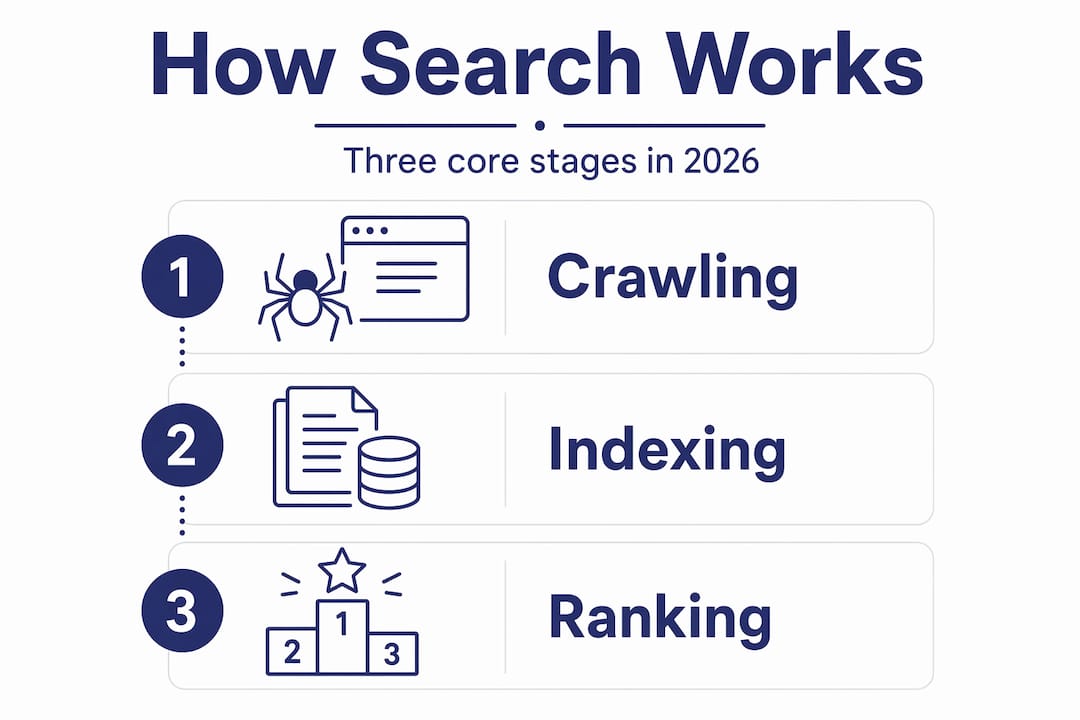
Indexing is where analysis happens. Once a page is crawled, the search engine processes its content: the text, images, structured data, load speed, and dozens of other signals. That content is then stored in a massive catalog so it can be retrieved in milliseconds when a user submits a query.
Ranking is the decision phase. Search engines use over 200 signals to decide where a page appears in results. Those signals include keyword relevance, content freshness, backlinks, page speed, and mobile-friendliness. The result is an ordered list where position one gets the most attention and position eleven gets almost none.
Here is a quick comparison of all three stages:
| Stage | What happens | Key factors |
|---|---|---|
| Crawling | Bots discover pages via links | Site structure, internal links, XML sitemaps |
| Indexing | Content is analyzed and stored | Content quality, structured data, page clarity |
| Ranking | Ordered results are generated | Relevance, authority, user experience signals |
These three functions of search engines are not isolated. A technically broken site slows crawling. Poor content quality hurts indexing. Weak authority scores drag down rankings. You need all three working well.
How AI is reshaping modern search
Traditional search returned a list of links and let you figure out the rest. That model is being replaced. AI and search are converging into unified systems that resolve user intent end-to-end, shifting from navigation to decision-making. The search engine no longer just points the way. It answers the question directly.

This shift is powered by a technique called retrieval-augmented generation, or RAG, which pulls relevant content and synthesizes it into a direct response. The result is that users often get what they need without clicking a single link. That has real consequences for traffic. AI-powered search features have caused a 58% reduction in click-through rates on top-ranking pages because answers appear directly on the results page.
Understanding the underlying technology helps you respond intelligently. Hybrid retrieval combines lexical matching and dense semantic models to handle both exact keyword queries and paraphrased intent. The lexical side, known as BM25, excels on rare or technical terms. The semantic side captures meaning and synonyms. Most SEO strategies built before 2023 optimized for one and ignored the other.
“AI isn’t killing search. It’s rewriting the decision layer where user intent is resolved end-to-end, requiring brands to optimize beyond links towards natural, synthesized answer surfaces.” — Technology Magazine
This is why adapting to AI search platforms has moved from a forward-thinking tactic to a present necessity. The brands that show up in AI-generated answers are not always the ones ranking number one in traditional results. They are the ones with content structured to answer questions directly, backed by real authority.
Pro Tip: Write content that answers the full question, not just the keyword. AI systems are trained to synthesize complete answers, and content structured around clear questions and direct responses is far more likely to be selected as a source.
The impact of search engines on user behavior
The importance of search engines goes well beyond driving traffic. They actively shape what users believe, what they buy, and which businesses they trust. When a user types a query, they are not just looking for a link. They are looking for resolution. The search engine decides which voices they hear.
Here is how that plays out in practice:
- Search personalization adapts results based on location, device, past behavior, and language. Generic content consistently underperforms in this environment because two users searching the same phrase may see completely different results.
- Voice and visual search are growing as user interfaces. Queries typed at a keyboard look different from spoken queries, and content optimized for one does not always serve the other.
- Zero-click results mean that featured snippets, knowledge panels, and AI overviews now resolve many queries on the results page itself. Your content can answer someone’s question without them ever landing on your site.
- Consumer decisions are shaped early. For local businesses, appearing in the top three map results can determine whether a prospect calls a competitor or calls you. The role of search engines in marketing is precisely this: whoever controls discovery controls consideration.
- Content authority signals matter more than volume. Google’s E-E-A-T framework, which stands for Experience, Expertise, Authoritativeness, and Trustworthiness, filters out generic or recycled content in favor of pages that demonstrate real knowledge.
The impact of search engines on visibility is direct and measurable. If you are not appearing for the queries your customers use, someone else is answering those questions for them.
Practical strategies to improve your search visibility
Knowing how search engines work is only useful if you act on it. The following steps reflect what actually produces results in the 2026 search environment, not just what worked three years ago.
-
Build content around user intent, not just keywords. A user searching “best plumber near me open now” wants a phone number and a review count, not a 2,000-word history of plumbing. Match content depth and format to what the searcher actually needs at that moment.
-
Fix your technical foundation first. Core Web Vitals and mobile-first design are baseline requirements in 2026. Slow load times, layout shifts, and poor interactivity cost you rankings regardless of content quality. Run a Core Web Vitals audit before investing in new content.
-
Optimize for both lexical and semantic search. Content should address exact terms and semantic intent to succeed under modern AI search. Use the exact phrase your audience searches, and also write naturally around the topic so that dense retrieval models can recognize your page as genuinely relevant.
-
Build authority with quality backlinks. A handful of links from credible, relevant sources outperforms dozens of low-quality directory listings. Focus on earning coverage from industry publications, local news, and topic-specific blogs.
-
Leverage AI platforms as additional visibility channels. Traditional Google rankings matter, but so does appearing in ChatGPT, Perplexity, and Gemini responses. Read the Battleseo guide on AI search optimization to understand how to structure content for both environments.
-
Optimize your Google Business Profile. For local businesses, this single asset drives map rankings, review visibility, and phone call volume. It is often the highest-return SEO task available to an independent business owner.
Pro Tip: Do not treat AI optimization and traditional SEO as separate projects. The same content quality signals, clear structure, and credible sourcing that rank you on Google also make you more likely to be cited by AI-generated answers.
My take on where search is really headed
I have been working in search marketing long enough to watch it change fundamentally at least three times. But what is happening now feels different in a way that I think most marketers are underestimating.
The conversation I keep having with business owners goes like this: they know AI is changing search, but they are waiting to see how it settles before they adjust. That instinct to wait makes sense in slow-moving markets. In search, it is a serious miscalculation.
What I have observed is that the brands winning AI-generated placement right now are not the ones with the biggest budgets. They are the ones who built content with genuine depth before AI search became a priority. Their content gets pulled into synthesized answers because it actually answers real questions thoroughly. There is no shortcut that replicates that.
The pitfall I see most often is a fixation on ranking position when the more useful question is whether your content gets referenced at all. A page ranked third but cited in three AI overviews is generating more qualified awareness than a page ranked first that never earns a mention beyond the blue link. The history of search engines shows a consistent pattern: every major shift rewarded those who understood the new system early and penalized those who clung to the old one.
My honest advice is to stop chasing clicks and start owning outcomes. That means being the source of record in your niche, not just a page that showed up for a query. That is a harder standard to meet. It is also a more durable competitive position.
— Mike
How Battleseo can help you get found
The evolution of search engines creates real opportunities for local businesses willing to adapt. AI-powered search is not a threat to local visibility. It is a new channel for it.
Battleseo specializes in combining traditional SEO with AI search optimization so independent business owners get found everywhere their customers are searching, whether that is Google, Google Maps, ChatGPT, or Gemini. Their local SEO services are built on the Local Command Directive™ framework, covering everything from Google Business Profile optimization to authority link building. If you want to understand exactly how to position your business for both traditional and AI-driven search, start with their local SEO visibility guide. Battleseo takes on only one business per category per market, so availability is limited.
FAQ
What is the role of search engines in digital marketing?
Search engines control which businesses get discovered during the research and purchase process. The role of search engines in marketing is to serve as the primary channel where consumer intent becomes visible, making search visibility directly tied to lead generation and revenue.
How do search engines work at a basic level?
Search engines follow a three-stage process: crawling discovers pages, indexing organizes their content, and ranking determines the order they appear in results based on over 200 signals including relevance, authority, and user experience.
How has AI changed the functions of search engines?
AI has transformed search engines from link directories into intent-resolution systems. Through techniques like retrieval-augmented generation, they now synthesize direct answers rather than just returning pages, which has reduced click-through rates by 58% on many top-ranking results.
Why does search personalization matter for content strategy?
Search personalization means two users searching the same query can see entirely different results based on location, device, and past behavior. Content written for a generic audience often fails to match the specific context a personalized algorithm is trying to satisfy.
What is the importance of search engines for local businesses?
For local businesses, search engines determine whether customers find you or a competitor first. Appearing in local map results and AI-generated recommendations directly affects call volume, foot traffic, and conversions at the local level.