

TL;DR:
- An AI-driven SEO workflow combines automation tools with human oversight to execute tasks faster and at greater scale. Building such systems requires documenting existing processes, implementing an orchestration layer, and maintaining human review for quality and strategy. Proper design prevents over-automation and ensures sustainable, quality search visibility improvements.
An AI-driven SEO workflow is defined as a system that combines artificial intelligence automation with strategic human oversight to execute search engine optimization tasks faster and at greater scale than manual processes allow. The industry term for this approach is “SEO workflow automation,” and it covers everything from keyword clustering to content publishing. Tools like Claude AI, Spyro, and Surfer now sit at the center of these systems, handling the repetitive work so you can focus on strategy. The efficiency gains are real: AI-driven workflows reduce keyword intent mapping from 40 hours to 4, a 90% time savings that directly expands your content pipeline and search visibility.
What tools and prerequisites build an ai-driven SEO workflow?
Building a functional SEO automation system starts with the right stack, not the right attitude. You need tools that cover four distinct functions: keyword research, content generation, rank tracking, and automation orchestration.
Here is a practical breakdown of the core tool categories:
- Keyword research and gap analysis: DataForSEO provides API access to keyword data at $0.10 per 100 queries, making automated gap analysis affordable even for smaller teams. Google Search Console and Ahrefs feed raw ranking data into your workflow.
- Content generation and optimization: Claude AI handles brief creation, draft generation, and intent mapping. Surfer SEO scores content against top-ranking pages in real time.
- AI citation tracking: Spyro tracks AI citations automatically and structures posts with answer-first hooks and schema markup to improve visibility on ChatGPT, Perplexity, and Gemini.
- Automation orchestration: n8n and Zapier connect your tools, manage task handoffs between AI agents, and trigger alerts when conditions are met.
Before you install a single tool, two prerequisites matter more than any software choice.
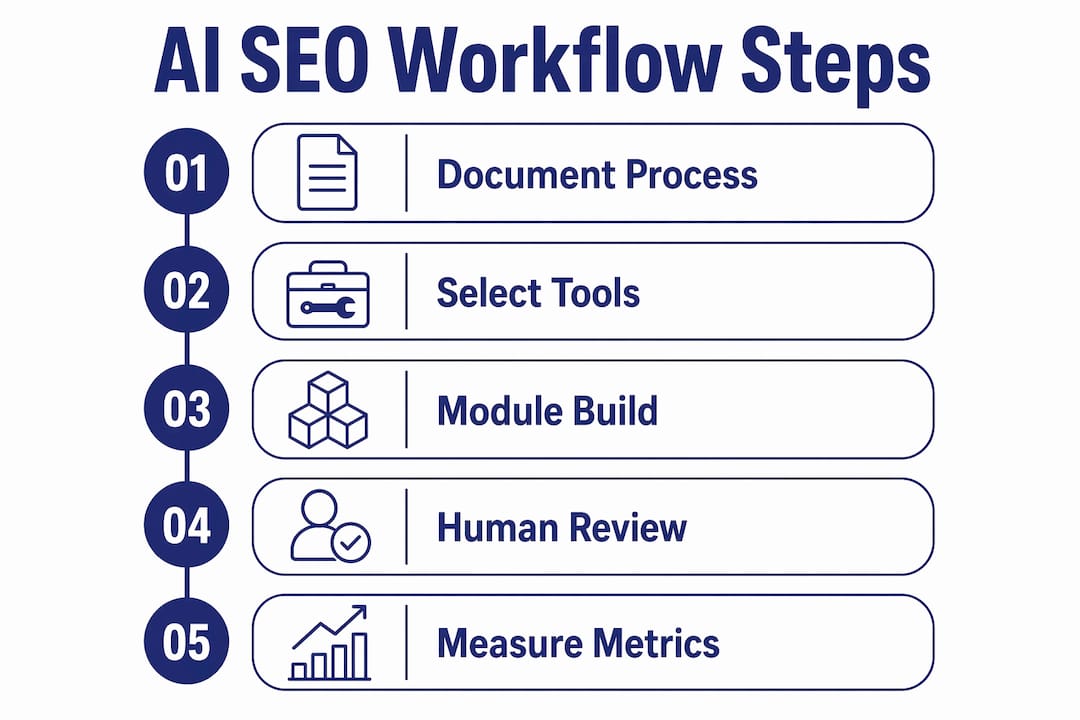
First, your existing SEO process must be documented and digitized. AI cannot automate a process that lives in someone’s head. Map your current workflow in writing, identify which steps are repetitive and rule-based, and separate those from the decisions that require editorial judgment.
Second, you need a human-in-the-loop principle built into the design. Effective AI SEO workflows automate repetitive, verifiable tasks but keep human control over strategy, editorial direction, and E-E-A-T validation. That boundary is not optional. It is the quality gate that separates high-performing workflows from content farms.
Pro Tip: Before connecting any AI tool to your CMS, run it in a sandbox environment for two weeks. Review every output manually. You will spot the failure patterns before they reach your live site.
| Tool Category | Example Tools | Primary Function |
|---|---|---|
| Keyword and gap analysis | DataForSEO, Ahrefs, Search Console | Identify ranking opportunities and content gaps |
| Content generation | Claude AI, Surfer SEO | Draft and score content against search intent |
| AI citation tracking | Spyro | Monitor and optimize for AI search visibility |
| Orchestration | n8n, Zapier | Connect tools, manage handoffs, trigger alerts |
How do you build an AI SEO workflow step by step?
A working SEO automation system follows a clear sequence. Skipping steps creates the exact chaos that frameworks like SOAR and RISE are designed to prevent. SOAR stands for Situation, Objective, Action, Result. RISE stands for Research, Ideate, Structure, Execute. Both prioritize alignment before speed.
Follow this sequence to build your workflow from the ground up:
-
Ingest live data. Connect DataForSEO, Google Search Console, and GA4 to your orchestration layer. Use Model Context Protocol (MCP) to give Claude AI access to fresh data from these sources directly, avoiding stale CSV exports that lead to outdated strategy decisions.
-
Run automated keyword clustering. Feed your keyword list into your AI tool and cluster by search intent: informational, navigational, commercial, and transactional. This step alone replaces hours of manual spreadsheet work.
-
Generate content briefs. Use Claude AI or a similar model to produce structured briefs for each cluster. Each brief should include target keyword, related entities, recommended word count, and competitor content gaps. Spyro adds answer-first hooks and schema recommendations at this stage.
-
Draft and score content. Pass briefs to your content generation tool. Surfer SEO scores drafts against live SERP data. Flag any piece scoring below your threshold for human revision before it moves forward.
-
Automate technical checks. Set n8n or Zapier to trigger automated schema insertion and image compression the moment a post is published to your CMS. This removes two of the most commonly skipped technical SEO steps from your team’s plate entirely.
-
Human editorial review. Every piece of content passes through a human editor before publishing. This is where brand voice, factual accuracy, and E-E-A-T signals get verified. No AI output skips this gate.
-
Publish and monitor. After publishing, automated rank tracking alerts fire when a page drops more than a set number of positions. Your team responds to alerts rather than running manual checks.
Pro Tip: Build your workflow in modules. Start with keyword clustering and brief generation only. Add content drafting in week three, technical automation in week five. Building outward from a base prevents you from breaking everything at once.
The human role in this system is not to supervise every automated step. It is to own the strategic decisions: which topics to pursue, which content to promote, and which signals indicate a ranking problem worth solving. AI handles the volume. You handle the judgment.

What are the common pitfalls in AI SEO workflows?
Over-automation is the most common failure mode in AI SEO systems. Teams that remove human review from the content pipeline produce generic, low-quality pages that rank briefly and then drop. Search engines, and increasingly AI citation engines like Perplexity, penalize thin content regardless of how efficiently it was produced.
Here are the pitfalls that consistently damage results:
- Stale data feeding bad decisions. If your AI tools pull from monthly CSV exports instead of live APIs, your keyword strategy is always weeks behind the market. MCP-enabled integrations solve this by feeding real-time data directly to your AI models.
- No orchestration layer. Running Claude AI, Surfer SEO, and Spyro without a coordinator like n8n means conflicting outputs and missed handoffs. One tool optimizes for readability while another optimizes for keyword density, and the result satisfies neither goal.
- Unclear ownership. When no one owns the workflow, no one catches the errors. Assign a workflow manager who reviews automation logs weekly and has authority to pause any step that produces substandard output.
- Ignoring brand voice. AI models produce grammatically correct, topically relevant content that sounds like no one in particular. Your editorial team must apply brand voice at the review stage, not as an afterthought.
“AI can accelerate SEO outcomes or amplify chaos depending on workflow structure and team orchestration.” — Search Engine Land
The fix for most of these problems is governance before tooling. Define who approves what, what triggers a human review, and what metrics indicate the workflow is drifting from quality standards. A well-structured approach to AI for SEO treats automation as a system with rules, not a set-and-forget machine.
How do you measure and improve your SEO workflow over time?
Tracking the right metrics separates a workflow that compounds results from one that plateaus. The three categories worth monitoring are ranking performance, AI citation growth, and content production efficiency.
| Metric | What to Track | Review Frequency |
|---|---|---|
| Ranking improvements | Position changes for target keywords in Google Search Console | Weekly |
| AI citation growth | Brand mentions in ChatGPT, Perplexity, and Gemini responses | Monthly via Spyro |
| Content throughput | Briefs to published posts per week | Weekly |
| Technical health | Crawl errors, schema validation failures, Core Web Vitals | Bi-weekly |
| Competitor gap changes | New keyword opportunities from DataForSEO gap reports | Monthly |
Automated dashboards in Google Looker Studio pull from Search Console and GA4 to surface ranking trends without manual reporting. Set threshold alerts in n8n so your team gets notified when a high-value page drops more than five positions. Responding to a signal is faster than discovering a problem in a monthly review.
Competitor gap analysis is where AI adds the most ongoing value. DataForSEO’s API lets you run automated gap reports that surface new keyword opportunities as competitors publish content. You are not reacting to what they did last quarter. You are seeing it in near real time.
Pro Tip: Run a human audit of your workflow outputs every 30 days. Pull 10 random published pieces and score them against your E-E-A-T checklist. If more than two fail, your automation rules need adjustment before you scale further.
Scaling the workflow means building modular content frameworks. A reusable schema for service pages, a standard brief template for informational content, and a checklist for local landing pages each reduce setup time for new content types. You are not rebuilding the system for every new campaign. You are adding a module to an existing structure. For deeper context on how schema markup fits this system, the technical foundation matters as much as the automation layer above it.
The part most teams get wrong about AI and SEO
I have watched a lot of SEO teams adopt AI tools with genuine enthusiasm and produce worse results than they had before. The pattern is consistent. They automate the visible parts, the content drafts and the keyword lists, and leave the structural work untouched. Then they wonder why rankings do not move.
The uncomfortable truth is that AI amplifies whatever process you already have. If your SEO process is disorganized, AI makes it disorganized at scale. If your content lacks a clear point of view, AI produces more content that lacks a clear point of view, faster. The technology is not the fix. The structure is the fix.
What actually works is treating the workflow as a system with defined inputs, outputs, and quality gates at every stage. The teams I have seen get real traction from AI SEO automation share one trait: they spent more time designing the workflow than they did selecting the tools. They knew exactly what a human needed to review and why before they wrote a single automation rule.
The other thing worth saying plainly: AI citation visibility on platforms like ChatGPT and Perplexity is now a measurable business outcome, not a future consideration. Pivoting from traditional keyword focus to entity-rich, answer-first content is the structural shift that makes a workflow future-proof. The teams building that structure now will have a compounding advantage over the ones waiting to see how it plays out.
— Mike
How Battleseo helps you build a workflow that actually performs
Battleseo builds AI-powered SEO systems for independent business owners who want real search visibility, not just more content. The approach combines traditional ranking work with AI search optimization so your business gets found on Google, Google Maps, ChatGPT, and Perplexity.

If you are ready to move from manual SEO to a system that compounds results, Battleseo’s AI optimization services cover the full stack: keyword strategy, content frameworks, technical SEO, and AI citation tracking. The exclusivity model means your competitors in the same market cannot access the same system. Explore the AI search optimization guide to see exactly how the workflow applies to local and national visibility goals.
Key takeaways
An AI-driven SEO workflow delivers compounding results only when automation handles repetitive tasks and human judgment controls strategy, editorial quality, and E-E-A-T validation.
| Point | Details |
|---|---|
| Define the workflow before choosing tools | Document your existing SEO process and identify rule-based tasks before adding any AI tool. |
| Use an orchestration layer | Connect tools like Claude AI, Surfer SEO, and Spyro through n8n or Zapier to prevent conflicting outputs. |
| Keep humans at the quality gate | Every AI-generated piece of content requires human review for brand voice, accuracy, and E-E-A-T signals. |
| Track AI citation growth | Monitor brand mentions in ChatGPT, Perplexity, and Gemini monthly using a tool like Spyro. |
| Scale with modular frameworks | Build reusable brief templates and content schemas so adding new campaigns does not require rebuilding the system. |
FAQ
What is an ai-driven SEO workflow?
An AI-driven SEO workflow is a system that uses artificial intelligence tools to automate repetitive SEO tasks like keyword clustering, content brief generation, rank tracking, and technical checks while keeping human oversight on strategy and editorial quality.
Which AI tools are most commonly used in SEO workflow automation?
Claude AI handles content generation and intent mapping, Surfer SEO scores drafts against live SERP data, Spyro tracks AI citations, and n8n or Zapier manage orchestration between all tools.
How much time can AI SEO automation actually save?
AI-driven keyword intent mapping reduces the task from 40 hours to 4 hours, a 90% efficiency gain that frees your team to focus on higher-value strategic work.
Do i need technical skills to build an AI SEO workflow?
Basic familiarity with tools like Zapier or n8n helps, but the more critical requirement is a documented, standardized SEO process. AI cannot automate a workflow that has not been defined in writing first.
How do i prevent AI from producing low-quality SEO content?
Build a mandatory human review stage into every workflow before publishing, set clear E-E-A-T scoring criteria, and run a monthly content audit to catch quality drift before it affects rankings.