

TL;DR:
- Search engines evaluate web pages using ranking signals based on content quality, authority, and technical performance. Google employs multiple interconnected systems that weigh signals differently depending on search intent, making a holistic SEO approach essential. Prioritizing content quality, backlinks, and technical health enhances long-term rankings more effectively than focusing on single factors.
Ranking signals are measurable criteria that search engines use to evaluate, compare, and order web pages in search results. Google’s systems assess relevance, authority, and user experience across every page they index, then combine those assessments to determine where your content appears. Understanding what are ranking signals is the foundation of every effective SEO strategy, because you cannot improve what you do not measure. The three core categories are content quality, authority, and technical performance. Each one feeds into a larger, interconnected system that no single tactic can game alone.
What are ranking signals and how are they categorized?
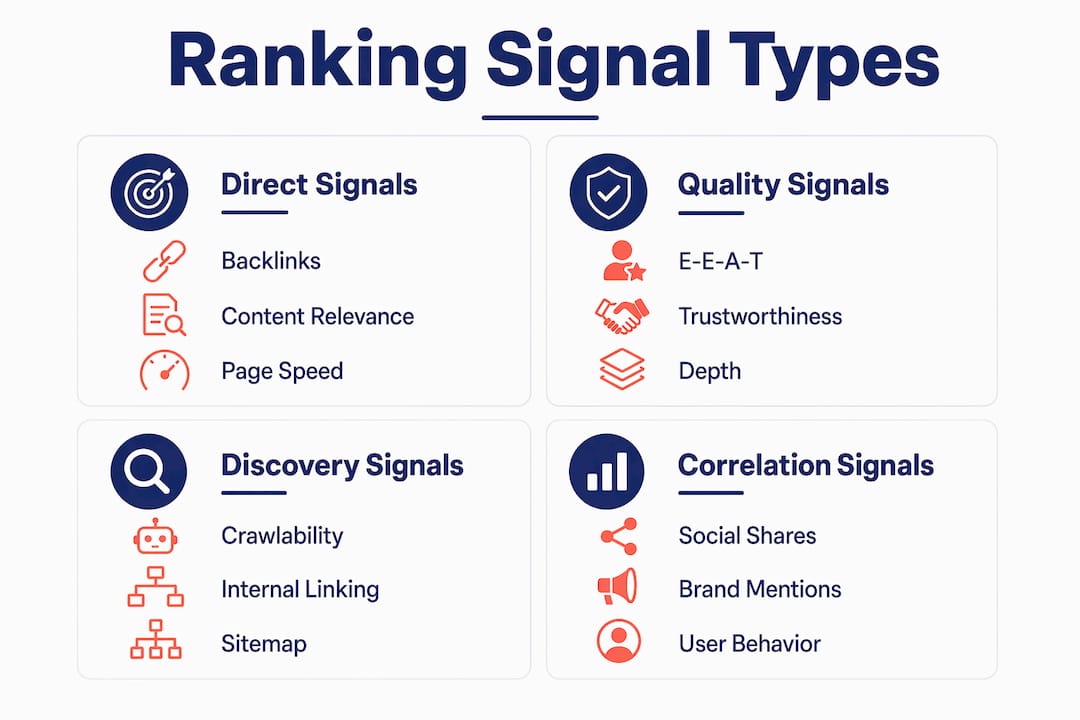
Ranking signals fall into four distinct categories: direct signals, quality signals, discovery signals, and correlation signals. Each category plays a different role in how search engines evaluate your pages.

Direct ranking signals are confirmed factors that Google’s systems actively use to rank pages. Backlinks and content relevance are the clearest examples. A page with authoritative inbound links and content that directly matches a search query will consistently outperform a page that lacks either.
Quality signals measure trustworthiness and depth. E-E-A-T (Experience, Expertise, Authoritativeness, Trustworthiness) is the most prominent quality framework Google applies. A medical article written by a licensed physician carries more weight than one written anonymously, even if both cover the same topic.
Discovery signals determine whether Google can find and index your content at all. Crawlability, internal linking structure, and XML sitemaps all fall here. Without solid discovery signals, your content never enters the ranking competition.
Correlation signals are traits frequently observed in high-ranking pages but not confirmed as direct causes. Social shares and time-on-page fall into this bucket. They may reflect quality rather than drive rankings directly.
| Signal type | Examples | Role in ranking |
|---|---|---|
| Direct | Backlinks, content relevance | Confirmed ranking inputs |
| Quality | E-E-A-T, trustworthiness | Evaluates page credibility |
| Discovery | Crawlability, sitemaps | Controls indexing access |
| Correlation | Social shares, dwell time | Associated with, not proven to cause, rankings |
Pro Tip: Do not spend budget chasing correlation signals like social shares. Focus first on direct and quality signals, then let correlation signals follow naturally from good content.
How do ranking signals interact within Google’s systems?
Google does not apply ranking signals as a simple checklist. Modern search relies on multiple interconnected systems, including relevance systems, quality evaluation systems, spam detection systems, and entity understanding systems, all working together based on what a specific query demands.
Here is how the process works at a high level:
- Query interpretation. Google’s systems parse the search query to understand intent, entities, and context before evaluating any page.
- Signal collection. Raw inputs like page content, backlink profiles, and technical health data are gathered for candidate pages.
- Signal processing. AI models convert raw inputs into higher-level quality scores. Clicks, for example, are processed as raw signals and used to train ranking models, not counted directly as ranking votes.
- Dynamic weighting. Systems weigh signals differently depending on query type. A local search query triggers heavier weighting on proximity and Google Business Profile data. An informational query prioritizes content depth and E-E-A-T.
- Final ranking output. Pages are ordered based on the combined output of all active systems for that specific query.
This architecture explains why SEO professionals who focus on a single factor rarely see lasting results. A page with excellent content but poor technical health will stall. A technically perfect page with thin content will not rank either. The systems are designed to reward pages that score well across multiple dimensions simultaneously.
Pro Tip: When auditing a site, check all four signal categories before prioritizing fixes. A single weak category can suppress the performance of strong signals elsewhere.
Which ranking signals matter most for SEO success in 2026?
Google uses hundreds of signals, but the confirmed high-impact factors for 2026 cluster into a manageable set. Knowing which ones carry the most weight lets you allocate effort where it produces real results.
The top confirmed ranking signals are:
- Content quality and relevance. Content must directly answer the query with depth and accuracy. Thin or generic content does not rank, regardless of how well the page is optimized technically.
- Search intent alignment. Google evaluates whether content satisfies the searcher’s expected outcome. A page targeting “best running shoes” that reads like a product spec sheet misses the intent of a buyer looking for comparisons and recommendations.
- Backlinks from authoritative sources. Links from trusted, relevant domains remain one of the strongest direct signals. Quality outweighs quantity here by a wide margin.
- Core Web Vitals and page speed. Core Web Vitals, HTTPS, and mobile-friendliness are officially confirmed ranking factors. Slow pages and poor mobile experiences directly suppress rankings.
- HTTPS security. Google confirmed HTTPS as a ranking signal years ago. Any site still running on HTTP is leaving ranking potential on the table.
- Mobile-friendliness. Google indexes the mobile version of your site first. A desktop-only experience is a ranking liability.
- E-E-A-T signals. Author credentials, editorial standards, and site reputation all feed into quality evaluation. This matters most in health, finance, and legal content categories.
One common misconception is worth addressing directly. Clicks are not a direct ranking signal you can manufacture. Raw click data feeds AI models like RankEmbedBERT to generate quality scores, but artificially inflating clicks does not improve rankings. Google’s systems are built to detect and discount manipulated engagement.
Pages with high content quality but weak authority signals cannot rank well on their own. The same is true in reverse. Reinforcing all signal categories through content, authority, and technical SEO is the only approach that produces durable results.
How can marketers apply ranking signals to improve performance?
Knowing the signals is only half the work. Applying that knowledge through a structured process is what separates sites that grow from sites that stall. Here is a practical framework for putting website ranking indicators to work.
- Audit your technical foundation first. Technical health is a prerequisite for ranking, not an optional upgrade. Run a crawl audit to identify broken links, slow pages, missing HTTPS, and mobile usability errors. Fix these before investing in content or link building.
- Map content to search intent. For every target keyword, identify whether the intent is informational, navigational, commercial, or transactional. Then confirm your page format matches. A blog post works for informational queries. A product page works for transactional ones. Mismatched formats lose rankings regardless of content quality.
- Build E-E-A-T into your content process. Add author bios with credentials, cite authoritative sources, and keep content updated. For local businesses, this means connecting your content marketing to authority building through consistent publishing and expert positioning.
- Earn backlinks through digital PR and partnerships. Outreach campaigns, guest articles, and local press mentions all generate the kind of authoritative inbound links that move rankings. Avoid link schemes. Google’s spam detection systems are sophisticated enough to identify and penalize unnatural link patterns.
- Monitor Core Web Vitals regularly. Google Search Console reports Core Web Vitals data at the page level. Set a monthly review cadence and treat any pages in the “poor” category as urgent fixes.
- Adapt your approach as signals evolve. Search ranking systems change continuously. Staying current with SEO strategies for 2026 means reading Google’s official documentation and testing changes on your own site rather than relying solely on third-party interpretations.
Pro Tip: Treat your SEO audit as a quarterly process, not a one-time project. Signal weights shift with algorithm updates, and what worked six months ago may need recalibration today.
Key Takeaways
Ranking signals work as an interconnected system, and improving all signal categories together produces far better results than optimizing any single factor in isolation.
| Point | Details |
|---|---|
| Four signal categories | Direct, quality, discovery, and correlation signals each play a distinct role in how Google ranks pages. |
| Systems-based ranking | Google uses multiple AI-driven systems that weigh signals dynamically based on query intent, not a fixed checklist. |
| Top confirmed signals | Content quality, backlinks, Core Web Vitals, HTTPS, mobile-friendliness, and E-E-A-T are the highest-impact confirmed factors. |
| Clicks are not direct signals | Click data trains AI ranking models but is not a standalone ranking factor you can manipulate. |
| Technical health is foundational | Without crawlability, speed, and security, even high-quality content struggles to rank. |
What I have learned about ranking signals after years in the field
Most SEO professionals I talk to still think about ranking signals as a list to check off. Fix the title tag, get some backlinks, add a keyword. That mental model made sense a decade ago. It does not reflect how Google actually works in 2026.
What I have seen consistently with clients at Battleseo is that the sites making the biggest gains are the ones treating SEO as a system problem, not a task list. When we work through the Local Command Directive™ framework, we are not just building backlinks or writing content in isolation. We are reinforcing every signal category at once: authority through digital PR, technical health through on-page audits, and quality through content that genuinely answers what local searchers need.
The AI dimension is also changing the game faster than most guides acknowledge. Google’s ranking models are not static. They learn from user behavior, update with new training data, and shift how they weight signals based on what actually satisfies searchers. That means the SEO professional who wins in 2026 is the one who builds pages that genuinely serve users, not the one who finds the cleverest way to game a signal.
My honest advice: stop asking which single signal matters most and start asking whether your site is strong across all of them. The answer to that question will tell you exactly where to focus next.
— Mike
Ranking signals and local SEO: how Battleseo can help
Understanding ranking signals is one thing. Applying them consistently across a local market is where most independent businesses fall short.

Battleseo works exclusively with one business per service category per market, which means your competitors cannot use the same playbook. The Local Command Directive™ framework covers every major signal category: authority backlinks, Google Business Profile optimization, citation building, and on-page SEO. If you want to see how these signals apply specifically to your business, the local SEO visibility guide is a practical starting point. Battleseo also integrates AI search optimization so your business gets found on ChatGPT, Perplexity, and Gemini, not just Google.
FAQ
What are ranking signals in SEO?
Ranking signals are measurable criteria that search engines use to evaluate and order web pages in search results. They include content quality, backlinks, technical performance, and user experience factors.
How many ranking signals does Google use?
Google uses hundreds of signals, but the most impactful confirmed factors include content quality, backlinks, Core Web Vitals, mobile-friendliness, HTTPS, and E-E-A-T.
Are clicks a ranking signal?
Clicks are not a direct ranking signal. Google processes click data as raw input to train AI ranking models, but artificially inflating clicks does not improve your rankings.
What is E-E-A-T and why does it matter?
E-E-A-T stands for Experience, Expertise, Authoritativeness, and Trustworthiness. Google uses it as a quality evaluation framework, and it carries particular weight in health, finance, and legal content categories.
How often do ranking signals change?
Google updates its ranking systems continuously throughout the year. Core algorithm updates happen several times annually, and signal weights shift with each update, making ongoing monitoring a necessary part of any SEO program.