

TL;DR:
- Monitoring local rankings across different neighborhoods helps service businesses identify visibility gaps and measure real market performance.
- Tracking multiple metrics like Map Pack positions, reviews, and GBP engagement leads to higher revenue growth and better marketing decisions.
Local rankings are defined as your business’s position in Google’s Map Pack and local organic search results, measured at specific geographic points within your service area. Knowing why you should monitor local rankings is not optional for service businesses. 76% of mobile users who perform a local search visit a business within 24 hours. That single fact makes local rank tracking one of the highest-return activities a service business owner can do. Without tracking, you are flying blind in the most competitive part of search.
Why monitor local rankings as a service business owner
Local rank monitoring is the practice of tracking where your business appears in Google search results across different locations within your service area. The industry term for this is “local SERP tracking,” and it goes well beyond checking a single keyword position from your office computer.

Your ranking is not one number. It changes based on where the searcher is standing. A plumber in Dallas may rank first in the Map Pack for customers two miles away and fall off the first page entirely for customers five miles in the opposite direction. That geographic volatility is the core reason why tracking local rankings matters more than tracking national or city-level averages.
The importance of tracking local SEO becomes clear when you understand what you lose by not doing it. You miss ranking drops before they cost you calls. You miss geographic blind spots where competitors are winning customers you never knew you were losing. You also miss the data needed to justify any marketing spend.
Pro Tip: Check your rankings from multiple ZIP codes, not just your business address. Your office location biases the result and hides the true picture of your visibility.
What factors influence local rankings and why location granularity matters
Google’s local algorithm weighs three core factors: proximity, relevance, and prominence. Proximity is the distance between the searcher and your business. Relevance measures how well your Google Business Profile matches the search query. Prominence reflects your authority online, built through reviews, citations, and backlinks.
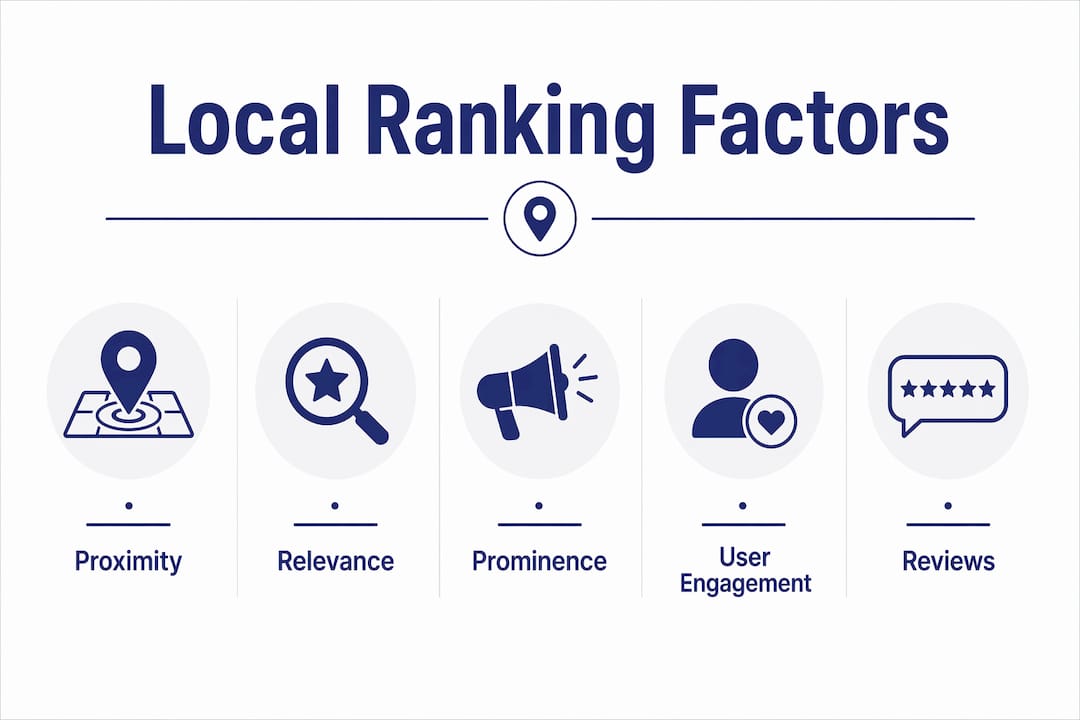
These three factors interact differently depending on where the search originates. City-level rank reports hide critical visibility failures because ranking first in a city can mean very different visibility in distinct neighborhoods. A roofing company that appears to rank well on average may be invisible in the ZIP codes where its best customers live.
Local Pack rankings and organic local rankings must be tracked as separate KPIs. Map Pack positions are driven primarily by Google Business Profile optimization and local citations. Organic local results are driven by backlinks and on-site SEO. Treating them as one metric produces a misleading picture of your actual visibility.
- Map Pack position: Where you appear in the three-business local box at the top of Google results
- Organic local position: Where your website ranks in the standard blue-link results below the Map Pack
- Geo-grid rank: Your average position tracked across a grid of GPS points or ZIP codes within your service area
- GBP engagement: Views, calls, and direction requests generated by your Google Business Profile
Pro Tip: Use a geo-grid tracking tool that places tracking points every one to two miles across your service area. This reveals the exact neighborhoods where your visibility drops off.
How tracking local rankings drives more customers and revenue
Rank data without context is just numbers. The real value of local rank monitoring comes from connecting position changes to business outcomes like calls, visits, and revenue.
Businesses tracking a mix of Local Pack positions, geo-grid rankings, and Google Business Profile engagement are 2.8 times more likely to see year-over-year revenue growth from local searches than those tracking keyword positions alone. That gap exists because multi-metric tracking reveals which specific actions produce results, not just which keywords rank.
Consider a concrete example. An HVAC company in Phoenix notices through geo-grid tracking that its Map Pack visibility drops sharply in the northwest quadrant of its service area. It invests in citation building and GBP posts targeting that zone. Within 60 days, calls from that area increase. Without the geo-grid data, that opportunity would never have been identified.
The benefits of local ranking analysis extend to budget decisions as well. When you can see which ZIP codes produce the most Map Pack impressions and which produce the fewest, you can direct ad spend and content efforts where they will have the greatest impact. You stop spending equally across your entire service area and start building outward from your strongest zones.
- Identify geographic gaps where competitors outrank you and customers are not finding you
- Measure the impact of Google Business Profile updates, new reviews, or citation campaigns
- Connect rank changes to call volume using integrated call tracking alongside ranking data
- Justify marketing investment by showing rank improvement tied to lead growth
What tools and methods work best for monitoring local rankings
The right monitoring method depends on tracking frequency, geographic precision, and the metrics you combine with rank data.
-
Set the right tracking frequency. Daily rank tracking is unnecessary because daily fluctuations of 1–3 spots are typical and not a signal of real change. Weekly or bi-weekly audits reveal genuine trends without triggering unnecessary reactions to normal algorithm tests.
-
Use geo-grid mapping tools. Static rank reports from a single IP address mask hyper-local shifts. Only ZIP code or GPS-based geo tracking reveals competitive threats within small distances. Local pack visibility can differ by several positions within a few hundred yards.
-
Track Map Pack and organic separately. Because the ranking factors differ, a drop in one does not always mean a drop in the other. Monitoring both gives you a complete picture and tells you which part of your local SEO needs attention.
-
Monitor Google Business Profile metrics alongside rank data. Views, calls, and direction requests from your GBP are leading indicators. If your rank holds steady but GBP calls drop, something in your profile, such as photos, hours, or review recency, may be hurting conversion.
-
Build a simple dashboard. Tracking four core metrics, Map Pack position, geo-grid rank, GBP views and calls, and website conversions, gives you everything you need without creating data overload.
Learning how to track local SEO results does not require expensive enterprise software. Many mid-tier tools offer geo-grid tracking and GBP integration at a price point that works for independent service businesses.
Pro Tip: Set a monthly review date on your calendar. Consistent monthly check-ins build a data history that shows you real trends over time, which is far more useful than checking rankings every morning.
How AI search trends and reputation signals are changing local rank monitoring
Traditional rank tracking is no longer enough on its own. AI-generated search summaries and zero-click results shift how visibility is perceived, because a business can rank well in the Map Pack but still lose traffic if an AI summary answers the searcher’s question without a click.
Reputation signals now carry more weight than ever. Google increasingly uses review signals as trust indicators in local ranking algorithms. Review volume, freshness, and sentiment all influence where you appear and whether searchers choose you over a competitor. A business with 200 reviews averaging 4.8 stars will outperform a business with 40 reviews at 4.2 stars, even if both rank in the same Map Pack position.
“The question is no longer ‘What is my rank?’ The better question is ‘Where do I rank, and how far does my visibility reach?’” — geo-tracking insight
A balanced monitoring approach built on four pillars prevents analysis paralysis and keeps your focus on revenue-generating actions:
- Visibility: Map Pack position and geo-grid rank across your service area
- Reputation: Review count, average rating, and recency of new reviews
- Engagement: GBP views, calls, and direction requests month over month
- Conversion: Website form fills, booked appointments, and tracked calls
Integrating AI search visibility into your monitoring is the next step. Platforms like ChatGPT, Perplexity, and Gemini are increasingly used for local service queries. Understanding how AI-driven search affects your local visibility is now part of a complete monitoring strategy, not a future consideration.
Key takeaways
Monitoring local rankings across geographic points, reputation signals, and engagement metrics is the most direct path to consistent customer acquisition for service businesses.
| Point | Details |
|---|---|
| Local rankings are location-specific | Your rank changes by neighborhood, so track across ZIP codes and GPS points, not just city averages. |
| Separate Map Pack from organic tracking | These rankings have different drivers and must be measured as distinct KPIs. |
| Multi-metric tracking grows revenue | Businesses tracking rank, GBP engagement, and conversions together are 2.8x more likely to grow year-over-year revenue. |
| Weekly audits beat daily checks | Daily fluctuations of 1–3 spots are normal. Weekly reviews reveal real trends without unnecessary panic. |
| Reputation signals now affect rankings | Review volume, freshness, and sentiment directly influence your local search placement and click-through rates. |
What I’ve learned after years of watching businesses track the wrong things
Most business owners I talk to check their rankings by Googling their own business from their office. That tells them almost nothing useful. Their browser is personalized, their location is fixed, and the result they see has no relationship to what a customer in the next ZIP code sees.
The bigger mistake is treating rank as the only metric that matters. I have seen businesses hold a steady Map Pack position for months while their call volume drops steadily, because their review count stagnated and a competitor with fresher reviews started winning the clicks. Rank stayed the same. Revenue did not.
The businesses that grow consistently are the ones that build a simple, repeatable monitoring routine. They check geo-grid data every two weeks, review their GBP engagement monthly, and watch their review velocity. They do not react to every small fluctuation. They look for patterns over 60 to 90 days and make one or two focused adjustments at a time.
Patience is not passive. It means trusting a system and giving changes enough time to show results before you change course again. The businesses that stop too early, or that chase every algorithm update, never build the data history that tells them what actually works in their specific market.
If you take one thing from this, make it this: measure where your visibility ends, not just where it peaks.
— Mike
Battleseo’s local SEO monitoring services
Knowing why local SEO monitoring matters is the first step. Putting it into practice is where most business owners get stuck, because the tools, metrics, and tracking cadence all need to work together.
Battleseo builds customized local SEO monitoring setups for independent service businesses across the U.S. The Local Command Directive™ framework covers Google Business Profile optimization, citation building, geo-grid rank tracking, and reputation monitoring in one structured program. Every client gets a clear picture of where their visibility stands and a plan to expand it. If you are ready to turn rank data into real leads, explore Battleseo’s local SEO services or read the beginner’s guide to local SEO to build your foundation first.
FAQ
Why should I monitor local rankings instead of just national rankings?
Local rankings reflect where your business appears for customers searching near your location, which directly drives foot traffic and calls. 76% of mobile local searchers visit a business within 24 hours, making local visibility far more tied to immediate revenue than national rankings.
How often should I check my local search rankings?
Weekly or bi-weekly tracking is the right cadence for most service businesses. Daily fluctuations of 1–3 positions are normal and not a reliable signal of real performance change.
What is a geo-grid and why does it matter for local rank tracking?
A geo-grid places tracking points across your service area at set distances, such as every one to two miles, to show your Map Pack position from each point. Static reports from a single location hide the rank gaps that cost you customers in specific neighborhoods.
Do reviews affect my local search rankings?
Yes. Review volume, freshness, and sentiment are active ranking signals in Google’s local algorithm. Businesses with more recent, higher-rated reviews consistently outperform those with stale or fewer reviews, even at similar Map Pack positions.
What metrics should I track alongside my local rankings?
Track Map Pack position, geo-grid rank, Google Business Profile views and calls, and website conversions together. Businesses that monitor this combination are 2.8 times more likely to see year-over-year revenue growth from local search.