
TL;DR:
- Search intent is the primary goal behind a user’s search and impacts how content should be optimized. Matching content type, format, and angle to the true intent improves ranking, conversions, and user satisfaction. Analyzing live SERPs reveals the actual intent Google attributes to queries more accurately than keyword tools.
Search intent is defined as the primary goal a user wants to accomplish when entering a query into a search engine. It is the “why” behind the search, not just the words typed. Google’s algorithms prioritize the story behind a query over simple keyword matching, which means content that ignores user intent will underperform regardless of technical SEO quality. For digital marketers, SEO professionals, and business owners, understanding search intent is the single most important factor in building content that ranks and converts in 2026.
What is search intent, and why does it matter for SEO?
Search intent sits at the foundation of every ranking decision Google makes. Aligning content with search intent is a non-negotiable ranking factor in 2026, surpassing keyword density and backlink volume in importance. That means a page with fewer backlinks but perfect intent alignment will outrank a heavily linked page that mismatches what the searcher actually wants.
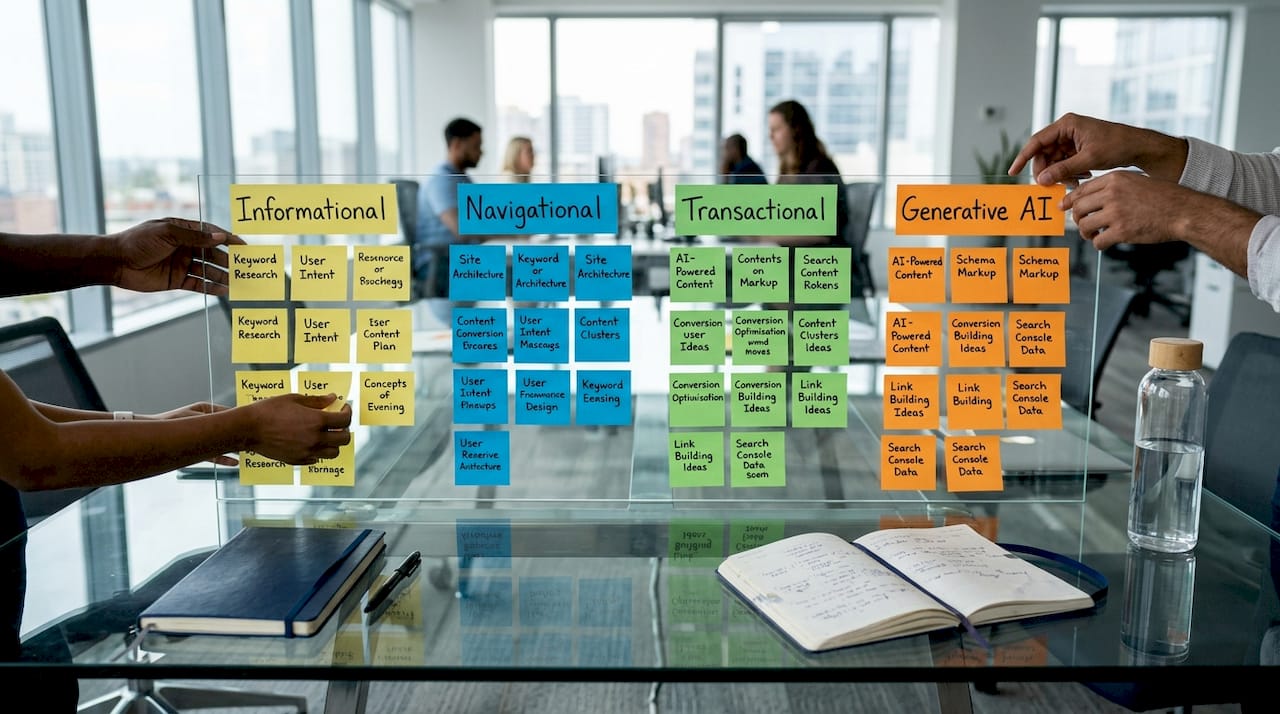
Google’s Search Quality Evaluator Guidelines classify intent into four categories: Know, Do, Website, and Visit-in-person. Traditional SEO models map these to informational, transactional, navigational, and local intent. Understanding both frameworks gives you a more complete picture of what Google rewards.
The practical implication is direct. If a user searches “how to fix a leaky faucet,” they want a tutorial, not a product page. Serving a product page for that query signals a mismatch to Google, and the page will struggle to rank no matter how well it is optimized technically. Intent alignment is the prerequisite for everything else in your SEO strategy.
What are the six types of search intent in 2026?
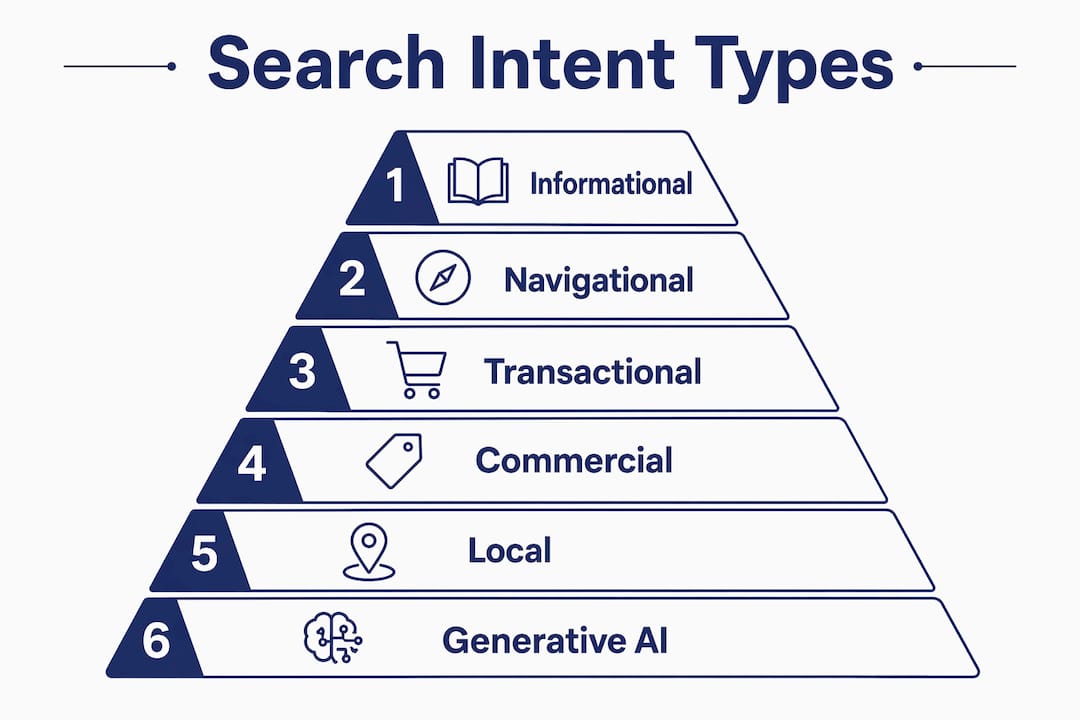
Six primary intent types now define how marketers categorize queries: informational, navigational, transactional, commercial, local, and generative AI. The last category is new and reflects how users now search specifically to get AI-generated answers rather than browse web pages.
| Intent type | User goal | Typical query example | Best content format |
|---|---|---|---|
| Informational | Learn something | “how does SEO work” | Blog post, guide, video |
| Navigational | Find a specific site | “Battleseo local SEO” | Brand page, homepage |
| Transactional | Complete a purchase | “buy SEO services” | Product or service page |
| Commercial | Research before buying | “best SEO agencies 2026” | Comparison article, review |
| Local | Find nearby business | “SEO agency near me” | Google Business Profile, local page |
| Generative AI | Get an AI-synthesized answer | “explain search intent simply” | Structured, authoritative content |
Each intent type demands a different content format and a different conversion path. Mixing them up is one of the most common and costly mistakes in content planning.
- Informational intent drives the most search volume but the lowest direct conversion. Use it to build topical authority and capture users early in the buying cycle.
- Commercial intent is the highest-value pre-purchase stage. Comparison posts, “best of” lists, and review articles serve this intent well.
- Local intent is critical for independent business owners. A well-optimized Google Business Profile is often the deciding factor for these queries.
- Generative AI intent is the newest category and requires content that goes beyond surface-level summaries. AI Overviews pull from pages that offer structured, authoritative answers, so depth and clarity matter more than ever.
Pro Tip: When you are unsure which intent type a keyword falls under, search it yourself in an incognito window. The format of the top five results will tell you exactly what Google believes the user wants.
How do you identify search intent accurately?
The most accurate method to decode search intent is analyzing live SERP features rather than relying on keyword tool labels alone. Keyword tools assign intent categories algorithmically, and they are often wrong for ambiguous or niche queries. The SERP itself is Google’s real-time answer to what intent it believes the query carries.
Follow these steps to identify intent for any target keyword:
- Search the keyword in incognito mode. This removes personalization and gives you a neutral view of what Google serves to the average searcher.
- Identify the dominant content type. When 90% of results share the same format, such as blog posts or product pages, that format confirms the intent. Nine out of ten results being blog posts signals informational intent clearly.
- Check for SERP features. Shopping results signal transactional intent. A local pack signals local intent. An AI Overview signals informational or generative AI intent and indicates that AI-driven SERP features are reducing clicks to standard organic results for that query.
- Analyze the content angle. Look at the titles and headings of the top three results. Are they “how to” guides, listicles, product comparisons, or brand pages? The angle tells you what specific sub-intent Google is rewarding.
- Note the content length and depth. Short answers dominate simple informational queries. Long, detailed guides dominate complex research queries. Match your content depth to what already ranks.
Pro Tip: Run this SERP analysis before writing a single word. It takes five minutes and prevents hours of wasted effort on content that will never rank because it targets the wrong format.
Why does intent alignment directly impact your rankings?
Content that fails to satisfy search intent produces poor search performance even when technical SEO is flawless. Google measures user satisfaction through behavioral signals: bounce rate, dwell time, and click-through rate. When a page mismatches intent, users leave fast, and Google interprets that as a quality failure.
Targeting high-volume keywords without acknowledging the specific user intent behind them leads to poor conversion and weak rankings. Traffic without intent alignment is noise. A page that ranks for the wrong intent will attract visitors who immediately leave because the content does not answer their actual question.
The benefits of correct intent alignment are concrete:
- Higher dwell time because users find what they came for
- Lower bounce rate because the content format matches expectations
- Better conversion rates because the page serves users at the right stage of their decision process
- Stronger ranking signals because Google sees satisfied users returning to the SERP less often
Keyword intent acts as a strategic filter. Before pursuing any keyword, ask whether your site can genuinely serve that intent and convert the user who holds it. If the answer is no, the keyword is not worth targeting regardless of its search volume.
The smarter SEO strategy is to build a keyword list organized by intent type, then match each keyword to a content format and a conversion goal. This turns your content calendar into a structured funnel rather than a collection of disconnected articles.
How do you apply search intent to your content strategy?
Intent-driven content strategy starts with the “3 C’s of search intent”: content type, content format, and content angle. Get all three right and you give your page the best possible chance of ranking.
- Content type is the broad category: blog post, product page, landing page, or video. Match the type to the dominant format in the SERP.
- Content format is the structure within that type: how-to guide, listicle, comparison, definition post, or case study. The top-ranking results will show you which format Google favors.
- Content angle is the unique positioning: “for beginners,” “in 2026,” “for small businesses.” The angle targets the specific sub-intent within the broader category.
Keyword intent should be treated as a rigorous filter in strategic planning. Before adding a keyword to your content plan, confirm that your site can realistically serve that intent. A local plumbing business should not target informational keywords about plumbing history. It should target local and transactional keywords where it can actually convert the searcher.
Generative AI intent requires a separate approach. Users searching with this intent want structured, authoritative answers that AI systems can synthesize. Write content with clear definitions, numbered steps, and direct answers to common questions. This also improves your chances of appearing in AI Overviews and being cited by platforms like ChatGPT and Perplexity. The AI SEO trends in 2026 show that structured, intent-matched content is the primary driver of AI citation visibility.
Pro Tip: Revisit your top-performing pages every quarter and re-run the SERP analysis. Intent for a keyword can shift over time as user behavior changes, and a page that matched intent last year may need a format update to stay competitive.
For ongoing monitoring, track your pages’ average position alongside engagement metrics in Google Search Console. A page with high impressions but low click-through rate often signals an intent mismatch at the title or meta description level, not a content problem.
Key Takeaways
Search intent is the single most important alignment factor in SEO, and matching content type, format, and angle to the user’s actual goal determines whether a page ranks or stalls.
| Point | Details |
|---|---|
| Intent defines ranking success | Content that satisfies search intent outranks technically stronger pages that miss the user’s goal. |
| Six intent types in 2026 | Informational, navigational, transactional, commercial, local, and generative AI each require a distinct content approach. |
| SERP analysis beats keyword tools | Live incognito searches reveal the true intent Google assigns to a query more accurately than any tool. |
| Intent is a conversion filter | Pursuing keywords your site cannot serve leads to traffic without results. Filter by intent fit first. |
| AI intent demands structure | Generative AI intent requires clear definitions, direct answers, and organized formatting to earn AI Overview citations. |
The uncomfortable truth about search intent most marketers miss
Most marketers treat search intent as a labeling exercise. They tag keywords as “informational” or “transactional” in a spreadsheet and move on. That is not intent analysis. That is intent theater.
The real work is understanding why the intent exists for a specific query at a specific moment. A search for “SEO agency” from someone in a small town carries local intent. The same search from someone reading a marketing blog carries commercial intent. The words are identical. The intent is not.
What I have found working with independent business owners is that the biggest missed opportunity is local intent. Most small business websites have no content that directly addresses “near me” or location-specific queries. They write generic service pages and wonder why they are invisible in local packs. The fix is not more content. It is the right content for the right intent.
The generative AI intent category is where I see the most confusion right now. Marketers assume that AI Overviews are a threat to organic traffic. They can be, for shallow informational content. But for content with genuine depth, clear structure, and authoritative sourcing, adapting to AI search is an opportunity to get cited across multiple platforms simultaneously. That is a traffic multiplier, not a traffic killer.
The mistake to avoid is chasing intent signals reactively. Do not rewrite your content every time Google updates its SERP layout. Build content that genuinely answers the full question behind a query, and the intent alignment will hold across algorithm changes.
— Mike
How Battleseo helps you rank for the right intent
Battleseo works with independent business owners to build content and local SEO strategies that match exactly what their customers are searching for. The approach covers every layer of intent, from informational content that builds authority to local and transactional pages that convert searchers into customers.
The Local Command Directive™ framework targets local and commercial intent directly through Google Business Profile optimization, authority backlinks, citation building, and on-page SEO. For businesses that also want visibility on AI platforms like ChatGPT and Perplexity, Battleseo’s AI search optimization services are built to earn citations from generative AI systems. If you want to boost your local visibility with a strategy built around real user intent, Battleseo takes on only one business per category per market, so your position stays exclusive.
FAQ
What is search intent in simple terms?
Search intent is the reason a person performs a search. It describes what the user actually wants to find, whether that is an answer, a product, a website, or a local business.
How many types of search intent are there?
There are six recognized types in 2026: informational, navigational, transactional, commercial, local, and generative AI. The generative AI category is the newest, reflecting searches designed to produce AI-synthesized answers.
Why does search intent matter more than keywords?
Google’s algorithms prioritize the goal behind a query over the exact words used. Content that matches the user’s intent ranks higher than keyword-stuffed content that ignores what the searcher actually wants.
How do I identify the search intent for a keyword?
Search the keyword in an incognito browser and examine the top results. The dominant content type, SERP features like local packs or Shopping results, and the content angles of top-ranking pages all reveal the intent Google assigns to that query.
What is generative AI search intent?
Generative AI intent describes searches where the user expects an AI-generated summary rather than a list of links. Content targeting this intent needs clear structure, direct answers, and authoritative sourcing to appear in AI Overviews and get cited by platforms like ChatGPT and Perplexity.