
TL;DR:
- Digital PR builds a brand’s online authority through earned media, backlinks, and digital storytelling, unlike paid advertising. It involves media outreach, creating data-driven content, and fostering influencer partnerships to establish trust and improve search rankings. Successful campaigns require goal setting, targeted research, relationship building, and ongoing measurement of backlinks and referral traffic.
Digital PR is defined as the practice of building a brand’s online presence and reputation through earned media coverage, authoritative backlinks, and digital storytelling across online publications, blogs, podcasts, and social platforms. Unlike paid advertising, digital PR earns visibility through credibility. It sits at the intersection of traditional public relations, content marketing, and SEO, making it one of the most compounding investments a business can make. Platforms like Mentionlytics and Cision have documented how earned media builds authority that paid campaigns simply cannot replicate. If you want your brand to rank higher, earn trust faster, and attract qualified traffic, digital PR is the mechanism that makes all three happen at once.

What is digital PR and what does it actually involve?
Digital PR is the online evolution of traditional public relations, built specifically for how audiences discover and trust brands today. Digital PR includes securing media coverage on online publications, earning backlinks from reputable sites, collaborating with influencers, and publishing data-driven studies that journalists and bloggers want to cite. The goal is not just press mentions. The goal is building a web of trusted, third-party signals that tell search engines and consumers alike that your brand is the real authority in its space.
What does digital PR involve on a practical level? The core activities break down into five areas:
- Media outreach: Pitching story ideas, expert commentary, and data to online news outlets, industry blogs, and podcast hosts
- Data-driven content: Creating original research, surveys, and studies that give journalists a reason to link back to your site
- Influencer partnerships: Collaborating with creators and subject matter experts to amplify your brand message to engaged audiences
- Press releases and digital storytelling: Distributing announcements through online wire services and crafting narratives that resonate with digital editors
- Brand sentiment monitoring: Tracking online mentions, reviews, and conversations to manage and protect your reputation in real time
Pro Tip: Before you pitch any publication, read its last 10 articles. Editors reject pitches that do not match their editorial voice. Matching tone and topic to the outlet increases your placement rate significantly.
How does digital PR differ from traditional PR and link building?
The confusion between digital PR, traditional PR, and link building is common. They overlap, but they are not the same thing.
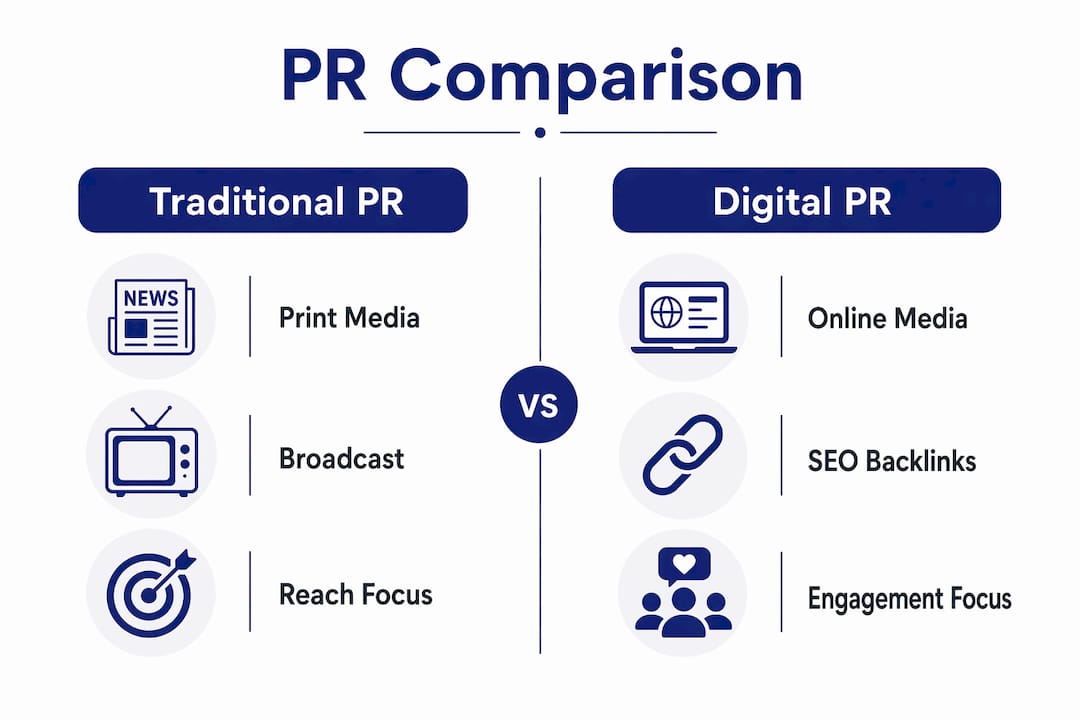
Traditional PR targets print newspapers, TV segments, and radio spots. Its success is measured in reach and impressions, and its results are largely untrackable at the conversion level. Digital PR targets online publications, blogs, and social channels where every mention is measurable and every backlink carries direct SEO value. Advertising’s impact ends when the budget stops, but a backlink earned through digital PR continues to pass authority to your site for years.
Link building, on the other hand, focuses narrowly on acquiring backlinks to improve search rankings. Digital PR is broader. It uses link acquisition as one output of a larger brand authority campaign. You are not just chasing a backlink. You are building a reputation that makes future links, press mentions, and customer trust easier to earn.
| Dimension | Traditional PR | Digital PR | Link building |
|---|---|---|---|
| Primary channel | Print, TV, radio | Online publications, blogs, social | Any site with domain authority |
| Core goal | Brand awareness and reputation | Authority, trust, and SEO visibility | Search ranking improvement |
| Measurability | Limited (reach, impressions) | High (traffic, rankings, backlinks) | High (domain authority, rankings) |
| Long-term compounding | Low | High | Medium |
| Audience trust signal | Moderate | High (independent media) | Low (often invisible to readers) |
Audiences are skeptical of brand marketing but rely on independent news outlets and influencers for information. That skepticism is exactly why digital PR outperforms both paid ads and pure link building for long-term credibility.
What are the advantages of digital PR for your business?
The benefits of digital PR compound over time in ways that most marketing channels do not. A single well-placed feature in an authoritative publication can drive referral traffic for years, improve your domain authority, and introduce your brand to an audience that already trusts the source.
The most direct SEO benefit is the backlink. High-quality backlinks, media features, and social shares contribute directly to improved search rankings, increased referral traffic, and stronger brand credibility. A link from a major industry publication carries far more weight than dozens of links from low-authority directories. That is why digital PR produces SEO results that pure link building tactics struggle to match.
Beyond SEO, the advantages of digital PR include:
- Third-party validation: A feature in Forbes, an industry trade publication, or a respected local news outlet tells your audience that an independent editor found your brand worth covering.
- Qualified referral traffic: Readers who click through from a relevant publication already understand the context of your business. They convert at higher rates than cold traffic.
- Brand authority accumulation: Each earned mention builds on the last. Over time, your brand becomes the name journalists reach for when they need an expert source in your category.
- Reputation protection: Active digital PR gives you a body of positive, authoritative content that pushes down negative search results and builds a resilient online image.
Brands increasingly use digital PR to track effects on search engine rankings and referral traffic, treating it as a measurable marketing channel rather than a soft brand exercise. That shift in measurement mindset is what separates businesses that get real ROI from digital PR and those that treat it as optional.
How to develop and execute an effective digital PR strategy
A digital PR strategy that produces results follows a clear sequence. Skipping steps early in the process is the most common reason campaigns underperform.
-
Set objectives tied to business goals. Define what success looks like before you pitch a single journalist. Are you trying to improve domain authority, drive referral traffic to a specific page, or build brand recognition in a new market? Each goal shapes your tactics.
-
Research your target publications and audiences. Identify the online outlets your ideal customers actually read. Look at their editorial calendars, their most-shared content, and the types of stories they cover. A pitch that fits the publication’s existing narrative is far more likely to land.
-
Create newsworthy, data-backed content. Journalists need a reason to cover you. Original research, proprietary data, and expert commentary give them that reason. Campaigns with newsworthy hooks backed by data maximize organic search success because they earn links naturally rather than through outreach alone.
-
Build genuine media relationships. Treat journalists and editors as long-term contacts, not one-time targets. Follow their work, engage with their content, and offer value before you ask for coverage. Reporters remember who helps them and who only pitches them.
-
Track results against your KPIs. Measure backlinks earned, referral traffic generated, domain authority changes, and brand mention volume. Review results monthly and adjust your content and outreach approach based on what is working.
Pro Tip: Repurpose every piece of earned media. A feature article becomes a social post, an email newsletter item, and a case study on your website. One placement should generate at least five additional touchpoints.
Learning how digital PR drives SEO success for small businesses gives you a concrete framework for connecting your outreach efforts to measurable ranking improvements.
What tools and metrics should you use to measure digital PR success?
Effective digital PR campaigns use monitoring tools to quantify coverage, track referral traffic, and evaluate engagement. Without measurement, you cannot tell which placements are driving business results and which are just vanity metrics.
The core tool categories every digital PR program needs:
- Media monitoring platforms: Tools like Mention, Cision, and Google Alerts track brand mentions across news sites, blogs, and social media in real time.
- SEO backlink trackers: Platforms that monitor your backlink profile show you which new links were earned, their domain authority, and the anchor text used.
- Web analytics: Google Analytics 4 shows referral traffic from specific publications, session quality, and conversion rates from PR-driven visitors.
- Social listening tools: Sentiment analysis tools measure how audiences are responding to your brand mentions across social platforms.
The metrics that matter most in digital PR are domain authority growth, number of referring domains, referral traffic volume, share of voice in your category, and branded search volume. Branded search volume is often overlooked. When more people search directly for your brand name, it signals growing awareness and trust, both of which feed back into your SEO performance.
| Metric | What it measures | Why it matters |
|---|---|---|
| Referring domains | Number of unique sites linking to you | Indicates breadth of authority signals |
| Referral traffic | Visitors arriving from PR placements | Shows real audience engagement |
| Domain authority | Overall site authority score | Reflects cumulative link quality |
| Branded search volume | Direct searches for your brand name | Measures growing brand recognition |
| Share of voice | Your mentions vs. category competitors | Tracks relative market presence |
Building authority backlinks through digital PR requires consistent tracking so you can identify which content types and outreach approaches earn the highest-quality placements.
Key Takeaways
Digital PR is the most compounding brand investment available to marketers because earned media builds authority that paid advertising cannot replicate and that search engines reward over time.
| Point | Details |
|---|---|
| Core definition | Digital PR earns visibility through media coverage, backlinks, and trusted online mentions. |
| Earned vs. paid | Paid ads stop working when the budget ends; digital PR authority compounds indefinitely. |
| SEO connection | High-quality backlinks from earned media directly improve search rankings and referral traffic. |
| Strategy sequence | Set goals, research publications, create data-backed content, build relationships, then measure. |
| Measurement priority | Track referring domains, referral traffic, domain authority, and branded search volume monthly. |
Why most digital PR campaigns fail before they start
Most businesses approach digital PR the way they approach advertising: create something, push it out, and wait for results. That mindset produces mediocre outcomes. Digital PR is a relationship business dressed in marketing clothes.
The campaigns I have seen fail almost always share one trait. They lead with what the brand wants to say rather than what a journalist’s audience wants to read. A pitch about your new product launch is not news. A pitch about original research your company conducted that reveals something surprising about your industry? That gets placed.
The other mistake I see constantly is treating digital PR as a one-time sprint. You run a campaign, earn a few links, and move on. Real authority builds from consistent, ongoing presence. The brands that dominate their categories in search results are the ones that show up in the press every quarter, not just when they have a product to promote.
One more thing worth saying plainly: digital PR and SEO should not operate in separate silos. Integrating AI search platforms into your visibility strategy is the next frontier, and the brands building earned media authority now will have a significant advantage as AI-powered search continues to reshape how audiences find information. The fundamentals do not change. Credibility, earned through third-party validation, is still the currency that matters most.
— Mike
How Battleseo can strengthen your digital PR results
Battleseo works with independent business owners who want to build real online authority, not just rankings. The Local Command Directive™ framework combines authority link building with Google Business Profile optimization, citation building, and content marketing to position your business as the dominant local authority in your category.
If you are ready to turn digital PR into a measurable growth channel, Battleseo’s local SEO services are built to amplify the authority signals that earned media creates. With offices in New London, CT and Harker Heights, TX, and a strict one-client-per-category model, Battleseo gives your business an exclusive competitive edge. Explore how the right combination of digital PR and local SEO can make your brand the first name customers find and trust.
FAQ
What is digital PR in simple terms?
Digital PR is the practice of earning coverage, backlinks, and brand mentions on reputable online publications, blogs, and social platforms to build authority and visibility. It differs from advertising because the media coverage is earned, not purchased.
How does digital PR help SEO?
Digital PR earns high-quality backlinks from authoritative sites, which directly improves search rankings and referral traffic. Brands that track digital PR consistently see measurable gains in domain authority and organic search visibility.
What are the main digital PR tactics?
The core tactics include media outreach, data-driven content creation, influencer partnerships, press release distribution, and brand sentiment monitoring. Each tactic is designed to earn trusted mentions and links on digital channels.
How is digital PR different from traditional PR?
Traditional PR targets print, TV, and radio with limited measurability. Digital PR targets online publications and social platforms where every mention and backlink is trackable and contributes directly to SEO performance.
How long does it take to see results from digital PR?
Digital PR results build over time rather than delivering immediate spikes. Most businesses see measurable improvements in referral traffic and domain authority within three to six months of consistent, well-executed outreach.