

TL;DR:
- Google Maps ranking is influenced by controllable factors such as relevance and prominence, which businesses can optimize through category selection, reviews, citations, and website alignment. Consistent activity, review velocity, and thorough profile management are essential for maintaining and improving local search positions. Using geo-grid heatmaps allows businesses to identify geographic ranking gaps and sustain long-term visibility in competitive markets.
Google Maps ranking is defined as your business’s position in Google’s local search results, directly controlling how many customers find, call, and visit you. The Local 3-Pack captures 42% of all local search clicks, making it the highest-ROI real estate in local search. This Google Maps ranking guide covers every factor Google weighs in 2026, from Google Business Profile optimization and review velocity to citation consistency and geo-grid tracking. The strategies here are drawn from Whitespark 2026 data, Google Business Profile best practices, and Local Falcon geo-grid analysis, giving you a clear, step-by-step path to local visibility.
What are the main Google Maps ranking factors?

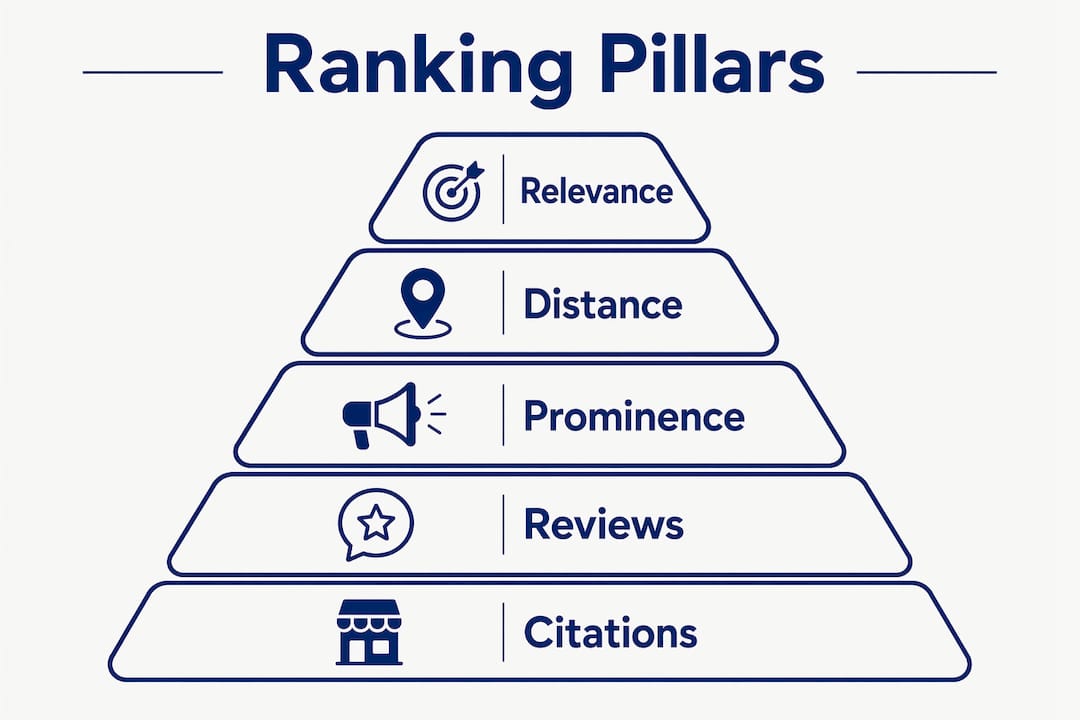
Google evaluates local rankings based on three pillars: relevance, distance, and prominence. Distance is largely outside your control, since Google calculates proximity between the searcher and your business address. Relevance and prominence, however, are fully controllable and where you should focus your effort.
Relevance signals tell Google what your business does and who it serves. The primary business category is the highest-weighted relevance factor, outranking keywords in your business name, description, or posts. Choosing a precise category like “Emergency Plumber” instead of “Plumber” or “Home Services” gives Google a clearer match signal for specific searches.
Prominence signals reflect how well-known and trusted your business is across the web. This pillar includes review volume, review velocity, star ratings, citation consistency across directories, backlinks from local websites, and behavioral signals like calls, direction requests, and profile clicks. Businesses that neglect behavioral engagement are leaving a growing ranking signal on the table.
Here is how the three pillars compare in terms of what you can control:
| Ranking pillar | Controllable? | Key signals |
|---|---|---|
| Relevance | Yes | Category, description, services, keywords |
| Distance | No | Physical address proximity to searcher |
| Prominence | Yes | Reviews, citations, backlinks, engagement |
Pro Tip: Never stuff keywords into your business name to gain relevance. Google’s filters treat this as a policy violation and can suspend your profile entirely. Let your category and description do the keyword work.
How to fully optimize your Google Business Profile
A fully optimized Google Business Profile is the foundation of every local search optimization guide worth reading. Profiles that are 100% complete are 7x more likely to receive clicks than incomplete ones, and yet roughly 55% of local businesses have not claimed their profile. That gap is your competitive advantage.
Follow these steps to build a profile that ranks and converts:
- Claim and verify your profile. Go to Google Business Profile Manager, search for your business, and complete phone or postcard verification. An unverified profile cannot rank.
- Select your primary category with precision. Pick the most specific category that matches your core service. Add secondary categories for supporting services, but keep them relevant.
- Write a keyword-rich business description. Use 750 characters to describe what you do, who you serve, and where you operate. Include your city name and core service terms naturally.
- Complete every available field. Add hours, phone number, website, service areas, attributes (like “wheelchair accessible” or “women-owned”), and a full product or service list.
- Upload 100 or more photos. Profiles with 100+ photos generate 520% more calls according to Google data. Add geotagged images of your location, team, and work to strengthen engagement signals.
- Preload the Q&A section. Write and answer your own most common customer questions. This fills a section Google indexes and prevents inaccurate third-party answers from appearing.
- Post weekly updates. Share offers, events, or service highlights with local keywords. Consistent weekly updates are a recognized activity signal that keeps your profile fresh in Google’s eyes.
Pro Tip: When writing your GBP description, include the name of your city or neighborhood at least once. Google cross-references your profile against your website, so matching location language across both strengthens your local prominence score.
For a deeper walkthrough of every profile field, Battleseo’s guide on optimizing your Google Business Profile covers each section with specific examples.
How to build review velocity and manage citations
Reviews are not just a reputation tool. They are a direct ranking signal, and the way you accumulate them matters as much as the total count. Review velocity, meaning a steady inflow of new reviews over time, outperforms having a large static total with no recent activity. Google reads a stagnant review profile as a sign of declining relevance.
The benchmark for competitive local markets is clear: top 3 map positions average 561 reviews with a 4.8-star rating. That number tells you the floor, not the ceiling. In less competitive markets, 50 to 100 well-maintained reviews with strong recency can be enough to rank.
Use these methods to build consistent review velocity:
- Automated follow-up emails. Set up a post-purchase or post-service email sequence using tools like Birdeye or NiceJob that requests a review 24 to 48 hours after the customer interaction.
- QR codes at point of sale. Print a QR code that links directly to your Google review form and place it on receipts, countertops, or packaging.
- Verbal requests from staff. Train your team to ask satisfied customers directly. A personal ask from a real person converts at a higher rate than any automated message alone.
- Respond to every review. Responding to reviews, both positive and negative, signals active management to Google and builds trust with prospective customers reading your profile.
Citation management is equally non-negotiable. Consistent NAP data (name, address, phone number) across all major directories prevents Google from lowering your prominence score due to conflicting information. Audit your listings on Yelp, Apple Maps, Bing Places, Facebook, and industry-specific directories using tools like Whitespark or BrightLocal. Fix any discrepancy in your business name format, suite number, or phone number immediately.
Pro Tip: Ask customers to include a keyword in their review naturally. A review that says “best HVAC repair in Austin” carries more relevance weight than a five-star review with no text. Never script reviews, but you can prompt customers by asking what service they used.
How to use local SEO strategies beyond your GBP
Your Google Business Profile does not operate in isolation. Google cross-references GBP data against your website, and website content that aligns with your profile categories strengthens your local prominence signals. This is where off-profile local SEO strategies become a force multiplier.
Here are the most impactful steps to take on your website:
- Build geo-targeted landing pages. Create one page per core service per location. A plumber serving three cities should have three separate service pages, each with unique content referencing local landmarks, neighborhoods, and customer scenarios.
- Add LocalBusiness schema markup. Structured data using Schema.org’s LocalBusiness and Service types tells Google exactly what your business offers, where it operates, and how to contact you. This reduces ambiguity and strengthens relevance matching.
- Place consistent NAP information prominently. Your business name, address, and phone number should appear in the footer of every page and on a dedicated Contact page. The format must match your GBP exactly.
- Optimize for mobile speed. Google’s local ranking algorithm factors in page experience signals. A site that loads in under 2.5 seconds on mobile performs measurably better than a slow competitor.
- Acquire local backlinks. Even a handful of quality local backlinks from sources like your chamber of commerce, local news outlets, or neighborhood blogs can significantly improve your map ranking. These links signal trust and geographic relevance simultaneously.
| Website tactic | Primary benefit | Ranking pillar affected |
|---|---|---|
| Geo-targeted landing pages | Relevance matching for service searches | Relevance |
| LocalBusiness schema | Structured data clarity for Google | Relevance |
| Local backlinks | Trust and authority signals | Prominence |
| Mobile speed optimization | Page experience signals | Prominence |
How to track and troubleshoot your Google Maps ranking
A single rank check from your office address gives you one data point. It does not tell you how you rank across your entire service area. Geo-grid heatmaps reveal actual local visibility by mapping your rankings across dozens or hundreds of points in your market, showing exactly where you dominate and where you disappear.
Tools like Local Falcon generate a color-coded grid where green means you rank in the top 3 and red means you are invisible. Viewing rankings through geo-grid heatmaps allows you to pinpoint geographic blind spots and target content or citation-building efforts toward those specific areas. A plumber who ranks #1 near their shop but drops to #12 six miles away has a clear geographic gap to close.
Use this checklist to maintain your rankings over time:
- Run a geo-grid scan monthly. Compare results month over month to spot declines before they cost you customers.
- Respond to new reviews within 48 hours. Delayed responses reduce the engagement signal Google measures from your profile activity.
- Update your GBP at least once per week. A post, a new photo, or an updated service description all count as activity signals.
- Audit citations quarterly. Business information changes. Check that your NAP is still consistent after any address, phone, or name update.
- Avoid common suspension triggers. These include keyword stuffing in your business name, using a virtual office address, and creating duplicate listings.
“Google Maps SEO is not a set-and-forget task. Consistent activity signals, steady review generation, and monitored engagement are what separate businesses that hold their rankings from those that lose them.” Source
Expect meaningful ranking movement within 60 to 90 days of sustained effort. Competitive markets may take longer, but the compounding effect of consistent optimization builds a position that is hard for competitors to displace.
Pro Tip: Use Local Falcon’s “Share of Local Voice” metric to measure what percentage of the grid you own versus your top competitors. It turns a complex ranking picture into a single number you can track and improve each month.
Key takeaways
Ranking in Google Maps requires consistent optimization across your Google Business Profile, review velocity, citation accuracy, and local website alignment. No single tactic wins alone.
| Point | Details |
|---|---|
| Complete your GBP fully | Complete profiles are 7x more likely to receive clicks than incomplete ones. |
| Prioritize review velocity | A steady flow of new reviews outranks a large, stagnant total every time. |
| Keep NAP consistent everywhere | Conflicting name, address, or phone data across directories lowers your prominence score. |
| Align your website with your GBP | One geo-targeted page per service category strengthens Google’s relevance matching. |
| Use geo-grid tools to track progress | Monthly heatmap scans reveal geographic ranking gaps you cannot see from a single location check. |
What I’ve learned from watching businesses win and lose on Maps
I’ve worked with local businesses across dozens of markets, and the pattern I see most often is this: owners put in a burst of effort, see some movement, and then stop. Rankings hold for a few weeks, then slide. A competitor who stayed consistent takes the spot. The “set it and forget it” mindset is the single biggest reason businesses fail to hold their Maps position.
The second thing I see constantly is owners obsessing over review count while ignoring review content. A business with 200 generic five-star reviews often ranks below a competitor with 80 reviews that include specific service keywords and location mentions. Google reads the text. The quality of what customers write matters as much as how many write it.
What actually works is treating your Google Business Profile like a living asset. Post weekly. Respond to every review. Add photos regularly. Run a geo-grid scan monthly and use what you find to guide your next move. If you are invisible six miles from your shop, that is where your next citation push or landing page should focus.
The businesses I see dominate their local markets are not doing anything exotic. They are doing the fundamentals consistently, month after month, while their competitors do them once and move on. That gap is where your opportunity lives. For more on building local search momentum, Battleseo’s local search marketing tips offer a practical framework for U.S. business owners at every stage.
— Mike
Ready to dominate your local market with Battleseo?
Battleseo specializes in Google Maps visibility and local SEO for independent business owners who want measurable results, not generic advice. Their Local Command Directive™ framework covers Google Business Profile optimization, citation building, authority backlinks, and on-page SEO to position your business as the dominant local authority in your market.
Battleseo takes on only one business per service category per market, so your competitors cannot use the same strategy against you. If you are ready to move up in local search and hold that position, explore their local SEO services to see what a focused, exclusivity-based approach looks like for your business.
FAQ
What are the top Google Maps ranking factors in 2026?
Google ranks local businesses based on relevance, distance, and prominence. Relevance and prominence are fully controllable through Google Business Profile optimization, review velocity, citation consistency, and local backlinks.
How many reviews do I need to rank in the top 3 on Google Maps?
Top 3 positions average 561 reviews at a 4.8-star rating in competitive markets, but review velocity matters more than total count. A steady flow of recent, keyword-rich reviews outperforms a large static total.
How long does it take to improve my Google Maps ranking?
Most businesses see meaningful ranking movement within 60 to 90 days of consistent optimization. Competitive markets may require sustained effort over 4 to 6 months before top-3 positions are achievable.
What is a geo-grid heatmap and why does it matter?
A geo-grid heatmap shows your Google Maps ranking across dozens of points in your service area, not just from your business address. Tools like Local Falcon reveal geographic blind spots where you rank poorly and need to focus your local SEO efforts.
Does my website affect my Google Maps ranking?
Yes. Google cross-references your Google Business Profile against your website, and aligned content strengthens your prominence signals. Geo-targeted landing pages, LocalBusiness schema, and consistent NAP data on your site all contribute to higher map rankings.