
TL;DR:
- Most local businesses rely on outdated SEO tactics that do not address AI-powered search signals. To succeed in 2026, they must incorporate structured data, entity authority, and comprehensive content covering local topics. Regularly measuring and updating their workflow ensures ongoing visibility in both traditional and AI-driven search results.
If your business is showing up on page two of Google while your competitors claim the top spots, or if you’ve noticed AI-powered search features are pulling answers from sources you’ve never heard of, you’re facing a problem that’s only getting more urgent. The way people find local businesses is changing fast, and a content workflow built for 2020 will not cut it in 2026. This guide walks you through a practical, updated SEO content writing workflow that works for both traditional search rankings and the AI-driven search experiences reshaping local visibility right now.
Table of Contents
- Why your SEO content workflow needs a 2026 upgrade
- Essential tools and materials for a seamless SEO content workflow
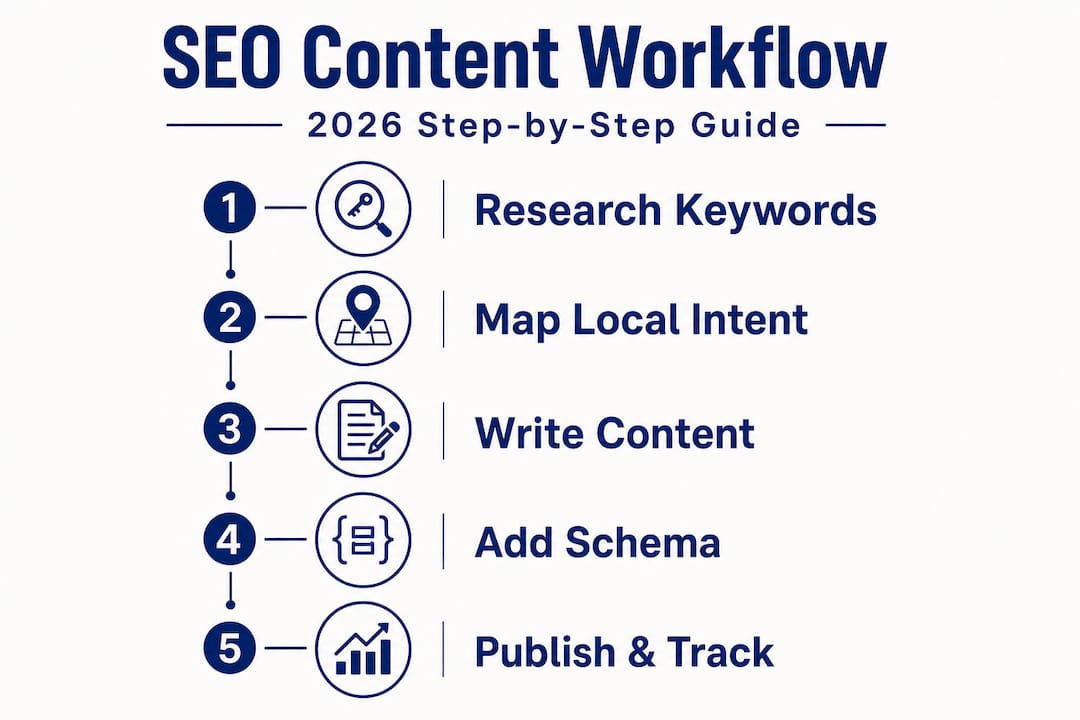
- Step-by-step SEO content writing workflow for 2026
- Common mistakes and troubleshooting tips
- How to verify and measure your SEO content impact
- The uncomfortable truth: Most local businesses still chase yesterday’s SEO
- Next steps: Amplify your local SEO impact with expert help
- Frequently asked questions
Key Takeaways
| Point | Details |
|---|---|
| Adapt to AI and traditional | You need different tactics for traditional search engines and AI-driven platforms to stay visible locally. |
| Use structured data | Adding schema markup and clear content structure boosts your chances in both AI and classic search results. |
| Comprehensive content wins | In-depth, entity-oriented coverage outperforms simple keyword targeting for both humans and AI. |
| Verify and measure impact | Consistently tracking performance reveals what works and where to improve your workflow. |
Why your SEO content workflow needs a 2026 upgrade
To understand the workflow, you first need to know why the old playbook no longer works.
For years, local SEO meant targeting the right keywords, building backlinks, and making sure your website loaded quickly. Those fundamentals still matter. But Google’s AI Overviews, Gemini, and other AI-powered platforms have introduced a new layer of requirements that most local businesses are not prepared for.
The data tells a clear story. According to 2026 best practices published on Google’s Search Central blog, only 19% of AI citations come from the top 10 organic results. That means the majority of AI-powered answers are pulling from sources that rank outside the traditional top ten. If your entire strategy depends on hitting page one, you’re missing most of the AI citation opportunity entirely.
AI platforms like Gemini and Google’s AI Overviews favor a different set of signals. They reward entity authority, structured data formats like HowTo and FAQ schema, and content that covers a topic with depth and clarity. Traditional search still values keywords and backlinks, but AI adds a new dimension.
| Ranking signal | Traditional search | AI-driven search |
|---|---|---|
| Keyword targeting | High priority | Medium priority |
| Backlinks | Essential | Supportive |
| Structured data (schema) | Helpful | Critical |
| Entity authority | Moderate | High priority |
| Topic comprehensiveness | Moderate | High priority |
| Local citations | Important | Important |
Here’s the core issue for local businesses: if you’re only publishing engaging SEO content optimized for keywords and nothing else, you’re building for a search experience that’s being rapidly replaced. Local businesses that adapt their workflow now will have a significant head start.
“The businesses that win in AI search are the ones that build genuine authority around what they do and where they do it. Structured data and comprehensive coverage are not optional extras anymore.”
Pro Tip: Run a quick test by searching for your primary service in your city. If Google surfaces an AI Overview and your business is not mentioned, that’s your signal that the current workflow needs updating.
Essential tools and materials for a seamless SEO content workflow
Ready to adjust your approach? Here’s what you’ll need to prepare before you start creating.
A disorganized toolkit slows everything down. Before you write a single word, knowing which tools handle which job saves time and prevents the frustrating gaps that derail content production. The good news is that most of what you need is either free or low cost.

| Tool type | Purpose | Examples |
|---|---|---|
| Keyword research | Identify search terms and local intent | Google Keyword Planner, Semrush |
| Content planning | Organize topics and publishing schedule | Notion, Trello, Google Sheets |
| Schema markup generator | Create structured data for AI visibility | Google’s Rich Results Test, Rank Math |
| Analytics platform | Track traffic, clicks, and conversions | Google Analytics 4, Google Search Console |
| Local citation manager | Maintain consistent business listings | BrightLocal, Yext |
| AI writing assistant | Speed up drafting and ideation | ChatGPT, Gemini |
Beyond tools, you need the right content assets ready before you begin. Entity authority and structured data are now critical for visibility in both AI and traditional search, which means your content assets need to go beyond basic blog posts.
Content formats and supporting assets to prepare include:
- Local landing pages with service descriptions, your address, and neighborhood-specific language
- FAQ sections that answer the questions your customers actually ask at the point of sale
- HowTo content that walks readers through processes relevant to your service category
- Customer reviews and testimonials formatted so search engines can read them
- Images with proper alt text and file names that reinforce your local keyword targets
- Business information assets including NAP (name, address, phone number) data for citation building
Understanding schema markup advantages before you start will help you see why these assets matter. Schema tells search engines and AI platforms exactly what your content is about, who you serve, and where you operate. Without it, AI platforms have to guess, and they often guess wrong.
Pro Tip: Before writing new content, compile a list of the top 10 questions your customers ask in person or by phone. These are gold for FAQ schema and form the backbone of your AI-ready content strategy.
Step-by-step SEO content writing workflow for 2026
With your tools ready, here’s the workflow that brings it all together.
This workflow is designed for business owners who do not have a full marketing team. Each step is specific enough to act on without requiring advanced technical knowledge.
-
Brainstorm with local intent in mind. Start by listing your primary services alongside your city or service area. Then add question-based variations. “How much does it cost to replace a water heater in Austin, TX?” is more useful than “water heater replacement.” Use Google’s autocomplete and People Also Ask sections to expand your list.
-
Research entities related to your topic. An entity is any real-world concept, person, place, or thing that search engines recognize. For a plumber, related entities include “pipe repair,” “water damage,” “local building codes,” and “licensed contractor.” Covering these naturally in your content signals topical authority to AI platforms.
-
Outline for comprehensiveness, not length. AI-driven platforms value comprehensive coverage and clear structure. Your outline should address the main question, supporting questions, local context, and next steps. This is different from padding an article to hit a word count.
-
Draft with clarity first. Write for your customer, not the algorithm. Use plain language, short paragraphs, and subheadings that mirror how your customers phrase questions. Save keyword placement for the editing stage.
-
Edit for on-page SEO basics. Place your primary keyword in the title, the first paragraph, at least one H2 heading, and naturally throughout the body. Add internal links to related pages on your site, and link to credible external sources where appropriate. Check out an SEO content audit checklist to make sure nothing gets missed.
-
Add structured data before publishing. For service pages, use LocalBusiness schema. For tutorial-style content, use HowTo schema. For FAQ sections, use FAQ schema. These additions take 15 to 30 minutes per page and can meaningfully improve how AI platforms represent your content.
-
Review and publish with a content calendar in mind. Sporadic publishing undermines authority. A consistent schedule, even one post per week, builds cumulative momentum over time.
| Workflow step | Traditional SEO focus | AI search focus |
|---|---|---|
| Brainstorm | Keyword volume and competition | Local intent and entity coverage |
| Draft | Keyword density | Comprehensive topic coverage |
| Edit | Meta tags and heading optimization | Structured data and schema |
| Publish | Internal links and backlinks | Entity signals and local citations |
| Measure | Rankings and organic clicks | AI mentions and structured data eligibility |
Reviewing content marketing strategies alongside this workflow helps you see how individual pieces connect into a broader authority-building system. One well-structured article rarely moves the needle alone. A series of connected, entity-rich pages does.
“Content that covers a topic from multiple angles, answers the questions people actually have, and is marked up with structured data is far more likely to surface in AI answers than a single keyword-optimized page.”
Pro Tip: After publishing, submit the URL to Google Search Console for indexing and check the URL Inspection tool to confirm your structured data is recognized correctly. This one step often gets skipped and costs visibility.
Staying current with SEO algorithm updates is part of maintaining a workflow that holds up over time. What works today may need adjustment in six months.
Common mistakes and troubleshooting tips
Even the best workflows stumble. Here’s how to avoid the most common roadblocks, and how to recover if you hit them.
The majority of local business content fails not because of bad writing, but because of predictable, fixable mistakes. Identifying them early saves months of wasted effort.
Common workflow mistakes to watch for:
-
Skipping structured data entirely. This is the single biggest gap in most local business content. Without schema, AI platforms cannot reliably categorize your business or content for inclusion in AI Overviews.
-
Publishing once and moving on. Search algorithms evolve, and content that ranks well today may drop six months from now if it is not refreshed. Stale content signals to search engines that you are not maintaining authority.
-
Over-optimizing for keywords at the expense of readability. Stuffing a keyword into every third sentence damages the user experience and triggers quality filters. Natural variation, including related terms and synonyms, performs better.
-
Leaving out FAQ sections and local entity details. A page about your service that does not mention your city, your service area neighborhoods, or the specific questions customers ask is a missed opportunity for both traditional and AI search.
-
Ignoring mobile formatting. Most local searches happen on phones. If your content looks cluttered on a small screen, users bounce before they engage, and that behavior signals quality problems to search engines.
As AI citation research shows, most AI citations come from outside the top 10 organic results, which means relying only on traditional keyword rankings leaves a large portion of search traffic on the table. Businesses that fix these structural problems often see improvements in AI visibility within weeks.
“Most small business content problems are not creativity problems. They’re structural problems. Fix the structure, and the results follow.”
Pro Tip: Schedule a quarterly content audit to catch these issues before they compound. Review your top five pages for outdated information, missing schema, and keyword cannibalization. Tools like Google Search Console and your analytics platform make this faster than it sounds.
For more detail on producing content that keeps readers engaged and search engines happy, the guides on engaging content tips and content marketing how-to are worth bookmarking.
How to verify and measure your SEO content impact
Mistakes fixed, it’s time to see the results. Here’s how to measure and optimize what matters.
Publishing content without measuring its performance is like running a paid ad without tracking conversions. You can not improve what you do not measure, and for local businesses, the right metrics tell a clear story about whether your workflow is working.
-
Set up Google Search Console and Google Analytics 4 as your foundation. Search Console shows which queries trigger your pages, how often they appear in results, and what your average position looks like. Analytics 4 tracks what users do after they arrive.
-
Check AI search visibility manually. Search for your primary service in your market and note whether an AI Overview appears. If it does, is your business or content cited? This is a simple weekly check that tells you whether your structured data and entity authority are being recognized.
-
Track local map pack rankings separately. Google Maps rankings are distinct from organic rankings. Use a rank tracking tool that separates these to get an accurate picture of your local visibility.
-
Review your SEO improvements monthly. Compare month-over-month changes in organic clicks, impressions, and conversion rates. Look for pages where impressions are rising but clicks are not, which often signals a title or meta description that needs improvement.
| Metric | What it measures | Review frequency |
|---|---|---|
| Organic clicks | Traffic from traditional search | Monthly |
| AI Overview mentions | AI search visibility | Weekly |
| Local pack position | Google Maps ranking | Weekly |
| Click-through rate | Title and description effectiveness | Monthly |
| Conversion rate | Leads or sales from organic traffic | Monthly |
| Structured data errors | Schema implementation health | Quarterly |
Structured data and entity authority signal relevance for both AI and traditional platforms, and regular measurement ensures your content stays visible as search continues to evolve. Businesses that build measurement into their workflow catch problems early and adjust before rankings drop.
Pro Tip: Connect your Google Search Console account to Google Looker Studio (free) and build a simple dashboard that shows impressions, clicks, and average position for your top pages. You’ll spend 15 minutes a week reviewing data instead of 90 minutes hunting for it.
The uncomfortable truth: Most local businesses still chase yesterday’s SEO
Most local SEO advice being published today still centers on traditional tactics: keyword research, meta tags, backlinks, and citation building. Those things matter, but they represent only part of the picture. The AI revolution in search is not coming. It is already here, and the businesses treating it as optional are quietly losing ground.
Here’s what we see consistently: a business owner invests time in building keyword-optimized content, earns a solid page one ranking, and then watches their traffic stagnate or decline as AI Overviews absorb the answers to the queries they used to capture. The ranking stays. The clicks disappear. If you ignore AI, you miss access to adapting for AI search opportunities that are reshaping how customers find local businesses.
The advantage for independent businesses is real. Large brands are slower to adapt. They have bureaucratic approval processes, legacy content systems, and marketing departments that tend to follow trends rather than lead them. A local business owner who understands entity authority, implements schema markup, and publishes comprehensive local content can outperform a national competitor in AI search visibility, even without a massive backlink profile. Early movers win in search. This has been true through every major algorithm shift, and it is true now. The businesses that embraced mobile optimization early dominated local search for years afterward. The same pattern is playing out with AI search today.
Next steps: Amplify your local SEO impact with expert help
With your workflow in place or upgraded, it is time to get even more from your SEO investment.
Building and maintaining a modern SEO content workflow takes consistent effort, and getting it right across both traditional and AI-driven search is a layered challenge. That’s exactly where Battle SEO comes in. Our local SEO solutions are built specifically for independent business owners who want to dominate their local market without competing with themselves.
We combine proven traditional SEO with the structured, entity-focused content strategies that drive AI search visibility. Whether you’re starting from scratch or looking to strengthen what you have, our AI search optimization guide gives you a clear picture of where you stand. If you are ready to work with a team that takes on only one business per category per market, explore our professional local SEO services and see whether a spot is available in your area.
Frequently asked questions
How do I make sure my content appears in both AI and traditional search results?
Optimize for entity authority and structured data by using schema markup and covering topics comprehensively, while also including targeted keywords and building backlinks for traditional ranking signals.
What is the most important new step in the modern SEO content writing workflow?
Adding structured data and building entity-based content now outweighs simple keyword targeting, as structured data signals are critical for visibility in both AI-driven and traditional search platforms.
Can small businesses compete with big brands in AI-driven search?
Yes. By building local authority through structured content and comprehensive topic coverage, small businesses can gain visibility in AI search results even without the backlink profiles that large brands rely on.
How often should I review and update my SEO content workflow?
Review your strategy at least quarterly, since regular measurement and adjustment are essential to staying aligned with search algorithm updates and evolving AI platform requirements.