

TL;DR:
- Customer reviews are essential for local SEO, influencing Google rankings through quantity, quality, and freshness. Consistently generating, responding to, and strategically embedding reviews enhances visibility, click-through rates, and search relevance while avoiding policy violations. Integrating review content across platforms and owned channels amplifies their impact, making reviews a vital yet often underutilized SEO asset.
Customer reviews are a direct ranking signal in Google’s local search algorithm, influencing your visibility in the Map Pack, organic results, and AI-powered search platforms like ChatGPT and Perplexity. Understanding why you should leverage reviews for SEO goes beyond reputation management. Reviews generate fresh, keyword-rich content, drive higher click-through rates through visible star ratings, and send behavioral signals that search engines use to evaluate your relevance and authority. For business owners and marketers competing in local markets, reviews are one of the most cost-effective SEO assets available.
How do customer reviews influence search engine rankings and visibility?
Google uses review quantity, quality, and velocity as key ranking signals for local search and Map Pack placement. These three attributes collectively shape your business’s prominence score, which is one of the three pillars Google evaluates alongside relevance and distance. A business with 200 recent, detailed reviews consistently outranks a competitor with 40 older ones, even when the competitor has a more polished website.
The mechanism works on several levels:
- Fresh content signal. Regular new reviews create fresh content for indexing and help your listing match long-tail local queries. A customer who writes “best gluten-free pizza in Harker Heights” in a review is essentially creating keyword content you did not have to produce yourself.
- Click-through rate improvement. Listings with strong ratings appear more clickable in search results. Star ratings displayed in SERPs attract higher engagement, and that positive behavioral signal feeds back into ranking models.
- Third-party social proof. Reviews function as citations from real customers, reinforcing your business’s credibility to both users and algorithms.
- Long-tail keyword expansion. Descriptive review text introduces natural language variations that match how real customers search, expanding your relevance for queries you may never have targeted directly.
The importance of reviews for SEO becomes clearest in competitive local markets. Two businesses offering identical services in the same zip code will diverge in rankings almost entirely based on their review profiles. That is a significant lever you can control.
What are best practices to generate and manage reviews without risking SEO penalties?

Generating reviews the wrong way can undo every benefit described above. Incentivizing reviews violates Google’s policies and risks review removal or listing suspension. The same applies to review gating, which is the practice of filtering customers by expected sentiment before asking for a review. Both tactics damage your long-term SEO results far more than they help in the short term.
Here is a compliant, practical approach to building a steady review flow:
- Ask at the right moment. Request a review immediately after a positive interaction, whether that is a completed service call, a product delivery, or a resolved support ticket. Timing matters more than frequency.
- Reduce friction with smart tools. NFC tap-to-review cards, QR codes at the point of sale, and direct review links in follow-up emails all remove the steps that cause customers to abandon the process. The easier you make it, the higher your conversion rate from request to published review.
- Respond to every review, including negative ones. Consistent, thoughtful responses add keyword context to your listing and demonstrate accountability. A professional response to a one-star review often reassures prospective customers more than the negative review itself damages you.
- Maintain steady velocity. A burst of 50 reviews in one week followed by silence looks unnatural to Google’s algorithm. Aim for a consistent monthly cadence that reflects genuine customer activity.
- Never write or purchase fake reviews. Beyond the policy violation, Google’s spam detection has improved significantly. Fake reviews are removed at scale, and the associated penalties can suppress your listing for months.
Pro Tip: Set a calendar reminder to audit your review request process every quarter. Check that your direct review link still works, that your NFC cards are placed where customers will see them, and that your team is consistently asking at the right moment in the customer journey.
Compliance and authenticity in review solicitation are not just ethical choices. They are the foundation of sustainable SEO improvements. Shortcuts create fragile results. A clean, steady review profile built over 12 months is an asset that compounds.
How can businesses use reviews across platforms and owned channels for SEO?
Most businesses treat reviews as something that happens on Google and Yelp, then stop there. That approach leaves significant SEO value on the table. The impact of reviews on search rankings multiplies when you integrate review content into your own website and content strategy.
Embedding reviews on your website
Embedding customer reviews on product and service pages produces unique, keyword-rich user-generated content that can rank for relevant queries. A plumber in New London, CT who embeds 30 Google reviews on their services page now has a page that mentions “emergency pipe repair,” “water heater installation,” and “licensed plumber in New London” without writing a single word of that content themselves. Tools like EmbedSocial, Elfsight, and Trustmara all support automated review embedding with schema markup.
Optimizing your Google Business Profile
Your Google Business Profile is the single most important platform for review-driven SEO. Responding to reviews directly within the profile adds fresh, indexed content. Including location and service keywords in your responses, without forcing them unnaturally, reinforces your relevance for those terms.
Here is a comparison of review integration approaches and their SEO impact:
| Approach | SEO benefit | Risk level |
|---|---|---|
| Embedding reviews on service pages | Adds unique UGC, improves keyword coverage | Low |
| Responding to Google reviews with keywords | Adds indexed content, signals engagement | Low |
| Sharing reviews on social media | Drives referral traffic, indirect SEO signal | Low |
| Review gating before solicitation | Short-term rating boost | High (policy violation) |
| Incentivized review campaigns | Temporary volume increase | High (listing suspension risk) |
Using review language in your content strategy
Review text is a direct window into how your customers describe your services. Mine your reviews for recurring phrases and incorporate that language into your page titles, meta descriptions, and service page copy. This is one of the most underused tactics in local SEO content marketing. When your website language mirrors how customers naturally talk about your business, you close the gap between search queries and your content.
What measurable SEO benefits result from using customer reviews?
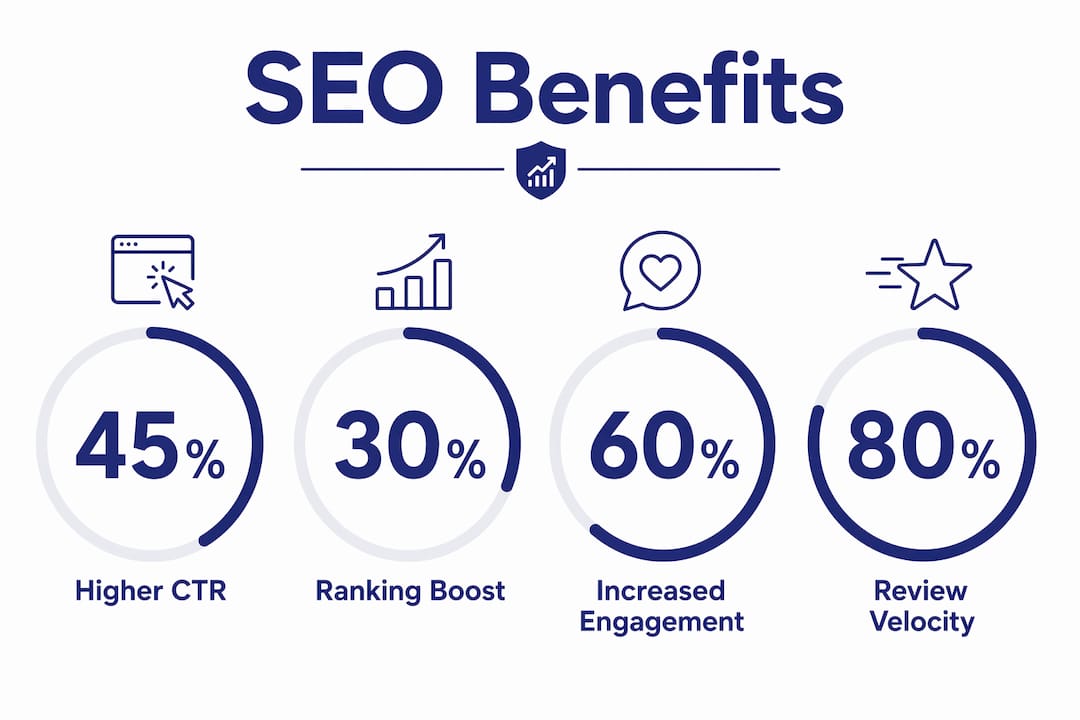
The SEO benefits of online reviews are well-documented and span multiple ranking factors simultaneously.
Local SEO visibility is strongly correlated with review quantity, quality, and recent activity. Businesses that maintain active review profiles consistently appear in the local three-pack, which captures the majority of clicks on local search results pages. That placement is not primarily determined by website authority. It is determined by your Google Business Profile signals, and reviews are a central component.
“Reviews should be viewed as a crucial SEO visibility lever, not just a reputation management tool.” — Moz
Beyond rankings, positive, descriptive reviews reduce hesitation and drive higher click-through rates and on-site engagement. When a user sees a 4.8-star rating with 180 reviews next to your listing, they are more likely to click, stay on your site longer, and convert. Each of those behaviors sends a positive signal back to Google’s ranking model, creating a compounding effect.
A steady velocity of new reviews signals continuous customer engagement, which search algorithms favor over stagnant listings. A business that stops collecting reviews for six months will often see gradual ranking decay, even if nothing else changes. Think of review velocity the way you think about publishing new blog content. Stopping entirely creates a freshness gap that competitors with active review profiles will exploit.
The behavioral metrics angle is worth emphasizing for marketers who track performance data. Reviews that drive higher CTR and on-site engagement improve the signals that Google’s ranking models use to evaluate user satisfaction. This means reviews influence not just local pack rankings but also how Google evaluates your overall site quality. For more on building this foundation, the local business SEO process at Battleseo covers how reviews fit into a full visibility strategy.
Key takeaways
Leveraging customer reviews for SEO requires consistent, compliant review generation combined with active response and strategic integration across your website and Google Business Profile.
| Point | Details |
|---|---|
| Reviews are a ranking signal | Google evaluates review quantity, quality, and velocity to determine local search prominence. |
| Fresh reviews prevent ranking decay | A steady monthly review cadence signals ongoing engagement and prevents visibility loss over time. |
| Compliance protects your listing | Incentivized reviews and review gating violate Google’s policies and risk listing suspension. |
| Embed reviews on your website | Review content on service pages adds unique, keyword-rich UGC that supports organic rankings. |
| Responses add indexed content | Thoughtful replies to every review generate fresh, keyword-relevant content on your Google Business Profile. |
Reviews are the SEO asset most businesses undervalue
I have worked with hundreds of local businesses across industries, and the pattern is consistent. Owners spend thousands on website redesigns and paid ads while ignoring a review profile that has not been updated in eight months. That is backwards. Your review profile is often the first thing a potential customer sees before they ever reach your website.
What I have found is that businesses treat reviews as a passive outcome of good service rather than an active part of their SEO strategy. The shift in thinking is simple but significant. You do not wait for reviews. You build a system that generates them consistently, responds to them professionally, and integrates that content into your broader SEO workflow.
The compliance piece matters more than most people realize. I have seen businesses recover from a Google algorithm update only to get hit by a review policy enforcement action because they were using a third-party tool that filtered negative reviews before sending the request. The short-term rating boost was not worth the months of recovery. Authenticity is not just a best practice. It is the only sustainable path.
One more thing worth saying directly: responding to negative reviews is not damage control. It is one of the highest-ROI activities in local SEO. A well-written response to a critical review demonstrates professionalism, adds keyword-relevant content to your profile, and often converts skeptical readers into customers. Most of your competitors are not doing this well. That is your opportunity.
— Mike
Ready to turn your reviews into a local SEO advantage?
At Battleseo, we build review-driven SEO systems for independent business owners who want to dominate their local market. Our Local Command Directive™ framework combines Google Business Profile optimization, citation building, and review strategy into a single, cohesive approach designed to put you at the top of local search results.
If you are ready to stop leaving visibility on the table, our local SEO services are built specifically for businesses like yours. We take on only one client per category per market, so your spot is exclusive. Spots are limited to 12 new clients per month. Reach out to Battleseo today to find out if your market is still available.
FAQ
Why do reviews matter for local SEO rankings?
Google uses review quantity, quality, and velocity as direct ranking signals for local search and Map Pack placement. Businesses with more recent, high-quality reviews consistently outrank competitors with older or fewer reviews.
How do star ratings affect click-through rates in search results?
Star ratings displayed in Google search results make listings more visually prominent and credible, which increases the likelihood that users click. Higher click-through rates send positive behavioral signals back to Google’s ranking algorithm.
What is review gating and why is it a problem?
Review gating is the practice of filtering customers by expected sentiment before sending a review request, directing only happy customers to leave public reviews. Google prohibits this practice, and violations can result in review removal or listing suspension.
How often should a business collect new reviews?
A consistent monthly cadence is more effective than occasional bursts. Steady review velocity signals ongoing customer engagement to search algorithms and prevents the ranking decay that comes from a stagnant review profile.
Can embedding reviews on my website improve SEO?
Yes. Embedding customer reviews on service or product pages adds unique, keyword-rich user-generated content that search engines can index. This expands your page’s relevance for natural language queries related to your services and location.