
TL;DR:
- Traditional SEO involves optimizing content, technical health, and off-page links to improve organic search rankings. These core pillars work together, and neglecting any weakens your site’s visibility in both traditional and AI-driven search results. Ongoing effort and foundational practices remain essential for long-term online success in 2026 and beyond.
Understanding what is traditional SEO is the foundation every business owner needs before chasing the latest trends. At its core, traditional SEO means earning higher rankings in organic, unpaid search results by improving your content, site structure, technical performance, and off-page authority. With AI-driven search tools grabbing headlines in 2026, it is easy to assume the fundamentals no longer matter. They do. In fact, without a solid grasp of traditional SEO basics, newer strategies have no real foundation to build on. This guide breaks down how it works, what techniques move the needle, and why it still drives real business results.
Table of Contents
- Key takeaways
- What traditional SEO actually means
- How traditional SEO works
- Traditional SEO techniques that work
- The real importance of traditional SEO
- My take on traditional SEO in 2026
- How Battleseo can put this to work for you
- FAQ
Key takeaways
| Point | Details |
|---|---|
| Traditional SEO defined | It is the practice of earning organic search visibility through content, technical health, and authority building. |
| Three core pillars | Technical, on-page, and off-page SEO work together to improve rankings and site credibility. |
| How search engines rank | Google evaluates relevance, usability, expertise, and user intent, not just keyword frequency. |
| Techniques that still work | Keyword research, optimized metadata, quality content, and link building remain proven ranking drivers. |
| AI does not replace the basics | Traditional SEO and AI optimization complement each other. One without the other leaves gaps in visibility. |
What traditional SEO actually means
Traditional SEO basics refer to the set of practices used to improve a website’s organic visibility on major search engines like Google and Bing. These practices fall into three categories: technical SEO, on-page SEO, and off-page SEO. Each one targets a different part of how search engines discover, evaluate, and rank your site.
Here is a quick breakdown of how these three pillars differ:
| SEO Type | Primary Focus | Examples |
|---|---|---|
| Technical SEO | Crawlability and performance | Site speed, mobile-friendliness, structured data, indexing |
| On-page SEO | Content and metadata | Keywords, title tags, headers, meta descriptions |
| Off-page SEO | Authority and trust signals | Backlinks, brand mentions, digital PR |
Technical SEO ensures search engine bots can actually find and read your site. A slow-loading page or a broken crawl path can bury a site with otherwise great content. Technical SEO foundations cover everything from page speed and mobile responsiveness to structured data markup that helps Google understand your content’s context.

On-page SEO is where most people start, and for good reason. Over 72% of sites miss optimized meta descriptions, which means a simple fix can give you a quick edge. This category includes your title tags, H1 and H2 headings, content depth, internal linking, and how well your page satisfies the searcher’s actual intent.
Off-page SEO focuses on what other websites say about you. High-quality backlinks act as votes of confidence, signaling to Google that your site is trustworthy and authoritative. A well-placed link from a respected industry publication carries far more weight than dozens of low-quality directory links.
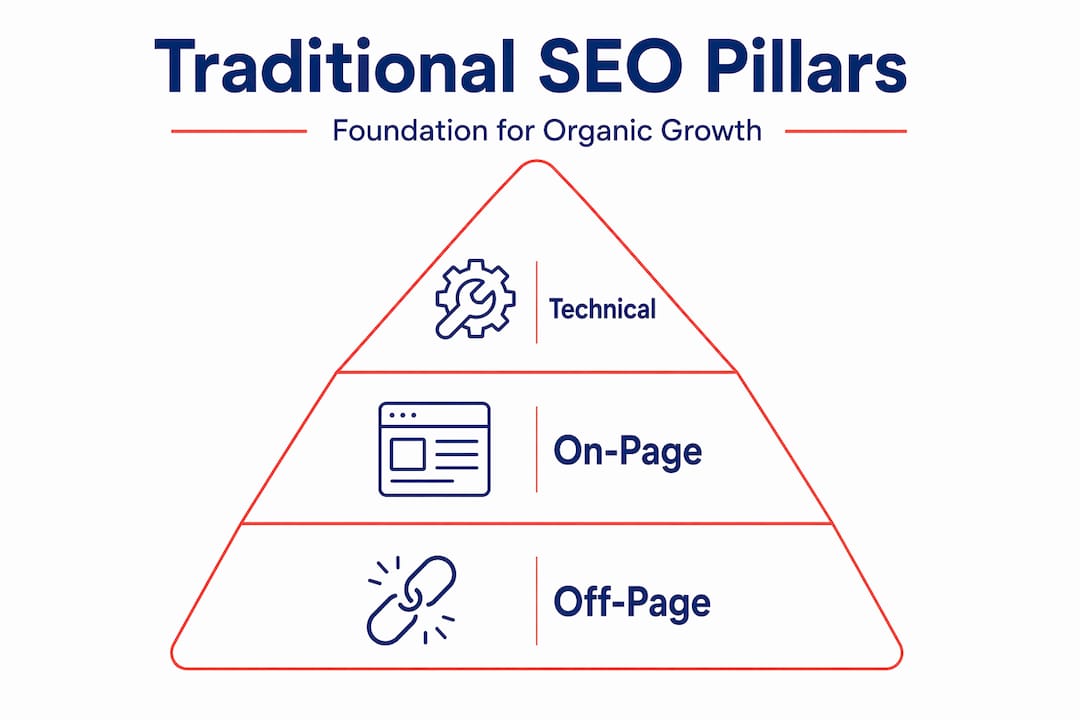
Pro Tip: Do not treat these three pillars as separate projects. The strongest sites address all three consistently. A technically clean site with great content and strong backlinks gives search engines every reason to rank you above a competitor who only focuses on one area.
How traditional SEO works
The mechanics behind traditional SEO start with three steps: crawling, indexing, and ranking. Search engines send out automated programs called crawlers to discover web pages. Those pages get stored in an index, essentially a massive catalog of the web. When someone performs a search, the engine pulls from that index and ranks results based on hundreds of signals.
Google’s ranking systems analyze query words, content relevance, page usability, expertise signals, and even the searcher’s location, all within a fraction of a second. That last part matters more than people realize. The same keyword can return different results depending on where you are, what device you are using, and your past search behavior.
Key signals Google evaluates include:
- Relevance: Does your content directly answer the searcher’s question?
- Usability: Is your page fast, mobile-friendly, and easy to navigate?
- Expertise signals: Does your content demonstrate knowledge and authority on the topic?
- User intent: Is the content format (informational, transactional, local) aligned with what the searcher actually wants?
Traditional SEO techniques work by systematically aligning your website with these signals. A business that adapts its content to match evolving algorithm priorities will outperform one that set up their site in 2018 and never touched it again.
Pro Tip: Keyword stuffing is the fastest way to tell Google you do not understand how SEO works. Google’s algorithms reward pages that cover topics comprehensively and match user intent. Write for the person searching, not for the crawler.
Ranking is not a single event. It shifts constantly as competitors update their pages, new content enters the index, and Google refines its algorithms. Consistent traditional SEO work compounds over time, which is exactly why businesses that start early build a sustainable advantage.
Traditional SEO techniques that work
Applying traditional SEO is not about following a rigid checklist. It is about understanding which tactics produce results and in what order to prioritize them. Keyword research involves manual effort, intuition, and experience, which takes time but gives you direct control over your brand voice and content strategy.
Here is a step-by-step approach to putting traditional SEO techniques into practice:
-
Start with keyword research focused on intent. Identify what your audience is searching for and why. A local plumber should target “emergency plumber in [city]” before trying to rank for the generic term “plumber.” Use tools to assess search volume and competition, then prioritize terms you can realistically win.
-
Optimize your title tags and meta descriptions. These appear directly in search results. Your title tag should include your primary keyword and stay under 60 characters. Your meta description should summarize the page value and invite the click, even though it does not directly affect rankings.
-
Structure your content with clear headers. Use one H1 per page that includes your main keyword. Break the body content into logical H2 and H3 sections. This helps both readers and search engines understand your page’s structure. Strong on-page SEO practices at this level separate average pages from well-ranked ones.
-
Improve your site’s technical health. Run a crawl audit to find broken links, missing image alt text, slow pages, and indexing errors. A site that loads in under three seconds on mobile already outperforms most small business competitors.
-
Build internal links with purpose. Connect related pages on your site to spread authority and help users find related content. A service page linking to a relevant blog post helps both the reader and the search engine understand your topical depth. You can see how content marketing supports SEO through this type of internal architecture.
-
Pursue quality backlinks. Reach out to industry publications, local directories, and partners for link placement. One authoritative backlink from a relevant site is worth more than fifty low-quality links.
Pro Tip: Never sacrifice readability for SEO. If a title tag sounds robotic or a paragraph is stuffed with keywords, it will hurt your click-through rate and dwell time, both of which send negative signals back to Google. The best SEO reads like it was written for a person, because it was.
The real importance of traditional SEO
The importance of traditional SEO becomes clear when you consider what organic traffic actually represents. Unlike paid advertising, where visibility disappears the moment you stop spending, organic rankings build compounding authority over time. A well-optimized page can generate traffic for years without ongoing ad spend.
Traditional SEO remains essential for organic traffic and brand presence even as AI-driven search tools gain traction. Think of it this way: AI search platforms like ChatGPT and Perplexity pull from trusted, well-structured web sources. A site with weak SEO foundations is less likely to be cited by those platforms, regardless of how much you invest in AI visibility tactics.
Here is what traditional SEO delivers for different types of users:
- Independent business owners: Consistent visibility in local and national search without ongoing ad costs. A strong organic presence builds credibility that paid ads cannot replicate.
- E-commerce operators: Product pages that rank for buyer-intent keywords drive purchase-ready traffic directly to your site.
- Service-based businesses: Local search visibility through optimized pages and a strong Google Business Profile attracts clients actively looking for what you offer.
- Content publishers and bloggers: High-ranking articles generate long-term referral traffic and establish topical authority in a niche.
- Startups and new businesses: Traditional SEO builds a searchable identity from day one, reducing dependency on expensive pay-per-click campaigns.
The relationship between traditional and AI-driven SEO is complementary, not competitive. Businesses that build strong traditional SEO foundations and layer in AI optimization are the ones that show up everywhere: in Google’s organic results, in Google Maps, and in AI search responses from tools like Gemini and ChatGPT. That kind of full-spectrum visibility is where the real competitive advantage lives today.
My take on traditional SEO in 2026
I have worked with business owners across dozens of markets, and the pattern I see over and over is the same. Someone hears about AI search or voice optimization and decides to skip ahead, bypassing the fundamentals entirely. Within six months, they are frustrated that neither approach is working. Here is why: AI search platforms still pull from the web. If your site is not structured well, loads slowly, and has no credible backlinks pointing to it, no AI tool will surface it reliably.
What I have learned is that traditional SEO is not the “old way.” It is the baseline. Every advanced strategy, whether that is AI visibility, structured data for rich results, or local search dominance, sits on top of the foundation that traditional SEO builds. Skipping it is like pouring concrete on wet sand.
The most common mistake I see is treating SEO as a one-time project. You do a site audit, fix the errors, publish a few keyword-optimized pages, and then stop. SEO is not a project. It is an ongoing practice, more like physical fitness than a surgery. The businesses winning in search right now are the ones making consistent, incremental improvements every single month. That discipline compounds into an authority gap competitors cannot close quickly.
The other thing worth saying directly: do not believe anyone who tells you traditional SEO is dead. Traditional and AI SEO complement one another. I have seen it work firsthand. The most visible local businesses we work with at Battleseo have both in place, and their lead volume reflects it.
— Mike
How Battleseo can put this to work for you
At Battleseo, we combine traditional SEO fundamentals with AI search optimization through our Local Command Directive™ framework. That means your business benefits from technical SEO, authority backlinks, on-page optimization, and Google Business Profile management, all while being positioned for visibility on AI platforms like ChatGPT and Gemini.
We work exclusively with one business per service category per market, so you are never competing with our other clients for attention or strategy. If you want to build the kind of organic visibility that lasts, explore our local SEO services or dive into our AI search optimization guide to see how the two approaches work together. We cap new client onboarding at 12 per month, so the window to get started is genuinely limited.
FAQ
What is traditional SEO in simple terms?
Traditional SEO is the practice of optimizing your website to rank higher in unpaid search results by improving content quality, technical performance, and off-page authority through backlinks and brand mentions.
What are the three main pillars of traditional SEO?
The three pillars are technical SEO (crawlability and site speed), on-page SEO (content and metadata), and off-page SEO (link building and reputation). All three work together to build sustainable search visibility.
How does traditional SEO differ from digital marketing?
Traditional SEO vs digital marketing is a common point of confusion. Digital marketing is the broader category covering paid ads, social media, email, and SEO. Traditional SEO is specifically focused on earning unpaid organic search rankings through site optimization.
Is traditional SEO still relevant with AI search growing?
Yes. Traditional SEO remains essential because AI search platforms reference well-structured, authoritative web content. A site without strong SEO foundations is less likely to appear in either traditional or AI-generated search results.
How long does traditional SEO take to show results?
Most businesses begin seeing measurable organic traffic improvements within three to six months of consistent optimization work, though competitive markets and newer sites may take longer to build significant authority.