

TL;DR:
- Maximizing your local search visibility relies on optimizing your Google Business Profile, citations, and backlinks to enhance relevance and prominence. A structured 90-day sprint with consistent actions—such as reviews, content updates, and citation cleanup—produces compounding ranking improvements. Building a unified, authoritative local ecosystem ensures your business outranks closer competitors through relevance and trustworthy signals.
Local search dominance is defined as maximizing your business’s online visibility so that nearby customers find you first, choose you over competitors, and convert into paying clients. The industry term for this practice is local SEO, which covers optimization of your website, Google Business Profile, citations, and backlinks for geography-specific searches. If you want to know how to dominate local search, the answer starts with three factors: relevance, prominence, and consistent execution. This guide gives you a step-by-step framework built specifically for U.S. local business owners who want real results, not theory.
How does Google determine local search rankings?
Google ranks local businesses using three core signals: relevance, distance, and prominence. Understanding how they interact is the foundation of every effective local SEO strategy.

Relevance measures how well your business profile matches what someone searched for. Distance is how far your location is from the searcher. Prominence reflects how well-known and trusted your business is across the web, based on reviews, backlinks, and citations.
Here is the critical insight most business owners miss: distance is fixed, but relevance and prominence are fully within your control. A competitor located two blocks closer than you can still be outranked if your profile is more complete, your reviews are stronger, and your website signals are sharper. Proximity bias is real, but it is not a ceiling.
The signals that build prominence include:
- Google reviews with high volume and strong average ratings
- Consistent NAP (Name, Address, Phone) citations across directories
- Authoritative backlinks from local and industry sources
- A fully completed Google Business Profile with photos, services, and posts
- On-page signals from your website, including location-specific content and schema markup
Pro Tip: Use a local rank tracker like BrightLocal or Whitespark to measure your rankings from specific zip codes, not just your office address. Google shows different results depending on where the searcher is standing.
Each of these signals compounds over time. A business that earns 20 new reviews this month, adds five new local citations, and publishes two Google Posts will outperform a static competitor within weeks, not years.
What are the essential steps to optimize your Google Business Profile?
Your Google Business Profile (GBP) is the single most influential asset in local search. Businesses that fully optimize a neglected GBP listing can jump 10 or more positions in local pack rankings. That is not a minor improvement. That is the difference between page one and invisibility.
Follow these steps to optimize your Google Business Profile for maximum local visibility:
- Claim and verify your listing. If you have not verified ownership through Google’s postcard, phone, or video verification process, nothing else matters. Start here.
- Select your primary category with precision. Your primary category is the strongest relevance signal you control. “Plumber” outperforms “Home Services” every time. Choose the most specific category that accurately describes your core business.
- Add relevant secondary categories. A plumber who also does water heater installation should add that as a secondary category. Each category expands the searches you are eligible to appear in.
- Complete every profile field. Business description, hours, website URL, services, products, and attributes all contribute to relevance. Incomplete profiles signal low effort to Google.
- Upload high-quality photos regularly. Businesses with photos receive significantly more direction requests and website clicks than those without. Add interior, exterior, team, and product photos on a consistent schedule.
- Publish Google Posts weekly. Posts keep your profile active and give Google fresh signals. Use them for promotions, events, and service highlights.
- Activate and manage the Q&A section. Seed it with your own frequently asked questions and answer them yourself. This controls the narrative and adds keyword-rich content to your profile.
Pro Tip: Review replies are treated as official content by Google and go through a policy review before publishing. Keep replies professional, compliant, and timely. A reply that violates Google’s content policy simply will not appear, which leaves your reputation unmanaged.
Managing reviews deserves its own focus. Ask satisfied customers for reviews through a direct link from your GBP dashboard. Respond to every review, positive or negative, within 48 hours. Google review replies can take up to 30 days to appear, so consistent engagement matters more than reactive bursts.
How to build local relevance and prominence beyond your GBP
Your Google Business Profile is the anchor, but the surrounding ecosystem determines how far your reach extends. Building strong local relevance requires your website, citations, reviews, and backlinks to work together as a unified system.
Follow this sequence to build outward from your GBP foundation:
- Create unique service and location pages on your website. Each page should include local testimonials, an embedded Google Map, your NAP, schema markup, and detailed service descriptions. Thin or duplicated location pages provide little ranking benefit and can actively suppress your visibility.
- Standardize your NAP across every citation. Your business name, address, and phone number must be identical on Google, Yelp, Facebook, Apple Maps, Bing Places, and every industry directory. Inconsistent NAP formats confuse Google’s algorithm and weaken your prominence signals. Use a tool like Yext or Moz Local to audit and correct discrepancies.
- Build local backlinks through partnerships and PR. Sponsor a local Little League team, contribute to a neighborhood blog, or pitch a story to your city’s news outlet. Local backlinks and unstructured citations from news sites and community blogs amplify prominence and help you overcome proximity bias.
- Earn reviews that mention your location and services. A review that says “best HVAC repair in Austin” carries more local relevance signal than a generic five-star rating with no text. Coach your customers by asking them to describe what you did and where.
Here is a comparison of citation types and their impact on local rankings:
| Citation type | Source examples | Ranking impact |
|---|---|---|
| Structured citations | Google, Yelp, Facebook, Bing Places | High: core NAP consistency signals |
| Industry-specific directories | Houzz, Avvo, Healthgrades, Angi | Medium-high: niche relevance signals |
| Unstructured citations | Local news, community blogs, podcasts | High: authority and prominence signals |
| Social profiles | LinkedIn, Instagram, X | Medium: brand entity reinforcement |
The businesses that rank at the top of local results in competitive markets are not just optimizing their GBP. They are building a web of consistent, authoritative signals that Google reads as proof of real-world prominence.
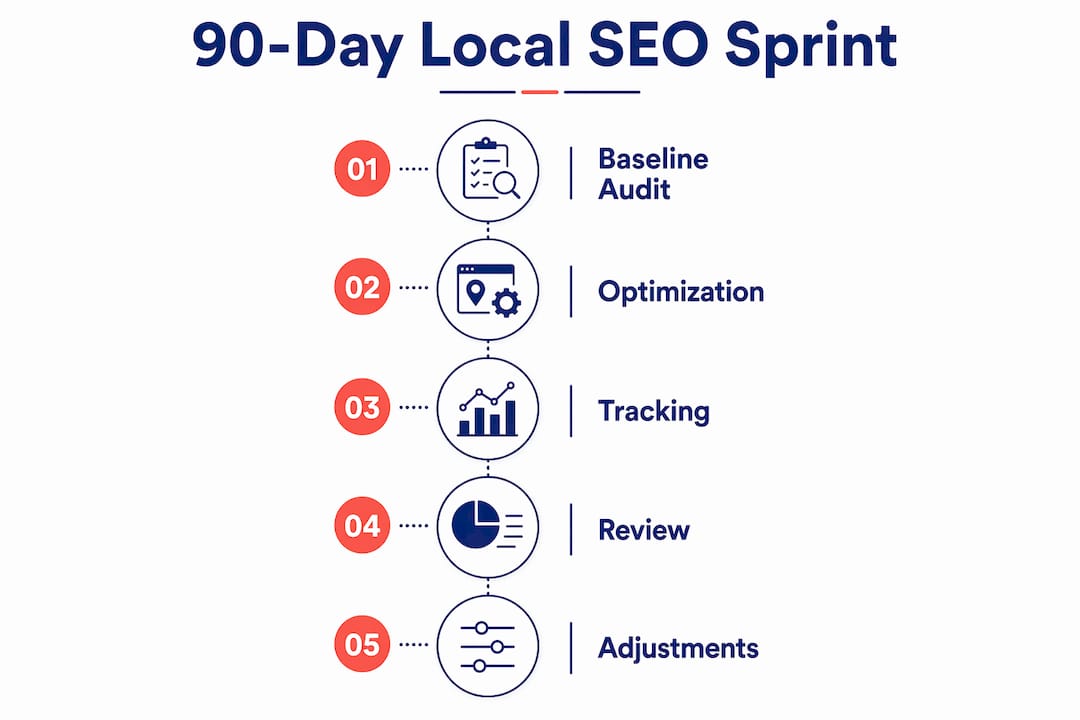
What is the 90-day local SEO sprint and how does it work?
A structured 90-day local SEO sprint is the most effective framework for compounding local search gains without losing momentum. The sprint model works because it enforces consistent execution across phases, which prevents the common mistake of fixing one thing and stopping.
Here is how the sprint breaks down:
| Phase | Weeks | Focus |
|---|---|---|
| Baseline and audit | 1 to 2 | Rank tracking setup, GBP audit, citation audit, competitor analysis |
| GBP fundamentals | 3 to 5 | Category optimization, photo uploads, posts, Q&A, review solicitation |
| Website and content | 6 to 9 | Service pages, location pages, schema markup, on-page optimization |
| Authority and reviews | 10 to 11 | Local link building, citation cleanup, review volume push |
| Scale and report | 12 | Measure rank movement, identify wins, plan next sprint cycle |
The key to making this work is measurement from day one. Before you change anything, record your baseline rankings using a local rank tracker set to your specific service area zip codes. Without a baseline, you cannot prove progress or identify what is actually moving the needle.
The sprint model also prevents a trap many business owners fall into: doing a burst of SEO work, seeing some improvement, and then stopping. Phased local SEO execution over 90 days produces compounding benefits that a one-time optimization push never will. Think of it as building outward from a base rather than making a single large bet.
Key habits to maintain throughout the sprint:
- Publish at least two Google Posts per week
- Request reviews from every completed job or transaction
- Add or update one citation per week
- Monitor your SEO analytics weekly for ranking shifts and traffic changes
- Respond to every new review within 48 hours
Common pitfalls that kill local search rankings
Even well-intentioned local SEO efforts can backfire. These are the mistakes that most frequently derail local business owners:
- Keyword stuffing in your GBP name. Adding keywords like “Best Plumber Austin” to your business name field violates Google’s guidelines and risks profile suspension. Use your legal business name only.
- Using a fake or virtual address. Google requires a physical, staffed location for service-area businesses. Fake addresses get flagged and suspended, often permanently.
- Inconsistent NAP across directories. Even minor variations, such as “St.” versus “Street” or a missing suite number, fragment your citation authority and weaken your rankings.
- Ignoring negative reviews. A string of unanswered one-star reviews signals to both Google and potential customers that your business is unresponsive. Reply to every review, including the difficult ones.
- Copy-pasting content across location pages. Duplicate location pages with only the city name swapped out are treated as thin content by Google and provide almost no ranking value.
- Letting your GBP go stale. Outdated hours, missing holiday hours, and no recent photos or posts all signal an inactive business to Google’s algorithm.
Pro Tip: Run a full SEO audit on your website and GBP at the start of every sprint cycle. Catching technical issues early prevents them from compounding into larger ranking problems.
Key takeaways
Dominating local search requires consistent optimization of your Google Business Profile, a unified citation and backlink strategy, and phased execution through a structured 90-day sprint.
| Point | Details |
|---|---|
| GBP is your primary ranking asset | Fully optimized profiles can jump 10+ positions; complete every field and post weekly. |
| Relevance and prominence beat proximity | You can outrank closer competitors by building stronger signals across reviews, citations, and backlinks. |
| NAP consistency is non-negotiable | Inconsistent name, address, and phone data across directories weakens Google’s trust in your business. |
| Sprint cycles compound results | A structured 90-day plan with phased execution outperforms sporadic one-time optimizations every time. |
| Review management is content strategy | Google treats review replies as official content subject to policy review; respond promptly and compliantly. |
What I’ve learned from working local SEO in competitive U.S. markets
After working with local businesses across markets in Connecticut and Texas, the pattern I see most often is this: business owners do a solid round of optimization, see their rankings improve, and then shift their attention elsewhere. Within 60 days, a competitor who kept publishing posts, earning reviews, and building citations has closed the gap.
Local search is not a project you complete. It is a system you maintain. The businesses I have seen hold the top spot in competitive categories are not doing anything exotic. They are doing the fundamentals consistently, every single week, without stopping.
One thing I tell every client: do not underestimate the power of niche positioning. A general contractor who builds out dedicated pages for “kitchen remodeling in Hartford” and “bathroom renovation in New London” will outperform a competitor with a single generic services page, even if that competitor has been in business longer. Specificity wins in local search because Google rewards relevance, and relevance is built through content that matches exactly what your customers are searching for.
The other thing I have found is that review velocity matters more than review volume. Fifty reviews earned over five years is less impressive to Google’s algorithm than 20 reviews earned in the last 90 days. Recency signals that your business is active and that customers are engaging with you right now. Build review solicitation into your standard operating process, not just your marketing calendar.
Finally, track your rankings from the zip codes where your customers actually live, not from your office. A business in downtown Austin may rank well from its own address but drop significantly in rankings when searched from a suburb 10 miles away. Knowing your geographic coverage gaps tells you exactly where to focus your next sprint cycle.
— Mike
Ready to take the top spot in your local market?
If you have read this far, you already understand what it takes to compete. The question is whether you want to execute it alone or with a team that has done it before.
Battleseo works with one business per service category per market, which means your competitors cannot hire us once you do. Our Local Command Directive™ framework covers Google Business Profile optimization, citation building, local link building, and on-page content, all structured around the 90-day sprint model described in this article. If you want to boost your local visibility fast with a team that treats your market as exclusive territory, explore what Battleseo offers and see if your category is still available.
FAQ
What is local SEO and why does it matter for my business?
Local SEO is the practice of optimizing your digital assets, including your website, Google Business Profile, and citations, to rank for geography-specific searches. It drives nearby customers to your business at the exact moment they are ready to buy.
How long does it take to see results from local SEO?
Most businesses see measurable ranking improvements within 30 to 60 days of consistent optimization, with stronger compounding gains appearing after a full 90-day sprint cycle.
What is the most important local ranking factor I can control?
Relevance and prominence are the two factors fully within your control. Fully optimizing your Google Business Profile and building consistent citations and reviews are the highest-impact actions you can take.
How do I get more Google reviews without violating guidelines?
Send customers a direct review link from your GBP dashboard immediately after a completed job. Ask them to describe the service and location in their review. Never offer incentives, as this violates Google’s review policies.
Does my website matter if I have a strong Google Business Profile?
Your website reinforces and amplifies your GBP signals. Unique service and location pages with schema markup, local testimonials, and NAP data provide the on-page authority that supports your profile’s rankings in competitive markets.