
TL;DR:
- AI in local search consolidates data from multiple sources into a few confident business recommendations instead of a ranked list.
- Businesses must focus on data accuracy, hyperlocal content, and diverse reviews across platforms to improve AI-based visibility.
The role of AI in local search is to synthesize data from multiple sources into a short list of confident business recommendations, replacing the traditional ranked list with a single, curated answer. Platforms like Google AI Overviews, ChatGPT, and Gemini now act as the first point of contact between a customer and a local business. Instead of scrolling through ten blue links, a customer asks a question and gets two or three named businesses as the answer. For U.S. local business owners and marketers, this shift changes everything about how visibility is earned, measured, and maintained. Understanding how AI reshapes local search is the first step toward competing in it.
How does AI in local search decide which businesses to recommend?
AI engines do not pick winners from a ranked list. They run parallel searches across multiple indexes, including Google, Bing, and third-party data sources, then synthesize those results into one to three top recommendations. That compression is the defining feature of AI-driven local discovery. A business that ranks fifth on Google Maps may never appear in an AI answer at all.
The data signals AI systems weigh include your Google Business Profile (GBP) completeness, review quality and recency, citation accuracy, schema markup, and brand mentions across the web. Each signal contributes to what practitioners call “AI confidence.” The higher the confidence, the more likely your business gets named.
Review specificity matters more than review volume. An AI model reading “Great plumber, fixed my burst pipe in Midtown Atlanta within two hours” extracts far more usable entity data than “5 stars, loved it.” Recency matters too. A business with 200 reviews from three years ago scores lower than one with 40 reviews from the past six months.
- GBP completeness: Fill every field, including services, hours, photos, and the Q&A section.
- Review quality: Encourage customers to describe the specific service, location, and outcome.
- Citation accuracy: Your name, address, and phone number must match exactly across every directory.
- Schema markup: Implement LocalBusiness schema so AI can parse your entity data without guessing.
- Brand mentions: Earn editorial references in local blogs, news sites, and community forums.
Pro Tip: NAP consistency paired with complete LocalBusiness schema is the foundation of entity resolution. A single address discrepancy across directories can cause AI to treat your listings as duplicates or flag them as inactive.
How does AI-driven local search differ from traditional local SEO?
Traditional local SEO focused on ranking signals: citation volume, keyword density in GBP descriptions, and proximity to the searcher. The goal was a top-three position in the Google Maps pack. That model still matters, but it no longer tells the whole story.
AI-driven local search optimization shifts the goal from “rank first” to “get recommended.” The difference is significant. A business can hold the top Maps position and still be invisible to a user asking ChatGPT or Gemini for a recommendation, because those platforms rely heavily on Bing and broader web crawling infrastructure, not just Google’s index.
Brand reputation signals now carry more weight than optimized directory listings. Mentions in editorial content, local news articles, Reddit threads, and neighborhood Facebook groups influence AI recommendations more than a generic Yelp listing. AI systems treat editorial mentions as trust signals because they reflect real community recognition, not self-reported data.
| Focus area | Traditional local SEO | AI-driven local search |
|---|---|---|
| Primary goal | Top-3 Maps ranking | AI recommendation inclusion |
| Key data source | Google index only | Google, Bing, and third-party web |
| Review strategy | Volume on Google | Diversity across Google, Yelp, Facebook, BBB |
| Content approach | City-level keyword pages | Neighborhood-level hyperlocal pages |
| Trust signals | Citation count | Editorial brand mentions |
| Schema priority | Optional enhancement | Core entity resolution requirement |
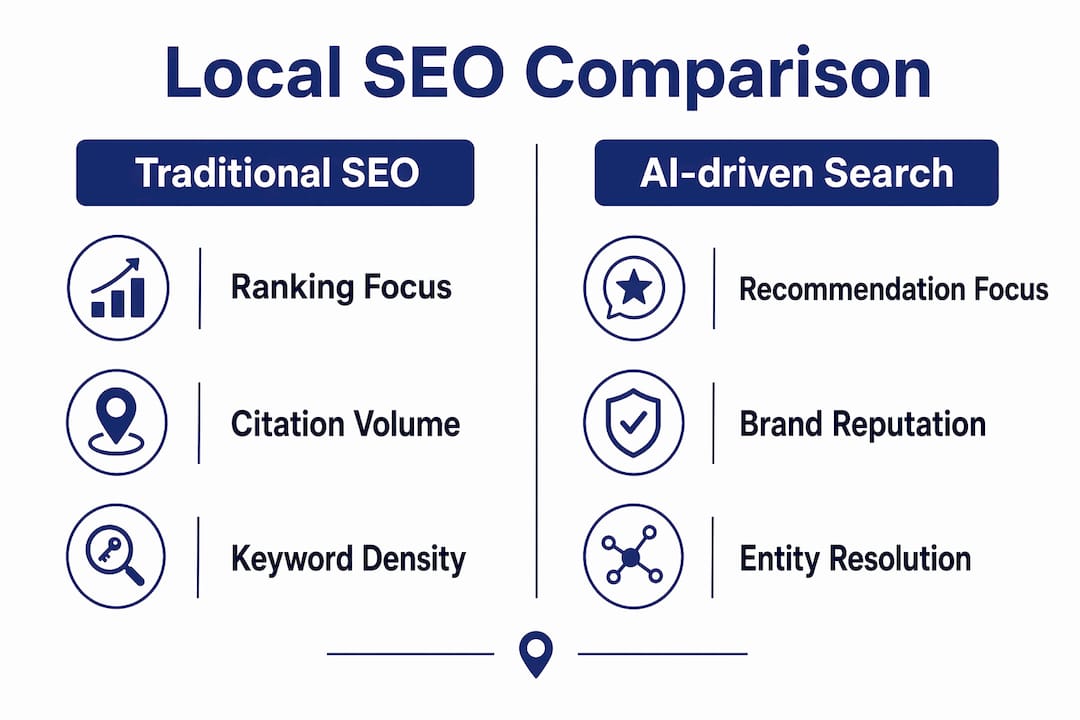
The table above shows that the two approaches are not opposites. They overlap significantly. But the weighting has shifted, and businesses that treat AI visibility as a separate discipline will outperform those that do not.
Practical strategies to optimize for AI-enhanced local search
Local businesses that win in AI-driven search build their visibility from the ground up, starting with data integrity and expanding outward into content and reputation. The following steps reflect what works in 2026.
-
Create hyperlocal content pages. Neighborhood-level pages that reference specific landmarks, zip codes, and community names give AI systems precise entity signals. A roofing company in Dallas should have separate pages for Oak Cliff, Uptown, and Lake Highlands, not one generic “Dallas roofing” page.
-
Complete your Google Business Profile fully. Every field in your GBP is a data point AI can use. Add your service menu, upload recent photos, answer every question in the Q&A section, and keep your hours current. An incomplete profile creates gaps that reduce AI confidence.
-
Diversify your reviews across platforms. Frequent reviews on multiple platforms help AI systems recognize and trust your business. Aim for a steady flow of reviews on Google, Yelp, Facebook, and BBB rather than a burst of reviews on one platform.
-
Earn editorial brand mentions. Reach out to local bloggers, neighborhood news sites, and industry curated lists. A mention in a “Best HVAC Companies in Phoenix” article on a local news site carries more AI weight than 50 directory citations.
-
Monitor your Bing presence. Check Bing Places for Business and confirm your listing is claimed, accurate, and active. Since ChatGPT draws from Bing’s index, a weak Bing presence directly limits your AI visibility.
-
Implement LocalBusiness schema. Add structured data to your website so AI crawlers can confirm your business name, address, phone number, hours, and service area without ambiguity.
Pro Tip: Structure your local content for AI clarity by writing in clear subject-verb-object sentences that name your service, your location, and your differentiator in the first two sentences of every page. AI models extract entity data from the top of a page first.
What emerging AI features are reshaping local search in 2026?
Google AI Overviews now generate short, narrative summaries that appear above the traditional local pack. These summaries pull from GBP data, recent reviews, and local web content to answer a user’s question directly. A business cited in an AI Overview gets brand exposure without the user ever clicking a link.

Gemini and ChatGPT handle local queries conversationally. A user might ask, “Who is the best pediatric dentist near me who takes Medicaid?” That query contains intent, location context, and a service filter. AI systems parse all three simultaneously and return a named recommendation, not a list of links to explore.
Personalization is accelerating this shift. AI systems produce visibility outcomes based on user intent, location, and interaction history rather than static rankings. Two people asking the same question in the same city may receive different business recommendations based on their past behavior. This makes brand recognition across multiple platforms more valuable than ever.
- Voice search queries are longer and more conversational, which rewards businesses with detailed, specific content over keyword-stuffed pages.
- AI result compression means fewer businesses get named per query. Being in the top ten is no longer enough if only one or two businesses get cited.
- Content freshness signals to AI that a business is active. Publishing new photos, posts, and updated service details regularly keeps your entity data current.
- Context sensitivity means AI recommendations shift based on time of day, weather, and local events. A restaurant that mentions its patio and happy hour in its GBP posts is better positioned for context-triggered recommendations.
The businesses that adapt fastest to these features will hold a significant advantage. The window to establish AI visibility before competitors do is narrowing.
Key Takeaways
AI-driven local search rewards businesses that build dense, accurate, and widely recognized entity data across Google, Bing, and third-party platforms rather than chasing a single ranking position.
| Point | Details |
|---|---|
| AI compresses results | AI returns 1–3 business recommendations, not a ranked list, so every signal counts. |
| Bing presence matters | ChatGPT draws from Bing’s index, making Bing optimization critical for AI visibility. |
| Reviews need diversity | Spreading reviews across Google, Yelp, Facebook, and BBB strengthens AI trust signals. |
| Hyperlocal content wins | Neighborhood-level pages give AI precise entity data that city-level pages cannot match. |
| Schema is non-negotiable | LocalBusiness schema and NAP consistency prevent AI from misreading or ignoring your listing. |
What I’ve learned after years of watching AI reshape local search
The biggest mistake I see local business owners make is treating AI search as a future problem. It is a present one. Businesses that waited to build their Bing presence, diversify their reviews, or implement schema are already behind in AI recommendation results, and catching up takes months, not days.
What surprises most clients is how much entity resolution matters. I have seen businesses with strong Google Maps rankings disappear entirely from ChatGPT and Gemini results because their address was listed differently across three directories. AI systems are not forgiving about ambiguity. They default to the business they can confirm with the most confidence, and that is rarely the one with the most citations. It is the one with the most consistent data.
My honest advice: stop measuring success by your Maps position alone. Start tracking whether your business gets named when someone asks ChatGPT or Gemini for a recommendation in your category and city. That is the metric that reflects where local search is actually going. The future of local search optimization belongs to businesses that treat AI platforms as a primary audience, not an afterthought.
Build your reputation on multiple platforms. Publish hyperlocal content that names neighborhoods, landmarks, and specific services. Keep your data clean and consistent. Those three habits will serve you better than any single ranking tactic.
— Mike
How Battleseo helps local businesses win in AI-driven search
Battleseo works exclusively with independent business owners who want to compete in both traditional local SEO and AI search visibility. The agency’s Local Command Directive™ framework covers Google Business Profile optimization, authority backlink building, citation accuracy, Digital PR, and on-page content, all structured to feed AI systems the confident entity signals they need to recommend your business.
Battleseo takes on only one business per service category per market, which means your competitors cannot use the same playbook. If you are ready to build the kind of multi-platform presence that gets your business named by ChatGPT, Gemini, and Google AI Overviews, explore Battleseo’s local SEO and AI optimization services or review the AI optimization service options to find the right fit for your market.
FAQ
What is the role of AI in local search results?
AI synthesizes data from business profiles, reviews, citations, and web mentions to deliver one to three confident business recommendations rather than a traditional ranked list. Platforms like Google AI Overviews, ChatGPT, and Gemini all use this approach.
Does Bing matter for local AI search visibility?
Yes. ChatGPT relies heavily on Bing’s index for local recommendations, so a business with a weak or unclaimed Bing presence will have limited visibility on AI platforms that do not use Google as their primary data source.
How do reviews affect AI local search recommendations?
Diverse reviews across Google, Yelp, Facebook, and BBB help AI systems recognize and trust a business. Specific, recent reviews that name the service and location carry more weight than high-volume generic reviews.
What is hyperlocal SEO and why does it matter for AI?
Hyperlocal SEO targets specific neighborhoods and landmarks rather than broad city-level keywords. Neighborhood-level content gives AI precise entity signals that improve recommendation accuracy and increase the chance your business gets cited for location-specific queries.
What is LocalBusiness schema and why do I need it?
LocalBusiness schema is structured data added to your website that tells AI crawlers your business name, address, phone number, hours, and service area in a machine-readable format. Without it, AI systems may misread or ignore your listing when building local recommendations.