

TL;DR:
- An SEO audit evaluates your website’s technical setup, content, and authority signals to identify fixes that improve search visibility. It reveals issues like crawl-blocking errors, slow performance, duplicate content, and weak backlinks that can hinder local rankings. Regularly conducting and acting on audits ensures continuous search success and surpasses competitors who neglect this vital process.
Your website might look polished and professional, but looks mean nothing if Google can’t properly read, crawl, and rank your pages. Thousands of independent business owners lose local customers every month because their sites carry hidden technical problems that no amount of good design can fix. An SEO audit is a structured evaluation of how well your website is optimized for search visibility, covering technical crawlability, content relevance, and authority signals, and it ends with a prioritized list of fixes you can actually act on. Understanding what’s inside that process is the first step toward real, measurable growth.
Table of Contents
- What is an SEO audit? Core elements explained
- The main stages of an SEO audit, step-by-step
- Common issues an SEO audit uncovers (and why they matter)
- How to act on your SEO audit results
- What most guides won’t tell you about SEO audits
- How Battle SEO can help you master local SEO audits
- Frequently asked questions
Key Takeaways
| Point | Details |
|---|---|
| SEO audits reveal hidden issues | A thorough audit can uncover problems even if your site looks good on the surface. |
| Crawlability comes first | Ensuring Google can access and index your pages is more important than fancy design. |
| Actionable fixes drive results | Addressing prioritized audit recommendations can quickly lead to more traffic and local customers. |
| Regular audits keep you ahead | Making audits an ongoing process ensures you adapt to changes in search and competitors over time. |
What is an SEO audit? Core elements explained
Now that you’ve seen why most sites are less optimized than they appear, let’s clarify what an SEO audit really covers and why each part matters.
Think of an SEO audit the way a mechanic thinks about a full vehicle inspection. You’re not just checking whether the engine starts. You’re checking the brakes, tire pressure, fluid levels, and engine mounts, because any one of those issues can leave you stranded. A properly run SEO audit checklist for your business website works the same way.
An SEO audit covers four core pillars, each one targeting a different layer of your site’s search performance:
- Crawlability and indexability: Can Google actually reach and read your pages? If your robots.txt file or meta tags are blocking the wrong pages, your site essentially disappears from search results, regardless of how good your content is.
- Technical performance: This includes page speed, mobile responsiveness, HTTPS security, structured data (also called schema markup), and how your site’s internal links connect pages together.
- On-page content quality: Does your content match what real people are actually searching for? This covers keyword relevance, search intent alignment, heading structure, meta descriptions, and duplicate content issues.
- Off-page authority signals: Are reputable external websites linking back to yours? Backlinks remain one of Google’s strongest ranking signals, and an audit reviews the quality and quantity of your link profile.
“An SEO audit results in a prioritized set of fixes based on how each issue impacts your overall search visibility.” This framing matters because it turns a potentially overwhelming list into a clear action plan.
Here’s a quick overview of how those pillars compare in terms of what they address:
| Audit pillar | What it evaluates | Why it matters for local businesses |
|---|---|---|
| Crawlability and indexability | Robots.txt, noindex tags, sitemap | Ensures Google can find your pages |
| Technical performance | Speed, mobile, HTTPS, schema | Affects rankings and user experience |
| On-page content | Keywords, headers, meta, duplicate content | Connects your pages to real search demand |
| Off-page authority | Backlinks, citations, brand mentions | Builds trust with search engines |
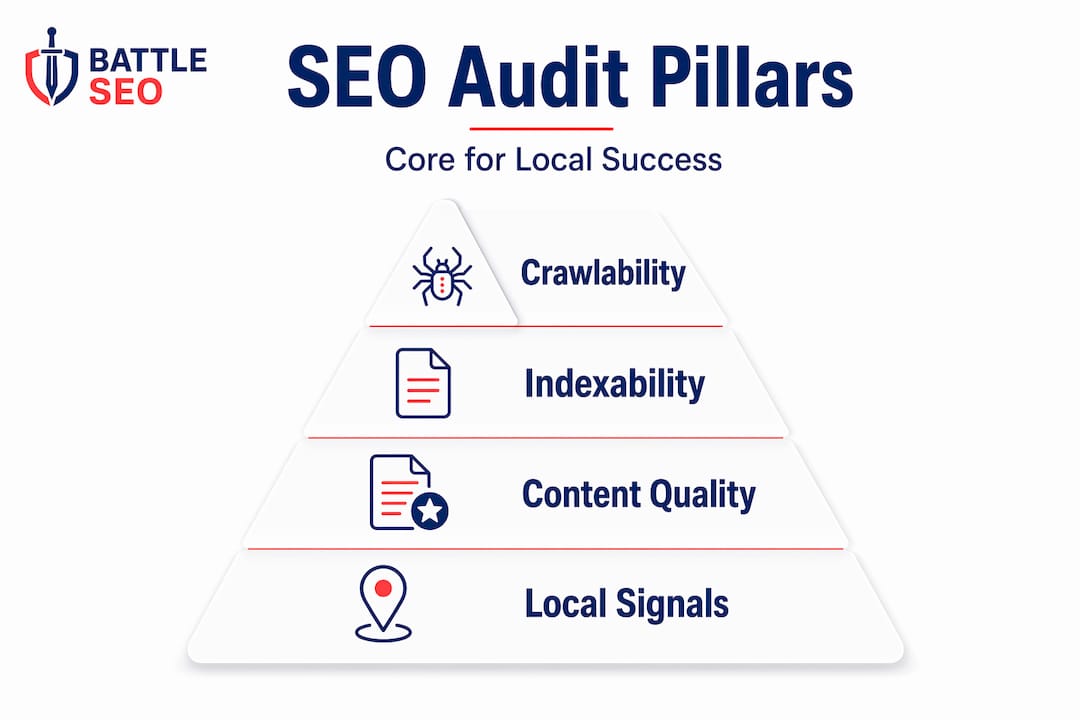
Each pillar is connected. Fixing only one while ignoring the others is like patching one tire and leaving the others flat. The real value of a full audit is seeing the complete picture so you know exactly where to focus first.
The main stages of an SEO audit, step-by-step
With the foundation in place, let’s walk through the main steps of a real SEO audit so you know what to expect and what details matter most.
A thorough audit doesn’t happen in a single pass. It moves through distinct phases, and each one builds on the last. Skipping early stages to jump straight to content fixes is one of the most common and costly mistakes local business owners make.
-
Crawl the site first. Before anything else, you run a crawl using a tool like Screaming Frog or a platform-based crawler. This generates a complete map of every URL on your site and flags errors like broken links (404s), redirect chains, duplicate titles, and missing meta descriptions. Think of this as taking inventory before you start reorganizing.
-
Check crawlability and indexability. This is where many audits reveal unexpected problems. A technical SEO checklist confirms this point: a “site looks fine” audit can still fail if Google is blocked from crawling or if important pages are not indexable. Common culprits include a robots.txt file that accidentally blocks your most important service pages, noindex tags left on by a developer during site maintenance, or canonical tags pointing to the wrong URLs.
-
Assess technical performance. Now you evaluate speed (Core Web Vitals is Google’s current standard), mobile experience, HTTPS security, structured data errors, and how your internal link structure distributes authority across your pages.
-
Review on-page content. This stage involves an SEO gap analysis to identify where your content is missing, thin, or misaligned with search intent. You’re checking whether your service pages use the right keywords, whether your headings follow a logical structure, and whether any pages are cannibalizing each other by targeting the same terms.
-
Evaluate off-page authority. Review your backlink profile for quality and relevance. This includes checking for toxic or spammy links pointing to your site, which can actively harm your rankings.
-
Compile and prioritize recommendations. The audit closes with a prioritized report. High-severity issues (like blocked pages or broken crawls) sit at the top. Lower-priority items like minor content improvements come later. This structure is what separates a real audit from a superficial once-over.
Pro Tip: Always test your robots.txt file and review noindex meta tags before diving into content improvements. These small technical details can quietly prevent Google from ranking your site no matter how strong your content is. Knowing how to update SEO strategies as platforms evolve keeps your audit process current.
Common issues an SEO audit uncovers (and why they matter)
You’ve seen the audit process. Now let’s make it real with the most common issues these reviews uncover and why tackling them improves your bottom line.
Most independent business owners are surprised by what shows up in an audit, especially when their site looks clean and professional on the surface. Here are the issues that appear most often:
- Blocked or noindexed pages: Service pages, location pages, or blog posts that Google can’t access due to a robots.txt error or a stray noindex tag. These pages earn zero organic traffic regardless of their quality.
- Broken internal and external links (404 errors): These frustrate visitors and waste the link equity (the ranking authority passed between pages) that your site has accumulated.
- Slow page load times: Google’s Core Web Vitals algorithm directly penalizes pages that load slowly, especially on mobile devices. A one-second delay in load time can reduce conversions significantly.
- Thin or duplicate content: Pages with fewer than 300 words, copied manufacturer descriptions, or location pages that are nearly identical to each other. Google deprioritizes thin content, particularly in competitive local markets.
- Missing or poorly written meta titles and descriptions: These directly affect your click-through rate (CTR) in search results. A weak meta description is a missed opportunity to convince someone to visit your site.
- Weak or toxic backlink profile: Unnatural links from irrelevant or low-quality sites can drag down your authority score, while a complete absence of quality backlinks leaves you invisible in competitive searches.
As confirmed by the technical SEO checklist, a “site looks fine” audit can still fail if Google is blocked from crawling or if important pages are not indexable due to robots.txt or noindex issues. That’s the core risk local business owners face when they assume everything is working.
Here’s how these issues compare in terms of their potential impact and fix priority:
| Issue | Impact on local rankings | Fix difficulty | Priority |
|---|---|---|---|
| Blocked or noindexed pages | Critical | Low to medium | Immediate |
| Slow page speed | High | Medium | High |
| Broken links | Medium | Low | High |
| Thin or duplicate content | High | Medium to high | Medium |
| Missing meta descriptions | Medium | Low | Medium |
| Weak backlink profile | High | High | Ongoing |
Fixing these issues, particularly the technical ones, has a direct and measurable effect on how many local customers find and choose your business. Strong content marketing for SEO can also address many content-layer problems once the technical foundation is solid.

Pro Tip: Always prioritize fixes that affect your most important business pages first. If you run a plumbing company, your “emergency plumber in [city]” service page matters far more than an older blog post. Don’t spend time polishing low-value pages while high-value ones have critical errors.
How to act on your SEO audit results
Once your site’s weak spots are laid out, the real progress and ROI comes from putting the audit findings into action. Here’s how to stay focused and get results.
An SEO audit results in a prioritized set of fixes, and that structure is your roadmap. The biggest mistake after receiving audit results is attempting to fix everything at once, or worse, fixing low-priority items first because they seem easier.
-
Tackle critical technical issues immediately. Crawl errors, blocked pages, and broken redirects are your first priority. These are foundational. Nothing else matters much if Google can’t properly access your site.
-
Fix on-page issues on your highest-traffic and highest-value pages. Update page titles, meta descriptions, header structure, and content depth for the pages that drive leads or revenue. One well-optimized service page can outperform ten weak ones.
-
Address content gaps using real search data. Use keyword research to find what local customers are searching for and build content that answers those questions directly. This is where local SEO content marketing plays a major role, connecting your expertise to the exact queries your audience types into Google.
-
Start building or cleaning up your backlink profile. Reach out for relevant local citations, industry directory listings, and earned editorial links. Remove or disavow links from spammy sources.
-
Document your starting point and track changes. Record your baseline metrics before making changes, including organic traffic, keyword rankings, and conversion rates (calls, form fills, or direction requests). This makes it easy to prove the value of each improvement.
A key stat to keep in mind: Crawl and indexability issues are often responsible for 30% or more of traffic loss in local search. That means fixing a single technical error blocking your service pages could recover a substantial portion of the traffic you’ve been losing without knowing it.
Review your results 60 to 90 days after making changes. SEO is not instant, but with consistent execution, you’ll see measurable movement in rankings, traffic, and customer inquiries within a few months.
What most guides won’t tell you about SEO audits
There’s one truth most SEO content skips over: the businesses that consistently outrank their competition aren’t necessarily doing more complex SEO. They’re doing the basics more consistently and revisiting them more often.
Many “good” websites lose significant traffic from simple, avoidable technical errors that were introduced during a site redesign, a plugin update, or a developer’s routine maintenance. A noindex tag on the wrong page. A misconfigured redirect. A robots.txt file that blocks an entire section of the site. As the technical SEO checklist points out, a site can look completely fine visually while failing at the crawl and indexability level where it matters most.
The second thing most guides underemphasize is frequency. Too many business owners treat an SEO audit as a one-time task. They run it once, make some fixes, and move on. But search engines evolve constantly, and so does your competition. AI-driven changes to Google’s algorithm, the rise of AI search platforms like ChatGPT and Perplexity, and frequent core updates mean that what ranked well 12 months ago may be losing ground today. Knowing when and why to update your SEO tactics is a core competitive skill, not a one-time project.
Smart business owners schedule audits after every major site change, after any noticeable traffic drop, and at minimum twice per year. This rhythm catches problems early, before they compound into serious ranking losses.
The third overlooked point is that audit findings are only as valuable as your follow-through. A long audit report that sits in a folder helps no one. Prioritize ruthlessly, fix what matters most, and build the habit of treating your site as a living, evolving asset.
How Battle SEO can help you master local SEO audits
If you’re ready to turn insights into action and outpace local competitors, here’s how to get powerful help moving forward.
Running a thorough SEO audit and executing on the findings takes time, expertise, and access to the right tools. Most independent business owners have the motivation but not the hours required to do it consistently. That’s exactly where working with a focused local SEO partner makes a real difference.
At Battle SEO, we specialize in helping independent business owners unlock local SEO visibility through our proprietary Local Command Directive™ framework, which covers everything from technical audits and Google Business Profile optimization to authority backlinks and AI search visibility. Our local SEO services are built around your specific market and category, with an exclusivity model that means we never work with your direct local competitor. If you want to understand how today’s AI-powered search landscape affects your visibility, our AI search guide is a strong next step. We cap new client onboarding at 12 per month, so availability is genuinely limited.
Frequently asked questions
How often should you do an SEO audit for a business website?
You should complete a full SEO audit at least once or twice per year, and immediately after major site changes or algorithm updates. Strong audit methodologies always start with crawl and indexability checks before reviewing content or structured data.
Will an SEO audit guarantee higher search rankings?
An audit identifies problems and opportunities, but higher rankings require taking action on those findings and committing to ongoing improvements. The audit is the map; execution is the journey.
What types of issues can an SEO audit find?
An audit uncovers crawl errors, blocked pages, duplicate content, slow load times, weak backlinks, and missing metadata. Even a site that appears polished can fail in search if Google cannot properly crawl or index its key pages.
Is a technical SEO audit different from a content audit?
Yes. A technical SEO audit focuses on crawl and indexability issues, site speed, and structural problems, while a content audit reviews the relevance, accuracy, and quality of your written pages. Both are essential and work best when done together.