
TL;DR:
- Most business owners view their online profile as a one-time setup, but ongoing management is crucial. Regular updates, accurate information, engaging visual content, and review management directly enhance local search rankings and customer trust. Consistent optimization and alignment with your website are vital for maintaining visibility and outperforming competitors.
Most business owners treat their online business profile the way they treat a business card: create it once, set it aside, and assume the work is done. That misconception costs real rankings and real customers. Business profile optimization is the ongoing process of refining, updating, and actively managing your business listings across platforms like Google Business Profile to improve search visibility, build credibility, and turn searchers into buyers. When done right, it directly impacts where you show up locally and whether customers choose you over a competitor two blocks away.
Table of Contents
- Key Takeaways
- What business profile optimization actually means
- Core components of an optimized business profile
- Visual content and engagement strategies that move rankings
- Integrating your profile with your website
- Routine maintenance to protect your rankings
- My take on profile optimization in the AI era
- Take your profile further with expert local SEO support
- FAQ
Key Takeaways
| Point | Details |
|---|---|
| Optimization is never one-time | Treat your business profile as a living asset that requires regular updates to stay competitive. |
| Category selection drives relevance | Your primary category carries three times the weight of secondary categories in local search ranking. |
| Visual content accelerates engagement | Short-form videos and real photos consistently outperform text-only profiles in algorithmic performance. |
| Profile and website must align | Google’s AI treats your profile and website as a single entity, so mismatched content hurts rankings. |
| Review recency beats review volume | A steady stream of new reviews outranks a large pool of old ones in Google’s local ranking system. |
What business profile optimization actually means
Understanding what business profile optimization means requires knowing what a business profile does. Platforms like Google Business Profile serve as your digital storefront in local search. When someone searches “plumber near me” or “best coffee shop downtown,” the results that appear in the Local Pack are not random. Google ranks them based on three core factors: relevance, distance, and prominence. Distance is largely fixed. Relevance and prominence are fully within your control.
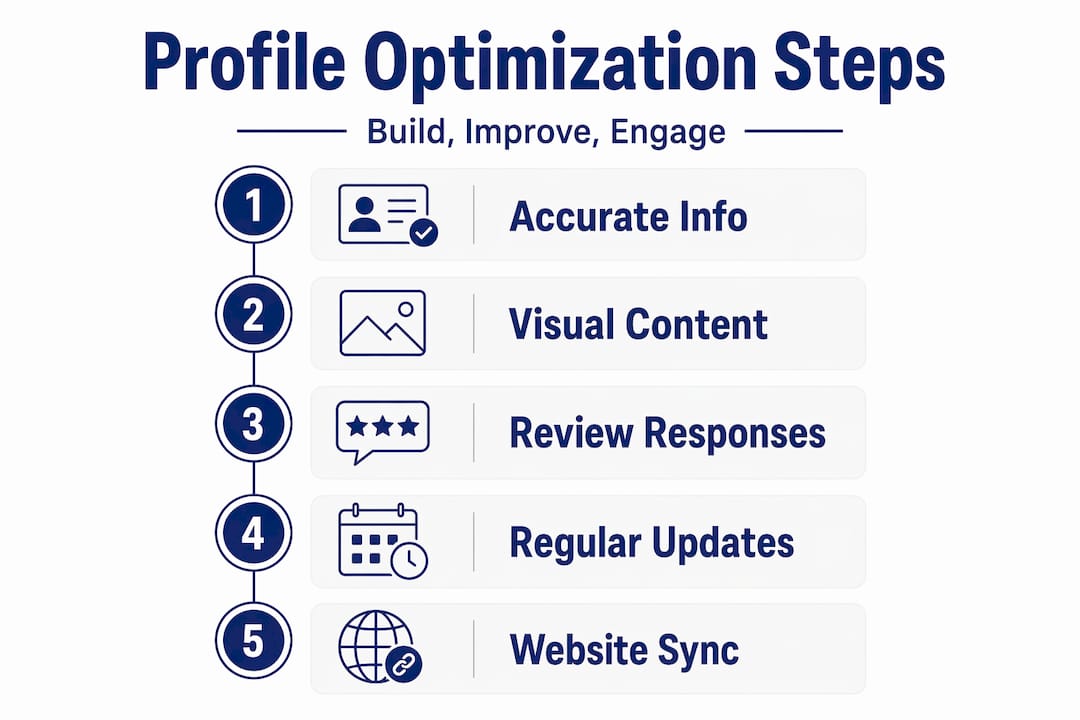
Business profile optimization is the practice of making every controllable element work in your favor. That means accurate business information, complete category selections, descriptive service listings, visual content, review management, and consistent posting. Each of these signals tells Google exactly who you are, what you offer, and whether you deserve a top spot.
The stakes have grown considerably with AI-driven search. Google’s systems now cross-reference your profile against your website, third-party citations, and customer signals to build an understanding of your business. Google explicitly recommends filling every profile field completely, using accurate categories, descriptions, services, and photos. Gaps in that picture don’t just limit you. They actively create ambiguity that pushes you down.
Here is what optimization covers at a high level:
- Business information accuracy: Name, address, phone number, website, and hours must be exact and consistent across every platform.
- Category and service coverage: Your primary and secondary categories define your relevance for specific searches.
- Visual content: Photos, videos, and virtual tours communicate trust and quality before a customer ever clicks.
- Engagement signals: Reviews, Q&A responses, and posts show Google your business is active and trustworthy.
- Compliance and verification: Keeping your profile verified and within platform guidelines protects it from suspension.
Improvement in these areas compounds over time. Think of it as building outward from a strong foundation. Each element strengthens the next.
Core components of an optimized business profile
Getting the fundamentals right is where most businesses either pull ahead or fall behind. Here is how to approach each major component methodically.
-
Choose your primary category with precision. The primary category you select is weighted three times more than secondary categories. If you run a full-service dental practice, “Dentist” is your primary, not “Health and Wellness.” Be specific. Generic categories dilute relevance.
-
Add secondary categories strategically. Secondary categories let you capture adjacent searches. A dental practice might add “Teeth Whitening Service” or “Orthodontist” if those services are offered. Every secondary category should reflect an actual service you provide.
-
Lock in NAP consistency. NAP stands for Name, Address, and Phone number. These three data points must match exactly across Google Business Profile, Yelp, your website, and every directory listing. Even minor variations like “St.” versus “Street” create trust inconsistencies that algorithms notice. This is the foundation of business listing optimization.
-
Write a business description that earns its place. Your description has a 750-character limit. Use it to explain who you serve, what makes you different, and what specific services you offer. Work your primary keyword and service terms in naturally. Avoid marketing fluff. Google reads this as a relevance signal, so specificity matters more than creativity.
-
Build out your service and product listings. Each service listing accepts a title and a description. Treat these like mini landing pages. Include the service name, what it involves, and who it benefits. A landscaping company that lists “Lawn Aeration and Overseeding” with a proper description will rank for that query. One that just lists “Lawn Care” will not.
-
Use attributes and special features. Google offers attributes for things like wheelchair accessibility, payment options, outdoor seating, and whether a business is woman-owned. These details filter search results and connect you with searchers whose queries include these specifics. Fill them out completely.
-
Stay verified and compliant. Keyword stuffing your business name leads to profile suspension. Google’s 2026 guidelines are strict about content accuracy, profile ownership, and guideline adherence. Suspensions are rising. Playing it clean is the only sustainable path.
Pro Tip: After completing your initial profile setup, use the “Suggest an Edit” feature on your own listing to check what the public sees. You’ll often catch errors you missed during setup.
Visual content and engagement strategies that move rankings
An optimized profile is not just a well-filled form. It is an active, engaging presence. The profiles that consistently rank at the top share one trait: they behave like a publishing platform, not a static directory listing.

Profiles using short-form videos of 30 seconds or less see 40% higher engagement than those using text alone. Uploading three to five images or videos weekly maintains algorithmic freshness. That is not a huge lift. It is a manageable habit that most competitors skip.
Google Vision AI automatically tags images, so real photos of your team, location, and products carry more algorithmic weight than stock photography. A dentist showing their actual waiting room and staff outperforms a competitor using generic smiling-patient stock images. Real photos communicate authenticity, and Google’s systems recognize the difference.
Here is what a high-performing engagement strategy looks like in practice:
- Post twice weekly. Posting at least twice weekly with photos improves profile completeness and ranking potential. Posts can be offers, events, product spotlights, or helpful tips. Each post should include a clear call to action like “Call now,” “Book online,” or “Learn more.”
- Manage reviews with recency in mind. Review velocity and recency outweigh total review count. A business with 20 reviews from the past month outranks one with 200 reviews from three years ago. Build a consistent, repeatable process for asking satisfied customers to leave reviews shortly after their experience.
- Coach customers on review language. Google uses review keywords as a relevance signal. When a customer mentions “emergency roof repair” in their review, that phrase supports your ranking for that query. When following up with customers, gently suggest they mention the specific service they received.
- Respond to every review. Responding to reviews promptly signals active management to Google. For negative reviews, a professional, solution-oriented response protects your reputation with potential customers reading the thread.
- Work the Q&A section. You can post questions to your own profile and answer them. This is an underused tactic. Seed the section with common questions like “Do you offer free estimates?” and answer them thoroughly. It improves local SEO and saves your staff time.
Pro Tip: Profiles with 4.5 to 4.8 star ratings see higher conversions than those with a perfect 5.0. Authenticity wins. Do not obsess over removing every negative review. A thoughtful response does more for conversions than a spotless rating.
Integrating your profile with your website
One of the most overlooked aspects of improving online business visibility is the relationship between your business profile and your website. These two assets are not separate. Google’s AI treats them as a single entity. When they tell different stories, ranking consistency breaks down.
Consider this comparison of aligned versus misaligned profiles:
| Element | Aligned approach | Misaligned approach |
|---|---|---|
| Service names | Profile and website use identical service titles | Profile lists “HVAC Repair,” website says “Heating and Cooling Services” |
| Business description | Website About page reflects profile description themes | Completely different positioning and language |
| NAP data | Consistent across profile, website footer, and all citations | Slight variations across platforms |
| Structured data | Website uses local business schema markup | No schema markup present |
| Service area | Profile and website target identical geographic terms | Profile targets city, website targets region |
The fix is a content audit. Review every service your profile lists, then check whether your website has a corresponding page or section with similar language and context. If your Google Business Profile mentions “commercial pressure washing” but your website only says “exterior cleaning services,” you are creating an entity mismatch that reduces your relevance for commercial-specific queries.
Local schema markup on your website gives search engines a structured, machine-readable version of your business information. It reinforces what your profile says and reduces any ambiguity about your location, services, and identity. Pair that with fast page load times and a mobile-first design, and your website becomes a powerful amplifier for your profile’s authority.
Routine maintenance to protect your rankings
One of the most underappreciated benefits of business profile optimization is the protection it offers. Neglect is not neutral. Businesses that ignore ongoing profile activity and review management lose local rankings regardless of past success.
Here is a practical maintenance checklist to keep your profile competitive:
- Check suggested edits weekly. Users and Google can suggest changes to your profile. Monitoring and addressing suggested edits quickly protects your profile from inaccurate or malicious changes that could trigger an algorithm penalty.
- Review profile insights monthly. Google provides data on how many people viewed your profile, what search terms triggered it, and what actions they took (calls, direction requests, website clicks). Use this data to identify which services need stronger content support.
- Audit NAP consistency quarterly. Run a citation audit using a tool like BrightLocal or Whitespark to catch inconsistencies across directories. New citations appear over time, and they are not always accurate.
- Update seasonal hours and offerings. A profile that shows incorrect holiday hours frustrates customers and signals inaccuracy to Google. Update hours proactively ahead of any schedule change.
- Keep photos and posts current. Fresh visual content tells Google and customers that your business is active. Stale photos from three years ago work against you even if everything else is optimized.
Think of this checklist not as extra work but as basic maintenance for a high-performing business asset. A profile that runs on autopilot loses ground to competitors who show up consistently.
My take on profile optimization in the AI era
I have worked with enough local businesses to know that most of them built a solid profile in 2021, got a decent ranking, and then forgot about it. That worked for a while. It does not work anymore.
What I have seen shift dramatically in the past year is how Google’s AI interprets a business. The algorithm is not just reading your profile fields now. It is cross-referencing your profile against your website, your reviews, your posts, and even what other sites say about you. If those signals conflict, your ranking suffers. I have seen profiles with 300 reviews lose their top position to a competitor with 40 reviews who simply maintained tighter content alignment and posted more consistently.
The businesses winning in local search right now are treating their profiles the way a smart content team treats a blog. They post, respond, update, and audit on a schedule. They think about what questions their customers are searching and make sure their profile answers those questions directly. That discipline pays off in Google Maps rankings in ways that feel disproportionate to the effort.
My honest advice: do not outsource your understanding of this, even if you outsource the execution. Know why each element matters. The business owners who grasp the mechanics are the ones who catch problems early and make better decisions about where to invest their time.
— Mike
Take your profile further with expert local SEO support
Understanding the mechanics of business profile optimization is the first step. Executing it consistently, across every platform and signal, is where independent businesses often need support.
At Battleseo, we specialize in local SEO services for independent business owners who want to be the dominant presence in their market. Our Local Command Directive™ framework covers Google Business Profile optimization, citation building, authority backlinks, and content alignment to drive measurable ranking improvements. We also help clients build visibility on AI platforms like ChatGPT and Perplexity, so your business gets found wherever your customers are searching. If you are ready to move beyond a basic profile and unlock local SEO results that compound over time, we would be glad to show you what that looks like.
FAQ
What does business profile optimization mean?
Business profile optimization is the ongoing process of completing, updating, and actively managing your business listings on platforms like Google Business Profile to improve local search rankings and attract more customers.
How do I optimize my business profile effectively?
Start with accurate NAP data, a keyword-natural business description, complete service listings, and regular photo uploads. Add weekly posts and a consistent review acquisition process to build engagement signals over time.
Why is my business category so important?
Your primary category is weighted three times more than secondary categories in Google’s local ranking algorithm, making it the single most important relevance signal you control.
How often should I update my Google Business Profile?
Post at least twice weekly, upload new photos monthly, respond to reviews within 48 hours, and audit your profile for accuracy at least once per quarter to maintain competitive rankings.
Can a poorly optimized profile hurt my rankings?
Yes. Inconsistent NAP data, outdated photos, missing service descriptions, and ignored reviews all reduce your profile’s relevance and trust signals, directly lowering your position in local search results.