

TL;DR:
- Proximity SEO focuses on improving local search visibility by accounting for how physical distance influences Google rankings.
- Building relevance and prominence can help businesses overcome the fixed disadvantage of their geographic location.
Proximity SEO is defined as the practice of improving your local business’s visibility by understanding how physical distance between your location and a searcher’s location shapes your rankings in local search results. Google treats proximity as one of three core pillars in its local ranking algorithm, alongside relevance and prominence. For local business owners, this means your map pack ranking shifts every time a potential customer moves a few blocks. Understanding proximity SEO is the first step toward building a local search strategy that works even when geography is not in your favor.
What is proximity SEO and how does it affect your rankings?
Proximity SEO refers to the discipline of local search optimization that accounts for the physical distance Google measures between a searcher and a business location. The industry standard term for this concept is “proximity modeling,” and it functions as a geographic filter inside Google’s local ranking algorithm. Proximity is the hardest of the three ranking pillars to influence because your physical address is fixed.

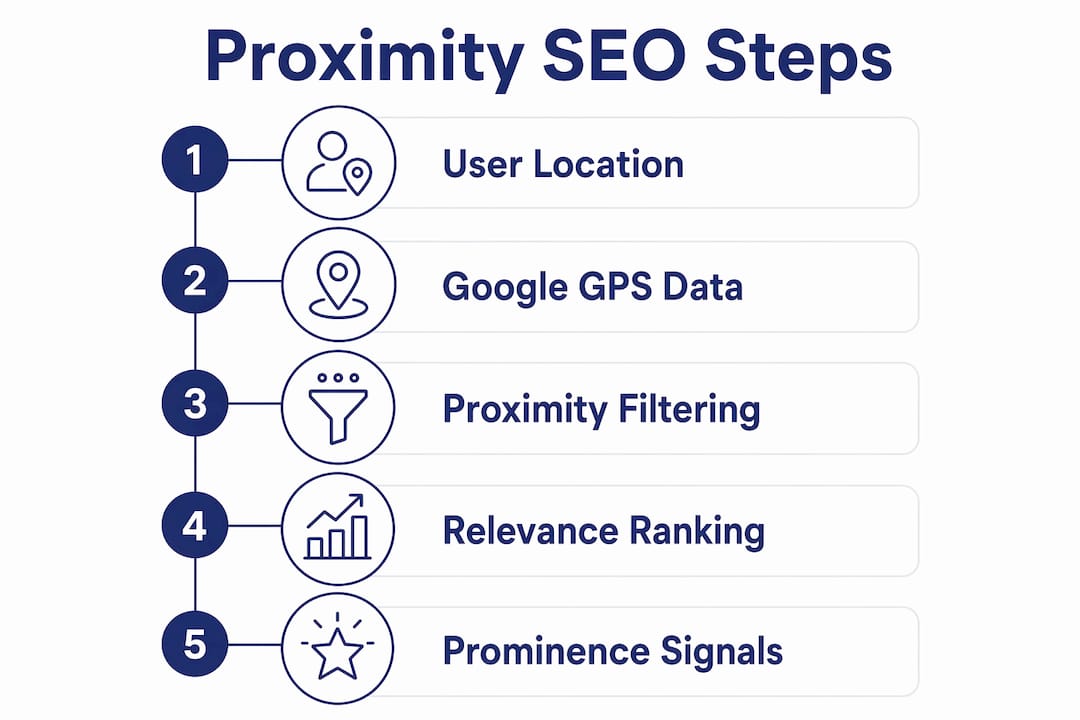
Google uses proximity as a gating layer. Proximity modeling determines eligibility in the local pack before relevance and prominence are even evaluated. Think of it as a bouncer at the door. If your business is outside the radius Google defines for a given search, relevance and prominence do not matter yet.
“Near me” searches trigger proximity filtering most aggressively. A user searching “plumber near me” on a phone in downtown Chicago will see results anchored to their GPS coordinates, not their home zip code. This is why local search visibility is not a static achievement. It shifts block by block.
How does Google calculate proximity in local search?
Google calculates proximity dynamically using a combination of GPS data, IP addresses, user search location, and query signals. Rankings recalculate continuously as a user’s location updates. A business that ranks first for a search at 5th and Main may drop to fifth place for the same search at 10th and Broadway.
The signals Google uses to determine proximity include:
- GPS coordinates from mobile devices, which provide the most precise location data
- IP address geolocation, used when GPS is unavailable or on desktop searches
- Explicit location terms in the query itself, such as “dentist in Austin TX”
- Google Maps viewport, which adjusts results based on the area a user is currently viewing
Proximity recalculates in real time as location or GPS data updates, making local rankings highly dynamic. This real-time nature is what makes proximity both powerful and unpredictable. A business cannot “set and forget” its local rankings the way it might with organic SEO.
Proximity bias compounds in competitive markets. Google’s priority on mobile users’ convenience means the ranking radius contracts as competitive density increases. In a city with 200 plumbers, Google shows searchers the closest credible options, not the best options citywide.
Why proximity is a ranking factor you cannot directly change
Proximity is fixed by geography. You cannot move your business address to rank better, and you cannot trick Google’s location signals. This creates what practitioners call the proximity paradox: the algorithm rewards convenience for the searcher, which creates a structural ranking disadvantage for businesses located outside a searcher’s immediate area.
Service-area businesses face a sharper version of this problem. Businesses that hide their address face a weaker proximity signal and steeper ranking drops as search distance increases compared to storefront competitors. A plumber who works from home and hides their address on Google Business Profile loses the proximity anchor that a storefront competitor has.
The limitations of proximity affect different business types in distinct ways:
- Storefront businesses have a fixed proximity signal tied to their registered address. They rank well nearby and fade quickly at distance.
- Service-area businesses with hidden addresses lose proximity advantage almost entirely and must rely heavily on relevance and prominence.
- Multi-location businesses can anchor proximity in multiple areas, but each location requires its own coordinated local SEO strategy to be effective.
- Franchise operators face the added challenge of competing against sibling locations in the same brand family.
Pro Tip: If you run a service-area business, add a specific service area in your Google Business Profile rather than hiding your address entirely. Google uses registered service areas as a secondary proximity signal, which partially compensates for the missing storefront location.
How relevance and prominence can overcome proximity disadvantage
Relevance and prominence are the two ranking factors you can actively improve. When both are strong enough, they can push your business past closer competitors who have weaker signals in these areas. Stronger relevance and prominence can outrank closer competitors who lack these signals.
Relevance is how well your business matches what the searcher is looking for. It is built through:
- Detailed, keyword-rich service descriptions on your Google Business Profile
- Localized website content that matches specific search intent
- Accurate business categories and attributes
- Niche or long-tail service targeting that matches specific queries
Prominence is how well-known and trusted your business appears to Google. It is built through:
- Customer reviews and your response rate to them
- Authoritative citations across directories like Yelp, the Better Business Bureau, and industry-specific platforms
- Local press mentions and Digital PR
- High-quality backlinks from local and industry sources
Highly specific service categories and niche targeting help businesses overcome proximity through improved relevance, even when they are farther from the searcher. A general contractor who specializes in historic home restoration will outrank a closer general contractor for searches like “historic home renovation contractor” because the relevance match is stronger.
| Ranking factor | Can you control it? | Primary tactics |
|---|---|---|
| Proximity | No | Choose location wisely; use service areas |
| Relevance | Yes | Optimize profiles, content, and categories |
| Prominence | Yes | Build reviews, citations, and backlinks |
The table above shows why local SEO effort concentrates on relevance and prominence. Proximity is the starting condition. Relevance and prominence are the variables you work with.
Proximity SEO strategies to expand your local visibility
You cannot change your address, but you can build outward from it. The following strategies help local businesses rank at greater distances by strengthening the factors Google does respond to.
-
Build a complete, optimized Google Business Profile. Your profile is the single most important proximity SEO asset. Fill every field: services, hours, photos, attributes, and Q&A. An incomplete profile signals low relevance. Battleseo’s Google Business Profile guide covers the specific fields that move rankings.
-
Accumulate and manage customer reviews. Reviews are a direct prominence signal. Ask every satisfied customer for a review, and respond to every review you receive. Google reads your response rate as an engagement signal. A business with 80 reviews and a 4.8 rating will consistently outrank a closer competitor with 12 reviews and a 3.9 rating.
-
Create localized landing pages for each service area. If you serve multiple neighborhoods or towns, build a dedicated page for each one. Each page should include the location name, local landmarks, service-specific content, and a local phone number where possible. This improves relevance for location-modified searches like “roof repair in Naperville.”
-
Target long-tail, niche keywords. Broad keywords like “plumber” are dominated by proximity. Niche and long-tail keywords that match specific user intent yield better local visibility at greater distances. “Emergency gas line repair contractor” is a query where relevance can beat proximity because fewer businesses match it precisely.
-
Build local authority through citations and link building. Consistent citations across directories, local chamber of commerce listings, and industry associations strengthen prominence. Pair that with authority backlinks from local news sites and community organizations to build the trust signals Google uses to rank businesses beyond their immediate radius.
Pro Tip: Use Google Search Console to identify which location-modified queries already bring you traffic. Those are your proximity sweet spots. Double down on content and profile optimization for those specific terms before expanding to new geographic targets.
Proximity is real, but it is not a ceiling
I have worked with local businesses that were convinced their location was killing their rankings. A law firm in a secondary business district, a dentist two miles from the dense commercial core, a contractor working out of a rural address. In every case, the instinct was to blame geography and stop there.
That instinct is wrong. Proximity sets the starting line, not the finish line. What I have seen work, consistently, is businesses that accept the proximity reality and then pour their effort into the factors they can control. The law firm that published detailed, localized content about specific practice areas started ranking for intent-specific searches that proximity-favored competitors were not even targeting. The dentist who built 200 reviews and a fully optimized profile started appearing in searches two towns over because prominence carried the weight.
The businesses that struggle are the ones that treat local SEO as a one-time setup. Proximity rankings shift daily. Google’s algorithm updates regularly. The local business owners who win are the ones who treat local search as an ongoing practice, not a project with an end date. Measure your ranking radius every quarter. Track which queries you appear for and at what distance. Adapt your content and profile based on what the data tells you, not what you assume. That discipline, more than any single tactic, is what separates businesses that dominate their local market from the ones that wonder why the competitor down the street keeps showing up first.
How Battleseo helps local businesses win beyond their front door
Local SEO is not a set-it-and-forget-it task, especially when proximity is working against you.
Battleseo’s local SEO services are built specifically for independent business owners who need to compete in markets where proximity alone does not guarantee visibility. The Local Command Directive™ framework covers Google Business Profile optimization, citation building, authority backlinks, localized content, and Digital PR. Each client gets an exclusive position in their category and market. Battleseo takes on only one business per service category per area, so your investment goes toward making you the dominant local authority, not splitting effort across competitors. If you are ready to build visibility that extends beyond your immediate block, explore local SEO options built for businesses like yours.
Key takeaways
Proximity SEO is the practice of optimizing local search visibility by understanding how physical distance shapes Google rankings, then building relevance and prominence to compete beyond your immediate geographic radius.
| Point | Details |
|---|---|
| Proximity is a fixed signal | Your business address sets your proximity baseline; you cannot optimize distance itself. |
| Google filters by proximity first | Proximity acts as a gating layer before relevance and prominence determine final rankings. |
| Relevance and prominence are your levers | Optimized profiles, reviews, citations, and localized content can outrank closer competitors. |
| Niche targeting extends your reach | Long-tail, service-specific keywords improve relevance and help you rank at greater distances. |
| Service-area businesses need extra effort | Hidden-address businesses lose proximity advantage and must rely more heavily on prominence signals. |
Perspective: why I stopped telling clients to worry about proximity
When clients ask me about proximity, my honest answer is: stop trying to fix it and start building around it. Proximity is a constraint, like the size of your storefront or your parking lot. You work with what you have.
The businesses I have seen succeed are the ones that treat relevance and prominence as their primary investment. They write detailed service pages. They ask for reviews every single time. They get listed in every credible local directory. They earn mentions in local press. Over time, those signals compound. Google starts showing them to searchers who are farther away because the trust signals are strong enough to justify it.
The proximity paradox is real, but it is not a sentence. It is a starting condition that better local SEO can overcome.
— Mike
FAQ
What is proximity SEO in simple terms?
Proximity SEO is the practice of understanding how physical distance between your business and a searcher affects your local search rankings. It is one of three factors Google uses to rank local businesses, alongside relevance and prominence.
Can I improve my proximity ranking without moving my business?
You cannot change your physical proximity to a searcher, but you can strengthen relevance and prominence signals to rank at greater distances. Strong reviews, optimized profiles, and localized content help compensate for geographic disadvantage.
Why do service-area businesses rank worse at distance?
Service-area businesses that hide their address have a weaker proximity signal than storefront competitors. Google relies on the registered location, and without a visible address, the proximity anchor is less precise, causing rankings to drop faster as search distance increases.
How does Google know where a searcher is located?
Google uses GPS data, IP addresses, and query signals to determine a searcher’s location. On mobile devices, GPS provides the most accurate signal. On desktop, IP address geolocation is the primary method.
What is the fastest way to improve local search visibility?
Completing and optimizing your Google Business Profile is the fastest single action. Adding accurate categories, detailed service descriptions, photos, and actively collecting reviews builds both relevance and prominence signals that Google uses to rank your business in local results.