
TL;DR:
- Search engine rankings are based on signals like relevance, quality, authority, and user experience.
- Combining traditional SEO with AI tools enhances local visibility and keeps businesses adaptable.
- Ongoing optimization, profile activity, and localization are key to maintaining high local search rankings.
Most business owners assume their position in Google search results comes down to luck or whoever has the biggest budget. That’s not how it works. Search engine ranking is the process by which search engines like Google determine the order of web pages and local business listings based on hundreds of signals evaluating relevance, quality, authority, and user experience. Once you understand what those signals are, you can start influencing them. This guide breaks down exactly how rankings work, how to use both traditional SEO and AI tools to your advantage, and what mistakes to avoid so your local business gets found by the customers who need you most.
Table of Contents
- How search engines rank local businesses
- SEO vs. AI optimization: which is right for your business?
- Actionable steps to improve your local search ranking
- Common ranking pitfalls and how to avoid them
- A fresh look: why rankings are won by those who adapt, not just optimize
- Boost your local ranking with proven SEO and AI solutions
- Frequently asked questions
Key Takeaways
| Point | Details |
|---|---|
| Ranking factors matter | Understanding ranking signals lets you proactively boost your local visibility. |
| SEO and AI synergy | Combining traditional SEO and AI optimization gives your business a strategic edge. |
| Action drives results | Step-by-step tactics and consistent updates help you stay ahead in search rankings. |
| Avoid easy mistakes | Watch for common pitfalls—like neglecting your GBP or missing AI features—to keep your ranking strong. |
| Adapt for success | Businesses that evolve quickly gain and maintain higher search engine rankings. |
How search engines rank local businesses
Search engines don’t pick winners at random. They use a layered system of signals to evaluate every page and listing on the web, then match the best results to each user’s query. For local businesses, this means your Google Business Profile (GBP), your website, and your overall online presence are all being scored simultaneously.
The core ranking signals that Google and other search engines evaluate fall into four broad categories:
- Relevance: Does your business clearly match what the user is searching for? This includes your GBP categories, the keywords on your website, and how well your content answers common customer questions.
- Quality: Is your website well-built, fast-loading, and easy to navigate? Thin content, broken links, and slow pages all signal low quality.
- Authority: Do other trusted websites link to yours? Online reviews, local citations, and mentions in local media all contribute to authority in your market.
- User experience: Are visitors staying on your site, clicking through your pages, and converting into customers? High bounce rates and short session times suggest your site isn’t meeting expectations.
For local searches specifically, Google also factors in proximity (how close your business is to the searcher) and user intent (whether someone is looking to buy now, research options, or find directions). A plumber searching for competitors will get different results than a homeowner with a burst pipe. Understanding this distinction helps you shape your content and GBP listing to match the intent of your ideal customer.
“Search engines use hundreds of signals to evaluate local businesses. Proximity and intent are the two local modifiers that most independent business owners overlook, even though they’re directly actionable.”
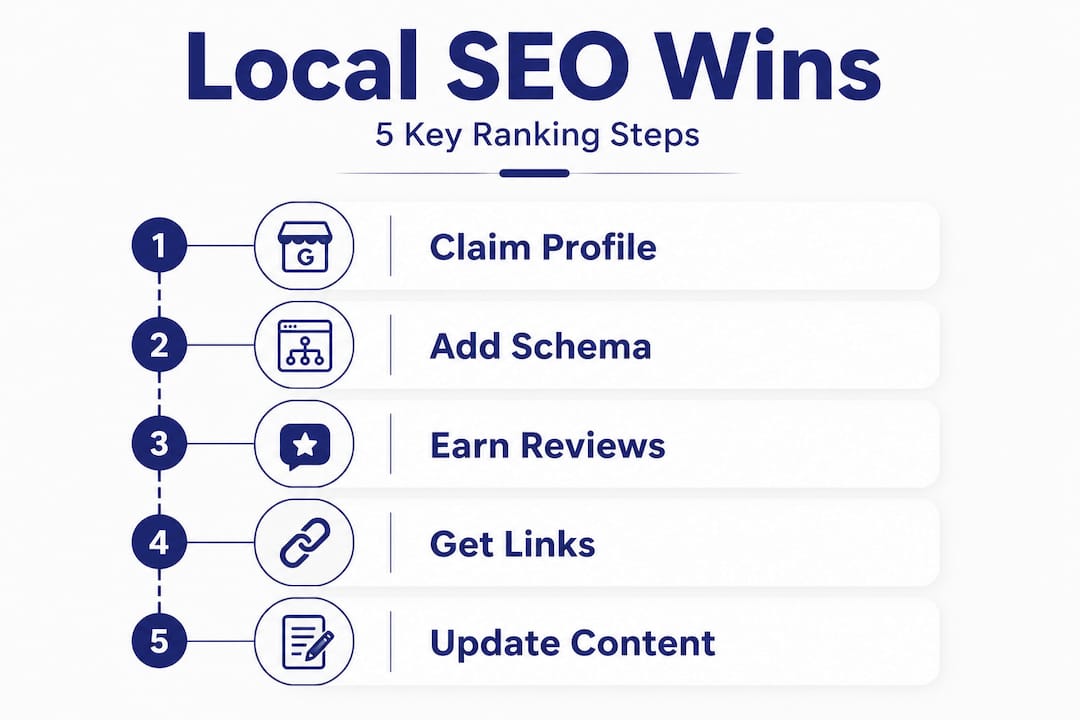
One quick win here: add structured data markup, sometimes called schema markup for SEO, to your website. Schema tells search engines exactly what your business does, where you’re located, what your hours are, and more, in a language the algorithm reads clearly. It’s one of the most impactful technical improvements a local business can make without requiring a complete website overhaul.
SEO vs. AI optimization: which is right for your business?
Now that you understand the ranking signals, you’ll want to assess how different methods help improve them. Traditional SEO and AI-powered optimization aren’t competing approaches. They’re complementary tools, and knowing when to use each one gives you a real edge.
Traditional SEO focuses on the foundational elements: keyword research, on-page optimization, link building, citation consistency, and GBP management. It’s proven, methodical, and essential. If your GBP is incomplete, your NAP (Name, Address, Phone number) is inconsistent across directories, or your website has no clear location-based content, traditional SEO fixes those issues first.
AI optimization adds a layer of speed and scale. AI tools can handle keyword expansion, content clustering, GBP automation, and content templates in a fraction of the time it would take manually. More importantly, AI optimization also prepares your business to appear in AI-generated search results from platforms like ChatGPT, Perplexity, and Google’s own AI Overviews, which are now appearing at the top of many local search results.
Here’s a direct comparison to help you decide where to focus:
| Feature | Traditional SEO | AI Optimization |
|---|---|---|
| Speed of results | Slower (weeks to months) | Faster iteration cycles |
| Keyword research | Manual, experience-driven | Automated clustering and expansion |
| Content creation | Crafted by writers | Templates and AI drafts |
| GBP management | Manual updates | Automatable scheduling |
| AI search visibility | Limited | Purpose-built |
| Cost efficiency | Higher time investment | Scalable with lower labor |
| Long-term authority | Strong | Stronger when combined with traditional SEO |
The honest answer for most independent business owners is that you need both. Traditional SEO builds the foundation. AI optimization scales your reach and keeps you visible as search behavior evolves. If you’re new to this, start with your GBP and website basics, then layer in AI search optimization once your core signals are solid.
Pro Tip: When using AI tools for content, always prioritize E-E-A-T (Experience, Expertise, Authoritativeness, and Trustworthiness). AI-generated content that lacks a genuine business voice or real-world examples can hurt your rankings rather than help them. Edit every AI draft with your own knowledge and local context before publishing.
If you’re ready to explore professional AI optimization services tailored for local businesses, there are structured options designed specifically to bridge traditional and AI-driven strategies.
Actionable steps to improve your local search ranking
After comparing SEO and AI strategies, it’s time to turn knowledge into action. Here are concrete steps built for independent business owners who want to move up in local search without wasting time on tactics that don’t move the needle.
-
Claim and complete your Google Business Profile. Fill out every field: business name, address, phone, hours, website, services, photos, and a keyword-rich description. Incomplete profiles rank lower than fully completed ones. Add new photos at least once a month to signal an active listing.
-
Audit your citations. Citations are online mentions of your business name, address, and phone number on directories like Yelp, Bing Places, and Apple Maps. Inconsistencies across these platforms confuse search engines and suppress your ranking. Use a tool like BrightLocal or Whitespark to identify and fix discrepancies.
-
Publish location-specific content. Write blog posts or service pages that mention your city, neighborhood, or region naturally. A roofing company in Austin should have content about “storm damage roof repair in Austin” rather than generic roofing tips. This directly improves your relevance signal for local queries.
-
Use AI for keyword expansion and content clustering. AI tools can identify keyword gaps and group related search terms into content clusters, making it easier to build topic authority around your core services. Instead of writing one page about “HVAC repair,” you can build a cluster of pages covering tune-ups, emergency repairs, seasonal maintenance, and brand-specific services.
-
Build authority through reviews and backlinks. Ask satisfied customers to leave Google reviews immediately after a job is done. Even a simple follow-up text or email with a direct link works well. For backlinks, reach out to local business associations, chambers of commerce, and local news outlets. One quality local backlink is worth more than dozens of generic directory links.
-
Set up tracking and adjust. Install Google Analytics 4 (GA4) and Google Search Console if you haven’t already. Monitor which pages drive the most traffic, which search queries bring users to your site, and how users behave once they arrive. If you use AI tools, set up AI referral tracking in GA4 to measure how much visibility you’re gaining from platforms like ChatGPT or Perplexity.
-
Automate where it makes sense. Scheduling GBP posts, monitoring reviews, and generating content briefs are all tasks you can partially automate for local growth. Automation frees you up to focus on the higher-value work that requires your personal expertise.
Staying informed about SEO algorithm changes is also part of the process. Google updates its algorithm hundreds of times per year, and even small core updates can shift your ranking meaningfully.

Key stat: Businesses that actively manage their Google Business Profiles and maintain consistent citation data are significantly more likely to appear in the local map pack, the three-business listing that appears above standard organic results for most local queries. That placement drives the majority of clicks for local searches.
Common ranking pitfalls and how to avoid them
Even the best strategies can fail if you stumble over common errors. Here’s how to spot and fix them before they hurt your ranking.
-
Neglecting your GBP after setup. Many business owners create a GBP listing once and never return. Search engines reward active profiles. Post updates, respond to every review (positive and negative), and update your hours during holidays. A stale profile signals an inactive business.
-
Ignoring AI Overviews and new SERP features. Google’s AI Overviews now appear for a growing share of local queries. If your content isn’t structured to answer questions directly and concisely, you’re invisible in that placement. Use answer-first formatting, clear headings, and schema tips to make your content easier for AI systems to parse and surface.
-
Focusing only on keywords instead of user experience. Stuffing your pages with location-based keywords while neglecting page speed, mobile usability, and clear calls to action is a common mistake. Google measures how users interact with your site. If visitors land and leave immediately, your ranking drops regardless of how keyword-optimized your page is.
-
Skipping a competitive gap analysis. Most business owners guess at what their competitors are doing better. A structured SEO gap analysis shows you exactly where you’re missing content, which keywords competitors rank for that you don’t, and where your backlink profile falls short. It’s one of the most efficient ways to identify quick wins.
-
Overlooking mobile performance. More than half of all local searches happen on mobile devices. A website that loads slowly or displays poorly on a phone is actively suppressing your ranking. Run a Google PageSpeed Insights test on your homepage and fix the highest-impact issues first.
Pro Tip: Local ranking signals include hundreds of factors you can influence over time. Prioritize the ones tied directly to your GBP and website quality first, since those have the most immediate impact on local map pack placement.
A fresh look: why rankings are won by those who adapt, not just optimize
Here’s the part most SEO guides skip entirely: technical optimization is just the price of entry. The businesses that consistently hold top rankings aren’t the ones who followed a checklist once. They’re the ones who treated SEO as an ongoing practice, not a one-time project.
The search landscape in 2026 looks very different from even two years ago. AI Overviews are reshaping how users interact with search results. Voice search is influencing how queries are phrased. Platforms like Perplexity and ChatGPT are now answering local questions that used to send users directly to Google. If your SEO strategy doesn’t account for these shifts, you’re optimizing for a version of search that no longer fully exists.
The businesses we see outpace their competitors are almost always the ones willing to test new approaches quickly. They run small experiments, like adding FAQ schema to a service page, or posting a short video update to their GBP, and they track what moves. When something works, they scale it. When it doesn’t, they move on without over-investing.
There’s a mindset shift at the core of this: stop thinking of your ranking as a destination and start thinking of it as a signal. It tells you how well your online presence is serving customers relative to your competitors. When it drops, that’s information. When it rises, that’s confirmation. Either way, the correct response is to keep learning and adjusting.
Adapting to future-proof SEO strategies means building habits around monitoring, testing, and updating, not just optimizing once and hoping the results hold. The businesses that embrace that mindset are the ones we see dominating local rankings year after year.
Boost your local ranking with proven SEO and AI solutions
Applying the right mix of traditional SEO and AI optimization takes time, expertise, and consistent effort. If you’re ready to move faster and more confidently, our team at Battle SEO is built specifically for independent business owners who want to dominate their local market.
Our local SEO services combine Google Business Profile optimization, authority link building, citation management, and on-page SEO into a single structured approach. We also help businesses get found on AI-powered platforms through our AI search optimization guide and tailored visibility strategies. We work exclusively with one business per category per market, so when you’re our client, we’re fully in your corner. If you’re serious about ranking higher and staying there, let’s talk.
Frequently asked questions
What factors influence search engine ranking for local businesses?
Search engines evaluate local businesses using hundreds of signals including relevance, content quality, website authority, user experience, proximity to the searcher, and the completeness of your Google Business Profile.
How can AI help my business improve its search rankings?
AI tools support keyword clustering, automated GBP management, and content template generation, while also preparing your business to appear in AI-generated search results on platforms like ChatGPT, Perplexity, and Google’s AI Overviews.
Can focusing on keywords alone boost my local ranking?
No. Search engines measure far more than keyword density, including how users behave on your site, how many authoritative sources link to you, and how consistently your business information appears across the web.
How often should I update my SEO strategy for best results?
Review your SEO strategy at minimum once per quarter, and more frequently when Google releases a major algorithm update or when you notice shifts in your search traffic patterns. Staying current with both traditional and AI-driven changes keeps your rankings stable and growing.