
TL;DR:
- Local SEO helps businesses appear prominently in geographically relevant searches, attracting potential customers. Building and optimizing your Google Business Profile, website, and reviews establish a strong foundation for visibility and rankings. Ongoing engagement, content-driven optimization, and AI tools enhance local search performance and sustained growth.
Every day, potential customers search for services like yours online. Some of them find your competitors first, call them, and never think about you again. That’s not because those competitors are better at their jobs. It’s because they’ve figured out how to show up when it matters. Local SEO (search engine optimization for geographically relevant searches) is the system that makes that happen. This guide walks you through the exact process, from setup to optimization to measurement, so your business can claim its share of local search visibility and stop losing customers to better-ranked competitors.
Table of Contents
- What you need before starting local SEO
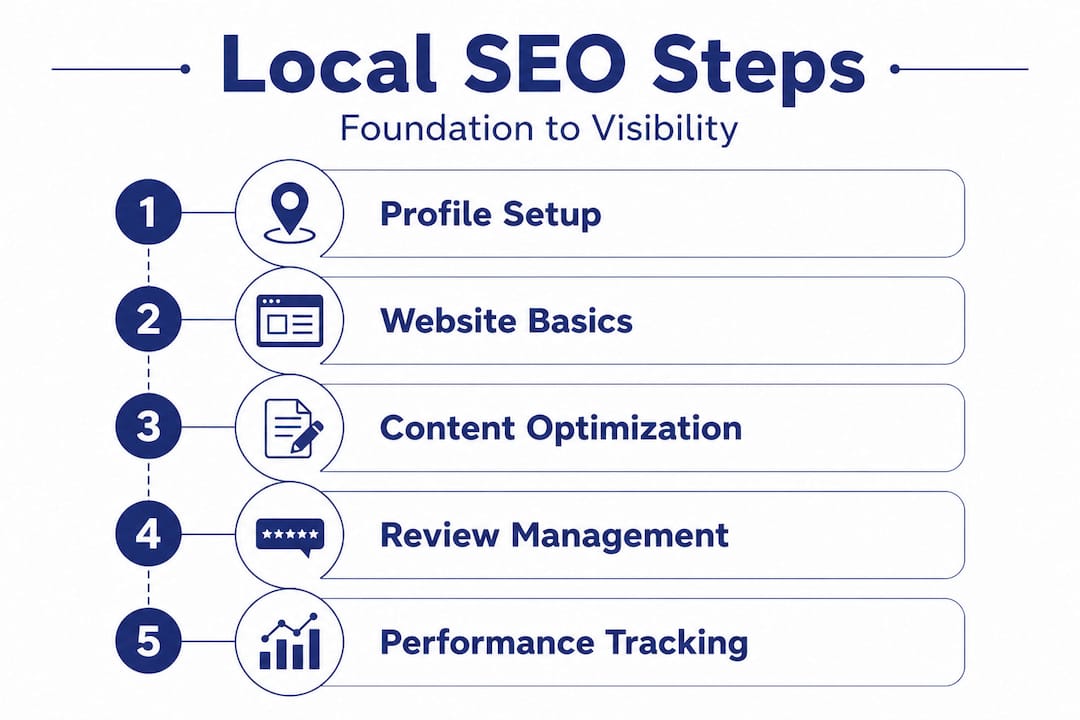
- Laying the foundation: Setting up your profiles and website
- Optimizing for local search: Content, links, and AI tools
- Troubleshooting and measuring local SEO success
- Our take: Why the most overlooked step in local SEO is customer engagement
- Ready to accelerate your local SEO success?
- Frequently asked questions
Key Takeaways
| Point | Details |
|---|---|
| Reviews drive visibility | Responding to and requesting reviews raises your search rankings on multiple platforms. |
| Preparation is crucial | You need proper tools, profiles, and a strategy before starting local SEO for best results. |
| AI boosts effectiveness | AI tools streamline process, identify trends, and help you dominate local search. |
| Measure and adapt | Tracking SEO performance lets you catch problems early and keep improving. |
| Engagement sustains success | Continuous customer interaction is key to ongoing local visibility and conversion. |
What you need before starting local SEO
Now that you understand why local SEO matters, let’s outline what you need to get started. Jumping in without the right tools and information is like trying to build a house without a blueprint. You need a clear picture of your current digital presence before making any moves.
The role of customer reviews from day one
Reviews are not something you manage later. They are foundational. 97% of consumers read reviews before making decisions, and they check an average of six different platforms to do it. That means your reputation is already being formed, whether you’re paying attention or not.
Before you do anything else, audit what’s already out there. Search your business name and see what appears across Google, Yelp, Facebook, and any industry-specific directories in your niche. What you find will tell you a lot about where you’re starting from.
Tools and platforms you’ll need
You don’t need to spend a fortune on software. A focused toolkit gets you most of the way there:
- Google Search Console (free): tracks how your website performs in Google search, including clicks, impressions, and technical issues
- Google Analytics 4 (free): shows you how visitors behave once they land on your site
- Google Business Profile (free): the most important local SEO asset for service businesses
- BrightLocal or Whitespark (paid): for citation tracking, ranking reports, and review monitoring
- Semrush or Ahrefs (paid): for keyword research and competitive gap analysis
The free tools alone are enough to get started. As you progress, investing in one paid platform for ranking and citation tracking pays off quickly.
Prerequisites checklist
Use this comparison to assess where you stand before touching anything:
| Area | Minimum requirement | Advanced standard |
|---|---|---|
| Google Business Profile | Claimed and verified | Fully optimized with photos, posts, and Q&A |
| Website | Live and mobile-friendly | Local landing pages and schema markup |
| Citations (business listings) | Name, address, phone consistent | Listed on 50+ relevant directories |
| Reviews | At least 5 on Google | 25+ across multiple platforms |
| Keyword targeting | Basic location + service terms | Long-tail local intent phrases |
Strong local SEO content marketing and solid ranking strategies for local businesses both start with this foundation. Without it, even great content won’t rank well.
Pro Tip: Before you build anything new, fix what’s broken. Inconsistent business name, address, and phone number (NAP) information across directories is one of the most common and damaging local SEO mistakes. Run a free citation audit on BrightLocal to find discrepancies.
Laying the foundation: Setting up your profiles and website
With everything in place, it’s time to start laying the SEO foundation. This stage is about building visibility on the platforms where customers are actually looking. Get this right and you create a strong base to build outward from.
Setting up and optimizing your Google Business Profile
Your Google Business Profile (GBP) is the single most influential asset in local SEO. It powers your appearance in Google Maps and the local pack (the map results that show up before organic listings). Here’s how to set it up correctly:
- Claim your profile at business.google.com. If a listing already exists, claim it rather than creating a duplicate.
- Verify your business using the method Google provides, typically a postcard, phone call, or video verification.
- Select your primary category carefully. This is arguably the most important GBP decision. Choose the category that best describes your core service.
- Add secondary categories for related services you offer.
- Write a business description that mentions your core service and city without stuffing keywords unnaturally.
- Upload photos: exterior, interior, team, and work samples. Profiles with photos receive significantly more engagement.
- Add your service list with descriptions and pricing where possible.
- Enable messaging and booking if your business model supports it.
- Set your service area if you travel to customers rather than having them visit you.
- Start posting weekly updates to show Google your profile is actively managed.
For a deeper look at maximizing your profile’s impact, our guide on Google Business Profile visibility walks through advanced tactics.
Website SEO basics for local businesses
Your website needs to speak the same language your customers use when searching. That means including city and service keywords in key locations: page titles, meta descriptions, headers, and the body content itself.

Build a dedicated page for each core service you offer. A plumber in Austin shouldn’t have one vague “services” page. They should have separate pages for water heater repair, drain cleaning, pipe replacement, and so on. Each page targets a specific combination of service plus location.
| On-page element | What to include |
|---|---|
| Page title (title tag) | Service + city name (e.g., “HVAC repair in Phoenix, AZ”) |
| Meta description | Brief benefit statement with location and call to action |
| H1 heading | Matches or closely resembles the title tag |
| Body content | 400-800 words covering the service, local context, and FAQs |
| Schema markup | LocalBusiness schema to help AI and search engines understand your info |
| Internal links | Connect to related service pages and your contact page |
Major review platforms to monitor
Build reviews systematically by requesting them from satisfied customers and responding to every review you receive, positive or negative. Use this table to prioritize your platforms:
| Platform | Best for | Priority |
|---|---|---|
| All local businesses | Highest | |
| Yelp | Restaurants, home services, retail | High |
| Community-based and service businesses | High | |
| Houzz | Home improvement and contractors | Medium |
| Healthgrades / Zocdoc | Healthcare providers | Medium |
| Avvo / Justia | Legal professionals | Medium |
Pro Tip: Time your review requests strategically. The best moment to ask is right after a positive interaction, whether that’s a completed project, a follow-up call, or a thank-you email. A simple, direct message like “We’d really appreciate a Google review” with a direct link converts at a much higher rate than a generic request.
If you want to understand how AI platforms like ChatGPT and Gemini are now part of this discovery landscape, the AI search optimization guide covers exactly how to position your business there too.
Optimizing for local search: Content, links, and AI tools
After setup, the next stage is optimization, which means making your business stand out in search. Setup gets you visible. Optimization gets you ranked above competitors.
Targeting keywords with local intent
Local intent keywords are phrases people use when they’re ready to hire or buy in a specific area. “Emergency electrician near me,” “best pediatric dentist in Denver,” and “affordable lawn care [city name]” are all local intent phrases. These are different from broad informational keywords, and they convert far better.
Use Google’s autocomplete and the “People also ask” section to find what your audience is actually searching. Then map those keywords to specific pages on your website.
- Research 3-5 primary keywords per service page
- Include the city or neighborhood name naturally within the content
- Use question-based keyword variations in FAQs embedded on your service pages
- Monitor keyword rankings monthly using your tracking tool of choice
Integrating AI tools for efficiency and ranking
AI tools have changed what’s possible for independent business owners without large marketing teams. Tools like ChatGPT, Perplexity, and Google’s Gemini are now surfaces where customers discover businesses, not just traditional search engines. Beyond visibility, AI tools can help you:
- Generate optimized service page drafts in a fraction of the time
- Analyze competitor profiles to identify keyword gaps
- Create review response templates that sound genuine
- Spot trends in customer questions and feedback across platforms
The ability to appear in AI-generated answers is a newer and growing opportunity, especially for local businesses that establish strong topical authority and consistent NAP signals.
Link building for local authority
Links from other websites to yours act as votes of confidence in Google’s eyes. For local businesses, the most valuable links often come from local sources:
- Local news outlets: sponsor or participate in events that generate press coverage
- Local business associations and chambers of commerce
- Industry directories specific to your trade or profession
- Community blogs or local lifestyle publications
- Partner businesses: a flooring company linking to a painting contractor they often work alongside
Our guide on local SEO link building outlines proven outreach strategies. For a broader view on fast-tracking visibility, unlocking local SEO covers quick wins you can deploy today.
Across all your platforms, 97% of consumers read reviews before making a purchase decision, checking an average of six platforms. That reality applies directly to your link and content strategy. Credibility online is cumulative.
Pro Tip: Don’t ignore unlinked brand mentions. Search for your business name in Google and check if any websites mention you without linking back to you. A quick outreach email asking them to add a link often converts at 20-30% because they already like you enough to mention you.
Troubleshooting and measuring local SEO success
Once you’ve optimized, ongoing troubleshooting and measurement ensures continuous progress. SEO is not set-and-forget. It’s more like tending a garden: regular attention keeps it growing.
Tracking the right metrics
Not everything measurable matters equally. Focus on metrics that connect to real business outcomes:
- Local pack rankings: are you appearing in the top 3 map results for your key terms?
- Google Business Profile insights: how many calls, direction requests, and website clicks per month?
- Organic traffic from local terms: use Google Analytics to filter by your target city or region
- Review velocity: are you consistently earning new reviews, or have they stalled?
- Conversion rate: of the visitors who land on your service pages, how many contact you?
“What gets measured gets managed. The businesses we see climb the fastest in local rankings are the ones tracking performance weekly, not quarterly. Small adjustments made early compound into big advantages over time.”
Diagnosing common local SEO problems
| Problem | Likely cause | Fix |
|---|---|---|
| Not appearing in local pack | Incomplete GBP or weak review count | Complete profile, accelerate review requests |
| Inconsistent rankings by location | NAP inconsistencies in citations | Run a citation audit and fix mismatches |
| Traffic but no conversions | Poor page UX or weak calls to action | Redesign CTAs, add social proof |
| Rankings dropped suddenly | Google algorithm update or penalty | Check Search Console for manual actions |
| Competitor outranking despite fewer reviews | Stronger backlink profile or better on-page SEO | Gap analysis and link building |
For a tactical checklist to address these issues, the top local SEO tips resource is a practical starting point. And if you’re focused on standing out in AI-driven results, standing out locally covers the modern visibility landscape.
Simple vs. advanced measurement comes down to resources. Google’s free tools (Search Console, Analytics, GBP insights) handle 80% of what you need. Paid tools handle competitive analysis, citation audits, and rank tracking at scale.
Our take: Why the most overlooked step in local SEO is customer engagement
Having explored the practical steps, let’s take a look at what most experts miss.
Most local SEO guides treat reviews as a checkbox. Claim your profiles, get some reviews, move on. That framing misses the actual opportunity. Customer engagement, meaning the ongoing cycle of requesting reviews, responding to feedback, and learning from what customers say, is where most independent businesses quietly fall behind.
Here’s what we’ve observed: businesses that respond to every review (not just the bad ones) build a compounding trust signal. Google’s algorithm interprets active engagement as a sign of a live, legitimate business. Customers reading reviews interpret it as attentiveness. Both outcomes help rankings and conversions simultaneously.
The businesses that break away from their competition aren’t the ones with the flashiest websites. They’re the ones with systems. A simple automated review request sent 48 hours after a job is completed outperforms any manual follow-up strategy over time. It’s consistent, scalable, and it runs while you’re focused on the actual work.
AI now makes this even more accessible. Platforms that monitor review sentiment, flag patterns in negative feedback, and draft personalized responses have come down significantly in cost. If your business receives reviews across multiple platforms, an AI-powered SEO automation approach can help you stay responsive without adding hours to your week.
The bottom line: technical SEO creates the floor. Engagement creates the ceiling. Most guides only teach you to build the floor.
Ready to accelerate your local SEO success?
You now have the full process, from prerequisites to optimization to measurement. But knowing the steps and executing them consistently are two different things. Independent business owners are already wearing a lot of hats.
Battle SEO works exclusively with one business per service category per market, so your investment goes toward dominating your niche, not sharing strategies with your competitors. Our Local Command Directive™ framework puts local SEO services, authority link building, Google Business Profile optimization, and citation building to work for you as a complete system. We also help clients establish visibility in AI-powered search surfaces covered in our AI search optimization guide. If you’re ready to stop guessing and start ranking, explore how to unlock local SEO and see what’s possible for your market.
Frequently asked questions
How long does it take to see results from local SEO?
Most local businesses notice significant ranking improvements within 3 to 6 months, though results depend on your competition level and how consistently you implement the strategy.
Which review platforms matter most for local SEO?
Google, Yelp, Facebook, and industry-specific platforms are the top priorities, given that 97% of consumers read reviews and check an average of six platforms before making a decision.
Why should I use AI tools for my local SEO process?
AI tools accelerate keyword targeting, automate review tracking, and surface competitive opportunities that would take hours to find manually, giving smaller teams a meaningful efficiency advantage.
How do I track my business’s local SEO success?
Monitor your local pack rankings, Google Business Profile insights (calls, direction requests, clicks), organic traffic from location-based terms, and your monthly review count using Google’s free tools plus one paid rank tracking platform.
Do customer reviews really affect my local rankings?
Yes. Systematically collecting reviews and responding to all of them directly improves your local search visibility, builds trust with prospective customers, and signals credibility to Google’s algorithm.
Recommended
- Unlock local SEO: boost your business visibility fast
- Search engine optimization: boost your business visibility
- Proven link building tips to boost local SEO visibility
- Top 5 Local SEO Tips To Get Found By More Customers
- 7 Essential Local Business Marketing Tips for Success
- SEO Optimized Strategies for Sustainable Growth and Visibility