

TL;DR:
- Most local service businesses mistakenly believe proximity guarantees top Google rankings, but reputation and optimization are far more influential. Improving relevance, prominence, and behavioral signals through complete profiles, reviews, and local SEO tactics are essential for higher visibility. Building genuine authority and consistent engagement drives sustainable success in local search rankings.
Most local service business owners assume that being the closest option automatically earns them the top spot in Google search. That belief costs them customers every day. The business down the street with a stronger reputation and a better-optimized listing will consistently outrank you, regardless of how close you are to the person searching. Understanding what actually drives Google ranking, and acting on it, is one of the highest-leverage moves you can make for your business.
Table of Contents
- What is Google ranking and why does it matter for your business?
- The core factors: relevance, distance, and prominence
- Local ranking signals that drive results
- User behavior: How actions and engagement shape ranking
- Practical steps: How to improve your Google ranking as a local service business
- What most guides miss about local Google ranking
- Get expert help to accelerate your Google ranking gains
- Frequently asked questions
Key Takeaways
| Point | Details |
|---|---|
| Ranking is multifactor | Google ranks businesses based on relevance, distance, and prominence rather than just proximity. |
| Prominence boosts visibility | High review counts and authority links can help you outrank competitors—even those closer to the searcher. |
| Optimize GBP for results | A complete and accurately categorized Google Business Profile dramatically increases chances of appearing in top local searches. |
| Engagement matters | Clicks, calls, and customer interaction signals directly influence local ranking performance. |
| Avoid risky tactics | Keyword stuffing and aggressive tricks can lead to suspension—focus on sustainable, review-driven reputation management instead. |
What is Google ranking and why does it matter for your business?
Google ranking refers to where your business appears in search results when someone looks for services you offer. It is not just about your website. For local businesses, it includes your position in the Google Map Pack, the three-business block that dominates the top of local search results. That placement drives calls, website visits, and foot traffic at a scale that almost nothing else can match.
According to Google’s own guidance, your ranking position is determined by hundreds of algorithms evaluating relevance, quality, and user satisfaction signals. Translation: Google is constantly asking, “Is this the best result for this person, right now?” Your job is to give Google every reason to say yes.
Here is why this matters in practical terms:
- Businesses ranking in the top three local positions capture the majority of clicks from people ready to buy.
- Most users never scroll past the first page of results, which means ranking below position ten is nearly invisible.
- Local searches have high commercial intent. Someone searching “plumber near me” is not doing research. They want to make a call.
- Higher rankings compound over time. A strong listing earns more clicks, which signals relevance to Google, which sustains the ranking.
The difference between ranking first and ranking fifth is not just a matter of pride. It is often the difference between a full schedule and a slow month. Our local search ranking guide breaks down the mechanics in even greater depth if you want to go further.
“Google ranking is not a static achievement. It is an ongoing signal that you are the most relevant, trustworthy, and prominent option in your market.”
With a clear definition in place, let us break down the key factors that actually influence where your business appears in local search.
The core factors: relevance, distance, and prominence
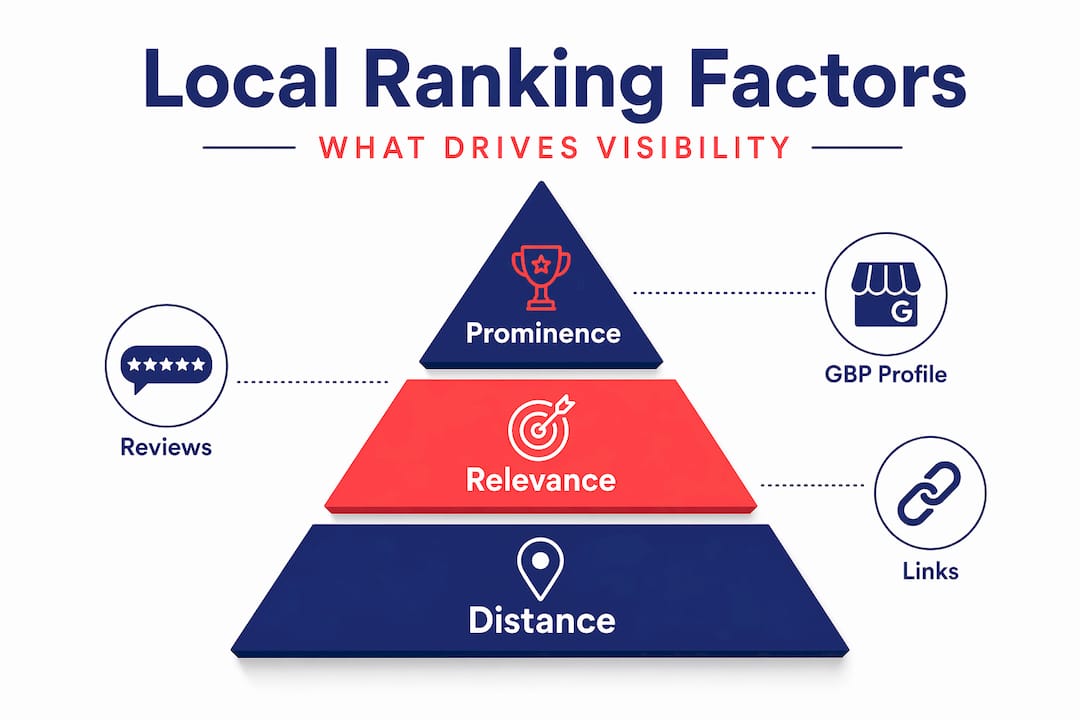
Google uses three main factors to rank local businesses: relevance, distance, and prominence. Each one is distinct, and each one is within your control to a meaningful degree.
Relevance measures how well your listing matches what someone is searching for. If your Google Business Profile (GBP) clearly communicates that you are a licensed electrician who serves residential customers, Google can confidently show you when someone searches “residential electrician.” Vague or incomplete profiles leave Google guessing, and Google does not reward uncertainty.
Distance reflects how far your business is from the searcher or the location they specified. It matters, but it is far less decisive than most business owners think. A business three miles away with excellent reviews and a complete profile will frequently outrank a business one mile away with a sparse listing and no reviews.
Prominence is the most nuanced and arguably the most powerful factor. It reflects how well-known and respected your business is, both online and offline. Reviews, backlinks, press mentions, social activity, and the overall completeness of your online presence all feed into prominence.
Here is a general breakdown of how these signals weigh in:
| Ranking Factor | Approximate Weight | Key Actions |
|---|---|---|
| Google Business Profile optimization | ~25% | Complete all fields, select correct categories |
| Reviews (volume, recency, responses) | ~20% | Actively request reviews, respond to all |
| On-page local SEO | ~15% | Local keywords, service area pages |
| Behavioral signals | ~10% | Clicks, calls, direction requests |
| Citation/NAP consistency | ~10% | Match business info across all directories |
| Backlinks and authority | ~15% | Earn links from local and niche sites |
| Other signals | ~5% | Social, photos, post activity |
When optimizing your Google Business Profile, the primary category you choose is critically important. It shapes how Google classifies your business as an entity. Choosing “Plumber” instead of the broader “Contractor” tells Google exactly what you do and makes you far more relevant for plumbing searches.
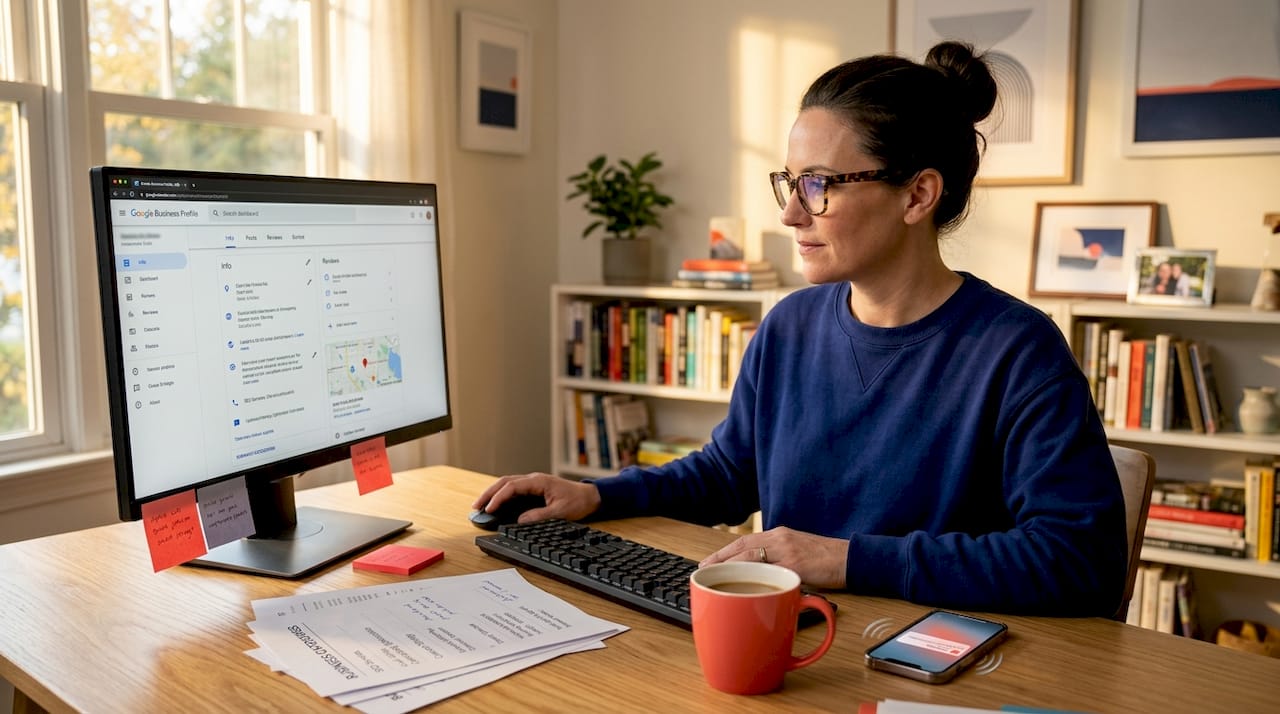
Pro Tip: Pick your GBP primary category based on your core revenue service, not the widest possible label. Then use secondary categories to cover additional services. Never add keywords to your business name field; that is against Google’s guidelines and risks suspension. For more ways to boost profile activity, explore these GBP engagement tips.
Now that you understand what matters most, let us explore exactly which signals Google looks at and how you can influence them.
Local ranking signals that drive results
Knowing the three core factors is helpful. Knowing the specific signals that move the needle is where the real work begins. Key local ranking signals include Google Business Profile optimization, reviews, citation consistency, on-page local SEO, and behavioral signals like clicks and calls.
Here are the most impactful signals, ranked by their practical return on investment:
- GBP completeness. Fill out every section: hours, services, description, photos, and service areas. An incomplete profile is a missed opportunity. Google uses every filled field to match you to relevant searches.
- Review volume, recency, and quality. A steady stream of four and five-star reviews is one of the strongest trust signals available. Responding to reviews, including negative ones, shows Google and potential customers that you are engaged.
- NAP consistency. Your Name, Address, and Phone number should be identical across every directory, website, and social profile. Inconsistencies confuse Google’s understanding of your business and dilute authority.
- On-page local SEO. Your website should include location-specific keywords, service area pages, and locally relevant content. A roofing company in Austin, Texas should have a page specifically about roofing services in Austin, not just a generic homepage.
- Behavioral signals. When users click on your listing, call your number, or request directions, Google interprets those actions as evidence that your listing is satisfying searcher intent. This reinforces your ranking.
Now compare what a high-performing local listing looks like versus an average one:
| Attribute | High-Performing Listing | Average Listing |
|---|---|---|
| GBP completeness | 100% filled, photos updated monthly | Basic info only, no photos |
| Review count | 300+ with recent activity | Under 50, last review 8 months ago |
| Response to reviews | Responds to all within 48 hours | Rarely or never responds |
| Backlinks | Local press, industry associations | Few or none |
| Website local content | Multiple service area pages | Single homepage only |
| Citation consistency | Consistent across 50+ directories | Errors in 30% of listings |
Businesses with 300 or more reviews and authority backlinks consistently outrank competitors with weaker profiles, even when those competitors are physically closer to the searcher.
Pro Tip: Do not treat reviews as a one-time push. Build a repeatable system where every satisfied customer receives a simple, direct request to leave a review. A text message sent within 24 hours of completing a job has one of the highest conversion rates for review requests.
For a structured approach to building local visibility from the ground up, our guide on unlocking local SEO is a practical starting point. You can also follow a local SEO step-by-step process or use our SEO audit checklist to identify gaps quickly.
User behavior: How actions and engagement shape ranking
Here is something that surprises many business owners: the way real people interact with your listing directly affects your ranking. Google is not just reading static data from your profile. It is watching what users do after they find you.
Google tracks a range of user engagement signals:
- Clicks to your listing from search results
- Calls made directly from your GBP phone number
- Direction requests from Google Maps
- Website visits initiated from your listing
- Time spent on your website after clicking through
This tracking mechanism is sometimes referred to as NavBoost. Click signals and user behavior measure satisfaction after a user interacts with a result, and Google uses this data to reinforce or adjust rankings over time. If searchers consistently click on your listing and engage with your content, that is a powerful vote of confidence in Google’s eyes.
E-E-A-T (Experience, Expertise, Authoritativeness, and Trustworthiness) is a related concept worth understanding. It is not a direct ranking factor in the technical sense, but it improves the quality and engagement signals that do influence rankings. When your website content demonstrates genuine expertise, users stay longer, engage more, and trust your business more readily. With AI-powered search results becoming more prominent on Google, E-E-A-T is becoming an even bigger indirect driver of visibility.
The practical takeaway is straightforward. Make it easy and natural for satisfied customers to take action. Encourage them to call, visit, and review. A business that consistently earns those signals drives more local visibility in a way that builds on itself over time.
Practical steps: How to improve your Google ranking as a local service business
Understanding the theory is valuable. Putting it into action is what actually moves your ranking. Here is a clear, prioritized sequence of steps to start improving your position in local search results.
- Audit your GBP profile completely. Log in, check every field, and fill in anything that is missing. Add high-quality photos of your work, your team, and your location. Write a clear, keyword-informed business description that tells Google and searchers exactly what you do and where you do it.
- Correct your NAP citations. Search your business name across major directories including Yelp, Bing Places, Apple Maps, and industry-specific listings. Correct any inconsistencies in your name, address, or phone number immediately.
- Build a review request system. Create a short, direct message you send to customers after each completed job. Include your Google review link. Respond to every review you receive, positive or negative, within 48 hours.
- Optimize your website for local search. Add your city and service area to title tags, headings, and page content. Create individual service area pages if you serve multiple cities or regions. Each page should be genuinely useful, not just a template with a city name swapped in.
- Earn local backlinks. Reach out to local news sites, community organizations, and industry associations. Being cited or mentioned in a local publication is one of the most effective ways to build prominence fast.
- Encourage behavioral engagement. Add a click-to-call button prominently on your website. Make it easy for users to request directions or send a message. The more actions users take, the stronger your engagement signals become.
Completing your GBP profile increases your likelihood of appearing in relevant searches, and more positive reviews directly improve your prominence score.
Pro Tip: Set a monthly 30-minute calendar block to review your GBP insights, check for new reviews, update any outdated information, and add at least one new photo or post. Consistent activity signals to Google that your business is active and engaged. Also stay aware of AI search changes on platforms like ChatGPT and Perplexity, where local business recommendations are becoming more common. Optimizing your business listing for these environments is quickly becoming a real competitive advantage.
What most guides miss about local Google ranking
Most local SEO content focuses heavily on checklists, and while checklists are useful, they miss the bigger picture. The businesses that consistently dominate local rankings are not doing more tricks. They are building more genuine authority.
Here is the insight that changes how you should think about this: proximity does not always win. A business with high prominence and strong relevance signals can consistently outrank a closer competitor. We have seen this play out in competitive markets repeatedly. A roofing company across town with 400 reviews, a complete GBP, and citations in a dozen local directories will outrank the guy two blocks away who has never claimed his listing.
The GBP primary category is critical for how Google understands your business as an entity. Choosing incorrectly, or worse, stuffing keywords into your business name, can trigger a suspension that removes your listing entirely. That is a costly mistake for a strategy that should be entirely sustainable.
The uncomfortable truth is that most businesses underinvest in reputation and overinvest in shortcuts. Buying fake reviews, stuffing your business name with keywords, or building low-quality links may produce short-term spikes but they tend to collapse, and the penalties can set you back months. The businesses that win long-term are the ones focused on GBP optimization strategies built around genuine authority: real reviews, real engagement, real content.
Sustainable local ranking is built on reputation, not manipulation. The sooner you orient your strategy around that principle, the faster you will see stable, lasting results.
Get expert help to accelerate your Google ranking gains
Improving your local Google ranking takes consistent, well-coordinated effort across your GBP profile, your website, your reviews, and your citations. If you want to move faster and avoid the trial-and-error that slows most business owners down, we can help.
At Battle SEO, we work exclusively with one business per service category per market. That means when we take you on, we are fully committed to making you the dominant local authority in your niche. Our Local Command Directive™ framework covers everything from local SEO solutions to authority backlinks, citation building, and on-page optimization. We also help you get found in AI-powered searches, not just Google. Explore our local SEO services to see how we approach ranking, and check out our in-depth GBP optimization guide to start with a strong foundation.
Frequently asked questions
Does proximity always determine Google ranking for local businesses?
No, prominence and relevance can outweigh proximity. According to Google’s own guidelines, businesses further away may still rank higher if they are more reputable or closely match search intent.
How many reviews does my business need to outrank competitors?
Businesses with 300 or more reviews and authority links tend to outperform competitors in local search rankings, making consistent review generation one of your highest-priority actions.
Is E-E-A-T a ranking factor for local Google results?
E-E-A-T is not a direct ranking factor for local search, but it improves quality and engagement signals that do influence rankings, and its importance is growing as AI-enhanced search becomes more prevalent.
What steps should I take if my Google Business Profile is suspended?
First review Google’s quality guidelines, ensure all business information is accurate and compliant, and then submit a reinstatement request through the GBP support portal with documentation of your legitimacy.
How frequently should I update my Google Business Profile?
You should update your Google Business Profile at least monthly, adding new photos, responding to reviews, and refreshing any changed business details to maintain active engagement signals.